

Financial risk in the built environment isn’t an external variable to be managed. It’s a governance failure to be eliminated. Many developers accept unpredictable costs as an inevitable burden, but this passive stance is what invites disaster. By prioritizing a governance-first framework, you move beyond the frantic energy of the market and focus on mitigating construction project financial risks through rigid, technical oversight.
You realize that a lack of transparency in reporting and the slow bleed of scope creep are the true threats to your project’s survivability. It’s time to stop gambling on speculative trends and start building on a foundation of tangible verification. You’ll learn how to protect your capital through disciplined governance and the VULPIN Check. We’ll explore a repeatable process for capital deployment that ensures your assets endure long-term cycles while stripping away the noise of the traditional financial world.
Key Takeaways
- Establish project viability before a single dollar is deployed. Use the VULPIN Check to move from theoretical models to tangible, technical proof.
- Shift from passive management to active oversight. Learn the essential framework for mitigating construction project financial risks by prioritizing governance over market speculation.
- Recognize the difference between standard construction management and disciplined execution. Use PCMNow to protect project margins and ensure professional oversight across complex developments.
- Secure asset survivability for the long term. Integrate sustainable housing through FoxyHome to reduce financial exposure across generational cycles.
- Reject the fragility of the static pro forma. Understand why traditional risk mitigation fails in a dynamic cost environment and how to build a resilient capital structure.
Beyond the Pro Forma: Why Traditional Risk Mitigation Fails
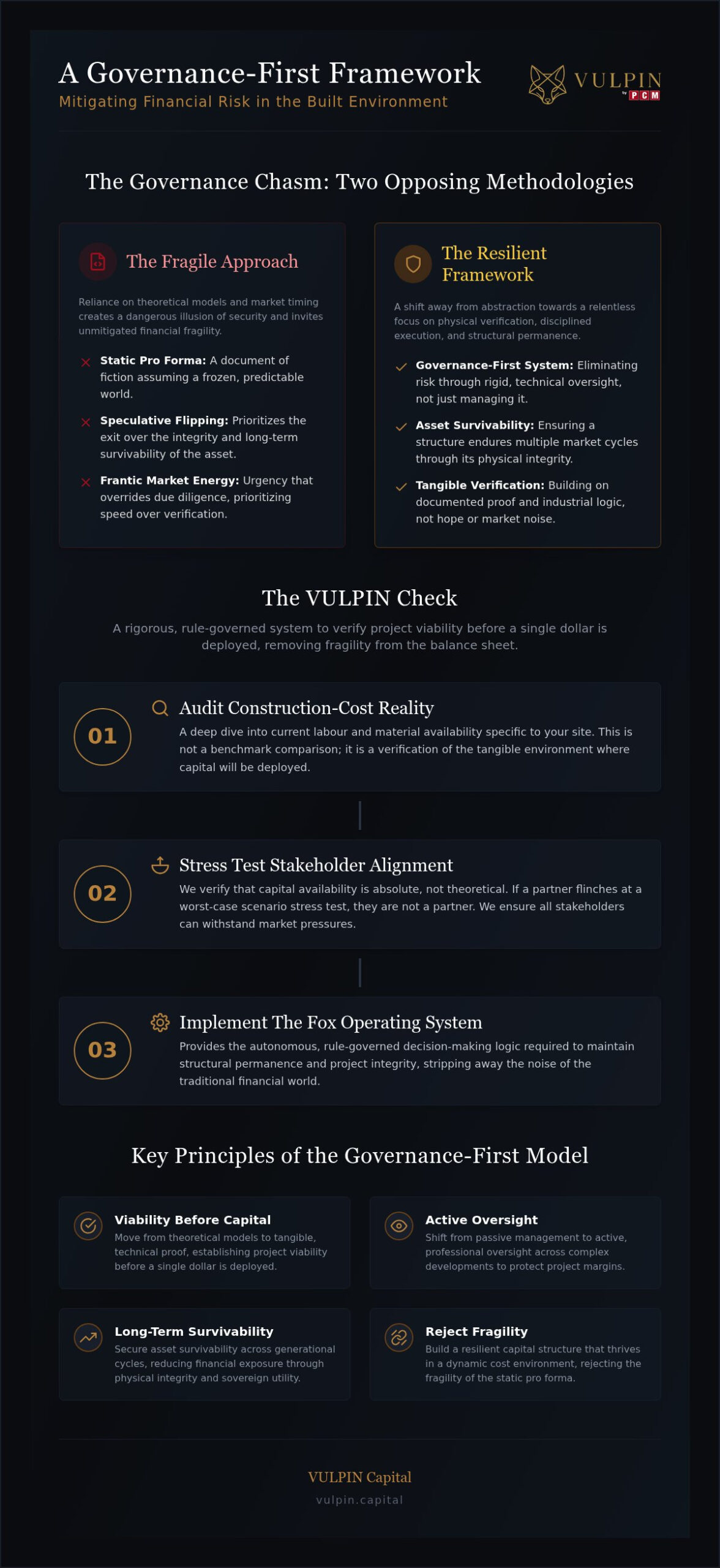
The static pro forma is a document of fiction. It assumes a world that remains frozen while the project moves forward. In a dynamic construction-cost reality, this reliance on fixed spreadsheets creates a dangerous illusion of security. Real governance requires acknowledging that a pro forma is merely a starting point, not a shield. Mitigating construction project financial risks demands a shift away from these digital abstractions and toward a relentless focus on physical verification. We don’t build on hope. We build on documented proof.
Speculative flipping introduces unmitigated financial fragility into the built environment. It prioritizes the exit over the integrity of the asset. This approach is the antithesis of what we value. We define asset survivability as the capacity for a structure to endure multiple market cycles through its physical integrity and sovereign utility. It requires stoic discipline to reject high-risk, low-governance opportunities that promise quick returns but offer no long-term stability. If the governance isn’t there, the capital stays home.
The Cost of Frantic Market Energy
Urgency is the enemy of due diligence. In national development projects, the pressure to capture the market often overrides the necessity of rigorous oversight. This psychological trap of market timing suggests that success is found in the calendar rather than the structure. It’s a fallacy. Speculation becomes a financial liability the moment you prioritize speed over the verification of the build. We reject this frantic energy. We choose structural permanence and the steady cadence of industrial logic over the noise of the crowd.
Defining Financial Risk in Real Assets
True financial risk isn’t just market volatility. It’s project-level execution failure. While external economic shifts are inevitable, the internal failure to manage a build is a choice. Effective Project risk management focuses on tangible verification rather than theoretical modeling. You must distinguish between the price of materials and the cost of poor governance. A long-term hold strategy serves as the ultimate risk mitigation tool. It allows an asset to mature and stabilize, shielded from the noise of short-term fluctuations. This is how we realize value in a world obsessed with digital abstractions. We don’t just manage projects; we architect systems of survivability.
The VULPIN Check: Verifying Project Viability Before Capital Deployment
Capital deployment is a matter of principle. It’s not a speculative bet. Before a single dollar is committed, the project must survive the VULPIN Check. This is our rigorous governance framework for national real asset deployment. It functions as a filter, removing fragility before it reaches the balance sheet. Most developers rely on software dashboards to provide a sense of control, but data visibility is not the same as risk mitigation. Without a rule-governed system, data is just noise. We don’t build on hope; we build on verified logic.
Mitigating construction project financial risks requires stress testing every assumption. We don’t accept “perfect conditions” as a viable path. In Canada, perfect conditions don’t exist. You face seasonal labour shortages, logistical bottlenecks, and fluctuating material costs. If a project requires a flawless market to succeed, it’s already a failure. We verify viability through technical oversight and industrial-grade standards. We look for projects that survive the worst-case scenario, not the best-case one. This is the only way to ensure asset survivability across long-term cycles.
The Verification Protocol
The VULPIN Check follows a methodical sequence. First, we audit the construction-cost reality. This isn’t a benchmark comparison; it’s a deep dive into current labour and material availability across the country. We don’t care about industry averages; we care about the specific reality of your site. Second, we stress test stakeholder alignment. Capital availability must be absolute, not theoretical. If a partner flinches at a stress test, they aren’t a partner. Finally, we implement The Fox operating system. This provides the autonomous decision-making logic required to maintain structural permanence. You can learn more about our governance-first approach to ensure your project meets these standards.
The Power of Saying No
Intellectual honesty is the foundation of our systems. We establish “red line” metrics before deployment. These might include specific debt-to-equity ratios or hard timeline slippage limits. If these metrics are breached, the project stops. Sunk cost bias is a psychological trap that leads to ruin. It’s the desperate urge to throw good money after bad. Walking away from a non-viable project isn’t a defeat; it’s a financial victory. It preserves capital for assets that actually deserve to exist. We value the integrity of the system over the excitement of the deal. If the verification fails, the project dies. This is how we maintain autonomous control over the built environment.
Navigating Construction-Cost Reality: Managing Overruns Through Disciplined Governance
Industry averages are a race to the bottom. Relying on national benchmarks to protect your capital is a strategy rooted in mediocrity. Most developers look at historical data and assume their project will follow the mean. This is a governance failure. Mitigating construction project financial risks requires moving beyond these abstractions and confronting your project-specific cost reality. We don’t care what the “average” build costs in Toronto or Vancouver. We care about the specific labour availability and material logistics affecting your site today. You must realize that benchmarks often average out the failures of poor management.
Disciplined execution is the only mechanism that prevents the erosion of project margins. When costs fluctuate, a lack of oversight leads to panic. We implement The Fox operating system to maintain absolute administrative oversight. It’s a system designed for industrial-scale control, ensuring that every decision is filtered through a pre-defined logic. This allows us to handle national supply chain fluctuations without compromising the integrity of the build. We prioritize structural permanence over the frantic search for cheap alternatives. Our approach is slow, methodical, and resistant to the urgency of the market. We organize our systems to endure, not to react.
Eliminating Scope Creep
Scope creep is a slow death for project margins. It begins with small, unvetted changes and ends in financial insolvency. We establish strict governance boundaries that define exactly what is permissible. You must have the discipline to say no to contractor change orders that threaten viability. If a change doesn’t serve the long-term survivability of the asset, it’s rejected. Choosing materials and designs based on structural permanence reduces the need for future modifications. It’s about getting the structure right the first time. Every deviation from the original plan is a potential leak in the capital structure.
Stakeholder Management and Reporting
Transparency isn’t about providing more data; it’s about providing the right verification. Investors don’t want a dashboard of meaningless metrics. They want proof of control. We provide transparent financial reporting that justifies project management fees through measurable risk reduction. When you demonstrate rigorous administrative control, you build credibility that lasts across market cycles. Our systems ensure that stakeholders are aligned with the reality of the build, not a polished digital abstraction. This is the difference between managing a project and architecting a sovereign asset. We provide the technical proof required to maintain confidence in complex national developments.
PCMNow: Professional Management for Complex National Developments
Managing a project is a clerical task. Governing an asset is a matter of principle. Most developers hire standard Construction Managers to oversee schedules and budgets, but these metrics are surface level. They don’t account for the underlying integrity of the capital structure. We reject the detached management style of global corporations that prioritize volume over verification. PCMNow is our framework for construction execution and asset survivability. It’s designed for those who realize that mitigating construction project financial risks requires a guardian, not just a manager. We don’t just watch the clock; we protect the capital.
Boutique governance firms outperform large PM corporations because they maintain a rugged, industrial mentality. A large firm often treats your project as one of a thousand entries in a database. We treat it as a sovereign system. PCMNow ensures that resources are only committed when viability is proven. This discipline prevents the premature deployment of capital into unstable environments. We focus on the physical reality of the build, ensuring that the final structure matches the administrative oversight that governed its creation. You can access our professional management framework to see how we maintain this level of control.
The Owner’s Representative Advantage
An Owner’s Representative is the stoic guardian of your capital. Unlike a standard Construction Manager who may have conflicting loyalties to subcontractors or timelines, the Owner’s Rep has a singular focus: the owner’s interest. We bridge the gap between architectural vision and industrial reality. This role is critical in managing complex stakeholder interests across national projects. We translate technical engineering requirements into sovereign financial decisions. We don’t accept excuses for delays or overruns. We hold the line on governance to ensure the project remains a viable asset rather than a financial liability.
Disciplined Execution in Action
Execution is where theoretical models meet the resistance of the real world. PCMNow implements rule-governed operations at every stage of development. This system integrates seamlessly with the VULPIN Check for continuous verification. If the data from the field doesn’t match the governance requirements, the system triggers an immediate response. We maintain an uncompromising standard for reporting and administrative control. This isn’t about creating more paperwork; it’s about creating a reliable internal logic for the project. We prioritize the integrity of the structure above all else, ensuring that every bolt turned and every dollar spent serves the long-term survivability of the asset.
Ensuring Asset Survivability: The Long-Term Financial Perspective
Asset survivability is a temporal challenge. It requires a mindset that extends beyond the immediate completion of a structure. True success in the built environment isn’t measured by a successful exit, but by the performance of the asset over decades. We build for the next century, not the next quarter. VULPIN Capital maintains this commitment as the final layer of mitigating construction project financial risks. When you prioritize structural permanence and sovereign utility, you insulate your capital from the volatility of short-term market cycles. We don’t build to flip. We build to endure.
FoxyHome represents the integration of sustainable housing with generational survivability. In the Canadian climate, environmentally conscious design is a financial necessity, not a moral luxury. High-performance buildings offer a superior return on investment by drastically reducing operational costs and maintenance requirements. We realize that a building that cannot withstand a sub-zero winter without massive energy expenditure is a financial liability. By utilizing FoxyHome systems, we ensure that the asset remains viable and valuable for both owners and tenants long after the initial capital deployment is complete.
Sustainable Housing as a Risk Hedge
Operational costs are a predictable threat to project margins. Energy-efficient design serves as a hedge against rising utility prices and carbon taxes. FoxyHome solutions prioritize the building envelope and industrial-grade mechanical systems to ensure long-term value. Net-zero home construction in Canada isn’t just about environmental stewardship; it’s about reducing the long-term financial exposure of the property. When a structure requires minimal external energy to function, it gains a level of autonomous control that speculative builds can never achieve. We focus on the physical reality of heat retention and material durability to protect your equity.
The Future of Real Asset Governance
The era of speculative flipping is ending. It was a period defined by frantic energy and a lack of technical oversight. The future of real asset governance belongs to those who embrace condition-driven management and sovereign asset philosophy. This approach requires transitioning away from reactive maintenance and toward proactive, rule-governed systems. We reject the fragility of traditional real estate models in favour of a disciplined, industrial mentality. Your project deserves an architecture of systems that guarantees its integrity across generations. You must take the first step toward this level of control. Secure your project’s future with the VULPIN Check and ensure your capital is deployed with absolute verification.
Architecting a Legacy of Structural Permanence
Governance is the only shield against the erosion of project margins. Mitigating construction project financial risks requires you to reject the frantic energy of the crowd and embrace a stoic, industrial mentality. You’ve learned how the VULPIN Check methodology serves as a technical prerequisite for capital deployment and why PCMNow provides the professional oversight needed for national Canadian execution. We don’t build on hope; we build on a foundation of verified logic.
The built environment doesn’t reward the hopeful; it rewards the prepared. Grounding your project in tangible verification ensures asset survivability across long-term cycles. Stop gambling on speculative trends and start building on a foundation of sovereign logic. It’s time to move beyond digital abstractions and secure the integrity of your structure.
Initiate the VULPIN Check for your next project to protect your capital through our proprietary governance framework. Build with structural permanence. Build for the next century.
Frequently Asked Questions
Is it possible to completely eliminate financial risk in construction?
Complete elimination of risk is a fallacy. However, you can eliminate systemic fragility by prioritizing a framework for mitigating construction project financial risks. We focus on removing governance failures and stripping away speculative market energy. This allows the asset to remain resilient even when external variables shift. You don’t manage risk by guessing; you mitigate it through rigid, technical oversight.
Can the VULPIN Check be applied to existing projects in distress?
The VULPIN Check functions as a rigorous diagnostic tool for projects already in motion. We audit the current state of the build to identify exactly where administrative oversight collapsed. If the project’s physical integrity or capital structure is fundamentally compromised, we provide the technical proof required to halt deployment. Identifying a failure early is the only way to preserve remaining capital and maintain intellectual honesty.
How much does professional project governance typically cost?
The cost of governance is negligible compared to the price of project failure. We don’t quote industry average fees because our work is project-specific and based on the complexity of the build. We focus on the measurable reduction of risk and the long-term survivability of the asset. High-integrity oversight pays for itself by preventing the slow bleed of scope creep and unvetted change orders.
What happens if a project fails the VULPIN Check viability test?
Failure is a definitive signal to stop. If a project cannot meet our predefined criteria for viability, capital stays home. We don’t adjust the standards to fit the project; we reject projects that don’t meet the standards. Walking away is a financial victory that protects your balance sheet from predictable ruin. We value the integrity of the system over the excitement of the deal.
How does FoxyHome improve the financial ROI of a development?
FoxyHome reduces long-term operational costs through high-performance engineering and sustainable design. In the Canadian climate, energy efficiency is a critical hedge against rising utility expenses and carbon taxes. These structures attract stable tenants and maintain higher valuations because they’re built for structural permanence. You’re investing in an asset that costs less to maintain across its entire lifecycle.
What is the difference between a project manager and ‘The Fox’ operating system?
A project manager is a clerical operator who tracks schedules and budgets. ‘The Fox’ is an autonomous operating system that enforces rule-governed logic across the entire development. It provides the administrative oversight necessary to ensure every decision aligns with the project’s governance framework. It removes human emotional variance in favour of industrial-grade consistency and documented verification.
Can VULPIN Capital manage projects across all Canadian provinces?
We operate with a national scope and maintain the expertise required to navigate diverse provincial regulations. Our systems, including PCMNow, are designed to handle the logistical complexities found across the country. We maintain a rugged, industrial mentality that adapts to the specific labour and material realities of any Canadian site. Whether in urban centres or remote areas, our governance remains uncompromising.
Is the VULPIN Check suitable for small-scale residential builds?
Our framework is architected for complex developments and national real asset deployment where mitigating construction project financial risks is a matter of institutional survival. While the principles of governance apply to any build, our systems are most effective for partners who value structural permanence. We prioritize high-stakes environments where disciplined execution and long-term asset survivability are the primary objectives.