

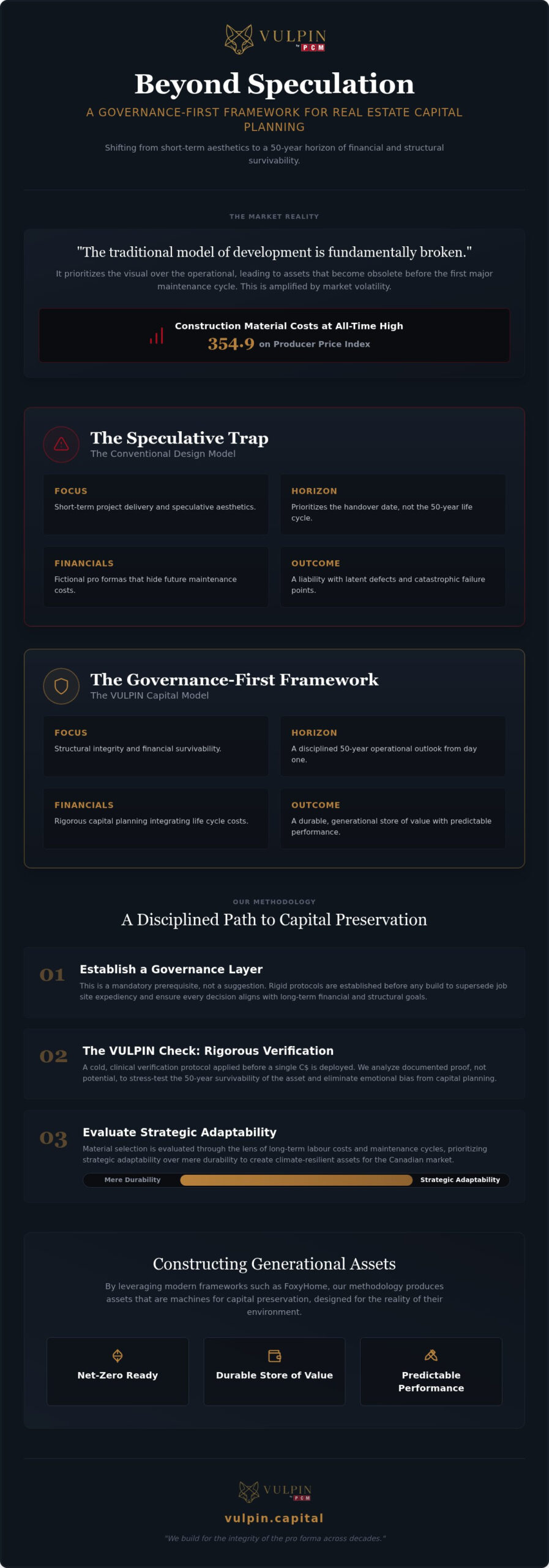
Aesthetics are a distraction for those who value structural permanence. In a market where construction material costs reached an all-time high of 354.9 on the Producer Price Index this March, speculative design is a liability. You likely recognize that the traditional model of development is fundamentally broken. It prioritizes the visual over the operational, leading to assets that become obsolete before the first major maintenance cycle. Rigorous capital planning for real estate assets isn’t about predicting the next trend; it’s about establishing a governance layer that resists market volatility and ensures long-term survival.
We don’t build for the applause of the crowd. We build for the integrity of the pro forma across decades. You’ll learn how to move beyond speculative aesthetics to create buildings that prioritize long-term survivability through disciplined financial performance. This article outlines our methodology for rigorous verification before a single C$ is deployed. We’ll examine the transition from reactive maintenance to a governance-first framework that ensures predictable asset performance. It’s a slow, methodical approach designed for operators, not speculators.
Key Takeaways
- Shift your perspective from short-term project delivery to a 50-year operational horizon where structural integrity meets financial survivability.
- Establish a governance layer as a mandatory prerequisite to any build, ensuring performance is a function of system management rather than aesthetic choice.
- Master disciplined capital planning for real estate assets by integrating rigorous verification protocols like the VULPIN Check before any capital deployment.
- Evaluate material selection through the lens of long-term labour costs and maintenance cycles to prioritize strategic adaptability over mere durability.
- Leverage modern frameworks such as FoxyHome to create net-zero ready assets that function as durable, generational stores of value.
The Speculative Trap: Why Conventional Design Erodes Capital Planning
Conventional design is a race to the bottom. It prioritizes the handover date over the 50-year operational horizon. Most developers design for delivery; they want the keys turned and the asset sold before latent defects emerge. This is not capital planning. It’s a game of hot potato played with institutional capital. True asset performance exists only at the intersection of structural integrity and financial survivability. If a building requires a full envelope replacement in its second decade, it’s a failure of governance. Speculative flipping incentivizes builders to hide defects behind drywall and ignore the reality of rising labour costs. We reject this. We design for the reality of the structure, not the convenience of the exit.
The Failure of Short-Term Financial Modelling
Traditional pro formas are often works of fiction. They assume a static environment where components never fail and degradation doesn’t exist. When aesthetics are prioritized over system accessibility, repair costs skyrocket. Value engineering is typically a euphemism for stripping an asset of its long-term viability to save upfront costs. This short-sightedness turns a necessary Capital expenditure into an emergency crisis. Real capital planning for real estate assets requires accounting for the eventual failure of every mechanical system from the moment of inception. We don’t hide the cost of maintenance; we integrate it into the governance of the build. The result is a portfolio of buildings that look identical to the untrained eye but perform vastly differently under the weight of time, burdened by hidden costs that erode the long-term pro forma.
Defining Asset Survivability in the Canadian Market
Canada’s climate is indifferent to your marketing brochures. Asset survivability requires a transition from market-driven acquisition to condition-driven development. A building that cannot withstand thirty Canadian winters without catastrophic thermal bridging is not an investment; it’s a liability. VULPIN rejects the frantic energy of speculative cycles in favour of stoic, disciplined growth. We prioritize climate resilience and maintenance-heavy planning because we intend to own the outcome. Performance is not a design choice. It’s a requirement of the structure’s internal logic. Our methodology filters for partners who understand that a building is a machine for capital preservation, not a temporary vehicle for market timing. We build for the reality of the Canadian environment, where durability is the only metric that matters.
Governance-First Design: Establishing the Rules for Capital Planning
Governance is not a suggestion. It is the framework that dictates whether an asset survives or decays. Most projects fail because they lack a sovereign internal logic. They rely on the goodwill of contractors or the vague promises of architects. We don’t rely on goodwill. We rely on systems. Effective capital planning for real estate assets begins with the establishment of rigid protocols that supersede the frantic energy of the job site. Performance is not an accident of design; it’s a function of the systems managing the project. The Owner’s Representative acts as the enforcer of these standards. Their primary duty is to neutralize contractor shortcuts and ensure that the original performance mandate is never compromised for the sake of a temporary schedule gain.
A building without an autonomous internal logic is a liability waiting to happen. Without a governance layer, the project is subject to the whims of a volatile market and the eroding quality of high-cost labour. We establish the rules before the first shovel hits the ground. This ensures that every decision made on-site aligns with the long-term financial and structural goals of the asset. We don’t build for the present moment. We build for the next half-century.
The VULPIN Check: Stress Testing Construction Viability
Emotional bias is the enemy of capital preservation. Before a single C$ is deployed, the project must pass The VULPIN Check. This is a cold, clinical verification of viability. We don’t look at “potential”; we look at documented proof. By establishing a rigorous Capital planning process, we eliminate the speculative hope that ruins pro formas. If the data doesn’t support the 50-year survivability of the asset, the project does not proceed. This level of governance prevents the common budget overruns that plague undisciplined builds. It’s an exclusionary filter designed to protect capital from the risks of poor planning and market volatility.
PCMNow: Bridging the Gap Between Design and Reality
Design is theoretical; execution is physical. PCMNow Project Management exists to bridge this gap. In a market where construction input prices for nonresidential projects rose at a 12.6% annualized rate in early 2026, cost reality must be the primary driver of every site-level decision. We manage stakeholders through a centralized governance framework that demands accountability at every stage. There are no “surprises” in a well-governed build. There is only the disciplined adherence to the established plan. You can explore our governance-first methodology to see how we maintain this level of control across complex developments. This approach ensures that capital planning for real estate assets remains grounded in the reality of the construction site, protecting the asset’s performance across its entire lifecycle.
Material Durability vs. Strategic Adaptability: A Comparison Framework
A building that merely stands is a monument, not an asset. True performance requires the intersection of physical endurance and economic viability. We’ve seen projects where high-grade materials were used without considering the labour required to maintain them. In a market where the construction industry needs over 500,000 new workers in 2026 to meet demand, labour-intensive maintenance is a structural flaw. Effective capital planning for real estate assets demands that we select materials based on their lifecycle costs rather than their initial price point. We prioritize components that allow for strategic adaptability. This means designing systems that can be upgraded or replaced without compromising the primary structure. A rigid, single-use design is a bet against technological progress. We prefer to build for a future that we cannot yet define.
Strategic adaptability is the antidote to obsolescence. We analyze material selection through the lens of maintenance cycles and the reality of rising labour costs. If a building component requires specialized, expensive intervention every decade, it’s a liability. We don’t design for the convenience of the architect. We design for the sanity of the operator. This transition from static design to an evolving asset requires a governance layer that understands the physical reality of degradation. We reject the idea that a building is a finished product at handover. It is a machine that requires a disciplined approach to survive the next fifty years.
The Fox: An Operating System for Asset Survivability
We reject the digital abstraction of traditional finance. The Fox is a specialized framework designed to guide capital deployment through rule-governed operations. It functions as an operating system for the physical asset, ensuring that every decision is condition-driven rather than market-driven. By prioritizing structural permanence, we eliminate the frantic energy of speculation. This methodology ensures that the asset remains a durable store of value across decades. It’s about maintaining autonomous control over the building’s performance metrics. We don’t guess; we verify through documented systems that prioritize the integrity of the structure above all else. This approach filters for partners who value stability over the excitement of the trade.
High-Performance Systems for Cold Climates
Canadian seasons are a relentless stress test for any building envelope. We design envelopes that realize extreme energy efficiency without sacrificing structural durability. Quality control is paramount. We often utilize pre-fabricated solutions to reduce on-site labour and ensure that every component meets our strict standards. Mechanical systems are designed with easy centre-of-building access. If a technician needs to tear down a wall to reach a valve, the design has failed. We ensure that high-wear components are easily accessible and replaceable. This focus on repairability reduces long-term lifecycle costs and ensures that the building continues to perform as intended through fifty Canadian winters. It is a rugged, industrial approach to comfort and efficiency.
Verification Protocols: The VULPIN Check for Capital Planning
Verification is the only defense against the erosion of capital. We don’t accept optimistic projections or the vague assurances of developers. We demand proof. The VULPIN Check serves as the gatekeeper, ensuring that every project is vetted against the harsh reality of the Canadian market before a single C$ is committed. Third-party construction audits are not optional. They are mandatory instruments for mitigating financial and legal risk. By establishing a “construction-cost reality” baseline early, we prevent the budget collapses that occur when operators ignore the 12.6% annualized jump in nonresidential input prices recorded in early 2026. Identifying early warning signs of asset distress during the design phase is a requirement of our governance layer. We don’t build on hope. We build on verified data.
Effective capital planning for real estate assets requires a rejection of traditional market energy. Most firms wait for a crisis to audit their projects. We audit the project before it exists. This clinical approach ensures that the structural integrity of the asset is matched by the financial integrity of the pro forma. If a project cannot withstand a rigorous stress test, it is discarded. We don’t compromise our standards to fit a market trend. Our protocols exist to protect capital from the volatility of an undisciplined industry. We are the filter that ensures only the most resilient assets move toward execution.
Step 1: Pro Forma Stress Testing
Spreadsheets are often used to hide truth rather than reveal it. We move beyond the “best-case” scenario to realistic capital improvement planning that accounts for 6.78% mortgage rates and persistent labour shortages. We factor in the reality that the Canadian construction industry requires over 500,000 new workers in 2026 to meet demand. This labour scarcity isn’t a variable; it’s a constant that must be priced into the build. Pro forma stress testing is the ultimate filter for project viability, forcing an honest assessment of whether an asset can survive decades of operational pressure without collapsing under the weight of its own debt or maintenance requirements.
Step 2: Technical Due Diligence and Governance
The lowest bid is usually the most expensive choice in the long-term. We vet contractors based on their execution history and their willingness to submit to our internal logic. This requires a disciplined reporting structure where accountability is the only currency. We implement a governance layer that dictates how stakeholders interact and how decisions are documented. Every design must align with the FoxyHome standard to ensure long-term sustainability and generational performance. This isn’t about following a trend. It’s about adhering to a documented methodology that prioritizes the asset over the ego of the builder. You can initiate The VULPIN Check to secure your project’s future against market instability.
Constructing Generational Assets with FoxyHome
FoxyHome is the practical application of high-performance design and absolute governance. It is where the theoretical integrity of a pro forma meets the physical reality of the job site. We don’t build for the next market cycle. We build for the next century. Integration of modern construction techniques with long-term asset survivability requires a rejection of the shortcuts common in speculative development. Sustainable housing is the only logical strategy for generational wealth preservation. It is a hedge against rising energy costs and tightening carbon regulations that will eventually render inefficient buildings obsolete. We move beyond the noise of the market to focus on disciplined, condition-driven development that ensures the structure remains a functional store of value for decades.
The frantic energy of traditional markets often ignores the physical degradation of the asset. We don’t. Our approach to capital planning for real estate assets treats the building as a machine that must perform under stress. By prioritizing the structural and financial survivability of the build, we create a boundary of high-integrity professionalism. This is not about following a trend. It’s about establishing a governance layer that protects capital from the volatility of an undisciplined industry. We build for those who value the permanence of the structure over the excitement of the trade.
The ROI of Sustainable Housing Solutions
Environmentally conscious design is frequently marketed as a moral preference. We view it as a mandatory risk management protocol. Environmentally conscious design reduces long-term operational and regulatory risk by anticipating the shift toward net-zero standards. The financial case for net-zero ready residential assets is clear: buildings that consume less energy preserve more net operating income over time. FoxyHome realizes the goal of building assets that outlive their creators. In a changing economy, strategic adaptability and energy efficiency are the primary drivers of long-term performance. We don’t rely on speculative exit valuations; we rely on the documented performance of the physical asset.
Engaging with VULPIN Capital
We are not a mass-market firm. Our ideological screening mechanism is designed to filter for specific partners who value governance over hype. If you seek the frantic energy of short-term speculation, you will not find it here. We prioritize intellectual honesty and a commitment to a specific, documented methodology. Initiating the VULPIN Check for your next real asset deployment is the first step toward securing autonomous control over your portfolio’s future. It is a move away from speculative aesthetics and toward a rigorous framework of capital planning for real estate assets. We invite those who understand the gravity of long-term stability to join our platform.
Secure your asset’s future with the VULPIN Check.
Securing the Generational Horizon
Building for the long term is a matter of principle, not a matter of style. We’ve established that asset survivability is the inevitable result of rigid governance and clinical verification. You now understand that aesthetics without structural integrity is a liability. True capital planning for real estate assets requires a rejection of market noise in favour of the documented methodology found in The Fox. Through PCMNow, we ensure that project management remains stoic and grounded in the physical reality of construction costs.
We don’t build for the applause of speculators. We build for the permanence of the structure. Our proprietary VULPIN Check methodology is the final filter for project viability, ensuring your capital is deployed only into assets capable of surviving fifty Canadian winters. It’s time to move from the frantic energy of traditional markets toward a disciplined, sovereign approach to development. This is how we ensure that the structures we create today remain functional stores of value for the next century.
Request a VULPIN Check for your next real asset deployment.
The path to generational wealth preservation is paved with discipline. We look forward to partnering with those who value the integrity of the build above all else.
Frequently Asked Questions
What is the primary difference between building durability and asset performance?
Durability is the physical capacity of a material to resist wear and environmental stress. Asset performance is the intersection of that physical endurance with disciplined financial survivability over a 50-year horizon. A building can be durable but perform poorly if its maintenance cycles are too labour-intensive for the Canadian market. We prioritize performance because it accounts for the total cost of ownership and operational integrity.
How does the VULPIN Check mitigate financial risk in Canadian construction projects?
The VULPIN Check functions as a clinical filter that removes emotional bias from project selection. It mandates a rigorous pre-construction audit of every financial and technical assumption before a single C$ is committed. By enforcing a construction-cost reality baseline, we protect capital from the 12.6% annualized input price spikes seen in the nonresidential sector in early 2026. It’s a protocol for certainty in an uncertain market.
Why does VULPIN Capital reject speculative flipping in favour of long-term holds?
Speculative flipping is a race to the bottom that rewards the concealment of latent defects and poor construction-cost reality. We reject this frantic energy because it erodes the long-term integrity of the structure. We prioritize generational holds because they demand the highest standards of governance and execution from the outset. A long-term perspective is the only way to ensure an asset remains a durable store of value.
What role does ‘The Fox’ operating system play in capital planning for real estate assets?
The Fox provides the autonomous internal logic required for consistent capital planning for real estate assets. It transitions management from market-driven guesses to condition-driven verification through a rule-governed framework. This system ensures that every operational decision reinforces the building’s performance metrics across its entire lifecycle. It eliminates the excitement of speculation in favour of stoic, predictable results.
Can sustainable housing solutions like FoxyHome be cost-effective in cold climates?
FoxyHome solutions are designed specifically for the relentless stress test of fifty Canadian winters. While upfront costs for net-zero ready envelopes may be higher, they eliminate the regulatory and operational risks that plague inefficient builds. High-performance design is the only logical strategy in an environment of rising energy costs and labour shortages. It is an investment in the building’s long-term survivability.
How do you justify project management fees for a long-term generational asset?
We view PCMNow project management as a mandatory risk-mitigation layer rather than an overhead cost. In a market where construction material costs hit record highs in March 2026, undisciplined management leads to catastrophic budget overruns. Our fees represent the cost of ensuring the asset remains a functional store of value. We don’t manage projects for the present; we manage them for the asset’s entire operational life.
What are the early warning signs that a building design will fail to perform financially?
Financial failure begins when aesthetics supersede system accessibility and repairability. If mechanical components are buried behind structural elements without a clear repair path, the building is designed for decay. A lack of technical due diligence during the design phase is the most reliable predictor of future asset distress. We look for designs that prioritize the sanity of the operator over the ego of the architect.
How can I realize better ROI through high-performance design and governance?
Better ROI is realized through the radical reduction of lifecycle costs and the prevention of premature obsolescence. Rigorous governance ensures that capital planning for real estate assets remains grounded in physical reality rather than speculative hope. By building to a higher standard of verification, you create a generational asset that outlives market volatility. It’s about protecting the pro forma through disciplined execution.