

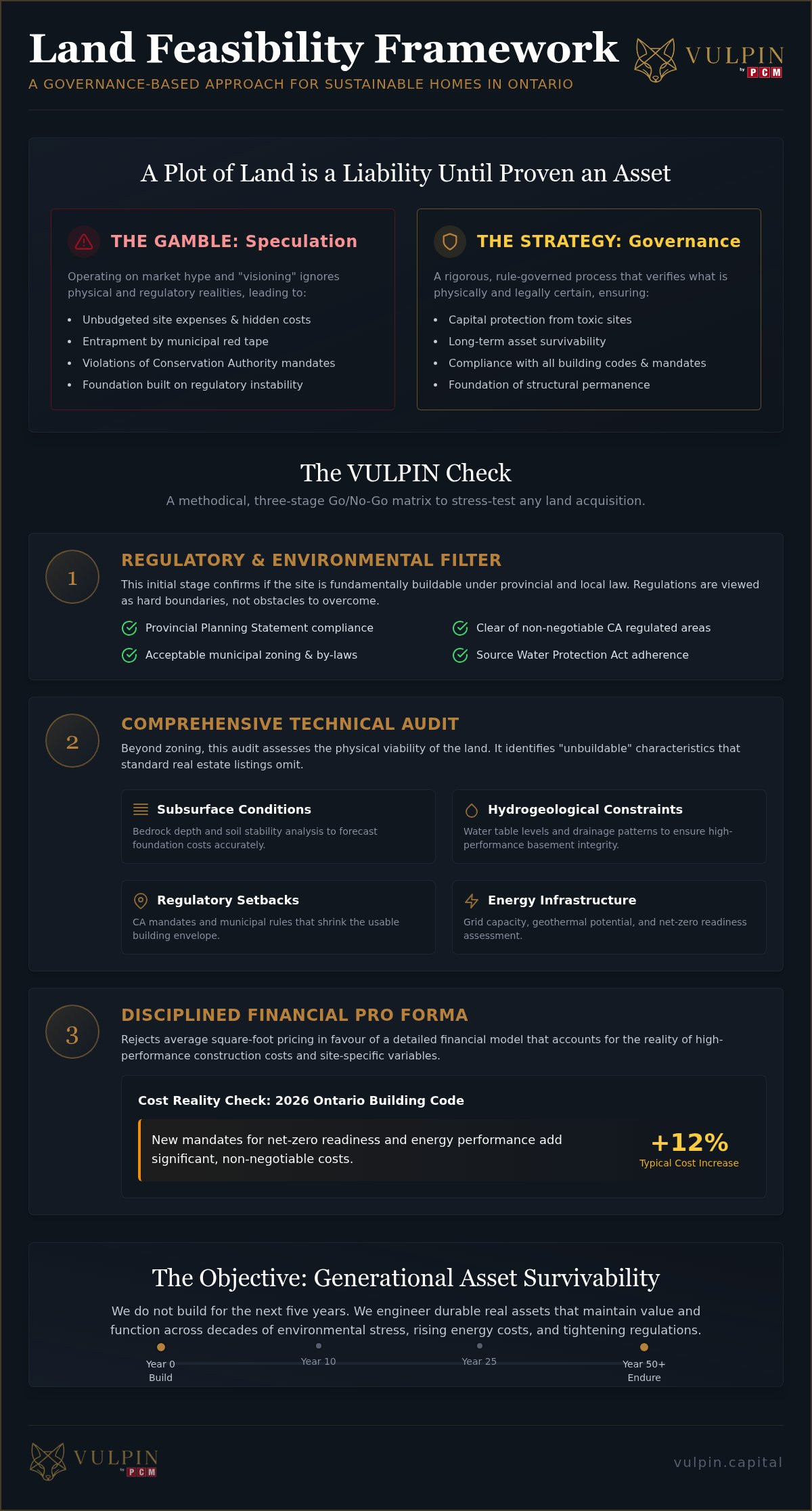
A plot of land is not an asset. It is a liability until it passes a rigorous governance filter. In the current market, speculative pricing for unserviced lots often ignores the physical reality of the 2026 Ontario Building Code. Without a disciplined land feasibility study for sustainable home Ontario, you are not investing; you are gambling against municipal red tape and hidden development costs. You likely realize that the recent code updates have already increased construction costs by up to 12 percent. This is the uncompromising reality of the modern landscape.
We do not operate on speculation or market hype. This article provides a framework to stress-test any site using a methodology designed for long-term asset survivability. You will discover how to apply a rule-governed decision process to land acquisition, ensuring you avoid the reality shocks of unbudgeted site expenses. We will outline the exact steps required to transform a high-performance build into a durable real asset that functions with structural permanence and administrative oversight.
Key Takeaways
- Understand why a land feasibility study for sustainable home Ontario is a technical audit of asset survivability rather than a creative architectural exercise.
- Learn to navigate the 2026 Ontario Building Code and Conservation Authority mandates that dictate site placement and envelope performance.
- Use the VULPIN Check as a rigorous Go/No-Go matrix to protect capital from toxic sites and municipal red tape.
- Recognize the danger of average square-foot pricing and why a disciplined pro forma is required to survive the reality of sustainable construction costs.
- See how a verified site transitions into a managed build through PCMNow and FoxyHome to ensure the final structure remains a durable real asset.
What is a Land Feasibility Study for Sustainable Homes in Ontario?
A land feasibility study for sustainable home Ontario is not a creative exercise. It is a technical and financial audit. It serves as the primary filter for capital deployment. Most market participants confuse Land-use planning with architectural “visioning.” We do not. Visioning is speculative; it focuses on what could be. Verification is governance; it focuses on what is physically and legally certain. In Ontario, where geography ranges from the unyielding Canadian Shield bedrock to sensitive, protected wetlands, a specialized lens is required. We view land through the prism of Real Asset Governance. If a site cannot support a high-performance envelope under the 2026 Ontario Building Code, it is a liability, not an opportunity. You cannot realize a sustainable vision on a foundation of regulatory or physical instability.
The Objective: Asset Survivability
We prioritize long-term durability. Short-term market trends are irrelevant to our methodology. A generational asset must withstand the specific climatic stresses of the Ontario corridor. It must remain functional when energy costs rise and environmental regulations tighten. Asset survivability is the ability of a structure to maintain value and function across decades of environmental stress. This is the first stage of the VULPIN Check. We do not build for the next five years. We build for the next fifty. Our focus remains on structural permanence and administrative oversight. If a property fails to meet these standards, it is rejected. There is no middle ground in asset preservation.
Beyond Zoning: The Technical Audit
Standard municipal zoning is a surface-level metric. It tells you what is permitted, not what is possible. A true technical audit digs deeper into the property’s physical constraints. It identifies “unbuildable” land that appears viable on a standard real estate listing. Environmental assessments are critical in sustainable home site selection. A lot might be zoned residential but sits within a Conservation Authority’s regulated area, creating a hard ceiling on development. A comprehensive land feasibility study for sustainable home Ontario must examine:
- Subsurface conditions: Bedrock depth and soil stability that dictate foundation costs.
- Hydrogeological constraints: Water table levels and drainage requirements for high-performance basements.
- Regulatory setbacks: Conservation Authority mandates that shrink the usable building envelope.
- Energy infrastructure: Grid capacity for net-zero readiness and geothermal potential.
We reject the frantic energy of the typical development cycle. We replace it with a slow, methodical verification process. This ensures that your capital is anchored in a site capable of supporting a FoxyHome solution without the shock of hidden site development costs.
Ontario Regulatory Constraints and Sustainable Site Selection
Regulations are not suggestions. They are the physical and legal boundaries of your project. A disciplined land feasibility study for sustainable home Ontario must begin with an audit of the Provincial Planning Statement. This document dictates the high-level governance of land use, but the local execution is where most projects fail. You cannot build a high-performance asset on a site that violates provincial mandates or municipal bylaws. We don’t view these rules as red tape to be bypassed; we view them as the primary data points for a Go/No-Go decision. If the regulatory environment does not support long-term asset survivability, the site is rejected. There is no room for speculative optimism in sustainable development.
Conservation Authorities and Environmental Protection
Ontario’s 36 Conservation Authorities (CAs) hold absolute power over site placement. They are not advisory bodies. They are enforcement agencies with the authority to terminate a project before it begins. If your property falls within a regulated area, such as a flood plain or a wetland, the CA will dictate where—and if—you can build. Protected status is often permanent. Navigating the Source Water Protection Act is a core requirement of any land feasibility study for sustainable home Ontario. We identify these constraints during the technical audit to prevent capital from being trapped in unbuildable land.
The Ontario Building Code (OBC) and High Performance
The 2026 Ontario Building Code updates have fundamentally changed the construction-cost reality. These mandates for net-zero readiness and tightened energy performance have increased construction costs by 8 to 12 percent. We don’t build to minimum code. Minimum code is a failure state for a sustainable home; it represents the worst house you can legally build. We integrate Passive House standards for thermal resistance and airtightness within the existing regulatory framework. For those seeking to manage these technical complexities, a governance-first approach to project management is the only way to ensure the structure remains a durable real asset.
Rural and remote regions present a different set of challenges. Logistics and labour mobilization in these areas can inflate budgets by 20 percent compared to urban infill projects. Grid connectivity is a primary hurdle. While off-grid power systems offer autonomy, they require significant capital investment for battery storage and redundant systems. A disciplined feasibility study weighs these costs against the stability of a grid-tied system. We reject the “frantic energy” of typical development in favour of a methodical verification of infrastructure. You must understand the cost of power and access before you commit to a site. If the infrastructure cannot support the FoxyHome performance standards, the site does not pass the VULPIN Check.
The VULPIN Check: Stress Testing Your Land Acquisition
The VULPIN Check is the first stage of our internal governance. It is a filter designed to protect capital from the toxic sites often found on speculative market listings. While competitors focus on “scouting” for design potential, we focus on verification. This is a technical and administrative stress test. We align our internal standards with Ontario’s Land Use Compatibility Procedure to ensure the site meets provincial objectives before a single dollar is committed to construction. A land feasibility study for sustainable home Ontario is not a suggestion; it is a prerequisite for entry into our system.
We utilize The Fox operating system to model asset survivability on every plot. This is a rule-governed Go/No-Go decision matrix. If a site fails any metric, we walk away. We do not negotiate with physical reality. Our methodology rejects the frantic energy of speculative flipping. We prioritize long-term stability and structural permanence. A land feasibility study for sustainable home Ontario is the only way to ensure your acquisition is a durable real asset rather than a financial ruin. We seek condition-driven acquisition where the land supports the build, not the other way around.
Step 1: Physical Verification and Soil Analysis
Physical reality is often hidden beneath topsoil. Digital surveys and real estate listings are frequently inaccurate. We conduct soil analysis and bedrock depth testing to determine drainage capacity and stability. Sustainable homes, particularly those utilizing high-thermal-mass components, require robust foundation engineering. If the subsurface conditions cannot support the load without excessive costs, the project ends. We verify the ground before we trust the map. This is about tangible verification, not theoretical modelling.
Step 2: Energy Modelling and Solar Orientation
A FoxyHome solution relies on precise energy modelling to achieve high-performance results. We calculate solar gain potential based on Ontario’s seasonal sun angles. We assess natural wind breaks and existing microclimates on the property. If the land’s orientation prevents the building from reaching its thermal goals, it is not a suitable site for a high-performance build. We do not fight the environment; we select land that works with it to ensure long-term energy autonomy.
Step 3: Infrastructure and Access Governance
Access governance is the final gate in our assessment. Rural Ontario sites often hide massive infrastructure costs that speculators ignore. We evaluate road access for heavy construction equipment to prevent mobilization shocks. We stress test the “all-in” cost of site preparation, including well drilling, septic systems, and grid connections. If the cost of bringing services to the lot exceeds the projected value of the asset, the project is terminated. We ensure every site is a viable platform for PCMNow Project Management before we proceed.
Construction-Cost Reality: Pro Forma vs. Market Speculation
Most developers operate on hope. We do not. The frantic energy of the Ontario real estate market often leads to catastrophic financial modelling. Using “average” square foot costs for a high-performance build is a fundamental error. In 2026, mid-to-upper custom builds in the GTA range from $420 to over $575 per square foot. These figures are the baseline for a land feasibility study for sustainable home Ontario. We prioritize construction-cost reality over architectural wish lists. If the numbers don’t align during the feasibility stage, the project stops. We do not negotiate with the balance sheet. Governance requires we acknowledge the 8 to 12 percent cost increase mandated by the 2026 Ontario Building Code updates. In rural areas, development charges might sit under $10,000, while urban Simcoe County ranges from $35,000 to $58,000. A failed feasibility study ignores these municipal variances.
Rejecting the Speculator’s Trap
Building for a long-term hold requires a different financial model than flipping for a quick profit. We reject the short-term energy of the speculator. “Cheap” land often carries hidden costs like extensive remediation or complex site servicing. These variables destroy the asset’s value. We maintain a stoic perspective. We don’t chase deals. We verify them. This discipline ensures capital protection from market cycle volatility. We build structures that function as durable real assets, not speculative chips in a digital game. In regions like Toronto, development charges alone can exceed $130,000. Ignoring these administrative realities is a failure of leadership. We filter for partners who value the integrity of the structure above all else.
Stress Testing the Pro Forma
Every project we manage includes a mandatory 20 percent contingency. This is not optional. Inflation and supply chain volatility in 2026 require this level of administrative oversight. We use The Fox to simulate worst-case financial scenarios before we break ground. This stress testing ensures project solvency during environmental or market stress. This is where PCMNow Project Management provides the necessary execution discipline. We don’t rely on theoretical savings. We rely on tangible verification and strict standards to maintain budget integrity from feasibility to occupancy. We integrate confirmed government incentives, such as the HST New Housing Rebate, only as secondary stabilizers. They are never the primary foundation of the pro forma. Our systems are built to ensure the asset survives even if the market remains stagnant.
Executing the Build: From Feasibility to FoxyHome
A land feasibility study for sustainable home Ontario is the gatekeeper. Once a property passes this filter, the project moves from verification into active deployment. This transition is managed through PCMNow Project Management. We do not allow the build to descend into the typical chaos of the Ontario construction market. Instead, we treat the construction phase as a rule-governed operation. This ensures the technical standards established in the feasibility phase are never diluted. Our goal is the creation of a durable real asset that functions as a self-sustaining system.
Disciplined Construction Management
PCMNow focuses on administrative oversight and rigorous stakeholder reporting. We act as the Owner’s Representative. This role is designed to protect the project’s integrity from the entropy of traditional trades. We reject the “frantic energy” of the industry. We replace it with a slow, methodical cadence. Every decision is documented within The Fox operating system. This provides a linguistic and structural speed bump against poor decision-making. We avoid construction cost shocks by adhering to the pre-verified systems established during the land feasibility study for sustainable home Ontario. We prioritize the integrity of the structure above all else. This is not a detached management style. It is the work of a disciplined operator.
The FoxyHome Solution
The final objective is the FoxyHome. These are high-integrity structures built to survive the specific stresses of the Ontario corridor. We integrate modern construction techniques with a focus on autonomous control and structural permanence. These homes are designed to meet and exceed the 2026 Ontario Building Code energy standards. They are not built for speculative flipping. They are built as sovereign assets for long-term hold. Every FoxyHome is a testament to the master craftsman persona we cultivate. We reject standard financial metrics in favour of tangible verification. The result is a home that functions with a reliable internal logic, resistant to external market trends.
The final objective remains clear. We build sustainable, sovereign assets that survive the century. This requires a preference for concrete results over theoretical modelling. If your site has been verified, the FoxyHome solution provides the performance guarantee you require. To begin this disciplined journey and protect your capital from speculative failure, engage the VULPIN Check for your Ontario land project. We only partner with those who align with our governance-first platform. Alignment with our worldview is a prerequisite for engagement.
Anchoring Capital in Physical Reality
Capital is either anchored in reality or lost to speculation. A successful land feasibility study for sustainable home Ontario is the primary mechanism that separates these two outcomes. We’ve established that the 2026 regulatory environment doesn’t permit architectural wish lists. It demands a governance-first approach to real assets. By utilizing our proprietary “The Fox” operating system, we replace the frantic energy of the market with a methodical verification process.
Execution discipline is maintained through PCMNow project management. This ensures that the integrity of the structure is preserved across decades of environmental stress. We don’t build for the next market cycle; we build for the next century. You now have the framework to distinguish between a toxic site and a sovereign asset. Take the first step toward structural permanence and autonomous control.
Stress-test your project with The VULPIN Check
Frequently Asked Questions
What is the average cost of a land feasibility study in Ontario?
Costs for a technical audit vary based on site complexity and the depth of subsurface investigation required. Industry professionals report that a comprehensive assessment typically involves disbursements for soil testing, environmental reviews, and legal boundary verification. We don’t provide “budget” estimates because a disciplined study must account for the specific physical realities of the lot.
Can I build a sustainable home on land with a Conservation Authority easement?
Construction is possible if the building envelope remains outside the regulated hazard area and complies with specific mandate restrictions. An easement exists to protect environmental features; building within one requires a permit that is often difficult to secure. We verify these boundaries during the VULPIN Check to ensure your project doesn’t face an immediate regulatory termination.
How does soil quality affect the cost of a net-zero home?
Soil stability and drainage capacity dictate the foundation engineering required for high-thermal-mass structures. Poor soil or shallow bedrock can increase foundation costs by a significant margin. A land feasibility study for sustainable home Ontario identifies these subsurface risks before you commit capital to a site that cannot support the FoxyHome performance standards.
Is off-grid living feasible in Northern Ontario vs. Southern Ontario?
Feasibility depends on winter solar gain and the availability of redundant biomass or geothermal systems. Northern Ontario requires more robust energy storage due to shorter winter days and extreme temperature fluctuations. Southern Ontario offers better solar potential but often faces more complex municipal regulations regarding autonomous utility systems and grid-tie mandates.
What is the difference between a land survey and a feasibility study?
A land survey is a legal description of property boundaries; a feasibility study is a technical audit of asset viability. A survey tells you where the land sits. A land feasibility study for sustainable home Ontario tells you if the land can support the 2026 Ontario Building Code energy standards and remain a durable real asset over several decades.
How long does a typical VULPIN Check take for a residential property?
The timeline depends on the responsiveness of municipal authorities and the complexity of the site’s environmental constraints. We prioritize methodical verification over speed. This slow, deliberate cadence ensures every site passes our internal governance before we transition the project into PCMNow Project Management. We don’t rush the filter that protects your capital.
Do sustainable homes in Ontario require special building permits?
Sustainable homes use the same permit process as traditional builds but must meet the 2026 OBC energy standards for net-zero readiness. While the permit itself is standard, the technical documentation for high-performance envelopes is more intensive. We manage this administrative oversight through our internal systems to ensure the build remains a rule-governed operation from start to finish.
Why does VULPIN Capital reject speculative real estate development?
Speculation prioritizes short-term exit energy over long-term asset survivability. We reject the frantic energy of flipping because it ignores the physical and structural integrity of the build. Our systems, governed by The Fox, are designed for the development of durable real assets. We only partner with those who value structural permanence and autonomous control over market speculation.