

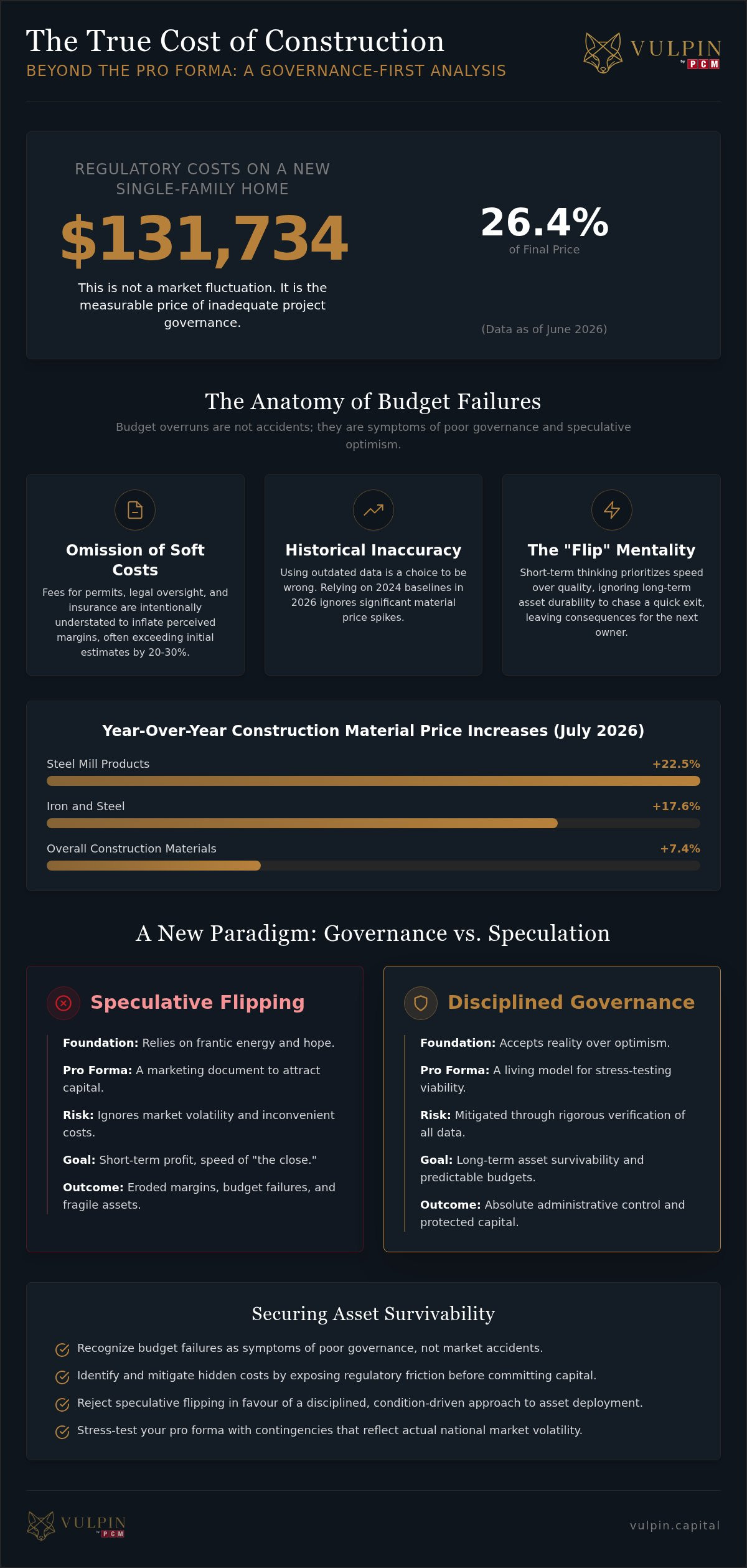
Most developers believe they are building assets. They are actually financing inefficiencies. By June 2026, the total cost of regulation for a single-family home reached $131,734, accounting for 26.4% of the final price. This is not a simple market fluctuation. It is a failure of oversight. These hidden costs in new construction projects are the measurable price of inadequate project governance and speculative optimism. You likely realize that the quoted “base price” is a fiction designed to invite capital rather than protect it.
We reject the frantic energy of traditional markets that rely on hope. You see the erosion of margins through contractor change orders and regulatory friction. This article exposes the structural failures that lead to budget overruns and teaches you how to secure asset survivability through disciplined governance. We will centre our analysis on verifying project viability before you commit capital. We are moving away from speculative risk and toward a reality of absolute administrative control and predictable, rule-governed budgets.
Key Takeaways
- Recognize that structural budget failures are symptoms of poor governance rather than unavoidable market accidents.
- Identify and mitigate hidden costs in new construction projects by exposing soft costs and regulatory friction before committing capital.
- Reject speculative flipping in favour of a disciplined, condition-driven approach to asset deployment and long-term survivability.
- Execute a rigorous stress-test of your pro forma to build contingencies that reflect actual national market volatility.
- Utilize professional project management systems to maintain absolute administrative control and eliminate speculative risk.
The Illusion of the Pro Forma: Why Hidden Costs Are Governance Failures
Hidden costs in new construction projects are rarely accidental. They represent the delta between a developer’s desire for a project to succeed and the cold, industrial reality of the site itself. Most pro formas are constructed as static promises; they are marketing documents designed to secure capital rather than operational manuals designed to protect it. When a budget fails, it is seldom due to “bad luck.” It is a failure of governance.
We view the pro forma as a living model that must withstand continuous stress-testing. If a project cannot survive the exposure of its omitted expenses, it is not a viable asset. Asset survivability is our primary metric. We do not prioritize the speed of the “close” or the excitement of the “groundbreaking.” We prioritize the structural integrity of the financial framework. A project that relies on perfect conditions is a project destined for failure.
The Psychology of Speculative Optimism
The traditional construction market is fueled by a frantic, speculative energy. This “optimism bias” leads to the intentional omission of inconvenient costs to make a project appear more attractive to lenders. Developers often rely on historical averages that fail to account for current volatility. For example, overall construction material prices rose 7.4% year-over-year as of July 2026, with iron and steel seeing a 17.6% increase. Relying on last year’s data is a choice to be wrong.
- Omission of Soft Costs: Fees for permits, legal oversight, and insurance are often understated to preserve perceived margins.
- Historical Inaccuracy: Using 2024 baselines in a 2026 reality ignores the 22.5% spike in steel mill products.
- The “Flip” Mentality: Short-term thinkers ignore long-term durability because they don’t intend to own the consequences of their shortcuts.
VULPIN Capital explicitly rejects the speculative flip. We focus on long-term hold strategies. This requires a stoic acceptance of reality over the comfort of a padded spreadsheet. We use The VULPIN Check to identify the hidden costs in new construction projects that others choose to ignore.
Governance as a Financial Shield
Project governance is not simple oversight; it is the structural refusal to accept unverified data. It functions as a shield against the erosion of profit margins by enforcing administrative control over every dollar deployed. This requires a disciplined operator who values the integrity of the system above the speed of execution. Third-party audits are not obstacles; they are essential validation points that ensure project viability before capital is committed to the ground.
Real Asset Governance is the rigorous verification of all resource commitments.
Categorizing the Invisible: Soft Costs and Regulatory Friction
Soft costs are the silent erosion of capital. While hard costs are visible in steel and concrete, soft costs are buried in administrative friction and bureaucratic inertia. These expenses frequently exceed initial estimates by 20% to 30% because developers fail to account for the complexity of modern compliance. We do not accept “unexpected” as a valid category for these expenses. They are predictable outcomes of a system that prioritizes oversight over production.
In 2026, the total cost of regulation for a new single-family home reached an estimated $131,734, representing 26.4% of the final price. This reflects a 40% increase from 2021 estimates. These hidden costs in new construction projects are not accidents; they are the measurable price of entering a regulated market without a governance-first strategy.
The Soft Cost Trap
Legal fees, financing costs, and architectural revisions represent the “paper” costs that bleed budgets long before a foundation is poured. With construction loan interest rates currently ranging from 9.75% to 11.25%, every month of administrative delay compounds the financial burden. Speculative operators often underestimate the time required for architectural iterations and legal reviews, leading to capital exhaustion.
Sustainable housing assets require a higher upfront soft cost allocation to realize long-term ROI. Investing in high-performance design reduces operational liabilities. You can analyze the specific trade-offs of this approach in our guide on Net-Zero Home Construction Costs in Canada. We prioritize these allocations because they secure the asset’s survivability against future energy mandates and carbon taxes.
Regulatory and Compliance Hurdles
Navigating building codes and environmental standards in 2026 requires more than a checklist; it requires a structural refusal to be delayed. Municipal delays and utility connection fees are often treated as “surprises” by amateur managers. However, with building permit costs for complex projects reaching $8,500 or more, the cost of carrying land during extended permitting phases is a significant drain on liquidity.
- Building Codes: Changes to codes over the past decade account for over $40,000 of the cost of a new home.
- Utility Friction: Connection fees and municipal levies often fluctuate based on local labour shortages and material volatility.
- Carrying Costs: High-interest construction loans turn permit delays into profit-margin eroders.
We utilize The VULPIN Check to account for this regulatory friction before the first shovel hits the ground. By identifying these hurdles during the pre-construction phase, we eliminate the speculative risk that traditional developers ignore. Quality control failures represent a hidden long-term liability; a failure in the building envelope today is a structural disaster in 2030. Disciplined governance treats quality as a non-negotiable financial metric.
Speculative Flipping vs. Disciplined Asset Deployment
Market participants often confuse gambling with investing. Speculative flipping relies on the frantic energy of rising prices to mask structural deficiencies and administrative shortcuts. We reject this approach. Disciplined asset deployment requires a stoic acceptance of construction-cost reality. A “cheap” project is often a vessel for hidden costs in new construction projects that manifest as catastrophic failures once the speculator has exited. We do not build for the exit; we build for the hold.
True value is found in the integrity of the structure and the reliability of the internal logic governing its creation. When a project is initiated under the guise of “low cost,” it usually ignores the reality of a tight labour market where commercial workers earn 15% to 25% more than their residential counterparts. This wage gap forces “cheap” projects to rely on less skilled labour, creating long-term liabilities in building performance and safety. We utilize PCMNow as a framework for disciplined execution to ensure that every resource commitment is verified and every outcome is predictable.
The True Cost of Speculation
Speculative developers frequently ignore long-term maintenance and building performance to meet a short-term exit strategy. They prioritize aesthetic trends over structural permanence. This intentional negligence creates a financial fallout that the eventual owner must settle. Cutting corners on insulation, HVAC efficiency, or structural waterproofing might save capital today, but it ensures asset degradation tomorrow. You can explore our foundational perspective on this in our guide to Disciplined Real Estate Investing Principles.
The hidden costs in new construction projects driven by speculation are often found in the building envelope. A failure to invest in high-performance materials leads to increased insurance premiums and higher operational costs. We recognize that the most expensive project is the one that was built poorly the first time. Our methodology prioritizes the durability of the physical asset over the excitement of a quick market win.
Condition-Driven Acquisition
VULPIN Capital utilizes “The Fox” operating system to evaluate asset survivability with mechanical precision. We do not look at what a building could be; we look at what it is. This means prioritizing structural integrity and sustainable materials over the superficial. Our Condition-Driven Asset Acquisition Strategy serves as an ideological screening mechanism to ensure that only high-integrity projects move forward.
- Tangible Verification: We reject theoretical modelling in favour of physical inspections and technical audits.
- Mechanical Metaphors: We treat the organization of a project like a self-sustaining engine that must be tuned for long-term performance.
- Autonomous Control: By owning the systems of governance, we eliminate the speculative risk inherent in unmanaged construction environments.
Disciplined acquisition is a matter of autonomy and principle. It requires the patience to wait for the right conditions and the conviction to walk away from projects that do not meet our strict standards for structural permanence.
Stress-Testing the Pro Forma: A Manual for Asset Survivability
A pro forma is not a statement of fact; it’s a hypothesis that must be tested until it breaks. We reject the “padded” contingency of the amateur manager. Instead, we demand an execution manual that anticipates the structural erosion of capital. To secure asset survivability, you must transition from a theoretical budget to a documented reality. This requires Red Teaming your own assumptions; you must intentionally seek the friction points that lead to hidden costs in new construction projects.
Building a contingency is not a guessing game. It must reflect national market volatility with technical accuracy. As of April 2026, it’s estimated that current tariff rates will lead to a 6.0% increase in construction material costs relative to a 2024 baseline. If your budget doesn’t account for this specific pressure, your pro forma is already obsolete. We don’t rely on historical averages; we rely on tangible verification.
Identifying Vulnerabilities in the Budget
We analyze material supply chains and labour inefficiencies with mechanical precision. A 24-month build cycle is an eternity in a fluctuating market. With construction loan interest rates currently sitting between 9.75% and 11.25%, even a minor delay turns your interest expense into a primary budget drain. We don’t hope for rate cuts. We build for their persistence and calculate the cost of carrying land through extended permitting phases accordingly.
A Viability Stress Test is a rigorous simulation of worst-case financial scenarios.
Implementing the VULPIN Check
We commit resources only when viability is proven through a rule-governed process. Speculative risk is filtered out before capital is deployed. By utilizing The VULPIN Check, we identify projects that cannot survive a reality-first audit. This process isn’t about being conservative. It’s about being accurate. We prioritize structural permanence over market hype.
Project reality is often obscured by optimism. You must enforce a framework that prioritizes verification over projection. Review our methodology for Managing Construction Project Cost Overruns to see how we maintain administrative control through national market fluctuations. This disciplined approach ensures that your capital is protected by systems rather than luck.
If you’re ready to move beyond speculative models and toward tangible verification, you should evaluate your next project with VULPIN Capital.
Systematizing Success: How PCMNow Secures Project Reality
Chaos in construction is a choice. It is the result of allowing unmanaged variables to dictate the pace of resource deployment. PCMNow Project Management serves as the industrial engine for your capital, enforcing a rigid internal logic on every project phase. We do not deploy managers to merely observe the decay of a budget. We deploy Owner’s Representatives to enforce disciplined governance. This ensures that hidden costs in new construction projects are not just identified, but neutralized before they can erode the asset’s viability.
When you eliminate the speculative energy of traditional markets, you uncover the true hidden costs in new construction projects that destroy unmanaged pro formas. We reject the frantic urgency of the “quick win” in favour of structural permanence. Success in the built environment is not an accident of the market; it is a documented result of superior administrative oversight.
Professional Management for National Projects
Managing complex stakeholder interests requires more than a spreadsheet. It requires a sovereign methodology. PCMNow integrates The Construction Project Governance Framework to move from reactive problem-solving to proactive administrative control. We treat capital deployment as an engineering challenge rather than a financial gamble. By maintaining absolute oversight over soft cost allocation and regulatory compliance, we eliminate the friction that traditional developers accept as inevitable.
Our systems don’t rely on the individual experience of a builder. They rely on a self-sustaining internal logic that remains consistent across national projects. We prioritize tangible verification over theoretical modelling, ensuring that every dollar spent is a deliberate investment in asset survivability.
The VULPIN Standard of Execution
The future of Canadian construction does not belong to the lucky. It belongs to the disciplined. We prioritize structural permanence and long-term asset durability through FoxyHome. These sustainable housing assets are designed to survive shifting environmental mandates and rising operational costs. They represent the rejection of the “flip” in favour of generational stability and high-performance engineering.
Reject speculation. Embrace the stoic reality of rule-governed budgets. Whether you are building high-performance housing or complex national assets, the standard of execution remains the same: verify everything, assume nothing. You can secure your project with PCMNow Project Management today. The time for market gambling is over; the era of disciplined asset deployment has arrived.
Securing Asset Survivability Through Disciplined Governance
The built environment rewards the disciplined and punishes the speculative. You now realize that hidden costs in new construction projects are the measurable price of inadequate oversight. By rejecting market hype and embracing a stoic reality, you transform a theoretical budget into a resilient execution manual. We prioritize structural permanence over the frantic energy of short-term gains in favour of generational stability. This is why PCMNow provides disciplined execution for complex national assets and FoxyHome integrates sustainability with long-term asset survivability.
Real asset deployment requires a sovereign methodology that values tangible verification above all else. The VULPIN Check serves as our proprietary governance standard for real asset deployment to ensure project viability before a single dollar is committed. You don’t have to rely on market luck when you have administrative control. We invite you to build with the precision of a master craftsman and the oversight of a seasoned operator.
Implement The VULPIN Check for Your Next Project and move toward a future of predictable, rule-governed construction results.
Frequently Asked Questions
What are the most common hidden costs in Canadian new construction?
Common hidden costs in new construction projects include site preparation, utility levies, and architectural revisions. Many developers fail to account for site grading or landscaping, which can reach 10% of a property’s value. These are not surprises; they are unmanaged line items. We treat every unverified expense as a threat to the asset’s viability. By identifying these early, we move from speculative hope to absolute administrative control.
How much should I set aside for a construction contingency fund in 2026?
A standard 10% contingency is insufficient in a market facing 7.4% material price inflation. We recommend a rule-governed contingency that reflects national market volatility; this often requires 15% to 20% to account for iron and steel fluctuations. This is not a safety net; it is a calculated reserve for verified risks. We prioritize construction-cost reality over the optimistic projections common in speculative flipping and unmanaged development environments.
What is the difference between hard costs and soft costs in development?
Hard costs represent the tangible materials and labour required to build the physical structure, such as concrete and steel. Soft costs are the administrative and legal expenses that occur behind the scenes, including permits, architectural fees, and financing interest. While hard costs are visible, soft costs often trigger the most significant hidden costs in new construction projects because they are frequently underestimated during the initial pro forma stage.
How does The VULPIN Check identify hidden costs before construction begins?
The VULPIN Check utilizes a proprietary governance standard to verify all resource commitments before capital deployment. It functions as a structural filter, exposing omitted expenses and unrealistic assumptions in the pro forma. By demanding predefined proof of project viability, we eliminate the speculative risk inherent in unmanaged environments. We commit capital only when the technical audit confirms the asset can survive worst-case financial scenarios through rigorous stress-testing.
Why do regulatory delays cause such significant budget overruns?
Regulatory friction translates directly into time, and in a high-interest environment, time is a capital drain. With construction loan rates between 9.75% and 11.25%, every month spent waiting for a permit increases the carrying cost of the land. These delays erode profit margins and disrupt labour scheduling. We view these overruns as governance failures rather than unavoidable municipal hurdles. Superior administrative oversight is required to navigate these national hurdles.
Can sustainable building materials help reduce hidden long-term costs?
Sustainable materials reduce operational liabilities and shield the asset from future energy mandates. While upfront costs may be higher, high-performance housing assets delivered through FoxyHome ensure long-term survivability. This approach rejects short-term speculative flipping in favour of generational durability. By investing in superior building envelopes now, we eliminate the hidden maintenance and carbon-tax costs that will plague standard construction in the coming decade and beyond.
What role does a Project Management framework play in cost control?
A disciplined framework like PCMNow Project Management provides the mechanical precision needed to manage complex national assets. It moves the organization from reactive problem-solving to proactive governance. By employing an Owner’s Representative to enforce strict standards, we maintain absolute oversight over every dollar deployed. This systematic approach ensures that the project reality aligns with the execution manual rather than a theoretical model, securing the integrity of the capital.
Is it possible to eliminate all hidden costs in a large-scale project?
Absolute elimination of every variable is impossible, but hidden costs in new construction projects can be neutralized through rigorous governance. We replace the concept of hidden costs with calculated risks. By using systems like The Fox, we ensure that every potential friction point is documented and accounted for in the stress-tested budget. The goal is not to avoid reality; the goal is to own the logic governing it.