

A polished pro forma can still rely on an untested site assumption. A feasibility study for real estate development Ontario should establish what the evidence supports before capital is committed. It should make uncertainty visible, not hide it behind precise-looking projections.
That distinction matters because site capacity, planning, market demand, construction requirements and financing conditions can pull a project in different directions. A convincing financial projection is not enough if its underlying assumptions have not been tested. A useful study connects the evidence across these areas and records what remains unresolved.
This guide sets out a disciplined way to assess a development proposal before committing further resources. It explains how to examine site and planning constraints, test market and financial assumptions, and connect construction evidence with financing requirements. The goal is a traceable decision gate: proceed when predefined evidence supports the next step, revise the proposal when key assumptions fail, or stop when the case does not hold. The VULPIN Check applies this governance-first principle to real asset deployment. It does not guarantee feasibility or returns. It provides a rigorous process for verifying what is known, what remains uncertain and whether the project has earned further commitment.
Key Takeaways
- Use a feasibility study for real estate development Ontario to test whether site conditions, planning constraints, market support and delivery requirements align.
- Separate documented facts from professional opinions, working assumptions and unanswered questions so decision-makers can assess the strength of the evidence.
- Make every material pro forma input traceable by recording its source, date, confidence level, owner and outstanding validation needs.
- Set proceed, revise, pause and stop conditions before reviewing results, then apply them consistently at each decision stage.
- Carry validated assumptions and open risks into project controls. Approval to proceed is a managed next step, not proof that uncertainty has disappeared.
What a real estate development feasibility study in Ontario must establish
A feasibility study is not simply a polished forecast. It is a structured test of whether the available evidence supports a proposed development across the site, planning context, market, technical requirements, delivery approach and financial assumptions. The general Feasibility Study concept applies, but real estate decisions also depend on how these factors interact and which questions remain open.
A feasibility study is an evidence-based decision tool that tests whether a project merits further commitment. It does not promise approval, fixed costs, available funding or a successful outcome. A positive finding is conditional on the evidence reviewed, the assumptions disclosed and the dependencies still outstanding. A model can calculate an attractive result without proving that its inputs are reliable.
What question should a development feasibility study answer?
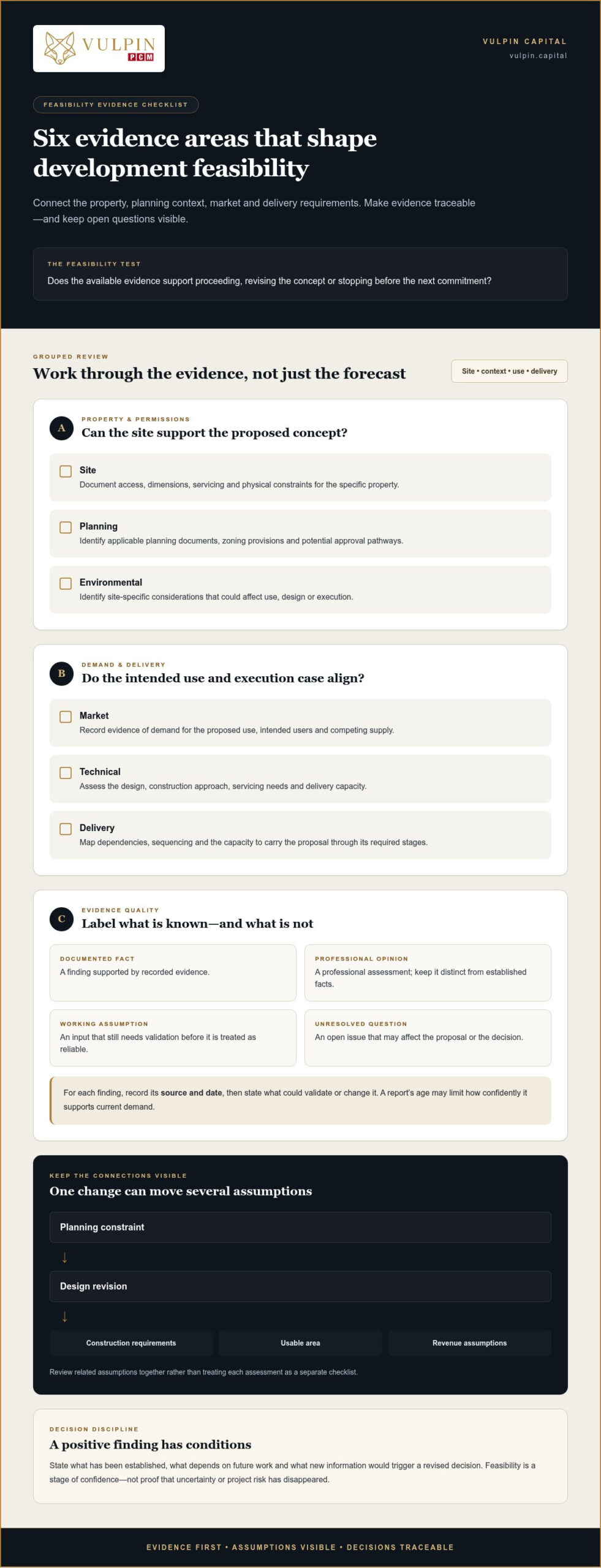
The central question is not simply, “Does the project look profitable?” It is: Does the available evidence support proceeding, revising the concept or stopping before the next commitment? Define the proposed development separately from the assumptions that need testing. The concept might describe the intended use and general form of a building. Assumptions might concern whether the site can accommodate it, whether demand supports it or whether delivery can follow the proposed sequence.
Set the decision context before analysis begins. Identify who will rely on the study, what decision it needs to inform and what commitment is being considered. That commitment might be authorizing further design work, advancing due diligence or allocating resources to a later project stage. Match the evidence threshold to the significance of the decision. The VULPIN Check applies this governance principle: predefined proof of project viability is required before resources are committed.
What does “feasible” mean in a real estate project?
A project is feasible only when its essential parts align. The site must be capable of supporting the concept; planning and technical constraints must be addressed; market evidence must support the intended use; and the delivery and financial assumptions must form a coherent case. A weakness in one area can change the conclusion in another. For example, a design revision can affect usable area, construction requirements and revenue assumptions at the same time.
Feasibility is a stage of confidence, not a permanent label. Early screening uses available information to identify major constraints and decide whether further investigation is warranted. Later analysis should replace provisional inputs with stronger evidence as surveys, design work, market analysis and other project information become available. Label each item clearly as a documented fact, professional opinion, working assumption or unresolved question. Do not present an early screening result as a fully validated conclusion.
For practical governance, record the evidence boundary and any conditions attached to a positive finding. State what has been established, what depends on future work and what new information would trigger a revised decision. A feasibility study for real estate development should leave decision-makers with more than a “go” or “no-go.” It should explain why the decision is defensible, what it relies on and where uncertainty remains. A study can discipline the decision, but it cannot remove project risk.
How site, planning, market, and technical evidence shape feasibility
Organize a reliable feasibility record so that evidence can be traced, challenged and updated. Group findings by subject, then show how one category affects another. A planning constraint may change the design, and a design change may affect construction requirements, usable area and revenue assumptions. Keep these connections visible instead of treating each assessment as a separate checklist.
- Site: Document access, dimensions, servicing and physical constraints for the specific property.
- Planning: Identify applicable planning documents, zoning provisions and potential approval pathways.
- Market: Record evidence of demand for the proposed use, intended users and competing supply.
- Technical: Assess the design, construction approach, servicing needs and delivery capacity.
- Environmental: Identify site-specific considerations that could affect use, design or execution.
- Delivery: Map dependencies, sequencing and the capacity to carry the proposal through its required stages.
Label each finding as a documented fact, professional opinion, working assumption or unresolved question. Add its source and date, then state what could validate or change it. A dated market report is evidence, for example, but its age may limit how confidently it supports current demand. Likewise, an early design concept does not prove that the site can accommodate the final scheme.
How do planning controls and site conditions affect a proposal?
Review the planning documents and zoning provisions that apply to the property, along with the potential approval pathway. Requirements can vary by municipality and change over time, so verify current provincial and municipal instruments before treating a planning conclusion as established. Assess access, servicing, physical constraints and environmental considerations using information specific to the project. Record each required approval, variance or external decision as a dependency, not an assumed outcome.
Planning capacity describes what the applicable rules may allow; physical site capacity describes what the property can actually accommodate. Both tests matter. A proposal that appears consistent with planning permissions may still face practical limits involving site configuration, access or servicing. A physically workable concept may also depend on a planning decision that has not been made.
How should market and technical evidence be tested?
Test demand against the proposed use and intended users, rather than relying on a broad market narrative. Record the evidence supporting assumptions about competing supply and likely absorption or occupancy, including when the information was gathered. For technical feasibility, test whether the design, construction approach, servicing needs and delivery capacity fit the concept. Flag conclusions based on incomplete studies, preliminary design or unverified inputs so they are not mistaken for established facts.
The Urban Land Institute (ULI) provides broader land-use and real estate development resources. Project conclusions still need to rest on evidence specific to the property and proposal. A feasibility study for real estate development Ontario should show the chain of dependencies: what must be true, what supports that conclusion and what remains unresolved. The VULPIN Check applies this evidence-led governance principle before resources are committed. As execution advances, governance-led project oversight can help keep verified assumptions and outstanding conditions visible.
Testing Development Pro Formas Without False Certainty
A development pro forma is only as reliable as its assumptions. Bring land, design, approvals, financing, construction, operations and revenue into one model so a change in one area can be traced through the others. For example, a delayed approval may affect financing timing, construction sequencing and when revenue could begin. A single headline return will not show that chain of effects.
For a feasibility study for real estate development Ontario, make each material input traceable. Record its source, date, confidence level, owner and outstanding validation requirement. Mark inputs as quoted, independently reviewed or preliminary. These labels are not interchangeable: an early estimate is not a confirmed commitment, and an assumption does not become evidence simply because it appears in a spreadsheet.
Which assumptions belong in a development pro forma?
Include project-specific capital requirements, operating assumptions, timing, financing structure and revenue inputs where evidence supports them. Make dependencies visible. If the scope is preliminary, an approval is outstanding or delivery sequencing is unresolved, show how that uncertainty affects the model instead of treating the preferred outcome as settled. Ontario’s land use planning information can help frame the planning context, but verify project-specific requirements and approval pathways before using them as model inputs.
Use an assumption register alongside the model. It should show not only what an input is, but also what it rests on and who is responsible for validating it.
| Assumption | Evidence | Sensitivity | Decision impact |
|---|---|---|---|
| Approval timing | Current project schedule and known dependencies | Test a longer timeline | May change financing and delivery conditions |
| Construction scope | Design status and available project inputs | Test scope changes | May affect capital needs and sequencing |
| Revenue | Market evidence, source and date | Test a weaker revenue case | May challenge the project’s decision threshold |
How does sensitivity analysis expose fragile conclusions?
Build a base case from current evidence, a downside case that tests adverse changes, and a revised case based on a credible change to the proposal or its assumptions. Vary material inputs individually to see which ones move the conclusion. Then test related changes together, such as a longer approval period combined with a shift in delivery timing. Do not insert convenient percentages or market benchmarks without supporting evidence.
Set decision thresholds before interpreting the scenarios. If the downside case breaches a threshold, identify which assumption caused the result and whether more evidence or a revised concept could address the weakness. Scenario analysis tests exposure; it does not predict or guarantee outcomes.
The VULPIN Check applies predefined evidence requirements before resources are committed. A disciplined pro forma supports that process by showing which assumptions are verified, conditional or still open. Governance-led project verification can help keep those conditions visible as a project advances.
How to turn feasibility findings into a documented proceed-or-stop decision
A feasibility conclusion should follow a defined review, not a rush to justify a preferred outcome. Set the decision rules before presenting the final results. This helps protect the process from optimism, sunk costs and pressure to keep moving while a material condition remains unresolved.
Capital follows verified evidence, not optimism or pressure. The decision standard should reflect the commitment being considered. A limited next-stage investigation may require a different evidence threshold from a major capital commitment. In either case, decision-makers should understand what evidence is required and what could change the recommendation.
What should a feasibility decision record contain?
Make the record useful to someone who was not part of the review. Summarize the proposal, evidence considered, key assumptions, scenario results and material dependencies. State the recommendation and explain its rationale. Record conditions, required next approvals, accountable owners and the evidence needed to close each open item. Document a decision to revise, pause or decline with the same care as a decision to proceed.
Use a staged sequence so each review has a clear purpose:
- Initial screening: Define the proposal and identify constraints that could prevent further work.
- Evidence review: Assess available site, planning, market, technical and delivery information; flag gaps and assign owners.
- Scenario testing: Examine how material changes affect the project case and its predefined decision thresholds.
- Decision: Compare the evidence with the rules set in advance, then record the rationale, conditions and next actions.
Define the four possible outcomes before reviewing the final analysis:
- Proceed when the required evidence supports the next commitment and conditions are assigned and manageable.
- Revise when the proposal needs a change that can be tested, such as adjusting scope or revisiting an assumption.
- Pause when a decision depends on missing evidence or an external outcome that remains unresolved.
- Stop when a material constraint or failed threshold undermines the case for further commitment.
For every open issue, name an accountable owner and the specific evidence required next. “Confirm servicing” is too vague to guide a project. State what information is needed, who is responsible for obtaining or assessing it, and which decision depends on it. That turns the record into an operating tool, not a summary filed away after approval.
How does governance improve a feasibility process?
The VULPIN Check uses predefined proof of project viability before resources are committed. It does not guarantee approvals, returns or project success. It establishes a disciplined evidence gate, makes the basis for a decision visible and keeps unresolved conditions in view. If a project proceeds, execution controls should carry validated assumptions and decision conditions forward instead of treating them as settled facts.
A feasibility study for real estate development Ontario is stronger when the decision can be traced from evidence to conditions to accountable action. The VULPIN Check’s evidence-led governance process structures commitments around verified proof, not expectation.
Next Steps After a Real Estate Feasibility Study
A proceed decision does not mean every risk has been resolved. It authorizes a defined next stage under stated conditions. Those conditions must travel with the project. If they remain only in the feasibility report, they can be lost as responsibilities shift from analysis to delivery.
How should a project move from feasibility into execution?
Build a controlled handoff. Transfer the approved scope, validated assumptions, decision conditions, accountable owners, dependencies and reporting requirements into the project’s working controls. Give each condition an owner and a clear status, such as open, in progress or closed. Keep source evidence accessible so the team can distinguish an approved basis from a preliminary input.
Set review points for changes that could alter the feasibility case. A design revision may affect scope; a planning development may change an approval dependency; financing conditions or construction information may alter delivery assumptions. Establish who can approve a change, what analysis it requires and when it must return to decision-makers. The aim is not to prevent change, but to ensure material changes are reviewed before they pass through the project.
PCMNow Project Management provides professional management for complex construction and development projects. Disciplined project management helps carry verified assumptions into controlled work while keeping responsibilities and dependencies visible. The feasibility record remains a reference point, not a substitute for active oversight.
When should a developer revisit feasibility?
Reopen the analysis when material evidence changes, an assumption no longer holds, an approval or other dependency shifts, or the project scope moves beyond the decision record. Compare actual conditions with the basis on which the project proceeded. Use current project evidence to assess the effect on cost, timing, delivery or revenue assumptions, then decide whether to proceed under revised conditions, pause for validation or reconsider the scope.
For example, if construction information requires a significant design change, trace its consequences through the affected assumptions rather than updating one line in isolation. A changed input can affect several parts of the project. Record the reason for the review, the evidence considered, the resulting decision and any new actions. This creates a clear history of how the project’s direction was governed.
A feasibility study for real estate development Ontario should lead to ongoing control, not a one-time sign-off. Uncertainty remains and conditions can change. The governance task is to identify changes early enough for decision-makers to assess them against the project’s evidence and approved limits.
The VULPIN Check is a structured governance and verification process that uses predefined proof of project viability before resources are committed. It can help structure that commitment around evidence and support a disciplined handoff. It cannot guarantee approvals, costs, funding or project outcomes.
Make the Next Commitment Earned
The next step is not to eliminate uncertainty. It is to decide how much uncertainty the project can responsibly carry and what evidence must be in place before making another commitment. A feasibility study for real estate development Ontario is most useful when its decision conditions remain active throughout the project, not sealed away after approval to proceed.
The VULPIN Check uses predefined proof of project viability before resources are committed. Once a project advances, PCMNow provides project management for complex construction and development projects, helping carry verified assumptions into execution. Neither process makes outcomes certain. Both support disciplined decisions and clear accountability as conditions evolve.
Keep the decision record active. Revisit it when material assumptions change, assign ownership for open conditions and let evidence determine the pace of commitment. Explore The VULPIN Check as a governance framework for evidence-led real asset deployment. Build the next stage on what the project can demonstrate and move forward with discipline.
Frequently Asked Questions
What is a real estate development feasibility study?
A real estate development feasibility study is a structured assessment of evidence about a proposed project. It examines the site, planning context, market, technical requirements, delivery approach and financial case to inform a decision before further commitments are made. It does not promise project success. Its conclusions depend on the proposal, the assumptions used and the quality and completeness of the information available when the analysis is prepared.
What does a real estate development feasibility study include?
It can include site conditions, a review of applicable planning information, demand analysis, design and construction considerations, operating assumptions, financing dependencies and scenario analysis. The scope should match the proposal and the decision at hand. An early screening, for example, may rely on limited design information, while a later review may test more developed inputs. Clearly distinguish documented information from preliminary assumptions because studies do not all include the same investigations.
How do you determine whether a property development is feasible?
Assess whether the proposed use aligns with the property’s capacity, planning conditions, market evidence, delivery requirements and a tested financial model. Developers commissioning a feasibility study for real estate development Ontario should compare its findings with decision thresholds set before interpreting results. If a key condition fails, the proposal may need revision or further investigation. A positive analysis remains conditional and can change as evidence changes; it cannot guarantee approvals, financing or returns.
How much does a real estate development feasibility study cost?
The cost depends on the project’s scope, the information already available about the site, the specialist analysis required and the decision the study must support. Before comparing proposals, define the questions to be answered and the work needed to address them. Clarify what evidence, analysis and deliverables each scope includes. This makes comparisons more useful than looking at price alone, without assuming different studies provide equivalent depth.
How long does a property development feasibility study take?
The analysis period depends on how complete the project information is, the proposal’s complexity, specialist input and any external review required. A study may take longer when important site records or project details need to be assembled. Keep its duration separate from later municipal, utility, lender and construction processes. Those stages involve external parties and their timing can vary; a feasibility study cannot establish a fixed schedule for them.
Do I need planning approval before conducting a feasibility study?
No. Early feasibility work can examine the planning context before approvals are secured, helping identify conditions that may affect a proposal. Treat required approvals as dependencies, not completed steps or assured outcomes. Applicable planning documents and processes depend on the specific proposal and jurisdiction. Verify current Ontario and municipal planning information for the property. A feasibility study assesses and informs; it does not grant planning approval.
Can a feasibility study guarantee that a development will make money?
No. A study evaluates available evidence and assumptions at a point in time. Market conditions, approvals, financing, construction and operations can change, affecting the project’s financial case. Scenario analysis can show how sensitive a conclusion is to changed inputs, but it cannot remove risk or guarantee income, costs, equity value or outcomes. Treat preliminary projections as estimates, disclose their assumptions and limitations, and update them when material evidence changes.
Who should prepare or review a development feasibility study?
The expertise required depends on the project and may include development, planning, design, construction, market and financial knowledge. Make sources traceable and assign clear responsibility for material assumptions. Independent review can help test important inputs where appropriate. The VULPIN Check is a governance and verification process that uses predefined proof of project viability before resources are committed. It does not replace specialist advice or guarantee that a project is viable.