

A parcel is not a project. A promising location and an attractive pro forma can still fail when site constraints, planning permissions, construction costs or financing assumptions are tested. A disciplined project viability assessment for land purchase separates verified evidence from assumptions before capital is committed.
Confidence should come from documents, not optimism. This checklist shows how to identify evidence gaps, test a parcel against applicable provincial and municipal requirements, and compare a base case with realistic downside scenarios. It also connects early land analysis to construction-cost reality and execution governance.
The review moves from site conditions and approvals to total project costs, revenue assumptions, financing and delivery risks. At each stage, ask: what is known, what remains unproven, and what could change the decision? The VULPIN Check applies this evidence-led discipline to real asset deployment. The result is a clear decision gate: proceed, revise the plan or decline the opportunity before uncertainty becomes an expensive commitment.
Key Takeaways
- A project viability assessment for land purchase tests whether a specific parcel can support a deliverable project, not simply whether the land looks attractive.
- Organize evidence across site conditions, planning, technical constraints, costs, financing, operations and revenue. Record each input’s source, date, confidence and reviewer.
- Compare the documented base case with evidence-supported downside scenarios, including planning delays, construction-cost pressure, financing changes and revenue sensitivity.
- Use clear decision gates: define the intended use, gather evidence, test assumptions, assign owners and deadlines to unresolved items, then decide whether to proceed, revise or decline.
- The VULPIN Check applies governance and verification to real asset deployment, with resources committed only when predefined proof of viability exists.
What a project viability assessment for land purchase must establish
A parcel can be well located, visually appealing and available at a compelling price, yet still be unsuitable for the project you intend to build. Land attractiveness describes the appeal of a property. Project viability asks whether a defined use can be delivered on that specific site under supportable assumptions.
A project is viable when site-specific evidence supports a deliverable use, a workable planning pathway and assumptions that withstand practical review. An optimistic pro forma alone is not proof.
A project viability assessment for land purchase is a structured test, not a prediction. It considers whether the intended use fits the parcel and applicable provincial and municipal planning framework, and whether technical, operating and financial assumptions are credible enough to inform a decision. The broader Feasibility Study concept also considers technical, economic, legal and scheduling feasibility. For a land acquisition, those factors need to be grounded in the specific property and proposed project.
The assessment reduces uncertainty by identifying what is supported, what is assumed and what remains unknown. It cannot guarantee planning approval, construction costs, financing, revenue or project success. Those outcomes depend on decisions and conditions that may change. The purpose is more practical: establish what evidence exists before deciding whether to proceed, revise the proposal or stop.
What questions should the assessment answer?
Start with three decision questions, each tied to the intended use rather than the parcel’s general appeal:
- Can the intended use fit? Examine whether the proposed project can physically fit the site and whether the applicable planning framework supports a plausible approval pathway. Check constraints such as access, servicing and site dimensions against the proposed layout. General policy direction is not a substitute for property-specific evidence.
- Can the project’s assumptions hold together? Compare documented costs with realistic revenue assumptions. A projected return is only as sound as the scope, timing, financing and operating inputs beneath it.
- What could change the decision? Identify missing records, unresolved site constraints, uncertain approvals or untested assumptions. Record why each gap matters and what evidence would resolve it.
These questions prevent a common error: treating a strong-looking pro forma as the conclusion. It is an input to test, not a verdict. If a key assumption has no reliable support, label it unresolved rather than presenting it as fact.
When should land be assessed?
Begin before material commitments or irreversible project decisions. An early screen can expose a fundamental mismatch between the intended use and the parcel before substantial resources are committed. It is not the final word. As the opportunity advances, replace preliminary assumptions with more detailed, property-specific verification and current project inputs.
Set a decision gate for each stage. Define what evidence must exist before moving forward, who is responsible for obtaining it and when the decision will be revisited. The VULPIN Check applies this governance principle to real asset deployment: commit resources only when predefined proof of project viability exists. Its framework distinguishes a documented basis for action from enthusiasm unsupported by evidence.
Test the land, planning pathway, costs, and project assumptions
A useful review is built from evidence categories, not a single spreadsheet. For a project viability assessment for land purchase, organize the file so a reviewer can trace each conclusion back to its source. Separate verified facts from estimates, working assumptions and unanswered questions. A projection doesn’t become evidence simply because it appears in a polished model.
Every material assumption needs traceable evidence, because a decision is only as reliable as the source, date and review behind its inputs.
What site and planning evidence belongs in the review?
Start with the parcel itself. Review available title information, intended use, access, servicing and known physical constraints. Where available, check how the legal description, survey or site plan relates to the proposed footprint. Record what each document establishes and what it leaves unresolved. Nearby services, for example, don’t by themselves establish that the proposed project can connect to them or that the site can accommodate its intended design.
Next, identify the planning authority for the property and the requirements that apply in that specific jurisdiction. Track relevant permissions, studies, approvals and dependencies as items to verify, not as outcomes already secured. Planning pathways vary by location and proposal; general policy language cannot establish what will be permitted on a particular parcel. Keep a list of required decisions and supporting documents so a potential approval path is not mistaken for an approval in hand.
How should the financial model be grounded?
Keep project inputs distinct. Separate land acquisition, construction, infrastructure, financing, operating expenses and other project-specific assumptions. For each, record the source, date, confidence level and responsible reviewer. Where a figure is preliminary, label it clearly and state what evidence would refine it. Construction-cost reality must follow the defined scope, rather than a convenient allowance detached from what the project requires.
Revenue assumptions need the same discipline. Identify the supporting records or market evidence, the relevant property or unit type, and any limits on how closely it matches the proposed project. Note the date and conditions behind the evidence. Don’t present an asking rent, sale estimate or other forecast as assured income. The model should show how its result depends on these inputs, not conceal uncertainty behind a single output.
A practical evidence register can include these fields:
- Category: site, planning, technical constraints, costs, financing, operations or revenue.
- Input and status: the finding or assumption, labelled verified, estimated, assumed or unresolved.
- Traceability: source document, date reviewed, confidence and responsible reviewer.
- Open action: what evidence is still needed and how it could affect the decision.
This register makes gaps visible and helps prevent old estimates from passing as current facts. For construction-cost oversight, the principles in a governance-first cost-control framework can help connect early assumptions with disciplined execution. That evidence-led approach is also central to The VULPIN Check, a governance and verification process for real asset deployment. It supports a clear record of what is known before resources are committed. PCMNow Project Management provides professional management for complex construction and development projects, with a focus on construction-cost reality and disciplined execution.
Compare the base case with downside scenarios before committing
A base case is the project’s documented working position, not a promise about what will happen. It should use the best available evidence for the proposed scope, planning pathway, construction approach, financing and revenue. A downside case then changes specific assumptions for reasons that can be explained, such as a longer approval pathway, additional infrastructure work, less favourable financing terms or weaker revenue support.
In a project viability assessment for land purchase, scenario testing shows which inputs carry the decision and which still need verification. Don’t apply arbitrary percentage changes simply to make a model look cautious. Identify plausible pressures, record their evidence and show how each one affects the project’s ability to proceed. Stress testing helps manage decision risk. It doesn’t eliminate project risk or guarantee a particular outcome.
| Assumption | Evidence | Base case | Downside case | Decision effect |
|---|---|---|---|---|
| Planning pathway | Property-specific requirements and outstanding dependencies | Current documented pathway | Longer review or added approval steps, if supported by the evidence | Could affect timing, carrying costs or project scope |
| Construction scope | Defined scope, technical findings and current project inputs | Supported scope and cost assumptions | Additional work or cost pressure tied to identified constraints | Could weaken the project’s financial position |
| Financing terms | Documented terms and stated conditions | Terms used in the working model | Less favourable terms or a change in availability | Could change funding requirements and feasibility |
| Revenue | Relevant market evidence, with limitations recorded | Supportable operating or sales assumptions | Lower revenue where comparable evidence justifies testing it | Could reduce the project’s capacity to meet obligations |
Which assumptions deserve sensitivity testing?
Test assumptions that could materially alter the result: land basis, construction scope, infrastructure needs, financing terms and operating requirements. Revenue sensitivity should use relevant, supportable market evidence, with differences from the proposed project stated plainly. Mark planning, technical and financing dependencies separately. An unresolved dependency is not a confirmed cost or delay, but it may still affect whether the project can proceed.
Change one assumption at a time first. This reveals which input has the greatest effect. Then test combined pressures where they could plausibly occur together, such as a planning delay alongside a financing change. Record the evidence and reasoning behind each case. A model should expose vulnerability, not bury it in blended assumptions.
How should competing land options be compared?
Compare parcels using the same project scope, evidence standard and assumption definitions. Put unresolved dependencies and execution demands beside projected financial outcomes. A parcel with a stronger model may still carry more unverified planning or technical risk. Consistent scenario definitions make the comparison useful; otherwise, apparent differences may reflect unequal assumptions rather than a better opportunity.
Use the review to set decision conditions: which evidence must be obtained, which downside cases remain tolerable, and what finding would trigger revision or refusal. A governance-first risk review can help structure that comparison, including the approach described in Construction Project Risk Management Framework: A Governance-First Guide. The result is not certainty. It is a more disciplined basis for choosing whether to advance, revise or decline.
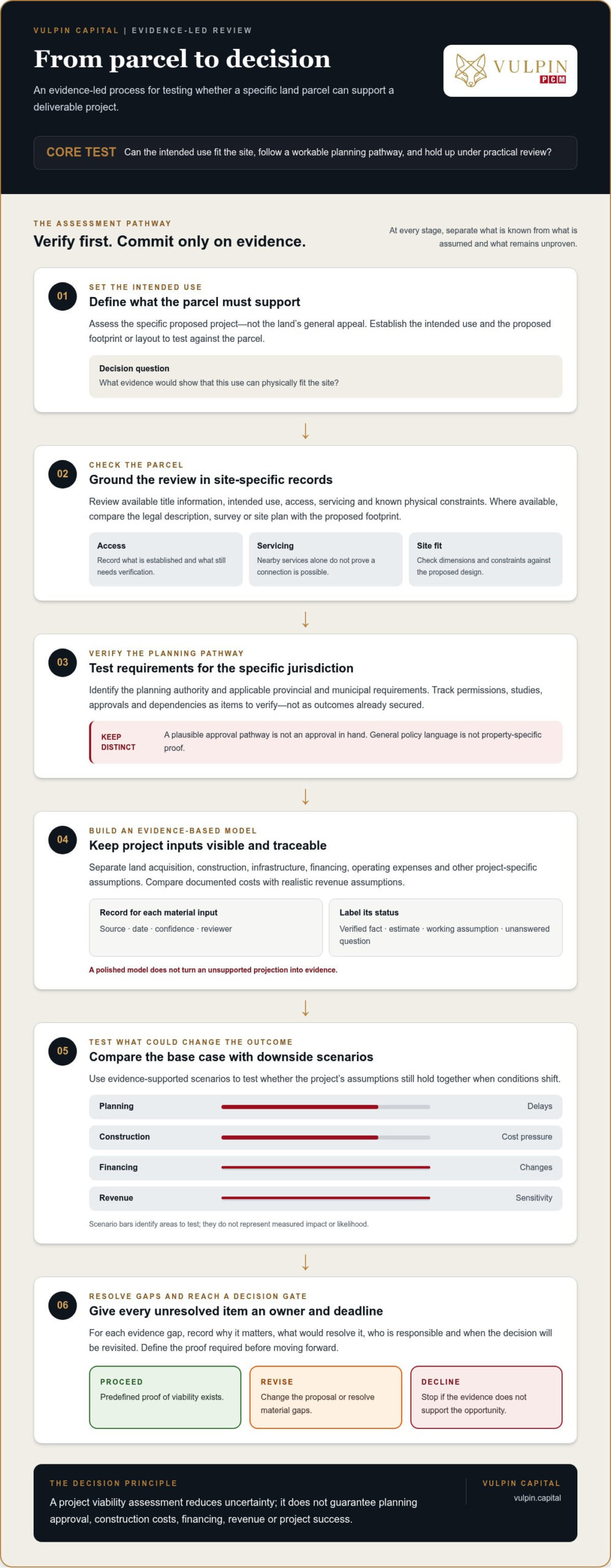
Use this pre-purchase checklist to decide what happens next
A pre-purchase checklist should end in a decision, not a thicker file of unranked documents. Set the decision criteria before reviewing the results, then move through the gates in order. If a critical dependency remains unresolved, don’t treat a positive model as permission to proceed. A model cannot replace required approvals or appropriate professional review.
- Define the intended use. State what the project is meant to deliver, its proposed scope and the assumptions that frame the assessment. Keep the use specific enough to test against the parcel and its planning context.
- Gather the decision evidence. Assemble relevant site, planning, technical, cost, financing, operating and revenue information. Note its source, date, confidence and reviewer.
- Test the assumptions. Compare the supported base case with relevant downside scenarios. Identify which changes could affect viability and why.
- Record the gaps. For each unresolved item, assign an owner, specify the evidence required and set a decision deadline. State how the finding could affect the project.
- Choose an outcome. Apply the predefined criteria to proceed, revise, defer or decline. Record the rationale and conditions for any next stage.
These gates make a project viability assessment for land purchase operational. They turn “we need more information” into a defined task, with accountability and a point at which the decision must be revisited. Criteria should be specific to the project. For example, if a proposed use depends on a planning determination, the decision record should identify that dependency rather than treat the model’s result as proof the use is achievable.
What should the decision record contain?
Keep a concise record of the intended project, evidence reviewed, key assumptions, sensitivity results and unresolved dependencies. State which criteria were met, which were not, and why. If proceeding is conditional, list the evidence required before the next commitment or project stage. The record should let someone who wasn’t in the discussion understand the decision without relying on memory or verbal assurances.
When should the project be revised or declined?
Revise the scope when site constraints or documented costs undermine the case as tested. Defer when critical planning, technical, financing or market evidence is unavailable but may still be obtained. Decline when material assumptions can’t be supported or the agreed criteria aren’t met. A decision to wait or stop is a valid result of disciplined review, not a failure of analysis.
For related review practices, explore Pre-Construction Due Diligence: A Stoic Approach. The VULPIN Check places governance and verification at the centre of real asset deployment. It is an evidence-led process, not a promise of project success.
How The VULPIN Check turns viability evidence into a decision
A land assessment produces evidence. Governance determines how that evidence is used. The VULPIN Check is a governance and verification process for real asset deployment. Its principle is direct: commit resources only when predefined proof of project viability exists.
This changes the decision from “Does the opportunity look promising?” to “What proof must be in place before the next commitment?” The standard is set in advance, not lowered to fit an attractive parcel or an encouraging pro forma. Evidence is reviewed against the intended project, its known constraints and the assumptions carrying the case. A result that depends on unresolved matters remains conditional, not established.
How does the VULPIN Check fit the assessment?
The site-specific review provides the record: what is known about the parcel, what planning and technical dependencies remain, and which financial assumptions have support. The VULPIN Check applies a governance lens to that record by relating evidence to predefined proof requirements. A missing item is not buried in a footnote. It is made visible as a decision dependency that may require more evidence, a revised scope or a pause.
This does not turn verification into approval. Planning authorities retain their decision-making role, and project-specific professional review remains distinct. Nor does a completed review guarantee costs, financing, revenue or delivery. It provides a disciplined basis for deciding whether the evidence supports committing resources, and what conditions must be addressed before proceeding.
For asset survivability, governance must connect documented assumptions to execution rather than end at acquisition. The principles in The Construction Project Governance Framework: A Manual for Asset Survivability align with this point: a decision record is useful only if it informs oversight as the project advances. Construction-cost reality and disciplined execution remain central after the land decision.
What is the appropriate next step?
Bring the assessment to a concise decision brief. State the parcel, intended project, evidence available, assumptions tested and unresolved decision points. Separate facts from estimates. Identify any approval, technical, financing or market dependency that could change the recommendation. Then state the proposed outcome and the evidence required before any subsequent commitment.
That brief gives the review a clear operating boundary. It helps decision-makers see what supports proceeding, what requires revision, and what is still too uncertain to carry forward. The project viability assessment for land purchase is not a forecast of success. It is a structured way to test whether available evidence meets a defined standard before resources are committed.
The VULPIN Check provides a structured viability review when a parcel or project needs an evidence-led decision. An assessment can support a decision; it cannot guarantee approvals or project outcomes. If you’re considering a land opportunity, discuss an evidence-led assessment with VULPIN Capital.
Carry a clear standard into your next decision
Before advancing a parcel, write down what evidence would change your decision. That discipline keeps the next step governed by proof, not by sunk effort or pressure to preserve an attractive plan. Revisit the criteria when the project scope or key assumptions change. A decision made on one version of a project shouldn’t automatically carry forward when its foundations shift.
A project viability assessment for land purchase can establish a decision standard that remains useful beyond acquisition. It gives each later commitment a clear test: does the available evidence still support proceeding? The VULPIN Check is a governance and verification process for real asset deployment, grounded in the principle that resources are committed only when predefined proof of project viability exists. It supports disciplined decisions; it doesn’t guarantee approvals or project outcomes.
If that approach fits how you intend to assess a land opportunity, explore The VULPIN Check. Take the next step with care, and let evidence set the pace.
Frequently Asked Questions
How early should I complete a project viability assessment for land purchase?
Complete an initial project viability assessment for land purchase before making a material commitment, then deepen it as evidence becomes available. For example, an early screen can flag that the intended use depends on a planning question that hasn’t been resolved. Record that dependency and decide what evidence is needed before advancing. Timing depends on the transaction and project, so treat the assessment as staged decision support, not transaction-specific advice.
Does a project viability assessment replace zoning or planning due diligence?
No. A viability assessment helps organize project evidence, but it doesn’t establish the planning rules or approvals that apply to a specific parcel. Requirements vary by jurisdiction and proposal. If a project depends on a particular use or form of development, record the relevant planning questions and distinguish confirmed information from assumptions. Don’t describe an approval as secured unless it has actually been granted.
How is land value treated in a development viability assessment?
Land value is an input to test, not proof that the proposed development works. Record the value evidence’s source, date and basis, then consider how the project case changes if that input shifts. For example, compare the land assumption with the costs and revenue supported by the current project scope. A preliminary model isn’t a guaranteed valuation or outcome, and its limitations should be clear to decision-makers.
Can a site with an existing building still be assessed for development viability?
Yes. Assess the existing building as part of the property and compare relevant project paths, such as retaining, adapting or replacing it, where those options are applicable. The presence of a structure doesn’t establish that redevelopment is feasible. Document what is known about the building and what needs further investigation, then test each proposed path against the parcel’s planning and technical context.
Should I assess land before submitting an offer?
Yes, an early review can reveal material unknowns before you decide whether to make an offer. Start with the intended project and available property information, then identify which questions could change your decision. The actual transaction terms matter, and an assessment doesn’t replace legal, planning, financial or technical advice. Discuss any offer conditions or due-diligence provisions with your legal adviser in light of the specific transaction.
What is the difference between land feasibility and project viability?
Land feasibility focuses on whether a site can accommodate a proposed use in practical terms, including relevant constraints and planning dependencies. Project viability takes a wider view of whether the development case is supportable, including costs, financing, operations and evidence-based revenue assumptions. The terms can overlap. State the scope clearly so readers know whether an assessment tested only site fit or the broader project case as well.
Can a viability assessment be updated when project assumptions change?
Yes. Update it when a material input changes, such as the project scope, new planning information, construction assumptions, financing terms or revenue evidence. Keep earlier versions and note what changed, why, and how the change affects the decision. For example, revised building plans may alter the assumptions used in the previous review. An update is a new assessment of the evidence, not a guarantee of future results.