

For anyone navigating complex construction projects, one distinction matters from the start: a plan can set a target, but it can’t make that target certain. The difference between a forecast and a promise matters when scope shifts, site conditions change, or decisions stall between the owner, consultants, and construction team.
Budgets and schedules need to respond to changing conditions while accountability remains clear. Effective construction management establishes who decides, what evidence informs each decision, and how changes affect scope, cost, and schedule. It makes project conditions visible rather than disguising uncertainty as certainty.
This guide explains the construction manager’s role from planning through execution and shows how to assess whether a project has meaningful controls, reporting, and decision accountability. It also explains how VULPIN Capital applies governance and execution discipline to complex construction and development projects. The focus is practical: how to distinguish a verifiable management process from broad service claims and keep decisions grounded as work unfolds.
Key Takeaways
- Effective construction management clarifies who makes decisions, how work is coordinated, and where accountability sits, without treating plans as guarantees.
- Trace a project from definition through planning, execution monitoring, and closeout, while keeping external approvals distinct from management activities.
- Compare management approaches by their scope controls, reporting, change documentation, and decision accountability, not by promises alone.
- Set clear objectives, decision authority, reporting expectations, and change records to strengthen owner readiness before execution advances.
- PCMNow Project Management applies governance, construction-cost reality, and execution discipline to complex construction and development projects.
What Construction Management Does for a Project Owner
Construction management coordinates a project’s scope, resources, decisions, and execution on the owner’s behalf. It establishes an operating structure: who is responsible for each action, what information supports a decision, and how issues move toward resolution. It does not guarantee that construction will finish on a particular date, within a fixed budget, or without disruption.
Construction management gives the owner a disciplined way to coordinate project decisions and execution while keeping responsibilities and changing conditions visible. A plan establishes intended scope, cost, and schedule. Management tracks those conditions as work proceeds, records changes, and brings decisions to the people authorized to make them. It cannot make uncertain conditions certain.
For a general introduction to the discipline, What is Construction Management? outlines its broad applications. For an owner, the practical question is how coordination and authority are defined for the specific project. Contractual responsibilities depend on the project agreements, not on a job title alone.
What does a construction manager coordinate?
A construction manager helps align the owner, consultants, contractors, and other project stakeholders around the approved scope and current work. Depending on the agreed responsibilities, this can include maintaining plans and decision records, coordinating communication, tracking reported progress, and identifying issues that need attention. The manager is not automatically authorized to direct every party or approve every change. Those powers depend on the agreements.
For example, a design detail may affect work planned by more than one contractor. The manager can make the dependency visible, record the question, identify who needs to respond, and escalate it through the agreed process. Clear reporting helps the owner understand the issue and its potential implications before treating an assumption as a settled decision. It does not itself secure an approval or dictate the response.
When does a project need structured management?
Structure becomes more valuable when a project involves multiple parties, interdependent work, material owner decisions, or changes that could affect other activities. Unresolved decisions can cause confusion when no one knows who owns the next action or how to document a change. A defined reporting rhythm and escalation path help the owner see what is known, what remains open, and where a decision is needed.
Early involvement can establish that framework before execution pressures accumulate. The owner can clarify objectives, decision authority, information flow, and how emerging issues will be recorded. That groundwork supports more deliberate decisions as planning develops into site activity. The construction project governance framework offers a related perspective on how defined oversight supports project accountability.
When assessing construction management, look beyond confident-sounding plans. Check whether the process makes roles, decisions, current conditions, and escalation visible. PCMNow Project Management applies governance and disciplined execution to complex construction and development projects, treating cost and schedule as managed conditions rather than promised outcomes.
How Construction Management Connects Planning to Site Execution
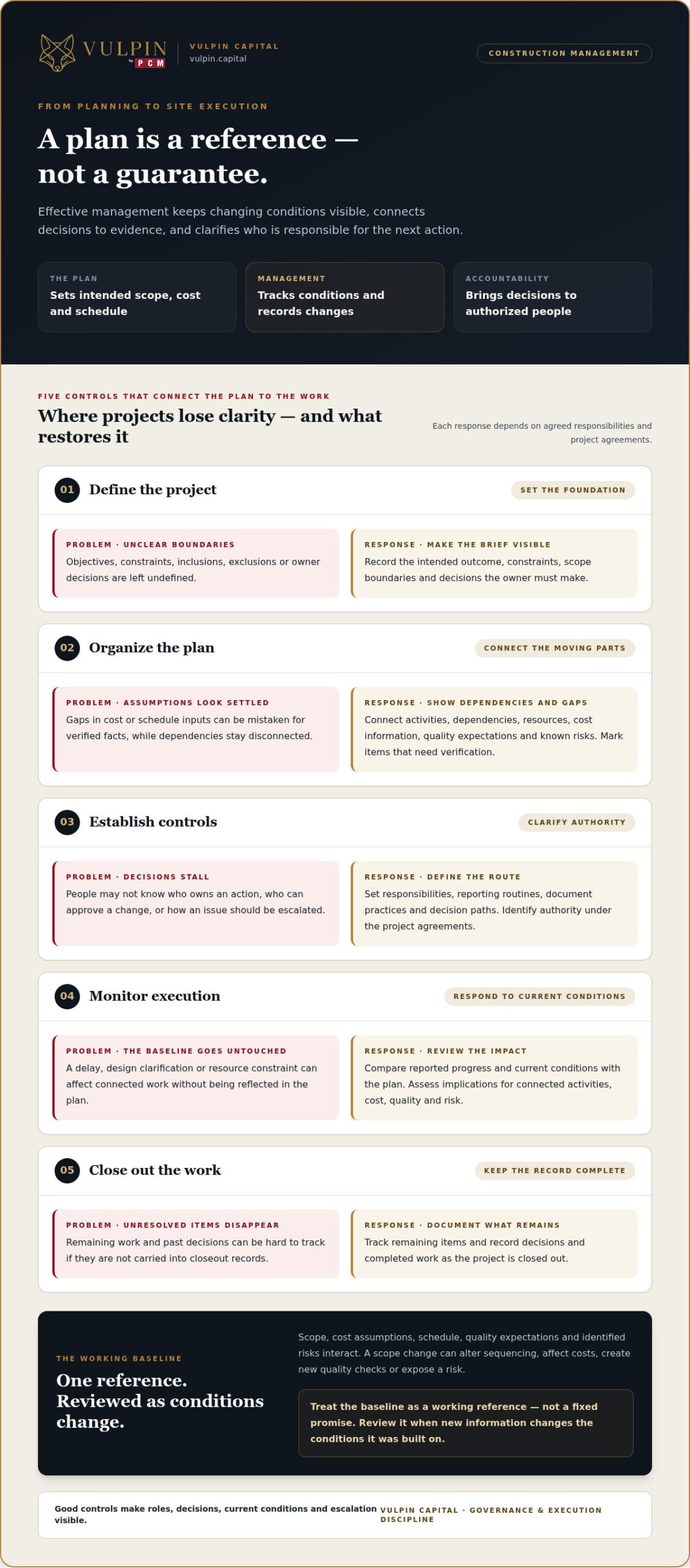
Planning becomes useful when it shapes decisions during the work, not when it sits untouched in a file. A project baseline brings scope, cost assumptions, schedule, quality expectations, and identified risks into one reference point. These elements interact: a scope change can alter sequencing, affect costs, create new quality checks, or expose a risk that was not previously material.
A project baseline is a working reference, not a fixed promise. Review it when new information changes the conditions it was built on. This helps owners understand what has changed, why it matters, and which decision is required next.
What happens before construction begins?
Before site execution, the owner and project team need a shared record of objectives, scope boundaries, responsibilities, assumptions, and decision rights. Cost and schedule inputs can then be organized against the defined work, with assumptions and unresolved items made visible rather than treated as settled facts. For construction management Toronto searches, it is especially useful to distinguish an estimate or target used for planning from a guaranteed result.
- Define the project. Record the intended outcome, constraints, scope inclusions and exclusions, and the decisions the owner must make.
- Organize the plan. Connect work activities, dependencies, resource needs, cost information, quality expectations, and known risks. Mark gaps that require verification.
- Establish controls. Set responsibilities, reporting routines, document practices, and the route for decisions and escalations. Identify which parties have authority under the project agreements.
- Monitor execution. Compare reported progress and current conditions with the plan. Assess how a delay, design clarification, or resource constraint may affect connected activities, costs, quality, or risk.
- Close out the work. Track remaining items, record decisions and completed work, and assemble the project information needed for handover, as defined by the agreements.
How are construction changes governed?
Record a proposed change before it becomes an untracked assumption. The record should identify what is changing and why, the known or potential effects on scope, cost, schedule, quality, and risk, and who has authority to approve it. Once authorized through the applicable process, update project records and forecasts. The cost overrun governance framework explains why cost decisions need evidence and accountable review.
Issue logs and regular reports make emerging conditions easier to address. An issue entry should name the matter, its status, the responsible party, the next required decision, and any dependencies. A report should distinguish confirmed information from forecasts and open questions. This gives the owner a usable record without implying that every issue can be resolved immediately.
Management has limits. A project team can coordinate submissions, track outstanding responses, and show how an approval affects the plan. It cannot decide for an external authority or guarantee when that authority will respond. PCMNow Project Management applies governance and execution discipline to complex construction and development projects. Learn more about PCMNow Project Management and how it connects planning controls with ongoing project decisions.
Construction Management Approaches: Compare Controls, Not Promises
Compare management approaches by the controls an owner can observe, not by claims of an on-time or on-budget result. A promise describes an intended outcome. A control shows how scope, cost information, decisions, and emerging conditions are tracked. Neither a detailed dashboard nor a reporting schedule removes uncertainty from construction.
For construction management Toronto searches, look for a process that makes responsibilities and project conditions clear. The comparison below contrasts loosely defined practices with documented controls. It is a way to assess how a management approach works, not a prediction of project performance.
| Control area | Loosely defined approach | Documented, governed approach |
|---|---|---|
| Scope clarity | Work is described broadly, with boundaries and assumptions difficult to trace. | Scope, exclusions, assumptions, and unresolved items are recorded and kept visible as the work develops. |
| Reporting | Updates rely on general progress statements, with limited distinction between confirmed facts and forecasts. | Reports show status, open issues, next actions, and relevant changes against the project’s current reference information. |
| Change control | Changes may proceed through informal conversations, leaving their rationale or effects unclear. | Proposed changes are documented, their known impacts assessed, and authorization recorded under the project’s agreements. |
| Decision accountability | It may be unclear who can decide, who must provide input, or how an unresolved matter is escalated. | Decision roles and escalation paths are defined, with decisions and outstanding actions recorded. |
Which controls help owners evaluate a management approach?
Look for named responsibilities, decision records, regular cost visibility, and a clear escalation route. Cost information is more useful when its basis, assumptions, and changes can be followed over time than when it is presented as a single unquestioned figure. Where a project structure includes an independent cost review, it can provide another perspective on assumptions and proposed changes. It does not make an estimate infallible or prevent overruns. Controls support examination and response; they do not dictate the outcome.
Risk management works the same way. A disciplined process can identify risks, assign follow-up, track changes, and support mitigation decisions. Conditions can still shift, and some uncertainty remains outside the manager’s control. Treat claims such as “on time” or “on budget” as intended outcomes, not evidence of how accountability will work if circumstances change.
What technology can and cannot prove
Building Information Modeling (BIM), when used on a project, can help coordinate design information and make potential conflicts easier to examine. Digital records and dashboards can organize updates and show what has been entered into the system. They do not independently verify site conditions, establish that information is current, or prove that a decision was approved by the right authority.
The useful test is the link between information and action: who supplied it, when it was reviewed, what decision followed, and where that decision is recorded. Technology can support that chain. Governance makes it accountable.
How Owners Can Set Up Effective Construction Management
Owner readiness starts with decisions made before project activity makes them urgent. A useful management structure needs more than a broad objective or a target date. It needs defined outcomes, visible scope boundaries, named decision-makers, and reporting that shows what is confirmed and what remains open. These foundations turn oversight into an operating discipline rather than a series of last-minute reactions.
What should owners define before engaging management?
Write down the intended project outcomes and the limits of the work. Identify who can approve scope changes, who provides technical input, and who must be informed before a decision proceeds. Record assumptions and open questions separately from verified information. They are items for review as evidence develops, not facts to build silently into the plan.
- Objectives: State what the project must accomplish and which priorities guide trade-offs.
- Scope boundaries: Describe included work, exclusions, constraints, and items awaiting definition.
- Governance roles: Name decision-makers, contributors, approval authority, and escalation routes.
- Update cadence: Set how often stakeholders need progress reporting and decision updates, with room for prompt escalation when a material issue arises.
- Change records: Decide how proposed changes, their rationale, expected effects, and authorization will be documented.
These decisions establish a working framework without pretending every detail is known at the outset. Review assumptions as designs, site information, and other evidence develop. If project viability itself is still being tested, the VULPIN Check governance standard is a separate resource for understanding how predefined evidence can inform whether resources should be committed. It is not a substitute for ongoing project management.
How should owners assess project reporting?
A useful report lets the owner see the project’s present condition and the decisions needed next. It should distinguish verified information from forecasts and make material changes clear. A polished status label is not enough if the underlying variance, responsible party, or next action is unclear.
- Status: Show what work is reported as complete, in progress, or unresolved, with the basis for that status.
- Variances: Explain differences from the current plan and identify potential effects on scope, cost, schedule, quality, or risk.
- Accountability: Assign each open issue or decision to a responsible owner, without blurring authority under project agreements.
- Next steps: Record the action, required decision, and date for follow-up.
Use the report to test whether an estimate has changed, an approval is pending, or completed work has been documented. These are different conditions and should not be collapsed into a single reassuring summary. PCMNow Project Management brings governance and construction-cost reality to complex construction and development projects. Explore PCMNow Project Management for disciplined oversight and accountable execution.
PCMNow Project Management: Governance Applied to Construction Execution
PCMNow Project Management is VULPIN Capital’s management service for complex construction and development projects. Its premise is direct: execution needs governance, not confident language about outcomes. Scope, cost information, decisions, and delivery conditions must remain connected as work advances. For owners searching for construction management Toronto, this means treating forecasts as working information that can change, not as guarantees.
PCMNow emphasizes construction-cost reality and disciplined execution. A project budget is useful only when its assumptions and changes remain visible. A schedule is useful only when dependencies and emerging conditions are understood. Management brings these facts into project decisions so owners can assess what is known, what needs attention, and what requires authorization. It cannot control every site condition, secure external approvals, or guarantee a particular cost, schedule, or result.
How does PCMNow emphasize disciplined execution?
Governance gives a project a decision structure. Visibility gives the owner a clearer view of its current state. Documentation preserves the reasoning behind decisions and changes. Together, these priorities connect planning to execution without confusing reporting with control over every outcome.
If a new condition affects planned work, the question is not simply whether the schedule remains unchanged. The project team needs to understand what information is verified, which activities may be affected, what decisions are required, and how the cost and schedule outlook should be reassessed. PCMNow’s approach keeps those considerations within the management process. It does not make a forecast certain or remove project risk.
The VULPIN Check has a different purpose. It uses predefined proof of project viability before resources are committed. That is a separate viability process, not construction management and not a guarantee of construction performance. Evidence supporting a decision to commit resources cannot assure how the project will proceed once work begins.
PCMNow Project Management also supports FoxyHome by PCMNow, a structured real-estate partnership exclusively for Toronto homeowners with a detached house. The homeowner contributes land to a Limited Partnership and retains a proportionate equity stake in the newly built, income-producing asset. The standardized, pre-engineered architectural kit converts an aging single-family home into a modern multi-family rental property, such as a six-plex. FoxyHome is not a traditional custom builder.
FoxyHome manages zoning, institutional financing, construction, and property management. Its standard builds integrate high-performance insulation, energy-efficient appliances, and optimized HVAC systems. The homeowner’s family receives a fully furnished relocation home during construction. The stated timeline is 9-12 months from contract signing to move-in, including 4-6 months of construction, subject to site conditions and external municipal cooperation, including City Hall processing queues, utility connection backlogs, and municipal fee disputes. Final occupancy dates are not fixed.
Proceeding depends on site-specific assessment, including lot dimensions, location suitability, and significant existing equity. The process moves from assessment to a detailed Pro Forma, then to review by the homeowner’s independent real-estate and corporate lawyer. Homeowners must retain their own legal counsel, and no agreement is signed until the lawyer has reviewed and approved the transaction. The partnership model mitigates many risks associated with custom infill development, but it does not eliminate all risk.
What should a first discussion establish?
A useful first discussion clarifies the project context and the questions that shape its management needs. Owners can prepare by outlining:
- Objectives: The intended project outcome and the priorities that guide decisions.
- Current position: What has been decided, what work or planning is underway, and which assumptions remain open.
- Constraints: Known dependencies, timing considerations, cost information, and unresolved matters that could affect execution.
- Decision structure: Who holds authority, who contributes information, and how decisions or issues are escalated.
These points create a practical starting record. Scope and management needs depend on the project, so distinguish verified facts from expectations and identify where further evidence is needed. That is more reliable than beginning with an assumed cost or delivery promise.
For a measured view of PCMNow’s governance-first approach to construction execution, explore PCMNow Project Management.
Make the Next Project Decision Deliberate
Decide what the project needs from its management structure before pressure narrows the options. Set a clear standard for how decisions will be examined, documented, and revisited as conditions change. That standard gives owners a stronger basis for acting without pretending uncertainty can be engineered away.
For complex construction and development projects, PCMNow Project Management applies governance to execution. VULPIN Capital emphasizes construction-cost reality and disciplined execution, keeping decisions grounded in project conditions rather than attractive but untested assumptions.
Construction management Toronto is most useful when accountability is built into the work from the start. If your project needs disciplined oversight, explore PCMNow Project Management.
Clear governance does not remove every obstacle. It helps you meet the work with better information and a firmer footing.
The website and educational materials are for educational and illustrative purposes only, do not constitute a financial guarantee, legal agreement, or offer of securities, and all projects are subject to property-specific appraisals, zoning, municipal approvals, and institutional financing terms. Projections on equity, construction costs, and rental income are preliminary and vary by property. No agreements are finalized until the homeowner’s independent legal counsel has reviewed and approved the transaction.
Frequently Asked Questions
What does construction management include?
Construction management can include coordinating planning, communication, project information, and execution oversight, according to the agreed scope. For example, the manager may organize design inputs and flag when a decision is holding up a dependent task. The project documents determine who can direct work or authorize changes. Read the management arrangement alongside other project agreements so responsibilities and decision authority are clear.
When should I engage a construction manager?
Consider engaging a construction manager when coordinating people, decisions, or interdependent work becomes difficult. Early involvement can help establish how information will be shared and who must resolve open questions before they affect active work. If design decisions and procurement planning are advancing together, for instance, clear decision ownership can help surface dependencies. Timing depends on project readiness and agreed duties, and the owner remains responsible for decisions assigned to them.
Can construction management guarantee a project will finish on time and on budget?
No. Construction management cannot guarantee that a project will meet every schedule or cost forecast. A specified material may become unavailable, a site condition may differ from an assumption, or a scope decision may change the sequence of work. The useful response is to record the change, assess its implications, and update relevant forecasts. Treat dates and cost projections as planning information that requires review, not as assured results.
How does construction management help control project costs?
It helps owners examine cost information by connecting it to the defined scope, assumptions, and changes. For example, a proposed material substitution can be recorded with its rationale and potential cost implications before the owner considers authorization. Estimates still depend on their detail and evidence. Reporting changes and variances supports informed scrutiny, but it cannot guarantee a final cost or prevent every overrun.
Is construction management the same as project management?
The terms can overlap, so the service description alone does not define what a role covers. One arrangement may focus on coordinating construction activities, while another may include broader planning or delivery responsibilities. Compare written scopes for assigned duties, decision authority, reporting expectations, and how the role interacts with the owner and other parties. Those details are more useful than assuming two services are equivalent because they share a label.
What should a construction management status report show?
A useful report distinguishes completed work from work reported as underway, and confirmed information from forecasts or unresolved matters. It should show which decisions are outstanding, who is responsible for the next action, and when follow-up is due. If a report marks an issue “resolved,” the supporting record should make clear what changed or what decision closed it. A dashboard entry alone does not verify site conditions.
Does construction management eliminate construction risk?
No. Management can support risk identification and mitigation, but it cannot eliminate every uncertainty. A documented dependency may still be affected by a decision or approval outside the manager’s authority. Owners can strengthen oversight by tracking who is handling each risk, what evidence is available, and when the issue needs review. A credible process makes exposure visible rather than pretending it cannot change.