

A commercial build depends on sound decisions, not optimism. Hiring a project manager for a commercial build means assigning someone to coordinate planning, procurement and execution, including contractor bidding and materials and equipment procurement. Their work keeps the budget, schedule and quality requirements in view from early planning through delivery.
That coordination matters because design choices, procurement and site work are interconnected. A delay or change in one area can affect the others, so clear responsibilities and documented decisions give business owners a stronger basis for oversight.
This guide explains what commercial construction project management involves, how responsibilities are shared and what to consider when deciding whether to hire a project manager. It covers how feasibility work, planning and procurement support cost control, scheduling and quality assurance, so you can understand the role before committing to a build and know what effective oversight should include.
Key Takeaways
- Separate the owner-side project manager’s oversight role from the contractor’s responsibility for delivering the work on site.
- Map procurement, planning and execution responsibilities early so decisions and handoffs are clear.
- Use a documented budget, schedule and quality process to track changes and identify pressure points before they disrupt delivery.
- Bring project management into planning when a build’s scope, coordination demands or operational impact exceed the owner’s capacity to manage directly.
- Use the VULPIN Check to assess project viability before committing to a commercial build.
What is Commercial Construction Project Management?
Commercial construction project management coordinates decisions from early planning through construction. The project manager connects the owner’s requirements with design, procurement, contractors, budget, schedule and quality controls.
Client-Side and Contractor Roles
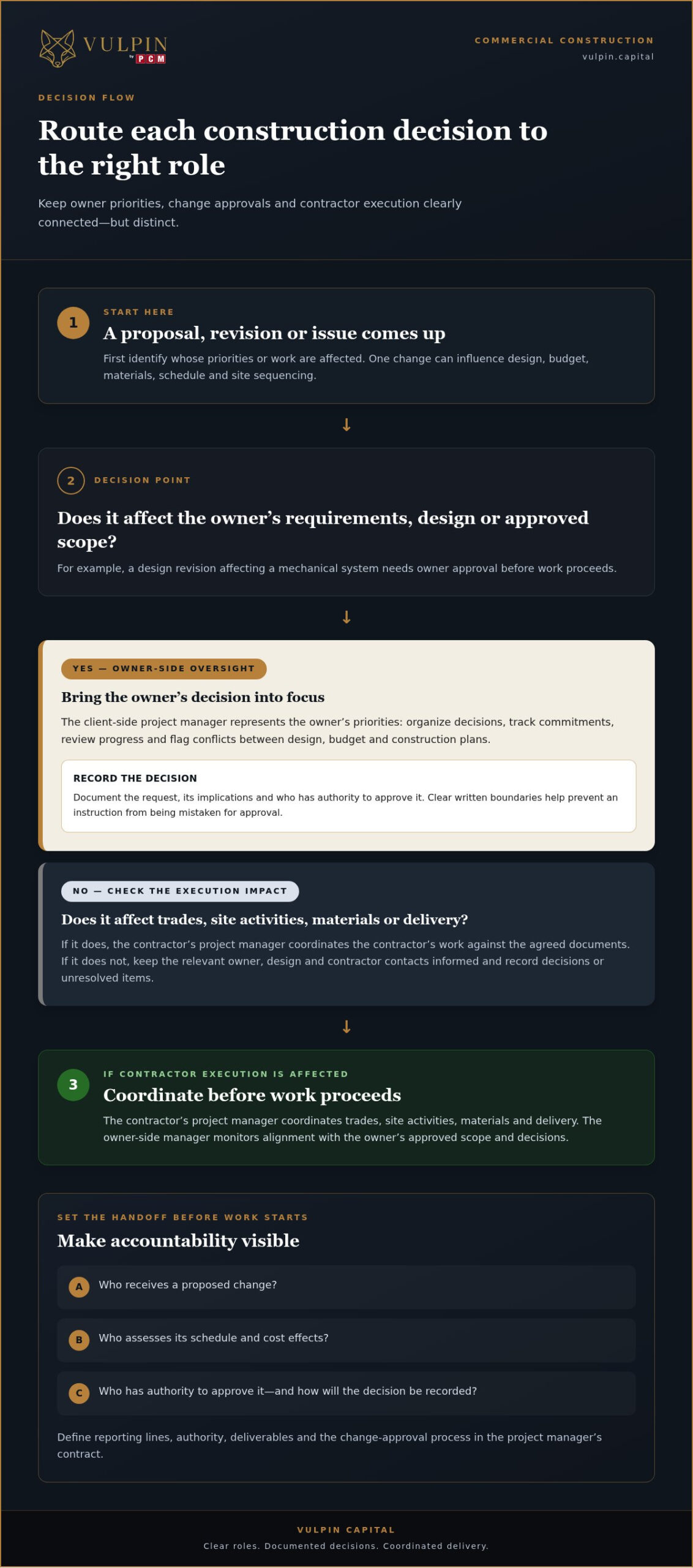
A client-side project manager represents the owner’s priorities. They organize decisions, track commitments, review progress and flag conflicts between the design, budget and construction plan. The contractor’s project manager coordinates the contractor’s work, including trades, site activities, materials and delivery against the agreed documents. For example, a design revision affecting a mechanical system needs the owner’s approval and the contractor’s coordination before work proceeds.
Hiring the wrong project manager can lead to missed coordination, unclear accountability, unmanaged changes and decisions that do not reflect the owner’s requirements. Look for relevant commercial-build experience and a clear process for documenting decisions, reporting progress and escalating issues.
Budgeting and Cost Control
Cost control starts with a defined scope and a budget organized by project component. The project manager tracks estimates, commitments, approved changes and forecast costs against that baseline. If a proposed finish exceeds its allowance, the owner can consider alternatives before procurement rather than discovering the impact during installation.
Value engineering compares design options based on function, durability and cost, rather than automatically choosing the lowest initial price. For example, changing a specified material may reduce the purchase price but introduce maintenance or performance trade-offs. The project manager records the options and their implications so the owner can make an informed decision.
Project Manager and General Contractor Roles
A project manager oversees coordination and project objectives; a general contractor organizes and performs construction work under its contract. Depending on the delivery structure, the contractor may also assign its own project manager. That person manages the contractor’s execution, while an owner-side manager represents the owner’s interests and monitors alignment with the approved scope and decisions.
Clarify reporting lines before work starts. Identify who receives a proposed change, who assesses its effects on schedule and cost, and who has authority to approve it. Written boundaries reduce the risk of an instruction being mistaken for approval or of both parties assuming the other is responsible for a decision.
Bidding, Procurement, and Hiring Costs
During procurement, commercial construction project managers typically invite contractor bids and coordinate the sourcing of materials and equipment. A disciplined process defines the scope, issues consistent bid documents, compares submissions against the same requirements and records the selection decision. Once procurement begins, lead times and delivery coordination need to align with the construction schedule.
In Canada, the cost of hiring a project manager depends on the project’s scope, duration and complexity, as well as whether the role is salaried or contracted. Service fees vary by engagement. Hiring a project manager for a commercial build is most useful when the owner needs structured oversight across connected decisions.
Commercial construction project management responsibilities
The project manager coordinates procurement, planning and execution, keeping decisions moving between the owner, design team and contractor. The role is practical: establish who is responsible, what information is needed and how each decision will be recorded.
Construction Execution and Stakeholder Communication
During construction, the project manager tracks work against the approved drawings, schedule and scope. They coordinate updates among the owner, consultants, contractor and trades, and record decisions and unresolved items. For example, a change to a tenant’s layout can affect electrical work, material orders and sequencing. A clear change record links the request to its impacts and identifies who has authority to approve it.
Permits, Zoning, and Code Compliance
For permits, zoning and code compliance in Canada, the project manager coordinates information from the design team and tracks submission requirements and review comments. They can organize responses and identify how a requested revision affects drawings or construction planning. Municipal authorities and qualified design professionals retain their respective approval and professional responsibilities. The manager coordinates and documents the process but does not replace those authorities.
Qualifications depend on the work and responsibilities assigned. Statistics Canada says construction managers usually need a university degree in civil engineering or a college diploma in construction technology. Assess relevant commercial experience, project controls, communication and documentation skills alongside education. Any licence or certification expectations should match the role’s actual duties and jurisdiction.
A project manager’s contract should define the scope, authority, reporting, deliverables, fee basis, duration and change-approval process. It should also specify record-keeping, meeting expectations and terms for ending or changing the engagement. These details clarify whether the manager advises, coordinates or has delegated approval authority before construction begins.
Use a deliberate hiring process: define the project’s needs, set the manager’s authority, assess relevant experience, review the proposed work plan and agree on contract terms. These are examples of advertised opportunities, not a universal salary scale.
Commercial construction project management services can include procurement coordination, planning, execution tracking, and stakeholder reporting. Owners seeking structured oversight can consider PCMNow Project Management as part of that process. The operating plan should name the decision-makers, reporting path, and records used to track each commitment.
Recent postings show a range of commercial and related roles. National listings highlight opportunities for mechanical project managers, construction project managers, senior project managers, and corporate real estate project managers across various industries. Job boards and professional networks consistently feature hundreds of commercial project manager roles nationwide.
Job titles and locations can help candidates compare the kinds of projects employers are hiring for, while the filter range gives a broad reference point rather than a guaranteed salary for any individual role.
Budget, schedule, and quality assurance
A commercial project manager keeps three controls connected: approved spending, planned sequencing and defined quality expectations. Construction changes can affect all three. A late equipment decision, for example, may change a purchase commitment, delay installation and require revised coordination. The manager makes those effects visible before the owner authorizes the change.
Budget control starts with a documented baseline tied to the project scope. The manager tracks estimates, contract commitments, invoices, approved changes and forecast costs in a consistent record. If a mechanical system changes, the cost review should include the equipment, related labour and any affected work. The owner can then compare the revised forecast with the approved budget before deciding.
Schedule control depends on sequencing, procurement and coordination. A project manager maps activities such as design approvals, equipment orders, delivery, installation and inspections. If a delivery date shifts, the manager identifies dependent tasks that need adjustment and communicates the effects. A schedule is useful only if it reflects actual decisions and constraints, not just a target date.
Quality assurance also needs defined records and checkpoints. The owner and project team should establish what documents demonstrate that installed work matches approved drawings and specified materials. For example, a review before closing a wall can identify a coordination issue while the relevant components remain accessible. The manager tracks observations, assigns follow-up, and records resolution through the project’s agreed process.
- Budget: Compare current commitments and forecast costs with the approved baseline.
- Schedule: Track dependencies, procurement decisions, and changes to planned sequencing.
- Quality: Record reviews, deficiencies, assigned actions, and their resolution.
- Change control: Document the request, impacts, decision-maker, and approval before implementation.
These controls matter at different scales. A Greater Toronto Area institutional construction project manager vacancy describes projects valued at approximately $20 million to $100 million. That project value illustrates why owners need a reliable method for connecting decisions, commitments, and reporting. The appropriate controls still depend on the project’s scope and delivery structure.
Use a regular reporting cycle to bring the three control areas together. Each update should show budget changes, schedule adjustments, open quality items and decisions awaiting approval. A tenant-requested layout revision, for example, can be reported alongside its cost review, affected work sequence and required drawing updates. The owner can then see the trade-offs in one record instead of receiving disconnected updates.
No report eliminates project risk. It gives the owner a documented basis for decisions and a way to spot emerging conflicts. Before work proceeds on a material change, record its cost, schedule and quality implications, then document the authorized decision.
Project kickoff and planning
A commercial project kickoff turns the owner’s objective into a sequence of decisions, documents and responsibilities. Start by defining the intended use, operational needs, scope boundaries, decision-makers and approval process. For example, a business planning a new workspace should identify required rooms, equipment and access needs, as well as how construction could affect operations. These details give the design team a clear brief.
Next, the project manager can coordinate feasibility work before design commitments become fixed. Commercial construction site investigations may assess soil conditions, environmental impact and historical integrity. The findings help the team understand site constraints and identify information that could affect design or execution. A site with uncertain soil conditions, for instance, may need further assessment before the foundation approach is settled.
Planning may also include feasibility studies, schematic design sketches and floor plans before contract documents are prepared. A project manager brings the owner’s requirements into these early discussions and records choices that affect space, function and construction scope. For example, a floor plan placing a receiving area near storage makes an operational requirement clear before detailed documents define the work.
Use the kickoff to establish a working plan that answers practical questions:
- Scope: Which spaces, systems, and owner-supplied items belong in the project?
- Authority: Who can approve design decisions, changes, and commitments?
- Information: Which drawings, site assessments, and operational details must inform planning?
- Coordination: How will the owner, design team, and construction team share decisions?
- Sequence: What must be resolved before procurement or contract documents proceed?
These steps create a decision record, not just a meeting agenda. If the owner changes a room’s function after schematic planning, the team can identify affected drawings and revisit the scope before advancing the documents. Recording the reason, decision-maker and affected work helps prevent conflicting instructions from carrying into later stages.
Before construction begins, use the plan to connect design development, procurement and execution. The project manager can organize outstanding questions, assign responsibility and track how each resolved item affects the next task. For example, a decision about equipment dimensions may need to come before the room layout is finalized. This sequence makes dependencies visible and gives the owner a clear basis for moving the project forward.
When should I hire a project manager for a commercial build?
Bring project management into the process when planning decisions start competing with your operating responsibilities. Ideally, engage a manager before design, procurement and construction commitments begin to overlap. In early planning, they can help organize the scope, responsibilities and decision paths before those choices become difficult to change.
Consider the role when a project involves several connected workstreams or stakeholders. A new commercial space may bring together an owner, designers, contractors, equipment suppliers and future occupants. If a room change affects mechanical layouts, purchasing and operations, someone needs to coordinate the decision across those parties. That is a clear case for hiring a project manager for a commercial build.
Your capacity as the owner is another practical test. If you cannot consistently review drawings, track decisions, coordinate meetings and resolve questions while running the business, project oversight may be under-resourced. A delayed response about equipment placement, for example, can leave the design team and contractor working from different assumptions. A project manager assigns ownership to those decisions and provides a documented process for resolving them.
Timing matters. Engage the manager before contract documents and procurement lock in major choices. At that stage, the manager can help structure project requirements, coordinate feasibility work and identify dependencies. Bringing someone in after construction starts can still support coordination, but they must first understand existing commitments, open changes and reporting arrangements.
A dedicated manager may be less necessary for a small, straightforward scope if the owner has the time and relevant experience to direct the work. The decision depends on the coordination burden, operational disruption, technical interfaces and the owner’s ability to make timely decisions. A simple interior refresh with few trades differs from a build involving specialized equipment and multiple design disciplines.
Before engaging a manager, define the assignment in writing. Specify the project phase, expected deliverables, authority limits, reporting method and process for handling changes. Assess experience against the actual scope, not just a job title. Ask to see a sample project schedule or reporting format, and use a realistic scenario to understand how the candidate would document a delayed decision or conflicting instruction.
Use this sequence to make the decision:
- Define the project scope and owner’s operational requirements.
- List the decisions, stakeholders, and coordination tasks requiring oversight.
- Identify which responsibilities the owner can manage consistently.
- Set the manager’s authority, reporting expectations, and project phase.
When the owner needs structured oversight across planning and execution, explore project management support as a next step.
VULPIN Capital: The VULPIN Check
VULPIN Capital offers The VULPIN Check to help owners assess whether a commercial build is viable before committing to execution. It provides a structured next step when you need to examine the project’s foundations, assumptions and fit with long-term asset goals.
As a project moves toward delivery, PCMNow Project Management provides disciplined oversight of execution. The right next step depends on your immediate need: assess viability first or establish management for project delivery. These are distinct stages, and neither replaces a defined scope, budget and decision process.
Bring your project objectives and current planning assumptions to the next conversation. Visit vulpin.capital to learn more about The VULPIN Check and VULPIN Capital’s project management offering.
Set the Next Decision in Motion
A commercial build needs a decision framework that remains useful after the initial plans are drawn. Before advancing, identify the assumptions you rely on, the decisions still open and who is accountable for each. That gives your next discussion a clear purpose: test the project’s direction and establish what needs to happen before commitments deepen.
Hiring a project manager for a commercial build is one part of that decision. The right support depends on whether your immediate need is to assess project viability, oversee execution or both. VULPIN Capital offers The VULPIN Check, PCMNow Project Management and The Fox. Consider which offering fits the decision in front of you rather than treating every project need as the same task.
Bring your build objectives and current plans into a focused conversation. You can contact VULPIN Capital about your build and decide on a considered next step. Clear decisions now give the project a firmer foundation for what follows.
Frequently Asked Questions
What does a project manager do on a commercial construction project?
A project manager coordinates the people, information and decisions needed to move a build forward. They can maintain a decision log, assign follow-up items and connect owner approvals to design and construction documents. For example, if an owner changes a reception area, the manager can track which drawings need revision and ensure the contractor receives the approved direction rather than an informal request.
How do I find and vet commercial construction project managers in Canada?
Assess candidates against the project’s building type, responsibilities, and delivery needs. Statistics Canada says a university degree in civil engineering or a college diploma in construction technology is usually required for construction managers. Ask candidates to describe comparable commercial work and explain their reporting approach. A useful review exercise is to discuss a sample project scenario and assess how clearly they identify decisions, owners, dependencies, and records.
Should I hire an independent construction project manager or use the general contractor’s project manager?
Choose based on whose interests need direct representation and what authority the role requires. A general contractor’s project manager coordinates that contractor’s construction delivery. An independent, owner-side manager can focus on the owner’s requirements and provide a separate reporting line. Some projects use both roles. Define their boundaries in writing, including who communicates changes, assesses their effects and has authority to approve decisions.
How can I assess a project manager’s experience with budgets, schedules, and change orders?
Ask the candidate to walk you through how they would manage a sample change, from request to documented decision. Look for a clear explanation of how they record the original scope, assess cost and schedule effects, identify required approvals and update project records. You can also review a redacted reporting example or ask how they would flag a forecast variance before it becomes a commitment. Specific methods matter more than broad claims.