

The best construction delivery method depends on what your project needs most: design input, budget control, speed or shared responsibility. Selecting the right construction delivery method means weighing those priorities against project risks, rather than assuming one model fits every build. Progressive design-build develops the design and refines the budget with one team before the owner commits to a final construction price; CMAR brings a construction manager into design early and can set a guaranteed maximum price; IPD aligns key participants through shared decisions and risk.
Cost matters, but it is only part of the decision. The contract structure also determines when the owner makes key commitments, how much control remains over design choices and who bears the consequences when plans or costs change.
This comparison explains how progressive design-build, CMAR and IPD differ in cost, control, schedule and risk. It also compares them with other common delivery models and offers a practical decision guide to help match the method to your project’s complexity, resources and tolerance for uncertainty. The aim is to make a sound, deliberate choice before the contract structure starts shaping the work.
Key Takeaways
- Progressive design-build lets the owner select a qualified team before the design and budget are fully developed, with approval gates before final price commitment.
- Design-bid-build keeps design and construction in separate, sequential phases; it can suit straightforward projects but may constrain schedule flexibility.
- CMAR brings construction input into design early and can establish a guaranteed maximum price, while adding a construction manager’s fee and a key point of project dependence.
- IPD aligns the owner, designer, contractors and suppliers around shared decisions and risk, making strong coordination essential.
- Compare each method against your project’s complexity, schedule, budget certainty, desired control and capacity to manage risk before choosing a contract structure.
Why Choose Progressive Design-Build?
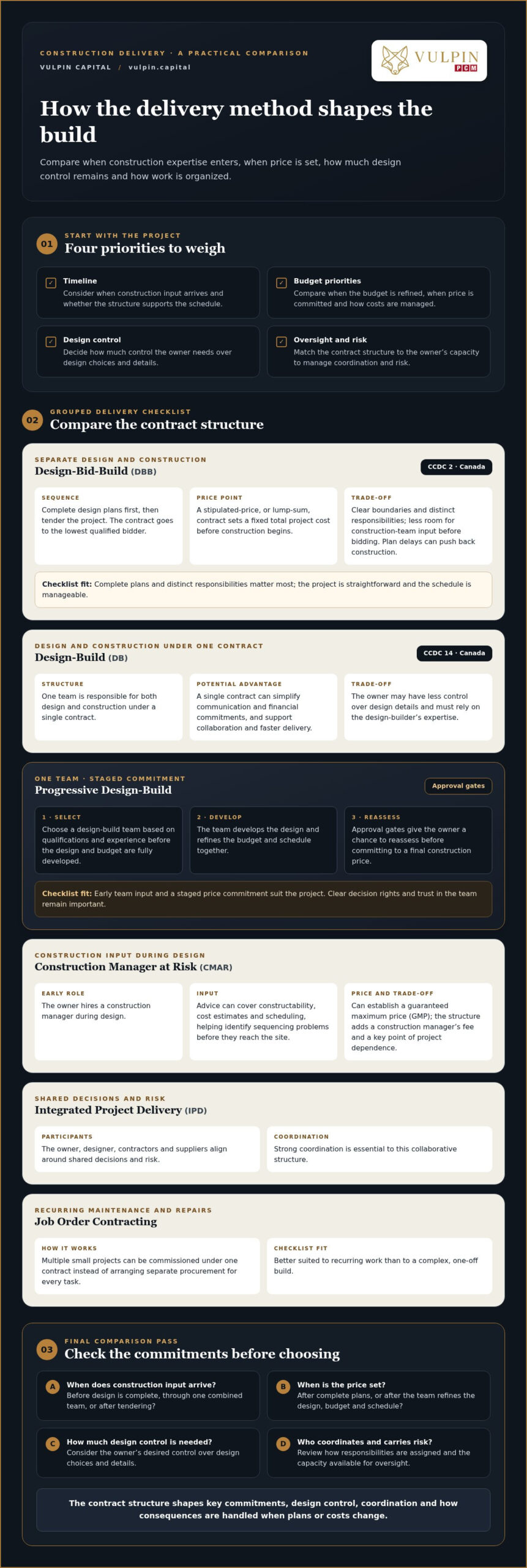
Progressive design-build suits owners who want contractor input before fixing the design and construction price. The owner selects a design-build team based on qualifications and experience. The team then develops the design and refines the budget and schedule. Defined approval gates let the owner reassess before committing to a final construction price.
That sequence differs from Design-Bid-Build (DBB). In DBB, the owner first hires an architect or designer to complete the project plans. The project is then tendered, and the contract goes to the lowest qualified bidder. Design and construction remain separate, sequential phases. Construction generally begins only after the design is complete, so delays in finalizing plans can push back the start of work.
In Canada, CCDC 2 is the standard stipulated-price contract identified for DBB projects. A stipulated-price, or lump-sum, contract sets a fixed total project cost before construction begins. It requires complete design documents before tendering. This can give owners clear contractual boundaries and a defined price, but it leaves less room to refine the design with the construction team before bidding. Separate design and construction teams may also reduce conflicts of interest. For a straightforward commercial build with complete plans and a manageable schedule, DBB can be a sound fit.
Design-Build (DB) places design and construction under one contract with one team. CCDC 14 is Canada’s stipulated-price contract form for design-build projects. One contract can simplify communication and financial commitments. It also puts design and construction coordination within the same team, which can support collaboration and faster delivery. The trade-off is owner control: the owner may have less control over design details and must rely on the design-builder’s expertise.
Progressive design-build keeps a single-contract structure while changing when key decisions happen. Instead of tendering completed plans for a fixed price, the owner selects the team first. The team develops the design, budget and schedule together, then presents them at approval gates. This gives the owner a chance to reassess before committing to a final price. It is useful when early collaboration matters, but it still requires clear decision rights and trust in the team.
| Option | Contract structure | Price and design timing | Key trade-off |
|---|---|---|---|
| DBB | Separate design and construction | Complete plans precede tender | Clear boundaries, sequential phases |
| Design-Build | Single contract for both | One team coordinates design and construction | Simpler communication, less owner design control |
| Progressive design-build | Single contract with approval gates | Team refines design, budget and schedule before final price | Early collaboration, staged commitment |
Choose DBB when complete plans and distinct responsibilities matter most. Choose progressive design-build when early team input and a staged price commitment better fit the project.
Which Delivery Method is Best for Your Project?
The project delivery method shapes who holds each contract, when construction input arrives and how risk is allocated. Compare the structure with your timeline, cost priorities and capacity for oversight.
Delivery Method Effects on Project Outcomes
Design-Bid-Build separates design from construction, giving owners distinct responsibilities but limiting contractor input until plans are ready. Design-Build combines design and construction under one contract, which can support faster coordination but requires trust in the design-builder. CMAR brings a construction manager into design early, while IPD aligns participants around shared decisions and risk. Each structure affects communication, disputes, quality reviews and budget control differently.
Job Order Contracting takes another approach for maintenance and repairs. It lets owners commission multiple small projects under a single contract instead of arranging separate procurement for every task. This structure suits recurring work better than a complex, one-off build.
Early Contractor Involvement in Planning and Design
Under CMAR, the owner hires a construction manager during design to advise on constructability, cost estimates and scheduling. Early input can reveal sequencing problems before they reach the site and help align design choices with trade work. Design-Build also brings construction expertise into design, but through a single team responsible for both functions.
Preconstruction input can help owners evaluate options before settling on a contract type or delivery method. For example, a proposed fast-track schedule may require phased construction and early procurement. Contractor advice can reveal whether the design and schedule support that sequence, instead of leaving the issue until bidding.
Procurement Rules for Construction Delivery
Canada has no single procurement route that applies identically to every construction project. Public-project procurement follows the owner’s applicable requirements and project documents; liability, bonding and insurance requirements can vary by jurisdiction and delivery method. Those documents establish how teams are selected and how responsibilities are assigned.
Canadian Construction Documents Committee forms distinguish contract structures: CCDC 5A covers construction management services, while CCDC 5B covers construction management services and construction. CCDC 11 is the standard contractor pre-qualification document. Job Order Contracting is often used for maintenance and repair work, allowing multiple small projects under one contract.
Typical Costs and Fees by Delivery Method
There is no single typical fee or total cost for each method. The amount depends on project scope, design completeness, schedule, contract terms and how construction risk is allocated. In DBB, competitive bidding may produce a lower initial project cost, while later design changes can affect the final amount.
CMAR may cost more because of the construction manager’s fees, but early involvement can improve cost control. A guaranteed maximum price can set a budget ceiling with defined contingencies. Design-Build and IPD allocate responsibilities differently, so compare the full contract, inclusions, contingencies and owner-retained risks, not just the initial price.
For a disciplined comparison, record each option’s contract structure, decision rights, schedule flexibility, cost controls and risk allocation. PCMNow Project Management is a relevant next step for owners who need project oversight while weighing those decisions. PCMNow Project Management can be considered as part of that planning.
Construction Manager at Risk (CMAR)
CMAR brings a construction manager into the project during design, then gives that manager responsibility for construction. Its defining controls are early cost and schedule input, an agreed price ceiling and a clear allocation of construction risk.
CMAR and Guaranteed Maximum Price
In CMAR, the construction manager advises on constructability, estimates and scheduling as the design develops. After design is complete, the manager becomes the general contractor and oversees construction. A guaranteed maximum price (GMP) sets a ceiling for the project budget, with contingencies defined for matters such as price escalation, tariffs or design development.
Open-book budgeting gives the owner visibility into costs, and owners may participate in selecting trade partners. The GMP adds cost certainty, but the contract still needs to define exclusions, contingencies and changes. Unlike a stipulated-price contract based on complete tender documents, CMAR brings construction input into design before the final construction price is set.
CCDC 5B is the Canadian construction management contract for services and construction. CCDC 3 is the Canadian cost-plus contract form, also used with a guaranteed maximum price option. The contract form matters: it sets out how services, construction work, payment and the price ceiling fit together.
CMAR Early Collaboration
Early collaboration gives the construction manager a role before the design is complete. The manager can review proposed assemblies, construction sequencing and procurement timing while changes are still part of design development. This input can help the owner identify cost or schedule conflicts before they become site issues.
CMAR can also improve communication between the owner, design team and general contractor through earlier coordination. But the manager becomes a critical point of project performance: a weak estimate, poor coordination or inadequate trade coverage can undermine the project. Owners need defined reporting, review points and decision authority to make early involvement effective.
CMAR is one of several project management and alternative delivery forms. In CM-as-Agent, the manager receives a fee while the owner retains financial control. Under CMAR, the manager later takes construction responsibility, and the contract can include a GMP. Construction Management Multi-Prime (CMMP) differs again: subcontractors hold direct contracts with the owner. This gives the owner direct relationships with trades, but also requires active coordination across those contracts.
Integrated Project Delivery (IPD) also relies on early collaboration, but aligns the owner, architect, contractors and suppliers through shared decisions and risk. CMAR instead centres on the construction manager’s advice and construction responsibility under the agreed contract. For a project with an evolving design, CMAR can suit owners seeking early contractor input and a defined budget ceiling. Projects that require shared stakeholder risk and decision-making may call for another structure.
Integrated Project Delivery (IPD)
Integrated Project Delivery brings the owner, architect, contractors and suppliers into one collaborative process from design through completion. Its defining features are shared decision-making, transparent communication and risk-sharing. IPD is designed around project-wide outcomes, rather than having each participant optimize only their own contract or work package.
The approach starts with participants working together during design, rather than waiting for completed documents before coordinating. For a complex institutional project with a tight schedule, early alignment can help teams resolve design and construction issues together. The structure requires substantial coordination. Each participant must contribute information, make timely decisions and keep project priorities visible as design and work progress.
Shared goals give that collaboration a practical basis. Under IPD and alliance methods, compensation is tied to project cost, schedule and profitability milestones. Participants therefore have a financial interest in meeting agreed project objectives. This differs from a structure where the owner mainly manages separate contracts and each party’s responsibilities remain distinct. IPD links participants’ incentives, but also requires clear agreement on goals and how progress will be assessed.
Risk-sharing is another central distinction. IPD can distribute project risk among stakeholders, encouraging joint problem-solving instead of blame when challenges arise. That does not erase individual responsibilities. The agreement must establish decision authority, communication channels and how shared risks will be handled. Without clear governance, the same interdependence that supports collaboration can make decisions harder to coordinate.
In Canada, CCDC 30 is the standard form of agreement for integrated project delivery. Owners can use it as a framework for defining the working relationship and project commitments among participants. The form supports an integrated approach, but the project still needs deliberate governance. Teams need a common understanding of scope, cost, schedule and the milestones tied to compensation.
IPD differs from CMAR in how responsibilities and incentives are structured. CMAR brings a construction manager into design and can establish a guaranteed maximum price, while IPD focuses on shared decisions and aligned participant incentives. Design-Build uses one team for design and construction, but IPD involves the owner, architect, contractors and suppliers in a broader collaborative process.
Before choosing IPD, assess whether the project is complex enough to justify intensive coordination. Confirm that key participants can engage from design through completion, agree on shared goals and work transparently. If the owner needs distinct contractual boundaries or cannot support joint decision-making, another delivery structure may fit better. IPD is not collaboration by label: its value depends on sustained participation, defined responsibilities and an agreement built around project outcomes.
Comparing delivery methods and their risks
Canada’s delivery methods distribute authority, cost exposure and coordination differently. Before construction begins, compare who controls decisions, carries risk and manages interfaces.
Main Construction Project Delivery Methods
The main construction project delivery methods in Canada include Design-Bid-Build (DBB), Design-Build, progressive design-build, Construction Manager at Risk (CMAR), Construction Management as Agent, Construction Management Multi-Prime, Integrated Project Delivery (IPD), Job Order Contracting and public-private partnerships. Each creates a different relationship between owners, designers, contractors and trade partners.
DBB separates design and construction, then uses bidding once the design documents are complete. Design-Build puts design and construction under one contract; progressive design-build selects the team before the design and budget are fully refined. CMAR adds early construction advice and may include a guaranteed maximum price. IPD aligns project participants through shared goals, while Job Order Contracting is often used for maintenance and repair work.
Risks Across Delivery Methods
Risk follows responsibility. With DBB, separate design and construction teams create clear boundaries, but a fast-track project can face rushed bidding and change orders. Design-Build can accelerate delivery, yet owners may give up some control over design details. CMAR can improve cost and communication controls through early involvement, but the construction manager can become a single point of failure.
IPD depends on strong coordination among all parties, so weak participation can undermine shared decisions. Under Construction Management Multi-Prime, subcontractors contract directly with the owner, increasing the owner’s responsibility for coordinating trade interfaces. Public-private partnerships can be affected by shifts in government priorities. Liability, bonding and insurance requirements can also vary by delivery method.
Use a practical risk screen before choosing a partner:
- Check internal capacity: identify the staff experience and availability for contract oversight, trade coordination and timely decisions.
- Set the control boundary: decide how much direct input owners need over design, trade selection and construction decisions.
- Test schedule pressure: assess whether construction must overlap design, and whether the project can support early procurement.
- Map failure points: identify the parties responsible for design coordination, price control, construction interfaces and changes.
- Assess the market: consider contractor experience and expected competition for the chosen procurement structure.
Selecting the right construction delivery method means matching those risks to the owner’s ability to manage them. For project oversight while weighing responsibilities and controls, explore PCMNow Project Management.
VULPIN Capital: The VULPIN Check
VULPIN Capital’s The VULPIN Check is a next step when you need to assess project viability before committing to a structure. It brings disciplined scrutiny to project assumptions, risks and execution requirements. If the delivery method is set but oversight remains a concern, PCMNow Project Management provides professional management for complex construction and development projects. For sustainable residential housing, FoxyHome offers solutions that integrate modern construction techniques with long-term asset survivability.
These services address different needs. The VULPIN Check supports project evaluation; PCMNow Project Management supports execution; and FoxyHome provides sustainable housing solutions. Choose based on the decision or project requirement in front of you, not on the delivery method’s label alone.
Contact VULPIN Capital or visit vulpin.capital to discuss the next step.
Set the Project’s Decision Framework
Before authorizing procurement, create a short decision record for the project. Name the priorities that cannot change, identify who holds each key decision and document how changes will be assessed. This gives owners and project partners a shared reference when design, schedule or scope choices create pressure. It also makes selecting the right construction delivery method part of project governance, rather than an isolated procurement choice.
VULPIN Capital offers The VULPIN Check to assess project viability, PCMNow Project Management for complex construction and development projects, and The Fox as a framework for asset survivability and decision-making. These may be relevant next steps when you need a disciplined review or project oversight tied to your plans. Start with the decision you need to make and the risks you need to govern.
Contact VULPIN Capital to discuss your project. Move forward with a clear framework and decisions grounded in the project’s priorities.
Frequently Asked Questions
How do design-bid-build, design-build, and construction management compare?
The methods differ in when construction expertise enters the work and how contracts divide responsibility. Design-Bid-Build separates design from construction; Design-Build combines both under one team. Construction management can describe different arrangements: under CM-as-Agent, the owner retains financial control, while CMAR gives the manager construction responsibility after design. CMMP creates direct contracts between the owner and subcontractors, so the owner must coordinate those trade relationships.
How should project owners choose a construction delivery method?
Start by ranking project priorities, then match the contract structure to your ability to manage it. For example, an owner with limited internal coordination capacity may prefer fewer direct trade relationships. An owner who needs contractor advice while plans develop may favour early involvement. Selecting the right construction delivery method also means considering procurement preferences and whether the owner needs direct control over design decisions or trade selection.
What factors affect the choice of delivery method, including scope, schedule, budget, and risk?
Scope complexity, design readiness, schedule pressure, budget certainty and risk tolerance all affect the choice. A straightforward build with complete documents can support a sequential process. A project that needs construction to overlap with design may favour Design-Build or CMAR. Owners should also assess staff experience and availability, expected contractor competition, and the level of oversight they can sustain throughout planning and construction.
How do delivery methods affect project timelines and cost certainty?
Methods that allow design and construction to overlap, including Design-Build and CMAR, can accelerate the overall timeline. Design-Bid-Build generally waits for completed design before construction, which can delay the start. Cost certainty depends on the contract and the design’s maturity: stipulated-price contracts establish a fixed total before construction, while CMAR can use a guaranteed maximum price with defined contingencies. Scope changes can still affect the project budget.
Who holds design, construction, and coordination risks under each delivery method?
The contract assigns responsibilities, so risk is not distributed identically across methods. In Design-Bid-Build, design and construction are covered by separate arrangements. Design-Build places both functions with one team under a single contract. In CMAR, the manager takes construction responsibility after design is complete. IPD shares risk among participants, while CMMP leaves the owner coordinating subcontractors under direct owner contracts.
What steps should an owner follow to select and procure a delivery method?
Begin by documenting scope, schedule priorities, budget needs and the level of owner control required. Assess available staff and their capacity for coordination. Decide whether construction input is needed before design is complete, then compare contract structures and risk allocation. For procurement, establish how teams will be selected and which qualifications matter. Public owners must account for applicable procurement requirements and project documents when setting the process.
What are common pitfalls when selecting a construction project delivery method?
A common mistake is choosing based only on the initial bid without accounting for design readiness, schedule or owner workload. Another is using a sequential approach for a fast-track project, which can lead to rushed bidding and change orders. Owners can also underestimate coordination demands, such as managing direct subcontractor contracts under CMMP, or assume a price ceiling removes every cost risk. Match the method to the project’s actual governance capacity.