

Many major developments don’t fail because of the market; they fail because of a lack of administrative discipline. You’ve likely seen average selling prices fluctuate significantly over the last year while planning fees, such as the C$232,000 required for an Official Plan Amendment, continue to climb. It’s a brutal environment where the margin for error has vanished. Relying on a traditional owner’s representative often results in passive reporting rather than active asset protection. VULPIN Capital rejects the frantic energy of speculation in favour of a stoic, engineering-led approach to governance.
You recognize that the old metrics of theoretical modelling are no longer sufficient to protect your capital from market corrections. This article provides a framework for establishing a rigorous verification process that ensures long-term asset survivability. We will examine why construction-cost reality and disciplined administrative oversight are the only metrics that matter in high-stakes Canadian development. You’ll learn how to move beyond the high failure rates of speculative projects by adopting a methodology rooted in tangible results and structural permanence.
Key Takeaways
- Shift focus from market momentum to administrative governance to ensure asset survivability in volatile urban environments.
- Implement the VULPIN Check as a mandatory verification gate to protect capital by requiring proof of viability before resource commitment.
- Discover why PCMNow Project Management is the essential owner’s representative Toronto projects require to enforce construction-cost reality and prevent administrative drift.
- Utilize The Fox operating system to execute a condition-driven strategy that prioritizes long-term stability over the excitement of speculation.
- Integrate FoxyHome sustainable standards to build generational assets that remain resilient against tightening regulatory requirements and market corrections.
Beyond Speculation: The Reality of Toronto Asset Development
Asset development is the disciplined deployment of capital into physical structures. It’s an administrative process. It’s not a speculative bet on market momentum. In a complex urban environment like Toronto, momentum is a poor proxy for viability. We reject the frantic energy of traditional markets. We focus on the gravity of the physical build. Real asset development requires an uncompromising commitment to governance. It’s about the integrity of the system, not the excitement of the trade. We position ourselves as a contrarian force against the industry’s obsession with short-term gains.
The Illusion of Passive Appreciation
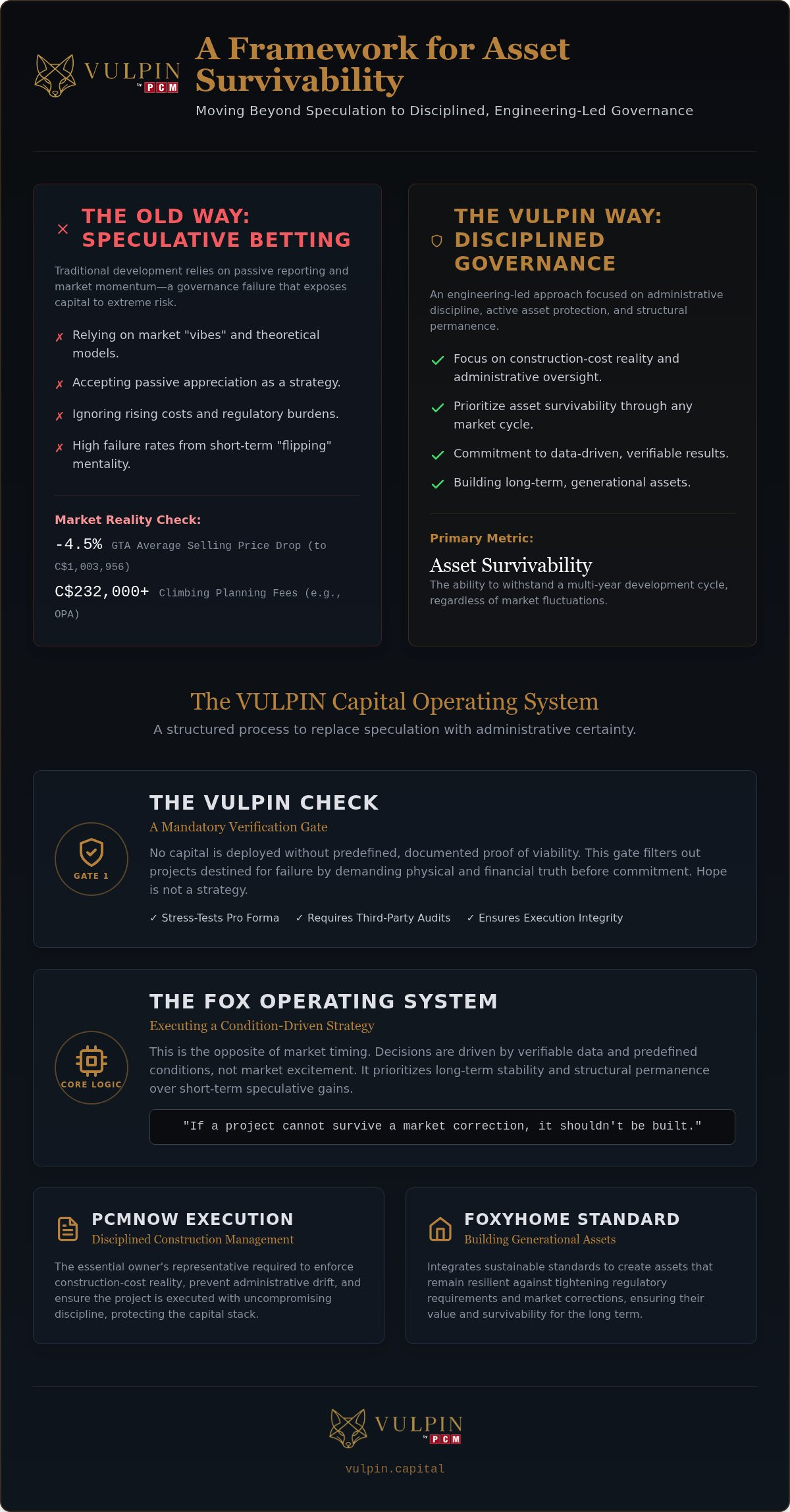
Relying on market trends is a governance failure. It’s a refusal to do the hard work of verification. In July 2026, GTA average selling prices fell 4.5% to C$1,003,956. Those who built their models on perpetual growth found themselves exposed. Speculative entries in high-demand markets often carry hidden costs that spreadsheets ignore. These include rising interest rates and shifting regulatory burdens. We shift the focus from the hypothetical exit price to execution integrity. An owner’s representative Toronto projects require must prioritize the budget over the hype. This involves a deep understanding of Construction management principles. It requires a refusal to accept optimistic projections without tangible proof. We don’t look for market “vibes.” We look for administrative certainty.
Asset Survivability as the Primary Metric
Asset survivability is the ability of a project to withstand a multi-year development cycle. It’s the primary metric of success. Financial modelling often ignores the friction of physical reality. We don’t. We use The Fox operating system to drive decisions based on data. This is a condition-driven strategy. It’s the opposite of market timing. We prioritize structural permanence and administrative oversight above all else. If a project cannot survive a market correction, it shouldn’t be built. We explicitly reject Short-term Speculative Flipping. We build for the long term. This requires a rigorous verification process. It ensures that capital is only deployed when viability is a documented fact. By the time we break ground, the project’s survivability has already been proven through The VULPIN Check. We value the integrity of the structure and the systems that govern it. This is how we protect capital from the high failure rates seen in speculative ventures.
The VULPIN Check: Verifying Project Viability Before Resource Commitment
The VULPIN Check is a mandatory verification gate. It replaces speculation with administrative certainty. Most developers commit capital based on optimism. We refuse to operate on hope. The principle is simple: no capital deployment occurs without predefined proof of viability. This is the uncompromising standard an owner’s representative Toronto developers require to survive. We filter out projects destined for failure by demanding physical and financial truth at the intersection of engineering standards and institutional governance. If the data doesn’t support the build, we don’t proceed. It’s an exclusionary process designed to protect the integrity of the capital stack.
Stress Testing the Pro Forma
Development spreadsheets are often works of fiction. They rely on best-case scenarios that ignore the friction of physical reality. We apply a stoic lens to every revenue projection and cost estimate. This isn’t about being cynical; it’s about being accurate. We require third-party construction project audits to verify every line item before a single shovel hits the ground. For comparison, look at the transparency in Toronto’s Capital Projects Pipeline. Large-scale public infrastructure requires this level of visibility. Your private asset development should be no different. We don’t accept industry averages as a substitute for project-specific reality.
The Governance of Resource Deployment
Resources are finite. Their deployment must be governed by strict rules, not by the frantic energy of the market. Our Construction Project Governance Framework serves as the manual for this process. It prevents administrative drift. It stops the slow erosion of capital that occurs when oversight is absent or detached. The VULPIN Check acts as a defensive shield for stakeholder capital. It creates a rule-governed ecosystem where every participant is held to the same standard of verification. This methodology ensures that every C$ spent is moving the asset toward long-term survivability. As a disciplined owner’s representative Toronto projects can rely on, we prioritize the integrity of the system over the speed of execution. If you value structural integrity and financial discipline, you can learn more about our methodology for asset protection.
Condition-Driven Strategy vs. Market Momentum
Market timing is an exercise in vanity. We reject the herd mentality that treats real estate like a digital abstraction. True asset survivability depends on the physical truth of the structure, not the fluctuating sentiment of the crowd. Our Condition-Driven Asset Acquisition Strategy prioritizes the engineering reality of the site over the noise of the financial press. A disciplined owner’s representative Toronto projects require must look past the spreadsheet. They must see the asset as a mechanical system that requires administrative oversight and structural permanence. This approach demands a rejection of marketing-driven metrics. We look for physical proof that an asset can function as intended for decades, regardless of the current interest rate environment or temporary supply shortages.
The Fallacy of Market Timing
The concept of “buying low” is a myth without a condition-based assessment. An asset purchased at a perceived discount is a liability if its structural integrity is compromised. Entering a project during periods of market euphoria often leads to over-leveraging and neglected due diligence. In July 2026, the GTA saw a 17.8% decrease in new listings. While the market tightens, the risk of rushing into sub-par assets increases. We identify survivability potential through a rigorous project life cycle framework that mirrors institutional standards. We look for assets that can withstand market corrections because their value is grounded in physical utility, not speculative growth. This level of scrutiny filters out projects that rely on “best-case” exit prices for their viability.
Implementing The Fox Operating System
The Fox is our specialized operating system for autonomous asset control. It is the antithesis of detached management. We operate as invested craftsmen who value the integrity of the system above all else. This OS enables a transition from passive oversight to active, data-driven operation. Every decision is documented. Every action is part of a broader methodology. We don’t guess; we verify. Preventative maintenance is not a secondary concern. It is a fundamental component of long-term value. By treating the project as a self-sustaining organism, we ensure it remains resilient against external volatility. This is the level of administrative discipline required to protect capital in high-stakes Canadian development. It’s about sovereign control over the asset’s future. Aligning with this worldview is a prerequisite for engagement. We don’t seek to please the mass market. We seek to build structures that endure.
PCMNow: Disciplined Execution in Construction Management
PCMNow Project Management is the antidote to scope creep. It is a system designed to enforce construction-cost reality. Most projects fail because the budget is detached from physical truth. We ground every dollar in the material requirements of the build. An owner’s representative Toronto partners with must act as a governance enforcer, not a passive observer. We manage stakeholders through rigorous financial reporting and absolute transparency. There’s no room for ambiguity in the capital stack. We prioritize the integrity of the structure over the frantic energy of the site. Our systems are built to withstand the pressure of complex urban environments. We don’t just manage projects; we architect systems of oversight that ensure the asset reaches completion without administrative drift.
Mitigating Construction Cost Overruns
Managing Construction Project Cost Overruns starts in the pre-construction phase. It’s not a reactive process. We establish a budget contingency plan that reflects the friction of reality. Our approach to contractor change orders is exclusionary. We resolve disputes through documented methodology rather than negotiation. In Toronto, where planning application fees increased by 4.82% in January 2026, administrative discipline is the only way to protect capital. We reject the “best-case” mentality that leads to financial erosion. Every expense must be verified against the project’s survivability metrics. We demand proof of value before resource commitment. This rigorous verification process is the only shield against the unpredictable cost spikes common in the Canadian market.
The Owner’s Rep as a Stoic Operator
PCMNow prioritizes administrative oversight. We reject the “excitement” often associated with large-scale developments. Our role is one of invested operation. We vet general contractors beyond their surface-level credentials. We look for alignment with our engineering standards. Disciplined execution is required for national developments to survive market corrections. As an owner’s representative Toronto can rely on for national consistency, we demand autonomous control over the asset’s trajectory. This level of oversight ensures that the project remains a self-sustaining organism. We operate on a different time scale than the rest of the market. We value durability over quick wins. Our methodology is documented and unyielding. If you require a partner who values structural permanence and administrative truth, secure your asset’s future through our PCMNow framework.
Sustainable Housing as a Generational Asset: The FoxyHome Standard
Sustainability isn’t a marketing layer. It’s a fundamental governance requirement for asset survivability. We reject the industry’s obsession with “VIP access” to flimsy speculative units. Instead, we integrate Net-Zero Home Construction Costs into a disciplined financial framework. This isn’t about aesthetic appeal. It’s about ensuring the asset remains viable as energy costs and regulatory burdens climb. FoxyHome delivers residential solutions designed to endure. An owner’s representative Toronto projects require must view environmental performance as a primary risk management tool. We utilize modern construction techniques, including advanced thermal envelopes, to ensure cold-climate survivability. We don’t build for the frantic energy of the current market. We build for the next century.
The Financial Case for Sustainable Building
High-performance assets provide a superior long-term return on investment. We calculate ROI over the asset’s entire lifecycle. FoxyHome reduces operational expenses by prioritizing energy autonomy and structural durability. This approach serves as a critical hedge against future regulatory changes. For instance, the 2026 Ontario Building Code amendments have already introduced tighter requirements for fire separations and secondary suites. Assets that ignore these trends today will face massive capital expenditures tomorrow. We protect stakeholder capital by building to the standards of 2030, today. It’s a slow, methodical process that rejects the excitement of the trade in favour of the gravity of the build.
Building for the Next Generation
The market is saturated with speculative units built for quick flips. We don’t participate in that energy. We focus on generational housing assets. This shift requires the use of modular and prefabricated solutions that offer administrative precision. Prefabrication allows for autonomous control over the production environment. It removes the variables that lead to scope creep and physical failure. This finalizes the arc of our methodology. Disciplined governance leads to a superior physical product. The Fox operating system manages these complex assemblies with engineering rigour. We don’t just build structures. We architect systems of permanence. Aligning with this standard is a prerequisite for those who value the integrity of their legacy over the noise of the crowd.
Securing Structural Permanence in the Canadian Market
Asset development in Toronto requires a rejection of market noise. You’ve seen how speculative flipping fails when costs rise and transparency disappears. True survivability is built on administrative oversight and physical truth. By prioritizing engineering-led standards over market timing, you protect your capital from the next inevitable correction. A disciplined owner’s representative Toronto projects can trust must act as a sovereign operator of systems. This means enforcing the national PCMNow project management hierarchy and ensuring every resource deployment is justified by data. You’ve moved beyond the frantic energy of traditional finance. Now, it’s time to apply this rigorous framework to your next project.
Our proprietary VULPIN Check methodology provides the verification gate necessary for high-integrity development. It ensures your capital is only deployed when viability is a documented fact. Secure your legacy by choosing systems that value durability and structural permanence above all else. We invite you to Subject your next asset deployment to The VULPIN Check. Build with the conviction that your asset is engineered to survive.
Frequently Asked Questions
What is the difference between an owner’s rep and a construction manager?
An owner’s rep provides strategic governance, while a construction manager focuses on site execution. The owner’s representative Toronto developers hire through our firm enforces administrative discipline across the entire project lifecycle. We don’t just manage trades; we protect the capital stack and ensure structural permanence. Construction managers are necessary for physical assembly, but they lack the institutional authority to oversee the project’s financial and regulatory survivability. We operate as an invested extension of the owner’s sovereignty.
How does the VULPIN Check prevent project failure?
The VULPIN Check prevents failure by requiring tangible verification before any resource commitment. Most projects collapse because they’re built on best-case scenarios and speculative optimism. We require proof of viability that accounts for construction-cost reality and regulatory friction. If the data doesn’t support the build, the project is terminated before capital is wasted. This exclusionary gate filters for assets with the structural integrity to survive a multi-year development cycle without administrative drift.
Why is construction-cost reality so difficult to maintain in Canadian markets?
Maintaining construction-cost reality is difficult due to the frantic energy of speculative markets and shifting regulatory burdens. In Toronto, planning fees for a Zoning Bylaw Amendment now exceed C$63,000, and recent building code amendments add layers of complexity. Many projects fail because they rely on outdated industry averages instead of project-specific verification. Without the rigorous oversight of a disciplined owner’s representative Toronto projects often succumb to scope creep and unverified contractor change orders that erode stakeholder capital.
Can sustainable housing really provide a higher ROI than traditional builds?
Sustainable housing provides a higher ROI by reducing operational expenses and hedging against future regulatory mandates. High-performance assets under the FoxyHome standard are engineered for long-term durability rather than short-term profit. These builds remain viable as energy costs rise and carbon-related regulations tighten. We view sustainability as a governance requirement. Traditional builds often face massive capital expenditures later to meet updated standards. We build for the next generation to ensure generational asset survivability.
What are the early warning signs of a construction project in distress?
Early warning signs of distress include administrative drift and a lack of transparent financial reporting. When change orders are approved without rigorous verification, the budget is no longer grounded in physical truth. Scope creep is another indicator that the project’s governance has failed. If the reporting feels like a marketing summary rather than a technical manual, the asset is at risk. Distressed projects often prioritize the speed of execution over the integrity of the administrative system.
How does PCMNow handle contractor disputes and change orders?
PCMNow handles disputes through a documented methodology that rejects the emotional energy of negotiation. We enforce an uncompromising standard for construction execution. Every change order must pass through a verification process that proves its material necessity. We don’t accept verbal agreements or vague estimates. By establishing rule-governed operations, we prevent the slow erosion of capital. Our system holds all contractors accountable to the engineering reality of the project, ensuring the budget remains a reflection of truth.
Why does VULPIN Capital reject speculative flipping?
We reject speculative flipping because it relies on market momentum rather than structural permanence. Flipping is a frantic, high-risk activity that often ignores the long-term viability of the physical asset. We focus on asset survivability and the disciplined deployment of capital into enduring structures. Speculative ventures have high failure rates during market corrections. We prioritize the stability of sovereign control and the internal development of systems that protect capital across multi-year temporal frameworks.
What role does The Fox play in day-to-day asset management?
The Fox serves as the operating system for autonomous asset control and data-driven management. It replaces detached oversight with invested operation. The system provides a framework for preventative maintenance and administrative discipline. Every day-to-day decision is filtered through this OS to ensure alignment with our long-term survivability metrics. It creates a self-sustaining internal logic for the project. By using The Fox, we maintain sovereign control over the asset’s trajectory and ensure every action is documented.