

Why do you continue to treat your capital like a wager when the tools for absolute control already exist? Most operators are currently paralyzed by construction cost overruns and the erratic reporting of general contractors. You likely feel the weight of an unstable market where traditional speculation is a failing strategy. In this environment, real estate development risk management Ontario requires more than just a spreadsheet; it demands a rigid administrative enforcement of construction reality. With the Bank of Canada policy interest rate holding at 2.25 percent and new legislative shifts like Bill 98 altering the approval landscape, the margin for error has vanished.
This manual shows you how to replace market hope with the VULPIN Check and the PCMNow execution framework. We’ll outline how to move from speculative gambling to a disciplined model of asset governance that prioritizes long-term survivability and mitigated financial exposure. You aren’t here to flip a property for a quick win. You’re here to build a system that endures. We will examine the transition from market anxiety to sovereign control through a rigorous construction execution framework that ensures predictable results in a volatile sector.
Key Takeaways
- Realize the critical distinction between speculative market gambling and disciplined asset governance to protect your capital from chronic construction cost overruns.
- Implement the VULPIN Check as a mandatory verification gate to ensure real estate development risk management Ontario is grounded in tangible reality rather than theoretical modeling.
- Shift from unreliable general contractor reporting to a rigorous execution framework using PCMNow for predictable project outcomes and administrative control.
- Prioritize asset survivability through FoxyHome sustainable housing techniques that secure long-term generational wealth and mitigate legal exposure.
- Transition from a detached manager to a disciplined operator by adopting a governance-first methodology that values the integrity of the physical structure above all else.
The Fallacy of Market Speculation vs. Construction Reality
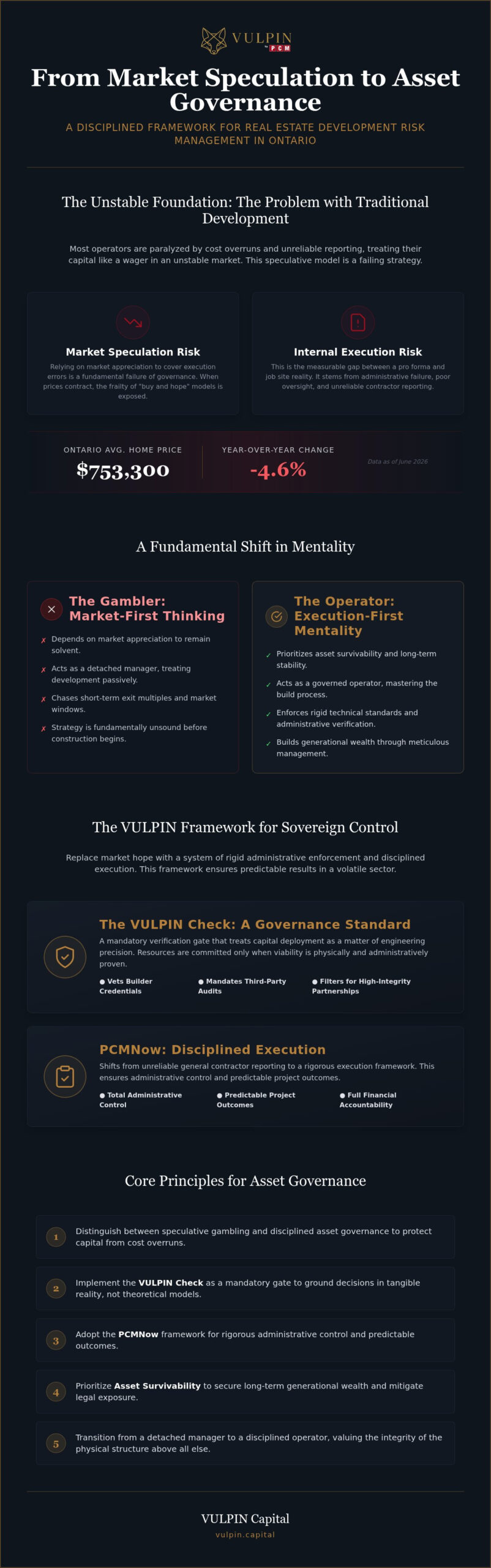
Risk is not a statistical probability of a market downturn. It is the measurable gap between a spreadsheet’s pro forma and the physical reality of a job site. In the current climate, real estate development risk management Ontario requires a rejection of the “buy and hope” model. As of June 2026, the average selling price of a home in Ontario dropped to $753,300, a 4.6 percent decrease year-over-year. This price contraction exposes the frailty of speculative flipping. When you rely on market appreciation to cover execution errors, you aren’t an operator; you’re a gambler.
We distinguish between market risk and execution risk. Market risk is external, governed by interest rates and provincial legislation like Bill 98. Execution risk is internal. It is the result of administrative failure, poor oversight, and unreliable reporting. A stoic developer ignores the frantic energy of market cycles to focus on what they can control. This means enforcing a rigid real estate development process where every nail and every dollar is accounted for through administrative verification. You don’t manage risk by timing the market. You manage it by mastering the build.
The Problem with Market-First Thinking
Relying on appreciation is a fundamental failure of governance. Many investors treat development as a passive asset class, expecting the sheer passage of time to generate value. This passivity is expensive. Project complexity in Ontario’s current regulatory environment, including the 2024 Building Code and its 2026 amendments, outpaces traditional management methods. If your strategy depends on a 10 percent annual price hike to remain solvent, your project is structurally unsound before the first shovel hits the dirt. Passive strategies don’t account for the industrial reality of cost overruns or the technical demands of modern construction.
Shifting to an Execution-First Mentality
The goal is asset survivability. We reject short-term exit multiples in favour of long-term stability. This shift requires you to move from being a detached owner to a governed operator. It is about the integrity of the structure. Disciplined investment principles demand that you prioritize the internal logic of the build over external urgency. Effective real estate development risk management Ontario is the only path to securing generational wealth through the meticulous management of physical assets.
- Stop chasing market windows that you cannot control.
- Start enforcing technical standards that you can.
- Commit resources only when viability is proven through tangible verification.
- Transition to a model where the administrator, not the market, dictates the outcome.
This approach isn’t about being fast; it’s about being permanent. You must realize that the market doesn’t owe you a return. Only a governed execution framework can provide one.
Implementing a Governance Standard: The VULPIN Check
Standard due diligence is a checklist for the complacent. It often fails to penetrate the surface of a project’s technical feasibility. To achieve true real estate development risk management Ontario, you must adopt a governance standard that treats capital deployment as a matter of engineering precision. This is the foundation of The VULPIN Check: A Governance Standard for Real Asset Deployment. We don’t commit resources based on market optimism. We commit only when viability is physically and administratively proven. This requires navigating the complexities of the Planning Act and zoning bylaws, as detailed in Ontario’s Land Use Planning Guide, with an uncompromising eye for detail. We reject the frantic energy of traditional markets in favour of a slow, methodical verification process that filters for high-integrity partnerships. The VULPIN Check functions as a mechanical governor on an engine, preventing the project from over-revving into financial ruin before it even leaves the station.
Proof of Project Viability
Viability isn’t a feeling. It’s a series of predefined proof points that must be met before a single dollar moves. We vet builder credentials not by their marketing brochures, but by their historical execution data and construction methodologies. A third-party construction project audit isn’t optional; it’s a structural necessity. This audit acts as a filter, ensuring the general contractor’s reporting aligns with the physical reality of the site. If the data doesn’t match the dirt, the project doesn’t proceed. This level of oversight ensures that the project remains an asset rather than a liability. It creates a boundary of high-integrity professionalism that feels grounded in physical reality rather than digital abstraction.
Stress Testing for 2026 Realities
The 2026 market presents unique challenges. While the Bank of Canada policy interest rate has held at 2.25 percent, material volatility and chronic labour shortages remain persistent threats. We stress-test the pro forma against these industrial realities, not just financial models. This includes evaluating the structural permanence of proposed designs to ensure they meet the 2024 Ontario Building Code and its latest 2026 amendments. We prioritize structures that can withstand both environmental and economic shifts. If you’re serious about protecting your capital, you might consider how disciplined asset governance can secure your next project. The VULPIN Check is the administrative armour of a development.
Disciplined Execution with PCMNow Project Management
Traditional project management is a failure of imagination. It treats the complex orchestration of labour and materials as a mere administrative task. PCMNow Project Management rejects this passivity. It’s a transition from “management” to disciplined governance. We don’t manage projects; we govern assets. This means preventing scope creep through rigid administrative controls that leave no room for ambiguity. If you aren’t actively managing construction project cost overruns through a system of tangible verification, you’re essentially writing a blank cheque to your general contractor. Effective real estate development risk management Ontario demands a framework that prioritizes the integrity of the budget over the comfort of the contractor.
The Reality of Construction Costs
Construction distress doesn’t happen overnight. It starts with small, unexplained delays and inconsistent site reports. These are the early warning signs of a project in trouble. A governance framework provides the leverage to say no to contractor change orders that lack technical justification. We view the owner’s representative not as a passive observer, but as a disciplined operator whose sole function is to enforce cost reality. They’re the architect of the system, ensuring that every expense is a verified necessity rather than a speculative addition. This internal oversight is what separates a sovereign asset from a failing venture.
Reporting and Stakeholder Transparency
We move beyond the dangerous reliance on “trust.” Trust is a psychological state, not a reporting metric. PCMNow utilizes verified reporting systems that provide stakeholders with uncompromising honesty. When you present a project budget to a board, you shouldn’t offer hope; you should offer data. Project management fees are often viewed as a burden, but in a governed system, they’re justified through the radical reduction of execution risk. You aren’t paying for a person to attend meetings. You’re paying for a sovereign logic that protects the asset from the frantic energy of a site in chaos. This is how real estate development risk management Ontario becomes a predictable reality rather than a market-based gamble.
Asset Survivability and Sustainable Housing
Most developers treat sustainability as a marketing layer. We treat it as a hedge against technical obsolescence. Asset survivability is the ultimate metric of a governed project. Real estate development risk management Ontario requires a shift from short-term exit multiples to the long-term durability of the physical structure. This is the industrial logic behind FoxyHome Sustainable Housing. By integrating modern construction techniques with high-performance standards, we ensure that the asset remains viable through shifting regulatory and environmental climates. You must understand the net-zero home construction costs Canada to realize that efficiency is a matter of administrative foresight, not just a response to the 2026 Ontario Building Code amendments. We don’t build for the current market cycle. We build for the next century.
Long-Term Hold Strategy vs. Speculation
Generational assets demand a different risk profile. While the market obsesses over the latest condo trends, a disciplined operator focuses on financial durability. We reject the frantic energy of speculative flipping. Land evaluation for custom sustainable projects must account for long-term hold potentials rather than quick liquidation. This involves assessing the intersection of environmental consciousness and technical permanence. If your project isn’t designed to survive the next thirty years of legislative shifts, it isn’t a secure investment. It’s a gamble waiting for a market downturn to expose its flaws. The July 22, 2026 amendment to the building code, which removed design constraints for four-storey non-stacked townhouses, provides a unique opportunity for those who prioritize structural integrity over superficial density.
Optimizing Building Performance
The work doesn’t end when the residents move in. Post-occupancy performance optimization is a critical risk mitigation tool. We utilize The Fox operating system for condition-driven asset management. This moves beyond simple maintenance to a regime of preventative oversight that protects your capital. Developing rigid maintenance schedules ensures that the physical integrity of the building remains uncompromised. The Fox ensures asset survivability through rule-governed operations. This system rejects the “fix it when it breaks” mentality of traditional property management. Instead, it enforces a sovereign logic of administrative verification. If you are ready to build for the long term, you should partner with a disciplined operator who values structural permanence over speculative hype.
Securing Your Project with VULPIN Capital
VULPIN Capital is not a detached manager. We are a disciplined operator. While traditional brokers focus on the next transaction, we focus on the integrity of the structure. We explicitly reject the frantic energy of traditional markets. This is a boundary of high-integrity professionalism grounded in physical reality. Real estate development risk management Ontario is a matter of administrative oversight, not digital abstraction. We prioritize long-term stability over the excitement of speculation. Our systems, such as PCMNow Project Management, provide the administrative oversight necessary for autonomous control and structural permanence.
The VULPIN Partnership Philosophy
We filter for specific partners. Alignment with our worldview is a prerequisite for engagement. We value the integrity of the structure above all else. Large project management corporations often treat developments as a volume business, prioritizing throughput over precision. We are a boutique governance firm. We operate like master craftsmen. We value a documented methodology over marketing hype. This slow, methodical rhythm ensures that we prioritize long-term temporal frameworks over quick wins. We don’t seek to please a mass audience. We seek to protect the asset. If you value excitement over integrity, you won’t find it here. We are patient, slightly aloof to market trends, and deeply committed to a specific execution framework.
Next Steps for Disciplined Developers
Transitioning to a condition-driven asset acquisition strategy is the first step toward autonomy. You don’t need a broker; you need a system. Requesting a VULPIN Check for your current project provides the tangible verification required to proceed with confidence. We don’t offer guarantees or financing; we offer a rigorous construction execution framework that enforces reality. The 2026 market landscape, with its stabilized interest rates and legislative shifts, rewards the disciplined and punishes the speculative. Secure your legacy. Ensure asset survivability. Reject the gamble.
- Request a VULPIN Check to verify project viability.
- Implement PCMNow to gain administrative control over construction sites.
- Adopt the Fox operating system for long-term asset governance.
The choice is between market anxiety and sovereign control. We provide the latter for those who have the discipline to follow a rigorous, documented methodology. Your capital deserves the protection of a governance-first platform.
Transitioning to Sovereign Asset Governance
The market doesn’t owe you a return. Relying on appreciation is a fundamental failure of leadership. True real estate development risk management Ontario is found in the rigid administrative enforcement of construction reality. We’ve outlined the path to replacing speculative hope with the proprietary VULPIN Check methodology and the PCMNow execution framework. These systems aren’t mere suggestions; they represent a stoic, governance-first philosophy designed to ensure asset survivability. You must reject the frantic energy of the crowd and embrace the technical permanence of high-performance builds. This is how you protect capital from the industrial reality of cost overruns and unreliable reporting.
Stop treating your capital like a wager. It’s time to transition from a detached manager to a master craftsman of systems. By prioritizing structural integrity and rigid administrative oversight, you secure long-term generational wealth that survives market volatility. The tools for autonomous control exist for those with the discipline to use them. Build with conviction and ensure your legacy remains grounded in physical reality rather than digital abstraction. We look forward to seeing your disciplined execution.
Secure your assets with the VULPIN Check
Frequently Asked Questions
What are the primary legal risks in Ontario real estate development for 2026?
Legal risks stem from the centralization of planning authority under the Building Homes and Improving Transportation Infrastructure Act, 2026. This legislation streamlines approvals but increases the penalty for administrative errors. Developers must navigate the 2024 Ontario Building Code and its July 2026 amendments regarding four-storey townhouses. Failure to align with these evolving provincial standards creates litigation exposure. Real estate development risk management Ontario requires rigid adherence to these statutory shifts to avoid regulatory entrapment.
How does the VULPIN Check differ from standard due diligence?
Standard due diligence is often a surface-level checklist focused on market timing. The VULPIN Check is a proprietary methodology that functions as a mechanical governor for real asset deployment. It demands tangible verification of every technical and administrative claim before capital moves. Unlike traditional reviews, it stress-tests the pro forma against industrial realities like chronic labour shortages. We don’t verify to comply; we verify to survive. It’s a filter for high-integrity professionalism and structural permanence.
Can sustainable building actually improve the ROI of a development project?
Sustainable building improves ROI by securing asset survivability against technical obsolescence and future carbon regulations. High-performance housing, like FoxyHome Sustainable Housing, reduces long-term maintenance liabilities and energy costs. In the 2026 market, efficiency is no longer optional. It’s a hedge against the rising costs of traditional material volatility. By prioritizing durability over speculative multiples, you create a sovereign asset that maintains its value through shifting legislative and environmental climates. It’s an engineering-first investment strategy.
How do I resolve disputes with building contractors without halting the project?
Resolving disputes requires a transition from emotional negotiation to rule-governed execution. Using the PCMNow Project Management framework, you enforce pre-existing administrative controls to address contractor change orders. If a claim lacks technical justification or verified data, it’s rejected. You don’t halt the project; you enforce the contract’s internal logic. This stoic approach ensures that the build continues while the owner’s representative maintains the integrity of the budget through rigid oversight. Discipline replaces the need for frantic urgency.
What is the “Fox” operating system and how does it manage risk?
The Fox is an operating system designed for condition-driven asset management. It manages risk by replacing reactive maintenance with a regime of preventative, rule-governed operations. This system ensures asset survivability by monitoring the physical integrity of the structure in real-time. It functions as a self-sustaining internal logic for the organization. By prioritizing structural permanence, The Fox allows developers to maintain autonomous control over their assets, rejecting the frantic energy of traditional property management. It values concrete results over theoretical models.
When is it more financially sound to walk away from a construction project?
It’s financially sound to walk away when the VULPIN Check reveals that project viability cannot be administratively proven. If cost overruns exceed the stress-test limits established in your pro forma, the project has become a wager rather than an investment. We reject the sunk cost fallacy. A disciplined operator recognizes when the gap between the pro forma and construction reality is insurmountable. Protecting your remaining capital is a matter of principle and long-term survivability in a volatile market.
How can I build credibility as a new developer in the Ontario market?
Credibility is built through the adoption of a documented, governance-first methodology rather than market hype. New developers should implement a rigorous construction execution framework to demonstrate they aren’t merely speculative gamblers. By utilizing systems like PCMNow, you signal to partners that your real estate development risk management Ontario is grounded in physical reality. Focus on becoming a master craftsman of systems. Integrity is verified through results and the rejection of the short-term flipping mentality.
What is the role of an owner’s representative in mitigating project overruns?
An owner’s representative mitigates overruns by serving as a disciplined operator who enforces cost reality on the job site. They move beyond trust to utilize verified reporting systems that provide stakeholders with technical honesty. This role isn’t about attending meetings; it’s about administrative oversight. They act as the architect of the project’s internal logic, ensuring that every dollar spent is a verified necessity. Their presence reduces execution risk by preventing scope creep and contractor overreach.