

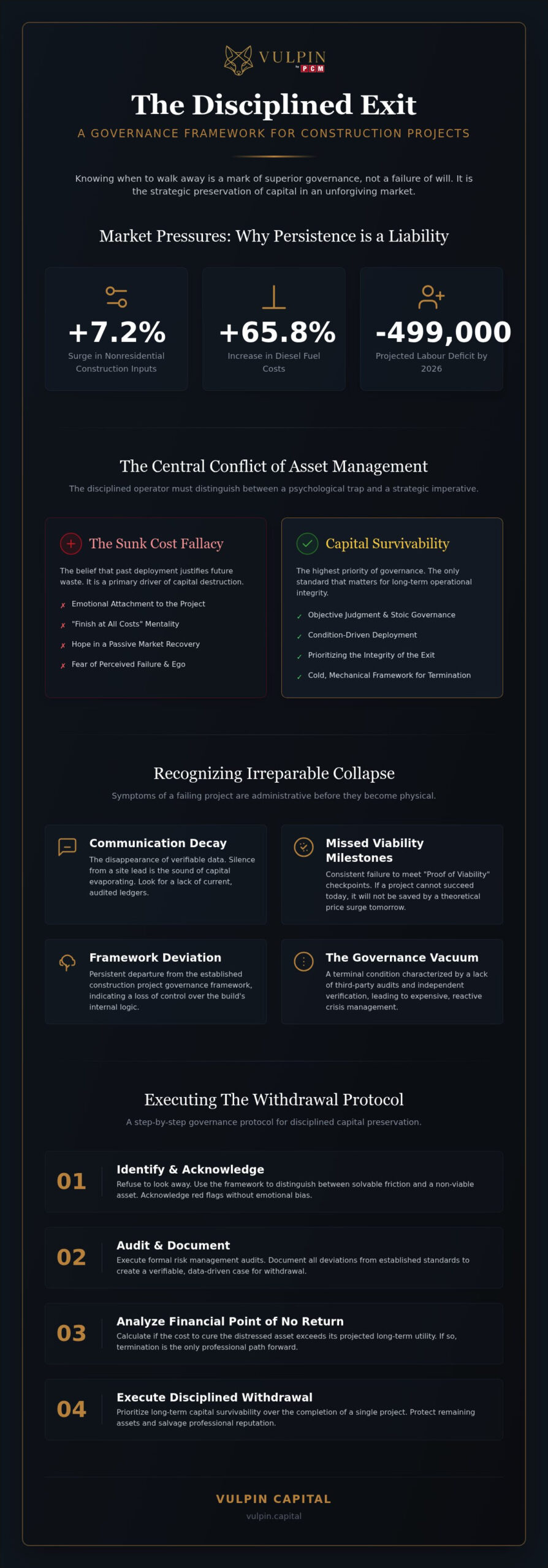
Persistence is often nothing more than a slow-motion liquidation of your future. In a market where nonresidential inputs have surged by 7.2 percent and diesel fuel is up 65.8 percent, staying the course out of pride is a governance failure. You must know exactly when to walk away from a construction project before the asset consumes the operator. Most developers mistake a sinking ship for a solvable challenge because they lack a cold, mechanical framework for termination. We do not celebrate the grind of a failing site; we prioritize the integrity of the exit.
You likely feel the weight of the sunk cost fallacy or the anxiety of looming legal repercussions from a broken contract. With the industry facing a deficit of 499,000 workers in 2026, your labour costs and timelines are no longer within your autonomous control. This article will teach you to identify the precise threshold where a project transitions from a manageable risk to an existential threat to your capital survivability. We will outline a protocol for protecting your remaining assets, salvaging your professional reputation, and implementing a C O N D I T I O N – D R I V E N strategy to ensure you never bleed out on a dead site again.
Key Takeaways
- Distinguish between a solvable friction point and a non-viable asset using a framework of stoic governance.
- Recognize the governance red flags, including communication decay and missed Proof of Viability milestones, that signal irreparable project collapse.
- Master the financial logic of when to walk away from a construction project by prioritizing long-term capital survivability over the sunk cost fallacy.
- Execute a disciplined withdrawal protocol that utilizes formal risk management audits to document all deviations from established standards.
- Establish a condition-driven strategy for future deployments by integrating The VULPIN Check into your asset management lifecycle.
The Disciplined Exit: Why Walking Away Is a Strategic Victory
Persistence is not a strategy. It is often a psychological trap. In the Canadian development landscape, the “finish at all costs” mentality is a primary driver of capital destruction. Knowing when to walk away from a construction project is a mark of superior governance, not a failure of will. We do not value the frantic effort to save a dying asset. We value the cold, administrative oversight required to preserve what remains of your capital. This approach aligns with a condition-driven real asset deployment Canada framework. It requires a total rejection of emotional attachment in favour of physical reality. Stoicism in asset management is about objective judgment. It is the ability to see a project exactly as it is, without the distortion of ego or the noise of market speculation.
The Myth of the Passive Market Recovery
Market appreciation is a digital abstraction. It is not a guarantee of viability. Banking on a future recovery to bail out an incompetent build is a speculative gamble. In 2026, where nonresidential input prices have risen by 7.2 percent, hope is a dangerous project management metric. We prioritize tangible verification over market hype. If the project cannot meet its Proof of Viability milestones today, it will not be saved by a theoretical price surge tomorrow. Real assets require rugged, industrial-grade logic, not the frantic energy of speculative flipping. We do not wait for the market to fix our mistakes. We organize our systems to prevent them or we terminate the exposure.
Asset Survivability vs. Project Completion
Completion is a vanity metric if the resulting structure is a liability. Asset survivability is the only standard that matters. You must ask: will this finished building generate value, or will it consume more capital in maintenance and debt service than it can ever return? This is where many operators succumb to the sunk cost fallacy. They believe past deployment justifies future waste. It doesn’t. An autonomous operator maintains an objective perspective on their portfolio. If the cost to cure a distressed asset exceeds its long-term utility, termination is the only professional path forward. Knowing when to walk away from a construction project ensures your organization remains a self-sustaining mechanism. Protecting your
C A P I T A L S U R V I V A B I L I T Y
is the highest priority of governance. We choose the discipline of the exit over the chaos of a failing build.
Recognizing the Irreparable: Structural and Governance Red Flags
Identification of failure requires a refusal to look away. When a project enters a death spiral, the symptoms are often administrative before they are physical. A primary indicator of when to walk away from a construction project is the total breakdown of documented communication. We do not mean missed phone calls or slow email responses. We mean the disappearance of verifiable data. If your contractor cannot provide a current, audited ledger or consistently fails to meet “Proof of Viability” milestones, the project has ceased to be an asset. It is now a sinkhole. You must recognize that silence from a site lead is usually the sound of capital evaporating.
Persistent deviations from the construction project governance framework signal that the operator has lost control of the build’s internal logic. In a market where diesel fuel has surged 65.8 percent and aluminium mill shapes are up 52.4 percent as of August 2026, a contractor who ignores economic reality is a liability. If they refuse to acknowledge that their original bid is mathematically impossible under current inflation rates, they are no longer building; they are hallucinating. We do not fund delusions. We fund structures grounded in physical and financial reality.
The Governance Vacuum
A project managed by urgency is a project destined for liquidation. Rules must precede action. When you observe a lack of third-party audits or independent verification processes, you are witnessing a governance vacuum. This is a terminal condition. Without administrative oversight, complex builds devolve into a series of expensive reactions to preventable crises. Professional operators recognize these signs it may be time to stop a project before the damage becomes irreversible. Stabilizing a failing build requires a return to first principles, often through disciplined real asset governance.
Technical and Environmental Non-Compliance
Asset value is tied to structural permanence and regulatory alignment. Irremediable failures in meeting net-zero home construction costs Canada standards are not minor setbacks. They are fundamental breaches of the asset’s future utility. Substandard labour and material choices often hide beneath the surface, compromising the generational value of the site. If the structural integrity or environmental performance cannot be verified through tangible evidence, the project fails the standard of survivability. We do not accept “close enough” when the goal is a high-performance, sustainable asset.
Knowing when to walk away from a construction project depends on your ability to separate the person from the process. If the process is broken, the person cannot fix it without a complete systemic overhaul. At this stage, the question isn’t whether you can finish, but whether you should. A non-compliant structure is a permanent drain on your resources. It’s better to exit with your remaining capital than to own a monument to administrative failure.
The Financial Point of No Return: Sunk Cost vs. Capital Survivability
Capital is a finite instrument of sovereignty. It must be deployed with cold, mathematical precision. The most common error in asset management is the belief that past expenditure justifies future waste. We do not chase ghosts. Sunk costs are irrelevant to the future viability of a structure. When determining when to walk away from a construction project, you must focus exclusively on the delta between the “Cost to Cure” and the “Exit Value.” If finishing the build costs more than the asset’s realized worth upon completion, the project is no longer an investment. It is a liquidation event in progress. You must also evaluate the opportunity cost of tied-up capital. Every dollar trapped in a non-performing site is a dollar that cannot be deployed into a high-performance, sustainable asset.
Quantifying Project Distress
Systemic failure often hides behind small, incremental budget leaks. We utilize the 20% Rule: if cost overruns exceed one-fifth of the original pro forma, the underlying logic of the build is likely broken. This threshold signals that the project has moved beyond simple inflation and into structural mismanagement. Effective governance requires managing construction project cost overruns through rigorous, real-time auditing. You must account for “hidden” costs that digital models often ignore, such as mounting legal fees, carrying costs, and the erosion of your professional reputation. The Point of No Return is the moment future deployment yields a negative net present value.
The Reality of Construction Liens and Liability
Termination is a technical manoeuvre that requires administrative rigour. In the Canadian landscape, mandatory holdbacks and lien risks create a complex web of liability. If a contractor is terminated for cause, the financial implications are immediate and severe. You must realize that a walk-off often triggers a cascade of claims from sub-trades that can freeze the asset’s title. Protecting your remaining capital requires a transition from trust-based management to a protocol of strict financial reporting. We prioritize the following steps to secure the site’s financial integrity:
- Conducting an immediate third-party audit of all work in place to verify value against payments.
- Issuing formal notices to all lien-holders to establish a clear timeline of liability.
- Securing the physical site to prevent the removal of materials already paid for by the owner.
- Transitioning to a disciplined execution framework to stabilize the asset for potential sale or restart.
Knowing when to walk away from a construction project is about recognizing that your primary duty is to the survivability of your organization. We do not fund failure out of a misplaced sense of honour. We preserve capital so it can be deployed where it actually produces results.
Executing the Withdrawal: A Step-by-Step Governance Protocol
Termination is not an emotional reaction. It is a technical procedure. Once you determine when to walk away from a construction project, the transition from operation to liquidation must be swift and documented. This begins with initiating a formal construction project risk management framework audit. We do not accept verbal assurances or “handshake” agreements during this phase. Every deviation from the “Proof of Viability” standards must be recorded as a matter of administrative record. Issuing formal notices of default based on objective performance metrics provides the legal foundation for a clean break. You must secure the site physically and administratively, ensuring all intellectual property and material inventory remain under your autonomous control.
The Audit and Verification Phase
Engaging an independent owner’s representative is essential to conduct an objective site-mortem. This individual must verify the exact percentage of completion against the actual funds disbursed. In an environment where material volatility is extreme, you cannot pay for work that does not exist in physical reality. Identifying salvageable components is a tactical necessity. For instance, with copper mill shapes up 26.0 percent as of August 2026, protecting on-site inventory is a direct preservation of capital. We prioritize a
S I T E – W I D E V E R I F I C A T I O N
to ensure that what you have paid for remains your asset.
Legal and Administrative Closure
Minimalizing exposure to breach of contract claims requires rigorous adherence to the termination clauses of your agreement. You are not abandoning the project; you are enforcing governance standards. Work with counsel to ensure all notices are served according to provincial regulations. Finalizing outstanding subcontractor payments is a critical step to prevent the cascade of liens that often follows a general contractor’s failure. You must also close out active permits with the relevant authorities to prevent ongoing liability. If your current build is failing these standards, you require disciplined real asset governance to stabilize the situation and prevent total capital loss.
Beyond Abandonment: Systems to Prevent Future Failures
Walking away is a tactical retreat designed to preserve the capacity for future victory. Once you have identified when to walk away from a construction project, your focus must shift from liquidation to the architecture of your next deployment. We do not return to the speculative chaos that led to the initial breach. Instead, we implement The VULPIN Check as a mandatory filter for all future capital allocation. This is a transition from hope-based management to a condition-driven execution model. In an era where the industry faces a deficit of 499,000 workers and material inputs remain volatile, governance is the only reliable defence against market instability. Utilizing PCMNow Project Management ensures that construction-cost reality is integrated into your pro forma from day one. We prioritize tangible verification over digital abstractions to ensure your organization remains a self-sustaining mechanism.
Integrating The Fox Operating System
The Fox is not a suggestion; it is a rule-governed operating system designed to remove human emotion from asset management. Human ego is the primary cause of project death. By utilizing automated decision-making frameworks, we ensure asset survivability is never compromised by the frantic energy of a site lead or the optimism of a developer. Sovereign philosophy dictates that you maintain absolute control over your portfolio through a documented, repeatable methodology. We operate on a different time scale than the rest of the industry. Our systems are built for
S T R U C T U R A L P E R M A N E N C E.
We do not speculate on the excitement of the market; we execute based on the integrity of the internal logic. This administrative oversight is the only way to realize long-term stability in a shifting economy.
Starting Over with FoxyHome
If your previous project failed due to the inherent chaos of traditional “stick-built” construction, the path forward requires a fundamental shift in methodology. FoxyHome represents the transition to sustainable, high-performance housing as a generational asset. We reject the administrative vacuum of standard residential builds in favour of modular governance. This approach ensures that energy efficiency and structural durability are engineered into the asset from the beginning, not added as expensive afterthoughts. Building for longevity requires a rugged, industrial mentality that prioritizes the physical reality of the structure over aesthetic trends. When you realize when to walk away from a construction project that no longer serves your capital survivability, you create the administrative space to build something that will endure. We do not build for the next quarter; we build for the next century. This is the difference between a manager and an architect of systems.
Securing Capital Survivability through Disciplined Termination
Termination is not an admission of defeat. It is an act of sovereign control. You have learned to distinguish between solvable friction and terminal governance failure. By calculating the delta between the cost to cure and the asset’s realized value, you protect your organization from the psychological trap of sunk costs. We don’t fund projects that have ceased to meet their Proof of Viability milestones. Understanding exactly when to walk away from a construction project is the highest form of risk mitigation for the Canadian developer. It ensures that your resources remain available for assets that prioritize structural permanence and administrative integrity.
The path forward requires a total rejection of speculative chaos. We provide stoic risk mitigation through uncompromising governance standards and our proprietary verification process. Stop the bleeding. Verify your project viability with The VULPIN Check. You possess the framework to salvage your reputation and your capital. Now, you must execute with the precision of a master architect. The integrity of your future portfolio depends on the discipline you show today.
Frequently Asked Questions
Is it better to finish a project at a loss or walk away now?
It is better to walk away the moment the cost to cure exceeds the asset’s realized value upon completion. Finishing at a loss represents a failure of governance and an irrational liquidation of your organization’s future capital. You must prioritize capital survivability over the emotional desire for completion. If the build no longer meets its Proof of Viability standards, termination is the only professional path to preserve your remaining portfolio.
Can I be sued if I walk away from a construction project I am funding?
Litigation is a significant risk in any termination, but a documented governance record is your primary defence. While you can be sued for breach of contract, provincial lien legislation provides pathways for termination based on verifiable non-performance. Working with counsel to issue formal notices of default based on objective metrics minimizes this exposure. We prioritize administrative rigour to ensure your exit is supported by a clear record of contractor failure.
How do I tell my contractor that I am terminating the project?
Communicate termination through a formal, written notice of default that cites specific breaches of the governance framework. You don’t need to justify the decision through emotional arguments or verbal debates. Stick to the administrative record. Define the exact moment when the contractor failed to meet established milestones. This objective approach ensures that the termination is handled as a technical procedure rather than a personal conflict, protecting your professional reputation.
What are the early warning signs that a construction project is failing?
Early warning signs include a total breakdown in documented communication and persistent failure to meet Proof of Viability milestones. When cost overruns exceed 20 percent of the original pro forma, it signals systemic mismanagement. You should also watch for a lack of third-party audits or independent verification. These red flags indicate that the project is being managed by urgency rather than by rules, which is a terminal condition for any complex build.
What happens to my construction loan if I stop the project mid-build?
Stopping a project mid-build usually triggers a default clause in your construction loan agreement. Lenders may freeze draws or call in the loan if they perceive the asset’s value is compromised. You must stabilize the site and provide a clear recovery or liquidation plan to maintain the confidence of your financial partners. Knowing when to walk away from a construction project involves preparing for these institutional repercussions before you pull the trigger.
How can I protect my remaining assets when a project goes south?
Protect your assets by conducting an immediate third-party audit and securing the physical site. You must verify the value of work in place against payments made to prevent overpayment for non-existent progress. Clear all outstanding subcontractor payments to mitigate the risk of liens freezing your title. Transitioning to a disciplined execution framework ensures that you maintain autonomous control over the remaining capital while exploring a recovery mechanism through PCMNow Project Management.
What is the VULPIN Check and how does it prevent project failure?
The VULPIN Check is a proprietary governance standard that verifies the viability of real asset deployments through rigorous technical audits. It prevents failure by removing human emotion from the decision-making process. By implementing this framework, you ensure that every project meets strict Proof of Viability standards before capital is deployed. It acts as an ideological screening mechanism, filtering for high-integrity builds and ensuring long-term asset survivability in volatile Canadian markets.
Can a project be rescued after it has been abandoned by the contractor?
A project can be rescued if the underlying asset still maintains structural and financial viability. We utilize PCMNow Project Management to stabilize distressed sites and implement a disciplined execution framework. This recovery mechanism focuses on realizing construction-cost reality and correcting governance failures. However, if the cost to cure exceeds the asset’s future utility, the project should be liquidated. Rescue is only a victory if it leads to a self-sustaining, valuable structure.