

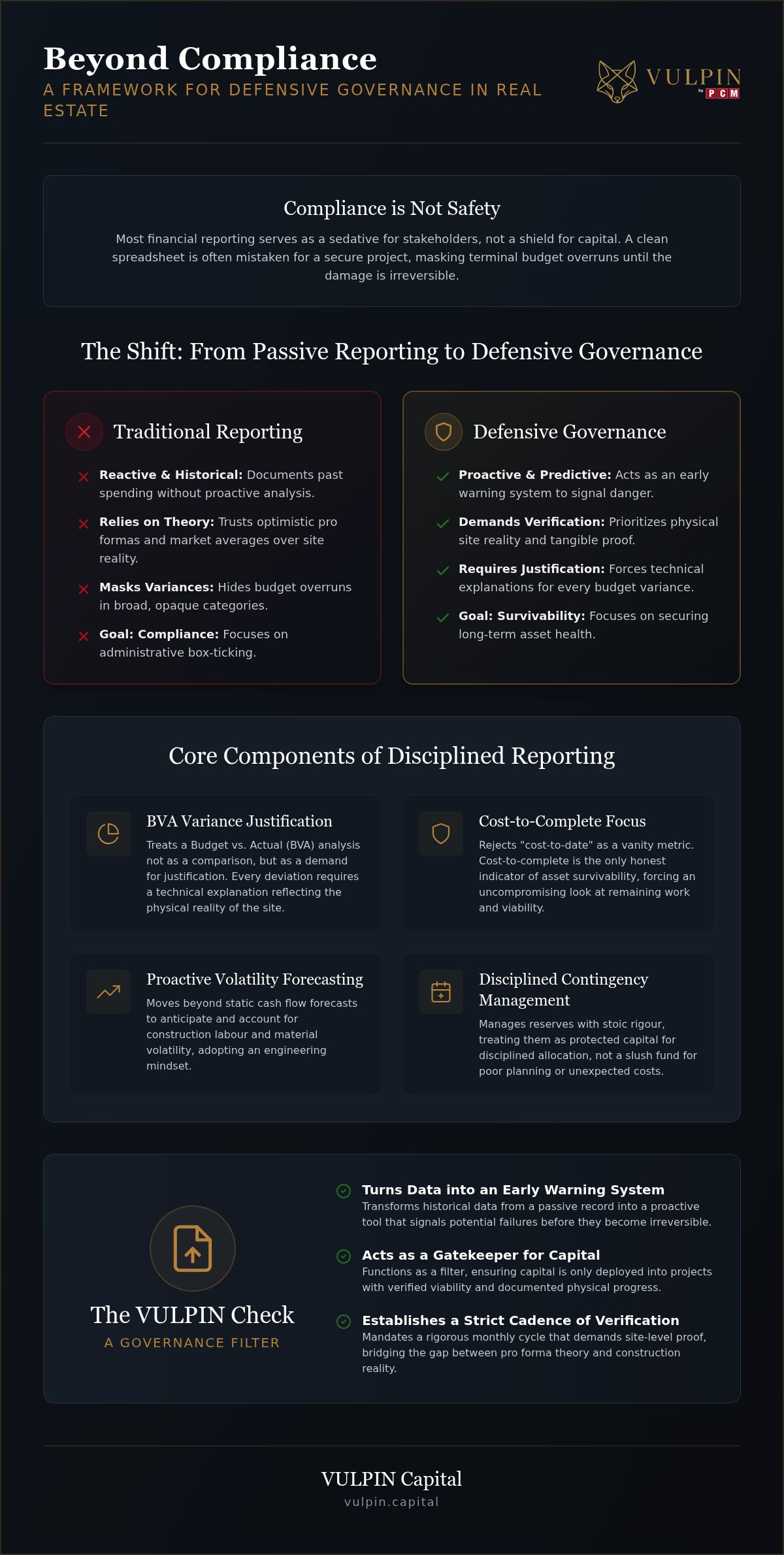
Compliance is not safety. Most financial reporting for real estate developments serves as a sedative for stakeholders rather than a shield for the capital. It’s a common failure to mistake a clean spreadsheet for a secure project. You’ve likely sat in boardrooms where theoretical pro formas were presented as gospel, only to realize months later that the general contractor’s opaque updates masked a terminal budget overrun. The ledger said one thing. The physical reality of the site said another.
S U R V I V A B I L I T Y I S N O T G U A R A N T E E D.
We agree that the current standard of reporting is broken. It’s a reactive exercise in administrative box-ticking that fails to signal danger until the damage is irreversible. This article provides a different path. We’ll show you how to move beyond compliance and establish a system of defensive governance. By prioritizing tangible verification over optimistic modeling, you can build a reporting framework that acts as an early warning system. We’ll explore how tools like the VULPIN Check and PCMNow ensure your data reflects the uncompromising truth of construction execution, securing long-term asset survivability in a volatile market.
Key Takeaways
- Shift from passive administrative recording to a system of defensive governance that prioritizes physical site reality over abstract ledger entries.
- Implement rigorous financial reporting for real estate developments by focusing on variance justification within your Budget vs. Actual (BVA) analysis.
- Establish a strict monthly cadence of verification that mandates site-level proof to bridge the gap between theoretical pro formas and construction-cost reality.
- Deploy the VULPIN Check as a governance filter to transform historical data into a proactive early warning system for capital protection.
- Secure long-term asset survivability by replacing speculative market metrics with concrete verification of labour and material volatility.
Beyond Compliance: Why Traditional Reporting Fails to Protect Real Assets
Reporting is not a ledger exercise. It’s a verification protocol. Most firms treat financial reporting for real estate developments as a passive history of expenditures. This is a failure of leadership. Real assets don’t survive on history; they survive on the structural integrity of their governance. Standard accounting practices focus on matching revenue to expenses. They do not address whether the capital deployed actually created a viable physical structure. If your system only tracks where the money went, you aren’t managing an asset. You’re just documenting its potential decline.
Defensive governance rejects the frantic optimism of traditional markets. While real estate investing often emphasizes high-speed exits and theoretical returns, a disciplined framework prioritizes asset survivability. Speculative reporting looks for the next buyer. Defensive reporting looks for the next failure point. We don’t value the excitement of speculation. We value the weight of durability. If your reporting doesn’t prioritize physical reality over digital abstraction, it isn’t governance. It’s just paperwork. True transparency requires a rugged, industrial mentality that demands results over modelling.
The Trap of Theoretical Pro Formas
A pro forma is a hypothesis. It rarely survives the first shovel in the ground. Many developers rely on market averages instead of site-specific data, which creates a dangerous blind spot in their oversight. Traditional reporting often masks project distress by burying construction-cost variances in broad, opaque categories. You won’t realize the project is failing until the budget is exhausted. We don’t accept theoretical models as proof of health. We demand tangible verification of every dollar spent on labour and materials. When the data diverges from the physical site, the reporting must signal an immediate warning.
Reporting as a Filter for Capital Deployment
Data is a gatekeeper. It’s not a suggestion. We use financial reporting for real estate developments to decide when to commit resources and when to pause. This requires a stoic refusal to fund projects that lack verified viability. Transparency is the only antidote to speculative franticness. When reporting reflects physical construction reality, it acts as a filter for the organization. It ensures capital is only deployed into structures that are built to last. We don’t manage projects through hope. We architect the systems that govern them, ensuring every deployment is backed by a documented methodology that rejects external urgency.
The Core Components of Disciplined Real Estate Financial Reporting
Disciplined financial reporting for real estate developments is built on the refusal to accept surface-level data. A Budget vs. Actual (BVA) analysis is a common tool, yet it is frequently weaponized to hide inefficiency. We don’t view a BVA as a mere comparison of numbers. It is a demand for variance justification. Every cent that deviates from the original plan requires a technical explanation that reflects the physical reality of the site. If a variance cannot be justified through tangible progress or documented market shifts, it signals a failure in governance.
Cash flow forecasting must account for more than just the next draw. It requires an engineering mindset that anticipates construction labour and material volatility. We reject static forecasts. A reliable reporting system incorporates contingency management as a disciplined allocation of reserves, not a slush fund for poor planning. Reserves are protected with the same stoic rigour as the initial capital. Systems like The Fox provide the structural permanence required for this level of oversight, ensuring that every fiscal decision is grounded in a documented methodology.
Cost-to-Complete: The Only Metric That Matters
Cost-to-date is a vanity metric. It tells you where you’ve been, but it says nothing about where you’re going. Cost-to-complete is the most honest indicator of asset survivability. It forces an organization to look at the remaining work with uncompromising intellectual honesty. This prevents the common trap where the last 10% of a project consumes 50% of the remaining time and budget. To organize data effectively, you must define the proof of viability for every remaining phase. If your reporting cannot accurately predict the cost to cross the finish line, your project is already in distress.
Labour and Material Escalation Tracking
The Canadian construction market is defined by volatility. Ignoring this reality is a choice to fail. Monthly financial reports must include “stress tests” that account for labour shortages and material price hikes. We don’t rely on hope that supply chains will stabilize. We track escalation in real-time to realize the true impact on long-term carry costs. This proactive tracking serves as an early warning system. It allows for the autonomous control of resources before a delay becomes a disaster. A project that cannot survive a 10% spike in material costs was never viable to begin with.
Pro Forma Theory vs. Construction-Cost Reality: Bridging the Gap
The pro forma is a digital abstraction. It represents hope, not physics. When the first shovel hits the ground, the theory usually dies. Financial reporting for real estate developments isn’t about maintaining the pro forma’s illusions. It’s about documenting their pivot to reality. We don’t trust the initial modelling as a permanent guide. We trust the physical site. If the data doesn’t align with the concrete poured, the data is wrong. This divergence is where most capital is lost.
Passive accounting is a liability. We utilize third-party construction project audits to verify ledger entries against structural progress. Speculation belongs to the frantic energy of the markets. Governance belongs to the disciplined operator. This rigorous verification is the only way of managing construction project cost overruns effectively. We don’t fund optimistic projections. We fund verified milestones. If you can’t verify the work, you shouldn’t pay the invoice.
Identifying “Soft Cost” Creep
Soft costs are a slow leak. Architectural and engineering fees balloon when administrative oversight is absent. Many developers realize too late that these fees don’t scale linearly with project value. They often lead to budget overruns that go unnoticed until the capital is exhausted. Regulatory delays in the Canadian market are an unavoidable reality. Your reporting must quantify the impact of these delays on the project IRR immediately. We don’t sacrifice quality for speed. Stakeholders may demand frantic energy. We provide the stoic discipline required to say no to unverified fee increases.
The PCMNow Approach to Execution Reality
Physical progress is the only truth. A report that claims 40% completion while the site remains a mud pit is a fiction. We use the PCMNow Project Management standard to ground our financial reporting for real estate developments in physical reality. This isn’t just software visibility. It’s engineering-led verification. If the percentage complete on the ledger doesn’t match the physical site, the report is invalid. We don’t record progress. We verify it. This methodology ensures that the capital deployed is always justified by tangible results, preserving the integrity of the asset above all else.
Establishing a Cadence of Verification: How to Organize Reporting
Governance is a rhythm. It requires a steady cadence of verification that refuses to yield to project momentum. Establishing a robust framework for financial reporting for real estate developments is not about filling out forms. It’s about building a defensive perimeter around your capital. We don’t follow the “everything is fine” narrative. We follow the data. A project that lacks a documented reporting cycle is a project that has already surrendered its autonomy to external market forces. We prioritize structural permanence over the frantic energy of the site.
To maintain control, you must follow a strict execution framework:
- Step 1: Define the “Proof of Viability” requirements for each project phase. If the current phase doesn’t meet its engineering and financial benchmarks, the next phase does not start.
- Step 2: Implement a monthly reporting cycle with mandatory site verification. Ledger entries must be physically confirmed on the ground. Concrete poured must match the invoice paid.
- Step 3: Conduct quarterly “stress tests” on the remaining budget. We model for failure to ensure survivability. We assume material costs will rise and labour will be scarce.
- Step 4: Establish a clear governance hierarchy for approving change orders. No single operator should have the authority to inflate the budget without oversight.
- Step 5: Review all reporting against our construction project governance framework to ensure alignment with the overarching asset strategy.
The Monthly Stakeholder Review
A high-integrity stakeholder report is an autopsy of the previous month. It must include verified physical progress, variance justifications, and updated cost-to-complete metrics. We present bad news with stoic transparency. Hiding a budget overrun is a breach of principle. Objective data is the only language we speak. If the report doesn’t hurt, it probably isn’t honest. Bad news is not a project failure; it’s a failure of the plan. We don’t manage through hope. We manage through the uncompromising verification of facts. To secure your project’s future, you must standardize your reporting governance today.
Change Order Governance
Change orders are the primary threat to reporting integrity. They often represent a slow surrender of control to the contractor. We establish a rule-governed process where every cost addition is scrutinized as a potential failure of the original plan. Using The Fox system ensures that asset survivability remains the priority during these changes. We don’t allow frantic adjustments. We demand a documented methodology. Every change must be justified by its impact on the long-term viability of the asset, not just the immediate convenience of the construction team.
Integrating The VULPIN Check: Turning Data into Defensive Governance
Data without a filter is noise. Most financial reporting for real estate developments stops at the point of entry. It becomes a passive recording of what has already happened. We reject this approach. We require active verification. The VULPIN Check serves as the final filter for every data point. It is a governance standard that demands physical proof before any capital deployment is authorized. If the reporting cannot be verified by a site audit, it is discarded. We don’t manage through trust. We manage through a documented methodology of oversight.
We explicitly reject speculative flipping. The frantic energy of quick exits often masks poor structural integrity and weak financial foundations. Our focus remains on long-term, condition-driven assets. Integrating a rigorous check into your ongoing project audits ensures that your reporting isn’t just a history of costs. It becomes a defensive shield for the capital. We prioritize the physical reality of the asset over the theoretical returns of a spreadsheet. This is the boundary of high-integrity professionalism that defines our work.
Asset Survivability as the Ultimate Goal
Real estate operates on a long-term temporal framework. A project must survive interest rate shifts and market downturns to be considered a success. Our reporting focuses on this durability. We ensure the project maintains sovereign, autonomous asset control regardless of external market volatility. This requires a reporting framework built for survivability, not just administrative compliance. We value the weight and permanence of the structure. If your governance doesn’t account for the next decade, it isn’t serving the asset. It’s just serving the ledger.
Next Steps for Disciplined Developers
Transitioning your current reporting to a governance-first model requires a shift in perspective. You must value intellectual honesty over optimistic modeling. Start by implementing a third-party audit for your complex construction projects. This provides the external verification required to identify hidden distress before it becomes terminal. We don’t seek to please a mass audience. We seek partners who value the integrity of the system above all else. Secure your project’s future with The VULPIN Check. Establish your defensive perimeter today.
Securing Asset Permanence Through Uncompromising Oversight
Asset survivability is a deliberate choice. It requires a rejection of the frantic energy that defines traditional real estate speculation. By moving from passive administrative compliance to a system of defensive governance, you prioritize the physical integrity of the structure over the illusions of a pro forma. Rigorous financial reporting for real estate developments ensures that every dollar deployed is justified by tangible site progress, not theoretical modelling. We don’t rely on market trends. We rely on a documented methodology of verification.
The transition to condition-driven asset management is the only path toward long-term stability. Utilizing the VULPIN Check methodology creates a sovereign, autonomous framework that protects your capital from volatility. It’s a commitment to intellectual honesty and structural permanence. You don’t have to accept opaque reporting or late-stage budget overruns as an inevitability. You can choose a different standard. Deploy Disciplined Governance with VULPIN Capital and build a foundation that is engineered to last.
Frequently Asked Questions
What is the most common mistake in real estate development financial reporting?
The most common error is passive recording. Professionals often mistake a balanced ledger for a successful project. They track where capital went but fail to verify if the physical asset was actually built to the required standard. This administrative focus hides budget overruns until they are terminal. Effective financial reporting for real estate developments must prioritize physical site verification over abstract accounting entries.
How does construction-cost reality differ from a project pro forma?
A pro forma is a theoretical model built on market averages and optimistic projections. It is a digital abstraction. Construction-cost reality is the uncompromising truth of material prices and labour availability on the ground. Bridging this gap requires a refusal to accept theoretical returns as proof of health. When the ledger diverges from the physical site, the pro forma must be discarded in favour of documented execution reality.
What are the essential KPIs for a real estate development project?
Disciplined operators focus on three primary metrics: Cost-to-Complete, Variance Justification, and Contingency Burn Rate. We don’t value vanity metrics like total spent to date. A project’s health is determined by its ability to cross the finish line within its remaining reserves. Every variance requires a technical explanation that reflects physical progress. If your KPIs don’t signal danger before the budget is exhausted, your reporting system has failed.
How often should stakeholders receive financial reports on a construction project?
Stakeholders should receive comprehensive reports monthly, supplemented by mandatory site-level verification. A monthly cadence ensures that variances are identified before they compound into structural failures. Every quarter, the reporting should include a rigorous stress test on the remaining budget. This rhythm prevents the frantic energy of late-stage realizations. Governance is a steady, methodical process that rejects the urgency of market trends in favour of long-term stability.
What is the difference between an owner’s rep and a construction manager in reporting?
A construction manager reports on their internal execution and sub-contractor performance. They are documenting their own work. An owner’s representative provides the external verification required for sovereign asset control. They act as a governance filter, ensuring that the CM’s data reflects physical progress. In a high-integrity reporting framework, the owner’s rep validates that the capital deployed actually created a viable structure. They are the architect of the oversight system.
How can financial reporting help mitigate risks in large-scale developments?
Financial reporting for real estate developments acts as a primary defensive mechanism by serving as an early warning system. By mandating site-level verification of all ledger entries, you identify cost creep in soft costs and material escalation before they become terminal. This disciplined approach allows for autonomous control of resources. It replaces the frantic reaction to market downturns with a stoic, documented methodology for maintaining asset survivability through every project phase.
Why is cost-to-complete more important than cost-to-date?
Cost-to-date is a record of what has already happened; it is a historical document. Cost-to-complete is the only metric that determines if an asset will survive to completion. It forces an uncompromising look at the remaining work and the capital required to finish it. We don’t fund history. We fund the finish line. If your reporting cannot accurately predict the cost to complete, you’ve lost control of the project’s viability.
How does the VULPIN Check improve reporting for real assets?
The VULPIN Check acts as a final filter for financial data, moving the organization from passive recording to active verification. It is a governance standard that demands physical proof for every expenditure. By integrating this check, developers ensure their reporting isn’t just paperwork; it’s a defensive protocol. This methodology rejects speculative metrics in favour of tangible verification, ensuring that the asset is engineered for long-term survivability and sovereign control.