

Most residential builds are liabilities disguised as assets. In the current market, the pursuit of sustainability is often derailed by speculative hype and contractor mismanagement. You’re right to be skeptical of the vague estimates and greenwashing that cloud the industry. Accurately assessing net-zero home construction costs Canada demands a shift away from standard financial metrics toward a governance-first reality check. We reject the frantic energy of traditional markets in favour of structural permanence and administrative oversight.
This article provides a disciplined analysis of the capital requirements and asset survivability of high-performance residential construction in 2026. You’ll gain a realistic cost framework for building envelopes that prioritize durability over aesthetic trends. We offer a methodology to verify project viability before you commit a single dollar of capital. We’ll examine the governance frameworks necessary to ensure your home remains a sovereign asset in a changing regulatory environment, ensuring the integrity of the structure remains the primary objective. This is not about speculative flipping. It’s about the internal development of systems that work.
Key Takeaways
- Recognize net-zero as a technical standard for generational asset survivability. Reject marketing sentiment.
- Distinguish essential capital requirements from speculative waste by analyzing the real net-zero home construction costs Canada in the 2026 environment.
- Replace the standard contractor model with PCMNow project management. This establishes a disciplined governance layer that protects the owner’s interest.
- Compare the capital efficiency of modular delivery against traditional stick-built methods to optimize structural permanence.
- Deploy the VULPIN Check as a mandatory verification step to stress test project viability before committing capital.
The 2026 Net-Zero Reality: Beyond Marketing Sentiment
The 2026 residential market is a landscape of forced adaptation. Net-zero is no longer a marketing sentiment or a badge of environmental virtue. It is a technical standard for asset survivability. Many developers hide behind vague terms like “near net-zero” or “net-zero ready” to mask architectural deficiencies. These labels often represent a failure to commit to the rigorous engineering required for true energy autonomy. In the current market, realizing a project that actually performs requires a shift in how we calculate net-zero home construction costs Canada. We reject the frantic energy of greenwashing. We favour disciplined engineering and structural permanence.
Regulatory shifts in 2026 have moved high-performance building from the periphery to the centre of the industry. This is a necessity, not a choice. Adhering to zero-energy building principles ensures that a structure produces as much energy as it consumes over a year. This is a hard metric. It is not open to interpretation. It is the baseline for any serious capital deployment in the residential sector. The 2026 market doesn’t care about your intentions; it only cares about documented performance.
Asset Survivability as a Core Principle
A high-performance envelope is a shield. It protects capital against the inevitable volatility of energy prices. Traditional builds are exposed to external shocks; net-zero assets are insulated from them. We view the envelope as a primary component of asset value. Speculative market trends are irrelevant to us. We focus on condition-driven value. The VULPIN Check serves as the prerequisite for any sustainable deployment. It ensures the physical reality of the build matches the financial projections. Without this verification, your capital is at risk. FoxyHome assets are designed to survive the next century, not just the next market cycle.
The Governance of High-Performance Envelopes
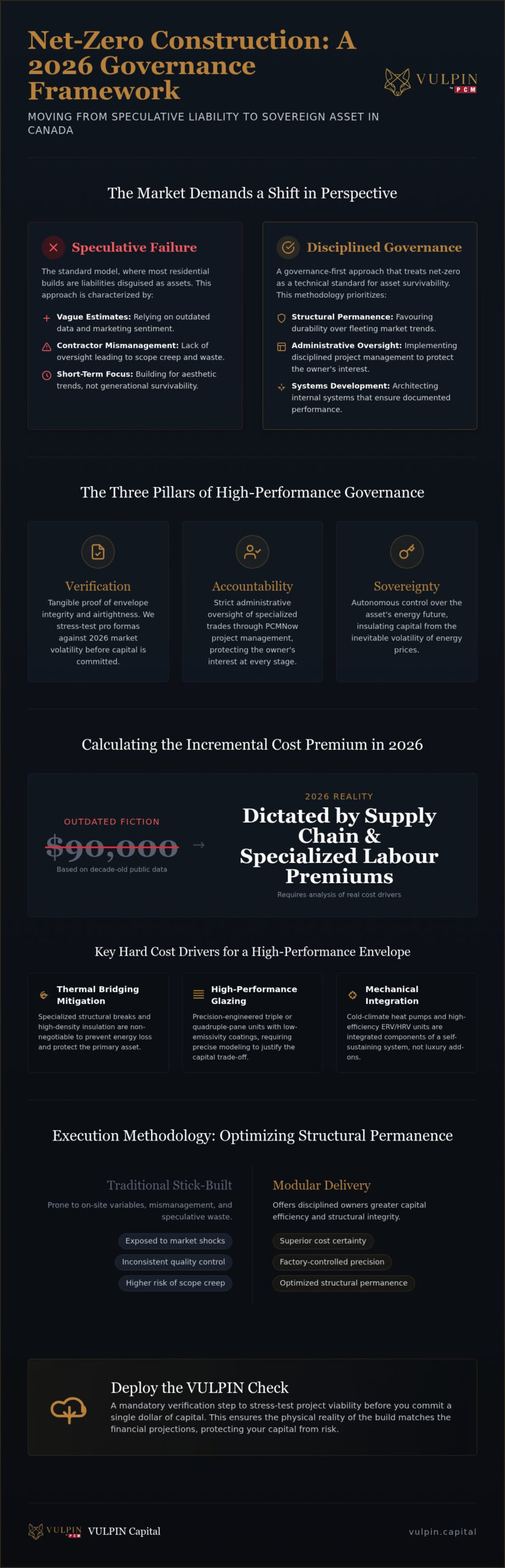
Governance is the antidote to scope creep and contractor mismanagement. You cannot manage what you do not verify. We establish a rigorous verification process for all energy targets before construction begins. The VULPIN Check is used to stress test sustainable pro formas against 2026 market volatility. This methodology focuses on three pillars:
- Verification: Tangible proof of envelope integrity and airtightness.
- Accountability: Strict administrative oversight of specialized trades.
- Sovereignty: Autonomous control over the asset’s energy future.
This is active asset management. It moves beyond the passive house ideals of the past. We don’t just build homes. We architect systems. This disciplined approach ensures that net-zero home construction costs Canada remain within the bounds of a realistic capital framework. We prioritize the integrity of the structure above all else. This is how you ensure long-term stability in an unstable market.
Calculating the Incremental Cost Premium in 2026
Outdated government data suggests an incremental cost of $90,000 for high-performance builds. This is a fiction. In 2026, the reality of net-zero home construction costs Canada is dictated by a supply chain that has yet to fully stabilize and a labour market where specialized skills command a significant premium. Relying on decade-old figures from public sources is a recipe for financial failure. True costs are found in the intersection of advanced material science and disciplined administrative oversight. You don’t build for today’s costs. You build for tomorrow’s survivability. The market rejects the unprepared.
Hard Costs: The High-Performance Envelope
The envelope is the primary asset. Achieving the necessary R-values requires more than just extra insulation. It demands sophisticated thermal bridging mitigation. High-performance fasteners and specialized membranes are non-negotiable. While triple-pane windows remain the current standard, the shift toward quadruple-pane glazing in northern climates represents a significant capital trade-off. This choice requires precise modelling to determine the point of diminishing returns. Mechanical systems are no longer luxury add-ons. They are integrated components of a self-sustaining system. Key hard cost drivers include:
- Thermal Bridging Mitigation: Specialized structural breaks and high-density insulation.
- High-Performance Glazing: Precision-engineered window units with low-emissivity coatings.
- Mechanical Integration: Cold-climate heat pumps and high-efficiency ERV or HRV units.
These hard costs are fixed by physical reality. They cannot be negotiated down without compromising the integrity of the structure. Any attempt to cut corners here will manifest as a long-term liability.
Soft Costs and Governance Fees
Energy modelling isn’t an administrative hurdle. It’s a financial safeguard. Skipping this step ensures your energy targets remain theoretical rather than physical. Without a rigorous PCMNow Project Management framework, the incremental cost premium often doubles due to mismanagement and scope creep. General contractors frequently have a conflict of interest. They prioritize their margin over your asset’s long-term performance. We allocate budget for third-party construction project audits because tangible verification is the only way to ensure the integrity of the build.
Labour premiums for specialized trades are a significant factor in 2026. Tradespeople who understand airtightness and complex mechanical integration are in high demand. If you attempt to use standard crews for a high-performance build, you’ll pay for their learning curve through rework and failed tests. Mismanagement is the single largest hidden cost in high-performance construction. To protect your capital, you must establish a governance layer that is independent of the build team. This is why the VULPIN Check remains the mandatory first step for those seeking a sovereign residential asset that will withstand the tests of time and regulation.
PCMNow: Disciplined Execution vs. Speculative Failure
Net-zero projects fail. They fail because they lack an uncompromising governance layer. Most owners rely on a General Contractor to manage the build. This is a mistake. A General Contractor prioritizes their own margin. You prioritize the performance of your asset. These goals are in conflict. This misalignment is the primary driver of inflated net-zero home construction costs Canada. PCMNow Project Management is the antidote. We do not simply manage the build; we govern it. We act as the Owner’s Representative to ensure technical standards are met without compromise. We reject the “trust me” culture of the construction industry. We replace it with tangible verification. This is how you control capital requirements. You don’t do it by cutting materials. You do it by eliminating mismanagement.
The Uncompromising Standard for Execution
Establishing a construction project governance framework is the first step. This is not optional. It is a manual for asset survivability. It provides the authority to reject contractor change orders that threaten the project’s integrity. Most change orders in high-performance builds signal a failure in planning or a lack of specialized knowledge. We use The Fox operating system to ensure every decision is driven by data. This internal logic ensures that the integrity of the structure remains the priority. We do not accept excuses. We only accept verified performance results. This disciplined approach ensures that net-zero home construction costs Canada remain tied to physical reality rather than speculative projections.
Rejecting the Speculative Flipping Mentality
Speculative flipping is the enemy of net-zero quality. Flipping focuses on superficial aesthetics and rapid exit strategies. Net-zero requires structural permanence and a commitment to generational value. We reject the frantic energy of the quick-turn market. FoxyHome assets are generational holdings. They are built for those who value long-term stability and autonomous control over their environment. Vetting your builder is mandatory. Do not look at their marketing materials. Look at their data. A builder who cannot produce documented airtightness results from previous projects is a liability. We mitigate financial risk through a focus on construction-cost reality. This is asset management for the disciplined owner who values the integrity of the structure above all else.
Modular vs. Stick-Built: Costs for the Disciplined Owner
The delivery method of a high-performance asset is a matter of capital efficiency. It is not a matter of stylistic preference. In 2026, site-built methods are often plagued by weather delays and inconsistent trade performance. These variables directly inflate net-zero home construction costs Canada. Modular delivery offers a controlled environment. It removes the chaos of the job site. FoxyHome integrates these modern techniques to ensure asset durability. We prioritize the reliability of the manufacturing process over the unpredictability of field labour. This is about structural permanence. It is not about traditional sentiment.
The Modular Financial Case
Manufacturing a home in a climate-controlled facility ensures that airtightness targets are met with mechanical precision. Precision engineering eliminates material waste. It prevents thermal leaks that are common in traditional builds. For family offices, this scalability is essential. Reduced construction timelines directly lower carrying costs. Capital is deployed more efficiently. The logistical costs of modular transport across the national landscape are a known variable. They are easier to manage than the unknown risks of a remote job site. We view modular delivery as a mechanical assembly. It is a predictable system that produces a reliable result. This approach minimizes the frantic energy of a typical construction site.
Stick-Built Realities in 2026
Stick-built construction remains a high-risk strategy for those concerned with net-zero home construction costs Canada. Managing on-site labour risks in remote locations is a significant administrative burden. Achieving net-zero airtightness in an uncontrolled environment is technically difficult. Wind, moisture, and temperature fluctuations compromise the integrity of membranes and seals. Managing construction project cost overruns is harder with site-built delivery. The lack of a controlled environment makes tangible verification nearly impossible until the structure is complete. By then, rework is expensive. We do not gamble with capital. We avoid delivery methods that rely on the hope of good weather and perfect trade coordination.
We do not accept the “standard” way of building. We architect systems that work. If you value structural permanence and disciplined capital deployment, you must choose a delivery method that supports those goals. Realizing a sovereign asset requires a methodology that rejects speculative waste. This is the only way to ensure the integrity of the structure. Establish your governance framework today to ensure your project remains viable and your capital remains protected from the volatility of the 2026 market.
Deploying the VULPIN Check for Your Net-Zero Asset
The final barrier to entry is the decision to commit capital. Most owners fail because they let emotion override engineering. Calculating net-zero home construction costs Canada requires a binary filter. We use the VULPIN Check as that filter. It is not a suggestion. It is a mandatory verification of viability before the first shovel hits the ground. If a project cannot survive a stress test against 2026 market volatility, it should not exist. We do not seek to save every project. We seek to protect the integrity of the capital and the structure.
The Viability Verification Process
Identifying early warning signs of project distress is a core competency. Sustainable builds often suffer from “optimism bias” where energy targets are prioritized over financial reality. We reject this. We commit resources only when there is predefined proof of viability. This stoic approach to pre-construction due diligence involves:
- Pro Forma Stress Testing: Validating material cost escalations against national supply chain data.
- Technical Audits: Ensuring the proposed envelope design meets the Fox operating system standards for durability.
- Labour Capacity Verification: Confirming the availability of trades capable of executing high-performance details.
Walk away. It is the strongest move an owner can make when the data fails. A pro forma that relies on aggressive tax credit assumptions or speculative energy savings is a liability. We only proceed when the internal logic of the system is self-sustaining.
Generational Asset Survivability
Transitioning from construction to long-term management requires a shift in mindset. You are no longer a builder. You are an asset operator. We utilize a condition-driven asset acquisition strategy to ensure the long-term hold remains profitable. Governance trumps market speculation every time. In the 2026 Canadian market, the only way to realize autonomous control is through documented performance. FoxyHome assets are designed for those who realize that structural permanence is the only hedge against inflation and regulatory shift.
Net-zero is the ultimate disciplined investment. It is not a trend. It is a sovereign philosophy grounded in physical reality. By rejecting the frantic energy of traditional markets, you establish a boundary of high-integrity professionalism. The VULPIN Check ensures that your capital is deployed into a system built to survive. This is the final word on net-zero home construction costs Canada. Build for permanence or do not build at all.
Securing the Sovereign Residential Asset
The pursuit of net-zero is not a search for environmental approval. It’s a commitment to asset survivability. We’ve established that net-zero home construction costs Canada are defined by disciplined governance rather than speculative market energy. You don’t build to flip; you build to hold. Structural permanence demands that you reject the “trust me” culture of standard contracting in favour of administrative oversight. It requires a methodology that prioritizes tangible verification over aesthetic trends.
Your capital deserves protection from the volatility of the 2026 market. By utilizing PCMNow Project Management, you ensure construction-cost reality. Through FoxyHome, you secure a generational asset designed for the future. The proprietary VULPIN Check serves as your final gatekeeper; it filters out projects that lack true viability. Take control of your architectural future by establishing a system that values integrity above all else. Success in high-performance construction is a matter of principle and precision. Apply the VULPIN Check to your sustainable project and begin the transition toward a resilient, self-sustaining asset.
Frequently Asked Questions
How much more does a net-zero home cost to build in Canada in 2026?
Net-zero home construction costs Canada in 2026 are dictated by technical reality rather than marketing sentiment. You should ignore outdated government targets that fail to account for current labour premiums and material escalations. The actual incremental cost represents a capital deployment into structural permanence. It’s a necessary expense to move an asset from a liability to a self-sustaining system. Precision in your initial pro forma is the only way to ensure the project remains viable.
Are net-zero homes a viable financial investment compared to traditional builds?
Traditional builds are becoming stranded assets as energy costs and regulations shift. A net-zero home is a viable financial investment if you prioritize long-term stability over speculative gains. We reject the frantic energy of the quick-turn market. These assets provide energy autonomy and protection against external economic shocks. You’re investing in a generational holding that maintains its value through documented performance and structural integrity. It’s a hedge against an unstable future.
What are the primary cost drivers in Canadian net-zero construction?
The primary cost drivers include the high-performance envelope, specialized mechanical systems, and the labour premium for skilled trades. Triple-pane or quadruple-pane glazing and advanced thermal bridging mitigation are non-negotiable hard costs. However, mismanagement is often the largest hidden driver. Without administrative oversight, scope creep and contractor errors can double the expected premium. Disciplined engineering and strict governance are required to manage these variables effectively and protect your capital from unnecessary waste.
Does a net-zero home require a specialized project manager?
Standard general contractors often have a conflict of interest that compromises the technical integrity of a build. A specialized manager using PCMNow project management acts as an uncompromising owner’s representative. This role is essential to verify that energy targets are met and that trades adhere to strict technical standards. You don’t manage what you don’t verify. Independent governance ensures that the integrity of the structure remains the primary objective throughout the construction process.
What is the VULPIN Check and why is it necessary for sustainable projects?
The VULPIN Check is a proprietary methodology used to verify project viability before any capital is committed. It involves stress testing your sustainable pro forma against 2026 market volatility and technical requirements. This process serves as a binary filter to identify early warning signs of project distress. We use it to ensure that resources are only deployed when there’s predefined proof of success. It’s a stoic approach to pre-construction due diligence.
Can existing Canadian homes be retrofitted to net-zero standards affordably?
Retrofitting an existing structure to true net-zero standards is a complex engineering challenge that often reveals unforeseen structural liabilities. While deep energy retrofits are possible, they frequently lack the capital efficiency of a new build. Achieving the necessary airtightness in an old envelope is difficult and expensive. For many owners, deploying capital into a new FoxyHome asset is the more disciplined choice. It ensures that the integrity of the system is built-in from the foundation up.
What are the long-term ROI benefits of a FoxyHome sustainable asset?
A FoxyHome asset delivers ROI through energy autonomy and generational durability. You aren’t just building a house; you’re architecting a sovereign system. The long-term benefits include complete protection from energy price volatility and a condition-driven asset value that exceeds speculative market trends. These homes are designed to survive for a century. They provide a stable, self-sustaining environment that functions independently of external infrastructure failures. This is the ultimate disciplined investment for a sovereign future.
How do I avoid cost overruns on a high-performance home project?
Avoiding cost overruns requires a governance-first framework established before the first shovel hits the ground. You must use the VULPIN Check to validate your budget against physical reality. Once construction begins, you should reject contractor change orders that don’t align with your technical energy modelling. Strict administrative oversight and tangible verification are the only ways to control net-zero home construction costs Canada. You don’t hope for a budget; you enforce one through disciplined project management.