

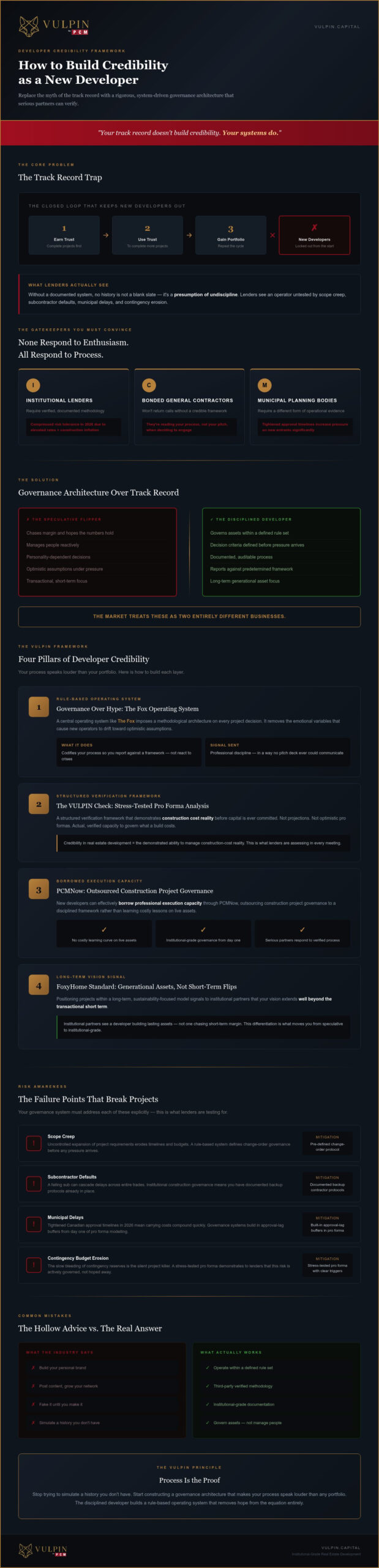
Your track record doesn’t build credibility. Your systems do. That’s a hard truth most new developers never hear, because the industry keeps telling them the same story: earn trust by completing projects, then use that trust to complete more projects. It’s a closed loop designed to keep new operators on the outside.
If you’ve already felt the weight of that reality, you’re not alone. Institutional lenders dismiss you before the meeting ends. Serious contractors don’t return calls. And without a disciplined framework to anchor your decisions, it’s easy to drift toward the speculative, transactional energy that defines the low end of this business. That’s not where you want to be.
Understanding how to build credibility as a new developer isn’t about faking a history you don’t have. It’s about constructing a governance architecture so rigorous that your process speaks louder than your portfolio. In this article, you’ll find a practical framework for doing exactly that: replacing the decades-long track record with verified methodology, disciplined execution capacity, and the kind of institutional-grade documentation that serious partners actually respect.
Key Takeaways
- Understanding how to build credibility as a new developer starts with replacing the myth of the track record with a rigorous, system-driven governance architecture that serious partners can verify.
- A rule-based operating system removes emotional bias from development decisions, allowing your process — not your portfolio — to signal professional discipline to lenders and contractors alike.
- The VULPIN Check functions as a structured verification framework, using stress-tested pro forma analysis to demonstrate construction cost reality before capital is ever committed.
- New developers can effectively borrow professional execution capacity through PCMNow, outsourcing construction project governance to a disciplined framework rather than learning costly lessons on live assets.
- Positioning your projects within a long-term, sustainability-focused model — as defined by the FoxyHome standard — signals to institutional partners that your vision extends well beyond the transactional short term.
The Mirage of the Track Record: Why Traditional Credibility Fails New Entrants
Credibility in real estate development has nothing to do with charisma. At its core, it’s a single, measurable thing: the demonstrated ability to manage construction-cost reality. Not projections. Not optimistic pro formas. The actual, verified capacity to govern what a build costs, what it takes, and what happens when the numbers shift. That’s what lenders are assessing. That’s what serious contractors are reading when they decide whether to return your call.
The problem is structural. When a developer has no history, the default assumption isn’t neutrality. It’s a presumption of undiscipline. Lenders don’t see a blank slate; they see an operator who hasn’t yet been tested by the specific pressures that break projects apart: scope creep, subcontractor defaults, municipal delays, and the slow erosion of contingency budgets. Without a documented system that addresses those exact failure points, a new developer is simply asking partners to absorb risk on faith alone. That’s not a pitch. That’s a liability.
The Canadian Development Landscape in 2026
Canadian lenders are operating with significantly compressed risk tolerance. Elevated interest rates, persistent construction inflation, and tightened municipal approval timelines have made institutional partners far more selective about who they back. In this environment, the “fake it until you make it” posture isn’t just ineffective; it’s a terminal strategy. The gatekeepers a new developer must convince, institutional lenders, bonded general contractors, and municipal planning bodies, each require a different form of evidence. None of them respond to enthusiasm. All of them respond to process.
Competence vs. Capital: The Developer’s Real Value
A developer’s function isn’t to find money. It’s to govern a real asset through a sequence of high-stakes decisions where the cost of error compounds. Lenders understand this distinction intuitively, which is why a rigid, documented methodology consistently outperforms a charismatic pitch. Third-party verification matters here precisely because new operators can’t rely on reputation to do that work. The system has to carry the weight instead.
This is the actual answer to how to build credibility as a new developer: stop trying to simulate a history you don’t have, and start constructing a governance architecture that makes your process the proof. The speculative flipper chases margin and hopes the numbers hold. The disciplined developer builds a rule-based operating system that removes hope from the equation entirely. Those are not the same business, and the market treats them accordingly.
Governance Over Hype: Establishing a Rule-Based Operating System
Most advice aimed at new developers circles back to the same hollow prescription: build your personal brand, post content, grow your network. That’s not a strategy. That’s noise. Headlines don’t survive a construction audit, and a LinkedIn following doesn’t reassure a lender when your contingency budget starts compressing. The real answer to how to build credibility as a new developer sits at the operational level, not the social one.
The shift that matters is structural. Stop thinking about managing people and start thinking about governing assets. These aren’t the same activity. Managing people is reactive, personality-dependent, and impossible to document in a way that satisfies institutional scrutiny. Governing assets means operating within a defined rule set, one that dictates decision criteria before the pressure arrives, not during it. That distinction is what separates a disciplined developer from a speculative one.
This is precisely the function of a central operating system like The Fox. It imposes a methodological architecture on every project decision, removing the emotional variables that cause new operators to drift toward optimistic assumptions. When your process is codified, your communication with lenders and contractors slows down in the best possible way. You’re not reacting. You’re reporting against a predetermined framework. That cadence signals professional discipline in a way that no pitch deck ever could.
Rejecting Speculative Energy
The Stoic Developer doesn’t chase deals. Projects either meet predefined viability criteria or they don’t advance. Full stop. This posture is immediately legible to high-integrity partners because it signals that your decisions are governed by documented standards rather than enthusiasm. Saying no to a project that lacks verified proof of viability isn’t caution; it’s the operating system working exactly as designed. Long-term stability isn’t a preference here. It’s a structural commitment built into every decision gate.
Implementing The Fox Methodology
An internal operating system like The Fox addresses a specific failure mode: the project that looks viable at inception and deteriorates through undisciplined execution. By establishing autonomous control protocols and repeatable documentation standards, it ensures that timeline governance and stakeholder reporting aren’t dependent on any single person’s judgment. The process holds the project together. That’s the kind of institutional-grade reliability that serious partners recognise immediately.
Documented, repeatable processes also solve a communication problem. When your reporting cadence is systematic rather than ad hoc, partners receive consistent, verifiable updates rather than reactive assurances. That rhythm builds a different kind of trust, one grounded in operational evidence. Developers who want to understand how this framework applies to their specific asset structure can explore the full methodology at VULPIN Capital’s governance platform.
Verification as a Value Add: Using the VULPIN Check to Secure Trust
Asking for feedback isn’t a credibility strategy. It’s a posture of deference that signals exactly what institutional partners fear most: an operator who doesn’t yet know what they don’t know. The question serious lenders are asking isn’t whether you’re open to input. It’s whether your numbers have been tested against construction-cost reality before you’ve committed a single dollar of their capital. That’s a fundamentally different standard, and it demands a fundamentally different tool.
The VULPIN Check is that tool. It functions as a structured, third-party governance and verification process designed to do one thing with precision: determine whether a project’s pro forma can survive contact with actual construction conditions. Not optimistic modelling. Not developer enthusiasm. Verified, stress-tested viability. Resources don’t move until that proof exists. That’s not caution for its own sake; it’s the operating principle that separates disciplined developers from speculative ones.
Stress Testing Construction Viability
A third-party construction project audit examines the components that optimistic pro formas routinely obscure: labour cost escalation, subcontractor sequencing risk, municipal approval lag, and the rate at which contingency budgets compress under real-world conditions. The VULPIN Check runs these variables against the project’s financial architecture before commitment, functioning as a shield against the construction-cost reality shocks that derail underprepared operators. Early warning signs, such as insufficient contingency allocation, unrealistic trade pricing, or timeline assumptions that don’t account for current permitting environments, are identified at the verification stage rather than discovered mid-build. That timing difference is everything.
Presenting Data to Stakeholders
When you present a project budget to a board or lending committee, the standard isn’t persuasion. It’s uncompromising honesty, supported by documented verification. Institutional capital doesn’t move on confidence; it moves on tangible evidence that the numbers have been pressure-tested by a methodology independent of the developer’s own optimism. That’s precisely where the VULPIN Check functions as the ultimate due diligence tool, giving stakeholders a verified foundation rather than a pitch to evaluate.
This is how to build credibility as a new developer without a portfolio to lean on: make the verification process itself the proof of competence. The VULPIN Check creates an exclusionary filter by design. Partners who require this standard of rigour are exactly the ones worth attracting. Partners who don’t aren’t the right fit for a governance-first operation. That’s not a limitation. That’s the system working correctly.
Professional Execution: Leveraging PCMNow for Construction Cost Reality
There’s a specific kind of hubris that costs new developers everything: the belief that managing a construction project is something you learn by doing it once. It isn’t. The failure modes are too numerous, too fast-moving, and too expensive to treat as a curriculum. Scope creep doesn’t announce itself. Subcontractor sequencing problems compound silently until they don’t. By the time an underprepared operator recognises the pattern, the contingency budget is already gone.
The disciplined answer isn’t to learn faster. It’s to stop treating construction project governance as a skill you need to develop independently before you can access it. PCMNow exists precisely to solve that problem. It functions as a borrowed execution framework, giving new developers access to institutional-grade construction project governance without requiring a decade of site-level experience to operate it. That’s not a shortcut. That’s the operating system doing what it was built to do.
The distinction between an owner’s representative and a standard construction manager matters here. A construction manager works for the build. An owner’s rep works for the asset. That difference in loyalty produces entirely different site behaviours. PCMNow operates from the owner’s position, maintaining rigid oversight of cost, scope, and timeline on behalf of the developer rather than the contractor. That structural separation is what prevents the slow erosion that dismantles underprepared projects.
Assembling a High-Integrity Team
Vetting builders beyond surface credentials means looking past licence documentation and completed project lists. The questions that matter are procedural: How do they handle change order requests? What does their subcontractor communication protocol look like? How do they document site decisions? Boutique firms with direct principal involvement answer these questions differently than large, detached corporations where accountability diffuses across management layers. A culture of documented accountability isn’t something you impose after the team is assembled. It’s a selection criterion from the first conversation.
Managing Cost Overruns and Contingencies
National construction contingency planning isn’t a fixed percentage applied uniformly. It’s a function of project complexity, municipal approval risk, and current trade pricing conditions. PCMNow’s governance framework treats contingency allocation as a living document, not a line item set at inception and ignored. When a contractor presents a change order, the response isn’t negotiation based on relationship. It’s a data-backed review against the original scope documentation. Either the change order reflects a verified deviation from the agreed scope, or it doesn’t advance. That’s the VULPIN philosophy made operational at the site level: every decision governed by documented standards, every cost deviation interrogated before it’s absorbed.
This is how to build credibility as a new developer without pretending to have experience you don’t possess. You borrow the execution architecture of operators who do. Explore PCMNow’s construction project governance framework to understand how that capacity applies to your asset structure.
The FoxyHome Model: Building Generational Assets, Not Short-Term Flips
The speculative flipper and the disciplined developer aren’t competing in the same business. They’re operating on entirely different time horizons, with entirely different risk profiles, and they attract entirely different capital. A developer who positions their work around generational asset durability isn’t just making a philosophical choice. They’re making a structural one that institutional partners and family offices read immediately.
FoxyHome represents that structural commitment made tangible. As VULPIN’s standard for environmentally conscious residential development, it reframes sustainable housing not as a premium feature but as the baseline expectation for any asset built to survive across decades of climate variability, energy cost escalation, and occupant turnover. In the Canadian context, where heating loads, moisture management, and envelope performance are non-negotiable engineering concerns rather than optional upgrades, high-performance construction isn’t idealism. It’s asset protection.
Sustainable Building as a Credibility Signal
Net-zero home construction costs are frequently misread as a premium expense rather than a durability investment. That framing is exactly backwards. An asset built to high-performance standards carries lower long-term operating costs, reduced maintenance liability, and stronger occupant retention, all of which translate directly into more predictable cash flow modelling for lenders. For a family office evaluating long-term survivability, those characteristics matter far more than a short-term margin play.
Integrating modern construction techniques with generational wealth goals through the FoxyHome standard also reduces the financial risk that underprepared developers absorb silently: deferred maintenance cycles, energy system obsolescence, and the accelerating cost of retrofitting assets that weren’t built correctly the first time. The FoxyHome model eliminates that deferred liability at the design stage rather than inheriting it at the balance sheet level.
This is precisely where understanding how to build credibility as a new developer intersects with asset philosophy. Choosing to build to a documented sustainability standard signals to institutional partners that your time horizon isn’t the next 18 months. It’s the next 40 years. That signal is not subtle, and serious capital reads it correctly.
Next Steps: From New Developer to Trusted Operator
Implementing the VULPIN system on a first project follows a clear sequence. The VULPIN Check establishes verified viability before capital is committed. PCMNow governs execution from groundbreaking through handover. The Fox provides the rule-based operating architecture that holds every decision to a documented standard. FoxyHome defines the asset quality threshold that positions the finished product for long-term institutional relevance.
Personal financial commitment alongside institutional capital isn’t optional within this framework. It’s the proof of alignment that serious partners require before they engage. Skin in the game isn’t a negotiating posture; it’s an operating principle.
How to build credibility as a new developer doesn’t begin with a pitch. It begins with a verified decision to govern assets with the same rigour that experienced operators have spent decades developing. That decision is available now. Contact VULPIN Capital to implement the VULPIN Check on your next asset.
Your Process Is Your Portfolio: Start Building It Now
Knowing how to build credibility as a new developer comes down to one decision: stop waiting for a track record to materialise and start constructing the governance architecture that replaces it. The framework covered here isn’t theoretical. The VULPIN Check stress-tests your numbers before capital is ever committed. PCMNow gives you disciplined execution capacity without requiring years of site-level experience to access it. And the FoxyHome standard signals to serious partners that your time horizon extends well beyond the next transaction.
None of this requires a completed project. It requires a decision to operate at an institutional standard from day one. That’s not a small distinction. That’s the entire difference between developers who attract serious capital and those who don’t.
The market doesn’t reward enthusiasm. It rewards verified process. If you’re ready to build on that foundation, secure your project’s future with the VULPIN Check and take the first step toward becoming the kind of operator serious partners actually want to work with.
Frequently Asked Questions
How can a new developer get a construction loan without a track record?
The answer isn’t to simulate experience you don’t have; it’s to replace the track record with verified process documentation. Lenders assess risk, and a rigorous governance framework, stress-tested pro formas, and third-party verification of construction cost viability can substitute for portfolio history. Personal capital commitment alongside the ask also signals alignment rather than speculation.
Canadian institutional lenders in the current rate environment respond to evidence, not enthusiasm. Arriving with documented decision criteria, a verified budget, and a disciplined execution framework gives underwriters something concrete to evaluate. That’s a fundamentally different conversation than asking a lender to absorb risk on faith alone.
What is the VULPIN Check and how does it help new developers?
The VULPIN Check is a structured verification process that stress-tests a project’s pro forma against actual construction cost conditions before any capital is committed. It examines variables that optimistic modelling routinely ignores: labour escalation, subcontractor sequencing risk, municipal approval lag, and contingency compression under real-world site conditions.
For a new developer learning how to build credibility as a new developer without a completed project to reference, the VULPIN Check functions as third-party proof of competence. It demonstrates to lenders and partners that your numbers have been pressure-tested by a methodology independent of your own optimism. That verification becomes the credibility the portfolio hasn’t yet produced.
Is it better to hire a large construction firm or a boutique project management team?
Size isn’t the relevant variable. Accountability structure is. Large firms often distribute responsibility across management layers in ways that make it difficult to identify who owns a specific decision when costs shift or sequencing breaks down. Boutique firms with direct principal involvement tend to produce clearer lines of documented accountability from the first site meeting.
The more important question is whether the team operates from the owner’s position or the contractor’s. An owner’s representative governs the asset; a construction manager governs the build. Those loyalties produce different site behaviours, different change order cultures, and different outcomes when contingency budgets start compressing.
How do I prevent cost overruns on my first development project?
Prevention starts at the verification stage, not the construction stage. Contingency budgets set at inception and treated as fixed line items are the single most common structural failure in first-time development projects. Realistic contingency allocation requires understanding current trade pricing conditions, municipal approval risk, and project complexity, not applying a uniform percentage across all asset types.
Every change order request needs to be interrogated against the original scope documentation before it’s absorbed. If a deviation isn’t verified against the agreed scope, it doesn’t advance. That discipline, applied consistently from groundbreaking through handover, is what separates projects that close on budget from those that don’t.
Can sustainable building actually increase my project’s ROI in Canada?
It depends on how ROI is being measured. High-performance construction typically carries higher upfront costs, but it reduces long-term operating expenses, lowers maintenance liability, and produces stronger occupant retention. For assets held over extended periods, those characteristics translate into more predictable cash flow modelling, which is exactly what institutional lenders and family offices want to see.
In the Canadian context specifically, envelope performance, heating load management, and moisture control aren’t optional upgrades; they’re engineering requirements for an asset built to survive across decades of climate variability. Building to a documented sustainability standard like FoxyHome eliminates the deferred retrofit liability that underprepared assets accumulate silently over time.
What are the most common reasons new development projects fail?
The failure modes cluster around a few consistent patterns: pro formas built on optimistic assumptions rather than verified cost data, contingency budgets that don’t reflect actual project complexity, and governance structures that depend on individual judgment rather than documented decision criteria. When any one of these collapses under site pressure, the others tend to follow quickly.
Scope creep is the quietest of these failure modes. It doesn’t announce itself; it compounds through small, undocumented deviations until the budget is structurally compromised. Developers who lack a rule-based framework for evaluating change orders absorb those costs reactively rather than governing them proactively. By the time the pattern is visible, the contingency is already gone.
How do I build a relationship with institutional lenders in Canada?
Institutional relationships aren’t built through networking; they’re built through demonstrated process rigour. A lender’s underwriting team isn’t evaluating your personality; it’s assessing whether your governance architecture can survive the specific pressures that break projects apart. Arriving with verified pro formas, documented decision criteria, and a disciplined execution framework positions you as an operator worth backing rather than a risk to be managed.
Consistency matters as much as the initial impression. Reporting against a predetermined framework rather than reacting to events as they arise signals the kind of operational discipline that institutional partners recognise immediately. That cadence, maintained across every stakeholder interaction, builds the kind of trust that a single pitch meeting can’t manufacture.