

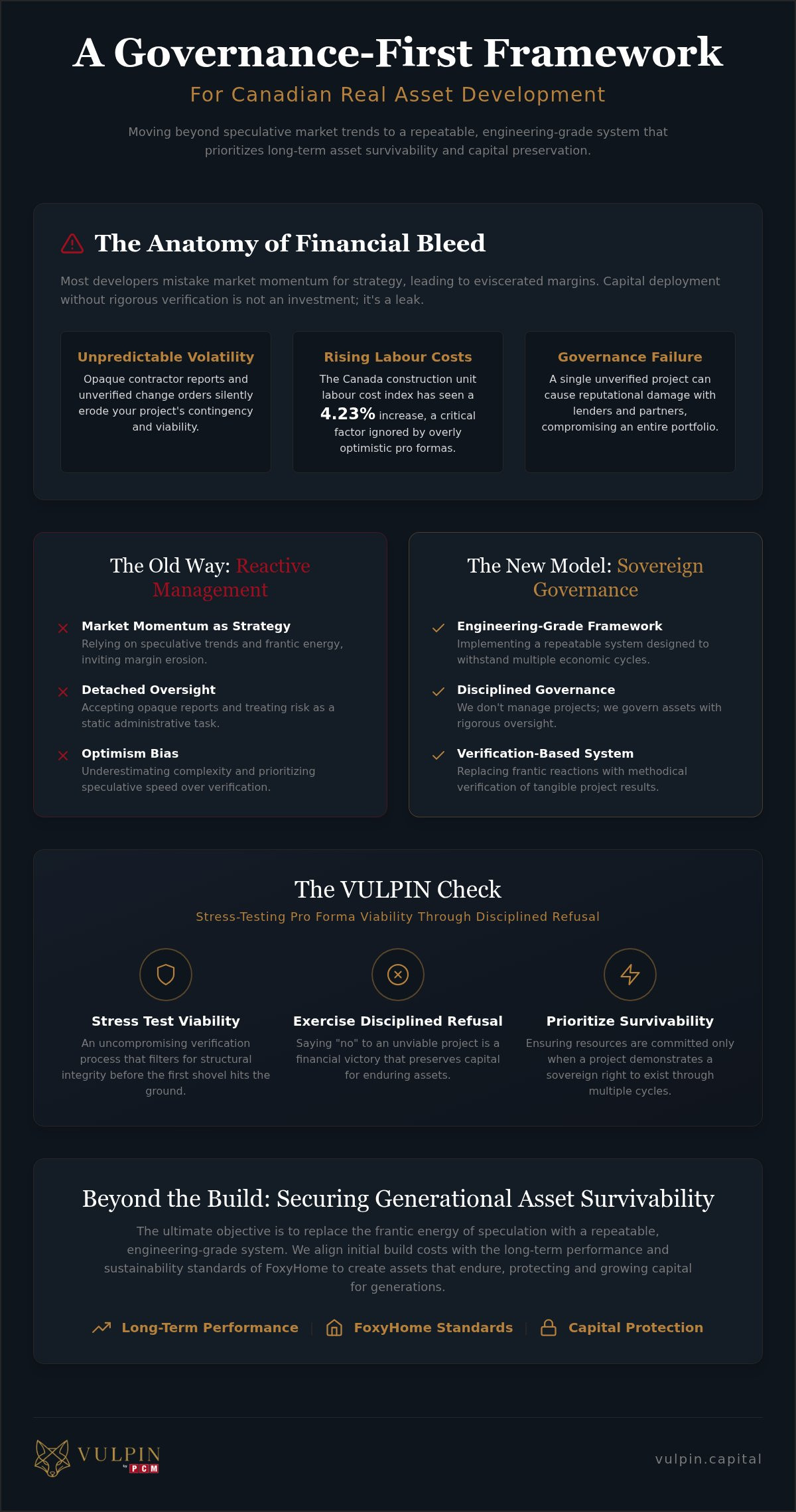
Most Canadian developers mistake market momentum for a strategy, only to find their margins eviscerated by the first shift in material indices. You likely feel the weight of unpredictable price volatility and the frustration of unverified change orders that erode your project’s viability. Relying on opaque contractor reports is no longer a viable path to capital preservation. In this environment, a rigorous construction project financial risk assessment Canada is not a luxury; it’s a structural necessity for any operator who values asset survivability over speculative speed. We refuse to participate in the frantic energy of traditional markets.
You recognize that the current landscape, marked by a 4.23 percent increase in unit labour costs and evolving safety mandates, requires more than just hope. We promise to provide you with an engineering-grade framework designed to withstand multiple economic cycles. You’ll learn how to replace frantic market reactions with a repeatable, verification-based system that prioritizes long-term stability. This handbook outlines the transition from detached management to a disciplined, governance-first methodology. We’ll examine the specific protocols required to ensure your capital remains protected regardless of external market franticness or shifting provincial tax regulations.
Key Takeaways
- Utilize the VULPIN Check to stress test pro forma viability and exercise the power of disciplined refusal when assets don’t meet strict governance standards.
- Establish an uncompromising standard for execution by transitioning from reactive construction management to the sovereign governance model of PCMNow Project Management.
- Implement a rigorous construction project financial risk assessment Canada to identify scope creep and early warning signs before they erode project contingencies.
- Secure generational asset survivability by aligning initial build costs with the long-term performance and sustainability standards of FoxyHome.
- Replace the frantic energy of speculative market trends with a repeatable, engineering-grade system for verifying tangible project results.
The Anatomy of Financial Risk in Canadian Construction: Why Projects Bleed Capital
Financial risk in the Canadian built environment isn’t merely a spreadsheet error. It’s the tangible possibility of capital loss through the unverified deployment of resources. A professional construction project financial risk assessment Canada requires moving beyond surface-level estimates to scrutinize the structural integrity of the entire pro forma. We reject the standard industry practice of hoping for the best while ignoring the friction of physical reality. Capital deployment without verification is not an investment. It’s a leak.
National developers often fall victim to a chronic optimism bias. They underestimate the administrative and physical complexity of execution across diverse Canadian landscapes. This frantic energy, fueled by a desire for speculative speed, acts as a solvent to structural permanence. When you prioritize velocity over verification, you invite the erosion of margins. True stability isn’t found in market momentum. It’s found in the rejection of speculative trends in favour of engineering-grade oversight.
Traditional project management fails because it treats risk as a static administrative task. It prioritizes detached management over the disciplined governance required for asset survivability. By ignoring sophisticated risk assessment methodologies, these managers allow capital to bleed through unmonitored change orders and opaque reporting from general contractors. We don’t manage projects. We govern assets.
Root Causes of Budget Instability
Instability begins with unverified assumptions. Unforeseen site conditions frequently stem from a failure in pre-construction geotechnical verification. This is compounded by scope creep. It’s a slow, silent erosion of pro forma margins where unmonitored design changes consume your contingency fund before the foundation is even set. The Canadian supply chain adds another layer of friction. With the Canada construction unit labour cost index reaching 145.22 in early 2026, representing a 4.23 percent increase from the previous year, any assessment ignoring these specific inflationary pressures is essentially a work of fiction.
The Financial Tuition of Governance Failure
The cost of governance failure extends far beyond a depleted bank account. It manifests as reputational damage with institutional lenders and national private partners that can take decades to repair. A single unverified project can compromise the integrity of an entire real estate portfolio. This is the distinction between a calculated investment and a speculative gamble. We don’t build for the next fiscal quarter. We build for generational survivability. True governance means having the discipline to recognize when a project’s risk profile no longer aligns with the sovereign reality of the Canadian market.
The VULPIN Check: Stress Testing Pro Forma Viability Through Disciplined Refusal
Risk is not a data problem solvable by software alone. While competitors suggest that real-time tracking prevents overruns, we recognize that tracking a disaster is not the same as preventing one. True governance begins before the first shovel hits the ground. The VULPIN Check is our uncompromising verification process for capital deployment. It’s designed to filter for structural integrity, ensuring that resources are only committed when a project demonstrates a sovereign right to exist. We prioritize asset survivability over the frantic speed of the speculative market.
A rigorous construction project financial risk assessment Canada requires moving beyond the theoretical comfort of a spreadsheet. We demand physical evidence of viability. This involves the principle of disciplined refusal. Saying “no” to an unviable project is not a failure; it’s a financial victory that preserves capital for assets capable of enduring multiple economic cycles. We do not participate in the optimism bias that chronically plagues national development. We verify reality instead.
The Three Pillars of Financial Stress Testing
Our methodology rests on technical, financial, and operational pillars. Technical verification involves a deep audit of design documents to identify coordination gaps and engineering errors that traditional managers overlook. Financial stress testing applies realistic contingencies based on current Canadian market conditions. With average year-over-year construction costs increasing by 4.70 percent as of early 2026, your pro forma must account for the specific volatility of national labour and material rates. Finally, operational readiness ensures the team is structured for autonomous control. We don’t rely on hope. We rely on documented systems.
Implementing a Governance-First Audit
Developer bias is a silent margin killer. Implementing a third-party construction project financial risk assessment Canada serves as a necessary linguistic and financial speed bump. It forces a pause. The VULPIN Check acts as a filter, identifying high-integrity partners who value transparency over opaque reporting. This audit is the national standard for real asset deployment. It ensures that every dollar spent is backed by a verified milestone. For those seeking to move beyond speculative models, the first step is adopting a governance-first deployment strategy that rejects the frantic energy of the status quo. We build for permanence, not for the next market cycle.
PCMNow Governance: Shifting from Reactive Management to Sovereign Execution
Reactive management is a posture of failure. It waits for the budget to bleed before applying a bandage. We replace this frantic energy with PCMNow Project Management. This is an uncompromising standard for complex execution that functions as the mechanical heart of a construction project financial risk assessment Canada. It ensures that every action taken on-site is a deliberate move toward asset survivability. We don’t manage projects. We govern them through institutional oversight and structural permanence. This approach rejects the excitement of speculation in favour of grounded, physical reality.
Effective governance requires a master craftsman mentality. It isn’t about detached managers observing from a distance. It’s about highly invested operators who understand the internal logic of the build. When you move beyond the frantic pace of traditional markets, you gain the clarity needed to enforce strict standards. We prioritize long-term temporal frameworks over quick wins. This steady cadence reinforces the integrity of the structure above all else.
Owner’s Rep vs. Construction Manager: A Governance Distinction
The distinction is sovereign. A traditional construction manager is often focused on the schedule of values and the immediate contract requirements. They operate within the existing market franticness. In contrast, an Owner’s Rep must act as a sovereign entity. Their primary loyalty is to the long-term health of the asset, not the contractor’s profit margin. Traditional general contracting models contain inherent conflicts of interest. Their efficiency often comes at the expense of your durability. PCMNow eliminates this friction. It positions the representative as an architect of systems who values tangible verification over theoretical modeling.
The Mechanics of Disciplined Execution
Sovereign execution requires a documented construction project governance framework. This framework acts as a linguistic and operational speed bump. It forces the team to process the gravity of every decision before capital is deployed. We utilize ‘The Fox’ operating system to facilitate condition-driven decision-making. This system removes emotional urgency from the job site. Decisions are made based on tangible verification and strict standards. Whether it’s responding to the 1.4 percent national increase in non-residential construction costs reported in Q2 2026 or managing site-specific hurdles, the process remains rhythmic and methodical. Rule-governed operations ensure project survivability regardless of external economic cycles. This is how we achieve autonomous control over the build environment.
A Stoic Handbook for Risk Mitigation: Identifying Early Warning Signs
Stoic risk management demands that we acknowledge failure before the first shovel hits the ground. It’s an engineering-grade discipline. We don’t hope for success; we architect systems that make failure nearly impossible. A proper construction project financial risk assessment Canada identifies the “slow bleed” of scope creep before it consumes the contingency fund. This requires rejecting the speculative flip mentality that prioritizes short-term exit speed over long-term hold stability. We build for generational survivability, not for the next market peak. By defining what we refuse to be, we establish a boundary of high-integrity professionalism.
Effective intervention must happen early. Waiting until the budget is blown is a management failure. We focus on managing construction project cost overruns through a framework of early identification and disciplined refusal. Competitors rely on field apps and daily reports, but these often mask systemic risks behind minor task completions. We look for the rot in the governance structure itself. True stability isn’t found in a digital dashboard; it’s found in the integrity of the process.
Red Flags of Project Distress
Identifying distress requires looking past the frantic energy of the job site to find the institutional cracks. Silence in construction is expensive. You must be vigilant for these specific markers:
- Delayed submittals: These are never just administrative hurdles. They represent cascading failures that directly impact the critical path and carrying costs.
- Unexplained change order frequency: If sub-trades are constantly revising costs, your pre-construction verification was insufficient.
- Communication decay: When field operators stop being transparent with the governance office, the project’s integrity is compromised.
Five Steps to Mitigate Financial Risk Nationally
Mitigation is a rhythmic, methodical process. It requires moving from philosophical foundations to specific execution frameworks. Follow these steps to ensure asset survivability:
- Establish a rigid change order approval process: Every request requires a formal pro forma impact analysis before approval. No exceptions.
- Conduct monthly third-party construction project audits: Verification must be independent of the project team to eliminate internal developer bias.
- Maintain a condition-driven acquisition strategy: Prioritize asset integrity and physical reality over market timing or speculative trends.
- Enforce strict financial reporting standards: Every stakeholder must provide transparent, engineering-grade data that allows for autonomous control.
- Implement sovereign oversight: Ensure the project operates on a different time scale than the rest of the world, prioritizing long-term temporal frameworks.
If you’re ready to move beyond the frantic energy of traditional development, secure your asset’s future through our governance platform.
Beyond the Build: Securing Generational Asset Survivability
Handover is not a conclusion. It is the beginning of a forty-year financial endurance test. Most developers treat the completion of a build as the point of exit, but we view it as the commencement of sovereign asset management. A comprehensive construction project financial risk assessment Canada must account for the operational decade that follows. We reject the “speculative flip” mentality. It is a posture of weakness that relies on market timing rather than structural integrity. Instead, we integrate net-zero home construction costs in Canada into a long-term performance model. This ensures the asset remains viable through shifting carbon regulations and energy price volatility. We prioritize durability over the frantic pace of traditional exit strategies.
FoxyHome represents our commitment to this generational survivability. We don’t build for the current interest rate environment; we build to endure the inevitable cycles of the Canadian economy. This requires a transition from disciplined execution to a condition-driven asset acquisition strategy. We only hold what we can verify. Verification is the only antidote to the uncertainty of the future.
Sustainable Housing as a Generational Asset
FoxyHome utilizes industrial-grade techniques to ensure energy independence and structural permanence. We do not chase aesthetic trends. We prioritize the internal logic of the structure. The financial case for high-performance buildings in Canada is clear when you look past the initial capital outlay. While traditional builds suffer from rapid depreciation and rising utility costs, sustainable assets maintain their value across economic downturns. This is the difference between a liability and a generational asset. We choose to hold superior quality rather than participate in the frantic energy of the retail market. Our systems are designed to filter for specific partners who value this level of integrity.
The Role of The Fox in Post-Construction Governance
Governance does not end at the ribbon-cutting. We utilize ‘The Fox’ to monitor building performance with technical precision. Deferred maintenance is a silent erosion of capital. By implementing a portfolio-wide capital improvement plan, we prevent the decay that typically follows a detached management approach. Our systems ensure autonomous control over the asset’s lifecycle. We invite you to organize your next Canadian development under a governance-first framework that values permanence over speed. Stop managing projects. Start governing assets. True wealth is built on the survivability of the structure, not the excitement of the trade.
Transitioning to Sovereign Asset Governance
The frantic energy of traditional Canadian development is a liability. We’ve outlined a framework that rejects the speculative flip in favour of structural permanence. True capital preservation requires a rigorous construction project financial risk assessment Canada that prioritizes verification over optimism. By implementing the proprietary VULPIN Check methodology, you move from detached management to a master craftsman mentality. This shift ensures your resources are only deployed when viability is a proven reality rather than a spreadsheet projection.
PCMNow Project Management ensures national Canadian execution through an uncompromising standard of administrative oversight. This is not about tracking errors in real-time; it’s about governing assets through sovereign representation. With condition-driven asset management via The Fox, your project transitions from a construction site to a generational asset capable of surviving multiple economic cycles. You don’t have to participate in market volatility. You can choose autonomous control and structural integrity instead.
Secure your asset’s future with VULPIN Capital’s governance framework. Build with the discipline that your capital deserves.
Frequently Asked Questions
What is the most common cause of construction cost overruns in Canada?
Optimism bias and the failure of pre-construction geotechnical verification are the primary drivers of overruns. Developers chronically underestimate complexity. A rigorous construction project financial risk assessment Canada identifies these site-specific hurdles before capital deployment. We reject the frantic energy of speculative speed. By prioritizing verification over market momentum, we eliminate the unmonitored erosion of pro forma margins. Stability is built on physical reality; not spreadsheet hope.
How does the VULPIN Check differ from a standard construction project audit?
Standard audits are historical post-mortems that track a disaster after it has occurred. The VULPIN Check is a forward-facing governance standard. It functions as a linguistic and operational speed bump. We demand physical evidence of project viability before any resource is committed. This process filters for high-integrity partners who value transparency. We don’t just record costs; we exercise the power of disciplined refusal to protect your capital from unviable assets.
Can disciplined governance actually reduce the total cost of a project?
Disciplined governance reduces total costs by preventing the slow bleed of unmonitored change orders and scope creep. While the initial investment in oversight is higher, it eliminates the financial tuition of governance failure. We prioritize asset survivability across multiple economic cycles. By removing emotional urgency and market pressure from the job site, we ensure that every dollar spent is backed by a verified milestone. Efficiency comes from structural integrity; not speed.
Is an Owner’s Representative necessary for smaller-scale Canadian developments?
Sovereign representation is a structural necessity regardless of project scale. Small-scale developments are often more vulnerable to the inherent conflicts of interest in traditional general contracting. An Owner’s Rep acts as a sovereign entity focused solely on the long-term health of your asset. PCMNow Project Management provides the administrative oversight needed to prevent detached management. We ensure your capital remains protected from the frantic energy of the retail market and speculative trends.
How do you handle material price fluctuations in a fixed-price contract?
We mitigate price volatility through strict supply chain verification and realistic contingencies within the pro forma. Fixed-price contracts often mask systemic risks if the contractor hasn’t secured material indices early. We analyze the 2026 Canada construction unit labour cost index to ensure your assessment reflects current inflationary pressures. Governance means having the discipline to recognize when a contract’s risk profile no longer aligns with the sovereign reality of the Canadian supply chain.
What are the early warning signs that a contractor is losing control of the budget?
Communication decay and delayed submittals are the earliest red flags of project distress. When field operators stop being transparent with the governance office, the project’s integrity is compromised. You must monitor the frequency of unexplained change orders from sub-trades. These are never just administrative hurdles; they are cascading failures. Identifying these signs early allows for the intervention required to prevent scope creep from consuming your entire project contingency fund.
How does FoxyHome ensure long-term asset survivability in cold climates?
FoxyHome utilizes industrial-grade techniques to ensure energy independence and structural permanence in harsh environments. We integrate net-zero construction standards to withstand Canadian climatic shifts. This approach moves beyond aesthetic trends to prioritize the internal logic of the structure. By engineering for generational survivability, we create assets that remain viable regardless of external energy price volatility. We build for the physical reality of the north, not for the next fiscal quarter.
What role does ‘The Fox’ play in preventing post-construction financial overruns?
‘The Fox’ operating system facilitates condition-driven decision-making to prevent capital decay after handover. It monitors building performance with technical precision. Deferred maintenance is a silent solvent of asset value. By implementing a portfolio-wide capital improvement plan, we replace reactive management with rhythmic oversight. This system ensures autonomous control over the asset’s lifecycle. We protect your capital from the financial overruns that typically follow a detached post-construction management posture.