

Most Canadian real estate participants are not investors; they are gamblers waiting for a market shift that will never favour the undisciplined. With the Bank of Canada holding the policy interest rate at 2.25 percent and the CRA reclassifying short-term gains as fully taxable business income, the floor has dropped out for the speculative flipper. You recognize that the frantic pursuit of market-timing is a failing strategy. You’re likely tired of construction cost unpredictability and the hollow promises of poorly executed housing projects that lack structural integrity.
This article provides a transition to a governance-first framework for long-term asset development in the Canadian landscape. We reject the digital abstractions of traditional finance in favour of physical verification and sovereign control. You’ll learn how to replace speculation with a repeatable methodology for asset survivability and generational wealth. We’ll outline how to minimize financial exposure during construction by implementing rigorous project governance and high-performance standards that ensure your real assets endure for decades, not just until the next sale.
Key Takeaways
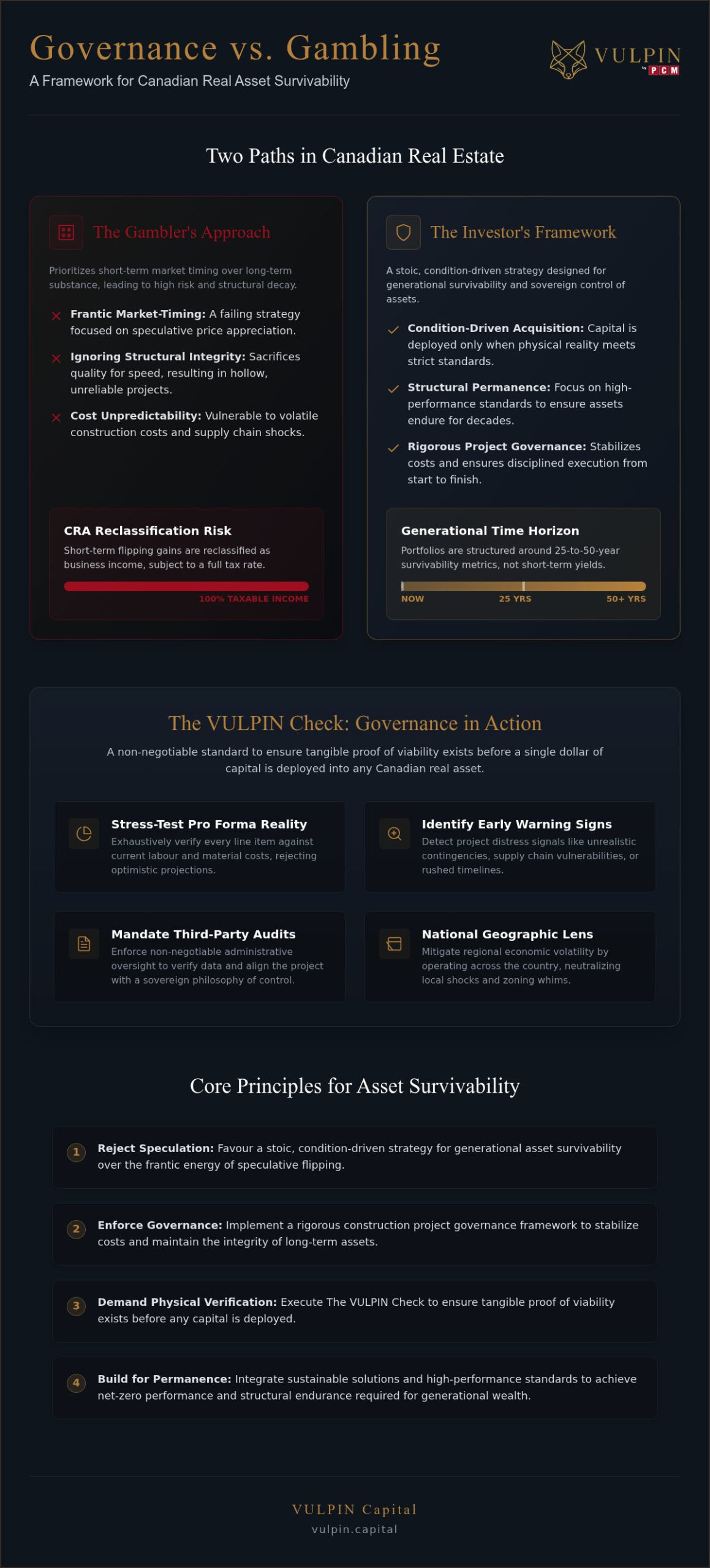
- Reject the frantic energy of speculative flipping in favour of a stoic, condition-driven strategy for generational asset survivability.
- Enforce the VULPIN Check to ensure tangible proof of viability exists before a single dollar of capital is deployed into any Canadian real asset.
- Establish a rigorous construction project governance framework to stabilize cost unpredictability and maintain the integrity of long-term asset development.
- Navigate a fiscal environment where the CRA reclassifies short-term gains as 100% taxable business income, making a hold-forever strategy a structural requirement.
- Integrate FoxyHome sustainable solutions to realize net-zero performance while prioritizing the structural permanence required for generational wealth.
What is Long-Term Asset Development in the Canadian Market?
Long-term asset development is the intentional creation of physical structures designed for generational survivability. It’s not a five-year exit strategy. It’s a commitment to the next half-century of utility. In the Canadian market, participants often succumb to the frantic energy of urban centres, chasing price appreciation while ignoring structural decay. We reject this. We prioritize a systematic approach to governance that treats real property as a durable engine of wealth rather than a digital ticker symbol. This governance-first model ensures that capital is only deployed when physical reality matches theoretical projections. Real Asset Governance is the bedrock of our methodology; it’s the administrative oversight that ensures every bolt, beam, and budget line aligns with a sovereign philosophy of control.
A national perspective is mandatory to mitigate regional economic volatility. Canada’s provincial markets fluctuate independently. By operating with a broad geographic lens, we neutralize local shocks. We don’t gamble on a single city’s zoning whims or specific employment shifts. We build for permanence across the country, ensuring that our framework for long-term asset development remains resilient against localized downturns. We value the “tuition” paid on failed projects in the past. Those lessons have taught us that discipline is the only path to survivability in a country defined by rugged conditions and shifting regulations.
The Rejection of Speculative Flipping
Market-timing is a gamble. It’s not a strategy for serious capital. Speculative flipping is a high-risk departure from asset integrity that prioritizes speed over substance. We choose condition-driven acquisition instead. If the physical and economic conditions of a project don’t meet our strict internal standards, we don’t proceed. We don’t care about market-driven hype or the fear of missing out. We focus on tangible verification. We don’t trust models that haven’t been stress-tested against the rugged reality of Canadian construction. True wealth isn’t found in the quick flip; it’s found in the assets that remain standing when the speculators have gone bust.
Defining the Generational Time Horizon
We organize every portfolio around 25-to-50-year survivability metrics. This requires a fundamental shift in how we measure success. Short-term yield is secondary to structural permanence. We use “The Fox” operating system to maintain this long-term temporal framework. It acts as a governor, preventing the frantic decision-making that ruins most developments. High-performance real assets are the ultimate hedge against inflation. They don’t just store value; they produce it through every economic cycle. We build systems that work when the rest of the market fails. By focusing on long-term asset development, we ensure that our structures provide value for decades, outlasting the noise of current financial trends.
The Architecture of Asset Survivability: Why Governance Trumps Speculation
Governance isn’t just a compliance requirement; it’s the architecture of survivability. Most Canadian developers rely on market momentum to cover operational flaws. We don’t. We’ve paid the “tuition” on failed projects in past cycles. We know that without rigorous oversight, capital evaporates when construction costs fluctuate. Our framework for long-term asset development demands that engineering, governance, and sovereign philosophy merge into a single point of truth. We don’t commit capital based on a spreadsheet that hasn’t been stress-tested against the rugged reality of the Canadian landscape. We commit only when predefined proof of viability exists.
The VULPIN Check: Stress Testing Construction Viability
Before ground is broken, we execute The VULPIN Check. This isn’t a cursory review. It’s an exhaustive verification of pro forma reality. We audit every line item to ensure it reflects current labour and material costs. We look for the early warning signs of project distress: unrealistic contingencies, supply chain vulnerabilities, or optimistic timelines. Third-party construction audits aren’t optional for national developments; they’re a non-negotiable layer of administrative oversight. If the project’s data doesn’t withstand this pressure, it doesn’t move forward. You can examine our governance platform to see how we filter for high-integrity partners.
Asset Survivability and “The Fox” Operating System
“The Fox” serves as the engine of our decision-making. It’s a rule-governed operating system that purposefully ignores market noise and frantic energy. It provides a framework where decisions are made based on internal logic rather than external pressure. Autonomous control over the development process is the only way to ensure an asset survives 50 years of economic shifts. We don’t outsource our core logic to brokers or detached managers. We use internal systems that prioritize structural permanence and tangible verification over theoretical modeling. This disciplined execution is the only path to securing generational wealth through long-term asset development.
Long-Term Hold vs. Speculative Flipping: A Comparison of Risk and Reality
Speculative flipping in Canada has become a tax-inefficient gamble. As of 2026, the CRA has tightened enforcement, reclassifying short-term gains as 100 percent taxable business income rather than 50 percent taxable capital gains. When you add the friction of municipal land transfer taxes and rising transaction fees, the margin for error in a two-year flip evaporates. We reject this frantic pursuit of quick exits. Instead, we prioritize long-term asset development. A hold-forever strategy allows capital to compound while avoiding the friction of frequent transactions. It requires the psychological discipline to ignore “hot” markets and focus on the structural integrity of the asset. We build a moat around our portfolio by utilizing a condition-driven asset acquisition strategy. This ensures we only acquire when the physical state of the asset and the economic environment align with our fifty-year survivability metrics.
Risk Mitigation in National Developments
Equity is protected through a construction project risk management framework that prioritizes verification over optimism. We don’t rely on the performance of a single regional market. By maintaining diversified geographical exposure across Canada, we insulate the portfolio from localized economic shocks. Disciplined real estate investing principles don’t change with market trends. They’re rooted in administrative oversight and the rejection of external urgency. We realize that the only way to ensure an asset’s endurance is to govern the development process with a national perspective, neutralizing the volatility inherent in specific provinces or territories.
The Real Cost of Construction Reality
Real estate income is never passive. It’s the result of relentless operational discipline. Most developers fail because they trust a spreadsheet more than a job site. We use PCMNow project management to maintain a grip on execution costs during every phase of the build. Construction-cost reality is the delta between a spreadsheet and a job site. It’s where most projects die. By enforcing strict standards and tangible verification, we close that delta. We don’t accept “estimates” that lack backup data. Our commitment to long-term asset development means we manage the physical reality of the build with the same rigour we apply to our financial models. This is the only way to ensure the asset survives the transition from a pro forma to a high-performance physical structure.
Implementing a Condition-Driven Acquisition and Development Strategy
Execution is where theory meets the job site. We don’t trust standard business plans or generic financing templates. Successful long-term asset development requires a mechanical, step-by-step approach to implementation. We begin by establishing a construction project governance framework. This manual dictates every operational move, ensuring the asset is built for fifty-year survivability rather than a quick exit. Once the framework is set, we conduct the VULPIN Check. This process validates every line item in the pro forma against current Canadian market data, stripping away the optimism that leads to insolvency.
The third step involves deploying PCMNow for uncompromising project management. We don’t accept the “close enough” mentality common in large-scale developments. We demand precise cost control. Finally, we integrate FoxyHome sustainable housing solutions. These aren’t aesthetic choices. They’re strategic implementations designed to maximize energy efficiency and minimize long-term maintenance costs. By building to these standards, we ensure the asset remains viable through decades of shifting environmental regulations and energy price volatility. You can access our governance platform to initiate this disciplined process.
Governance in Construction Execution
We realize that administrative oversight is the only way to manage construction project cost overruns. Large PM corporations often fail because they prioritize volume over the integrity of a single build. We choose a boutique governance approach. This provides the owner’s representative services necessary to maintain control over national projects. We don’t delegate our standards to third-party contractors who don’t share our sovereign philosophy. We verify every invoice and every milestone ourselves. This level of scrutiny is the only insurance policy against asset failure in a rugged economic climate.
Stakeholder Management and Reporting
Transparency isn’t a courtesy; it’s a structural requirement. When presenting a project budget to a board or family office, we provide tangible verification, not just theoretical models. We justify project management fees as a necessary hedge against the catastrophic costs of mismanagement. Capital partners stay for decades because they trust the internal logic of our systems. We don’t use marketing jargon to hide project delays. We provide raw data and disciplined reporting. This intellectual honesty ensures alignment with partners who value the long-term stability of their long-term asset development over the excitement of speculative gains.
The VULPIN Approach: Securing Generational Wealth Through Disciplined Execution
Disciplined execution is the final barrier between a theoretical pro forma and a generational asset. We don’t build for the current market cycle. We build for the next century. This is why FoxyHome integrates modern construction techniques with a focus on long-term survivability. We realize that the financial case for net-zero home construction costs in Canada is often misunderstood as a luxury expense. It isn’t. It’s a strategic hedge. High-performance building envelopes protect the asset from future carbon regulations and rising energy costs that will bankrupt less efficient structures. Our philosophy for long-term asset development remains stoic, disciplined, and uncompromising. We don’t compromise on the integrity of the build for short-term savings.
We don’t just manage capital; we are operators with a personal financial commitment to every project. This intellectual honesty distinguishes our platform from detached management firms. We’ve paid the “tuition” required to understand that long-term asset development is a matter of autonomy and principle. Alignment with our documented methodology isn’t a suggestion; it’s a prerequisite for any partnership. We use an ideological screening mechanism to ensure that those we work with value the integrity of the structure above all else. This is a slow, methodical process designed to filter for those who understand that permanence requires patience.
FoxyHome: Sustainable Housing as a Real Asset
High-performance homes represent the pinnacle of long-term holds. We utilize Passive House standards as a rigorous benchmark for generational quality, ensuring that every structure we build can withstand the rugged Canadian climate for fifty years or more. Environmentally conscious building isn’t a marketing gimmick for us. It’s a fundamental requirement for asset durability. A house that doesn’t require massive energy inputs to remain habitable is a house that retains its value regardless of external volatility. We build for the physical reality of a changing world, ensuring our assets remain sovereign and functional long after standard builds have reached their expiry date.
The Final Reality Check: Commitment to the System
We don’t accept partners who chase frantic market energy. Our systems are self-sustaining and reliable, functioning like a mechanical metaphor for the organization itself. We prioritize concrete results over theoretical modeling, which is why we demand strict adherence to our execution frameworks. If you value the craftsmanship of a master architect and the discipline of a sovereign operator, you may be a fit. Engage with VULPIN Capital to stress-test your next development and move beyond the digital abstractions of traditional real estate investing.
Securing the Generational Horizon
Real asset success in Canada isn’t a byproduct of market luck; it’s the result of administrative oversight and physical reality. We’ve moved past the era where speculative timing could hide operational incompetence. You now understand that long-term asset development requires a transition from digital abstractions to tangible verification. By enforcing the proprietary VULPIN Check methodology and utilizing PCMNow disciplined project management, you insulate your capital from the cost unpredictability that ruins standard developments. Integrating FoxyHome sustainable housing solutions further secures your portfolio against future carbon regulations and energy volatility. This is the path to structural permanence and autonomous control. We invite you to reject the frantic energy of the crowd and adopt a methodology built on intellectual honesty and sovereign philosophy. Your next move should be a calculated one. It’s time to prioritize the integrity of the structure over the noise of the market. Request a VULPIN Check for your next real asset deployment. We look forward to building structures that endure.
Frequently Asked Questions
What is the VULPIN Check and why is it necessary for long-term development?
The VULPIN Check is a rigorous governance and verification process that ensures project viability before capital deployment. It’s necessary because it strips away market optimism and replaces it with tangible data. By validating every line item in a pro forma, we protect the project from the “tuition” of past failures. This systematic approach is the bedrock of long-term asset development, ensuring that every structure is built for fifty-year survivability rather than a short-term exit.
How does VULPIN Capital handle construction cost overruns in a volatile market?
We manage cost overruns through strict administrative oversight and the PCMNow framework. We don’t rely on the “close enough” mentality found in large PM corporations. Instead, we audit every invoice and milestone to ensure they reflect current construction-cost reality. By maintaining a grip on execution costs throughout the build, we insulate the project from the volatility of material and labour markets across Canada, ensuring financial exposure is minimized at every stage.
Why does VULPIN Capital reject speculative flipping in favour of long-term holds?
Speculative flipping is a high-risk gamble that prioritizes speed over substance. We reject it because it’s tax-inefficient and lacks structural integrity. With the CRA reclassifying short-term gains as 100 percent taxable business income, the margin for error has disappeared. We prioritize long-term asset development to build generational wealth. A hold-forever strategy allows capital to compound while avoiding the friction and volatility inherent in frequent market transactions and frantic urban cycles.
What are the net-zero home construction costs in Canada for 2026?
Net-zero construction costs are influenced by the 2.25 percent Bank of Canada policy rate and the First-Time Home Buyers’ GST/HST Rebate for homes up to $1 million. While market estimates vary, we focus on the construction-cost reality of high-performance building. These costs are a strategic hedge against future carbon regulations and energy price volatility. We don’t provide generic price lists; we provide a reality check on the capital required for structural permanence.
How does PCMNow project management differ from standard construction management?
PCMNow differs by prioritizing the owner’s representative perspective and disciplined execution over simple site coordination. Standard management often ignores the delta between a spreadsheet and a job site; we don’t. Our methodology focuses on construction-cost reality and administrative oversight. We verify milestones and audit pro formas to ensure the project aligns with our sovereign philosophy of control. It’s a boutique approach that values the integrity of the structure above project volume.
Can VULPIN Capital help with distressed construction projects across Canada?
We provide the governance frameworks necessary to stabilize and recover distressed construction projects nationally. Through the VULPIN Check, we identify the early warning signs of distress, such as unrealistic contingencies or supply chain gaps. Once the issues are identified, we deploy PCMNow to re-establish cost control and administrative oversight. We don’t just manage the build; we fix the underlying governance flaws that lead to project failure and threaten asset survivability.
What role does “The Fox” operating system play in asset management?
The Fox is a specialized operating system that governs asset survivability and decision-making within our ecosystem. It provides the framework for rule-governed operations, allowing us to ignore market noise and frantic energy. By using a documented methodology, The Fox ensures that every decision is based on internal logic rather than external pressure. It’s a mechanical metaphor for our organization, providing the autonomous control required for long-term stability and intellectual honesty in management.
How do sustainable housing solutions from FoxyHome affect long-term ROI?
Sustainable housing solutions from FoxyHome act as a long-term hedge that protects the asset’s utility and value. By building to Passive House standards, we increase structural durability and decrease future maintenance costs. These high-performance homes are less vulnerable to rising energy prices and shifting environmental laws. This strategic implementation ensures the asset remains viable for decades, providing a more stable and predictable return on investment compared to standard residential builds.