

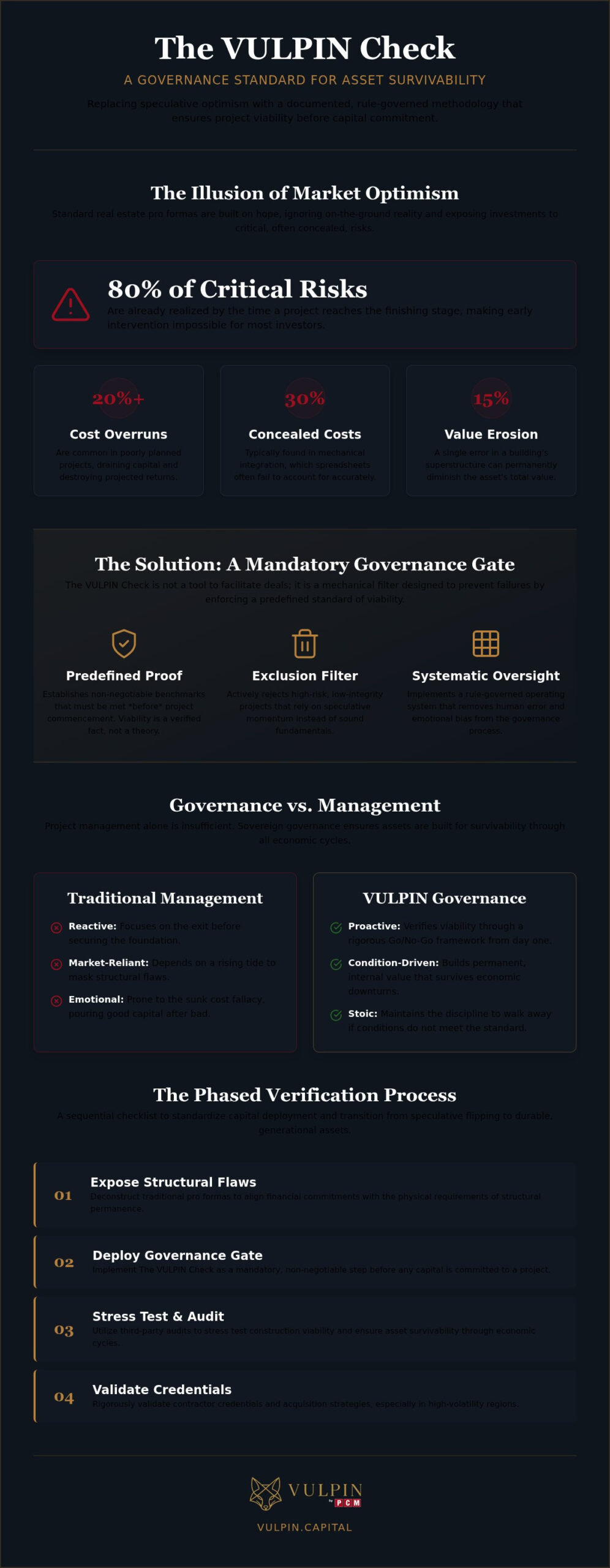
By the time a construction project reaches the finishing stage, 80% of the critical risks have already been realized. Most investors ignore this reality until cost overruns exceed 20% and the speculative bubble bursts. You’ve likely felt the frustration of pro formas that look perfect on paper but fail to account for the 30% of costs concealed in mechanical integration. We don’t trade in hope. We use The VULPIN Check to replace speculative optimism with a documented, rule-governed methodology that prioritizes structural permanence and administrative oversight.
This article teaches you to master an uncompromising verification process that ensures asset survivability before you commit a single dollar of capital. We’ll walk through a rigorous Go/No-Go framework that overrides market hype and enforces tangible proof of viability. You’ll learn how to standardize your deployment through a system that rejects the frantic energy of traditional markets in favour of long-term stability and sovereign control. This is the governance standard required for the Canadian landscape in 2026.
Key Takeaways
- Expose the structural flaws in traditional pro formas that prioritize market timing over tangible construction-cost reality.
- Deploy The VULPIN Check as a mandatory governance gate to verify project viability before any capital is committed.
- Learn why project management alone is insufficient and how third-party audits ensure asset survivability through economic cycles.
- Utilize a phased verification checklist to validate contractor credentials and acquisition strategies in high-volatility regions.
- Integrate FoxyHome frameworks to transition from speculative flipping to the development of durable, generational assets.
Beyond Speculation: Why Traditional Real Estate Pro Formas Fail
Standard real estate pro formas are works of fiction. They rely on the frantic energy of market timing and the hope that a rising tide will lift a poorly built ship. This speculative “flipping” mentality isn’t an investment strategy; it’s a gamble against time. Most developers build their spreadsheets on optimistic abstractions, ignoring the physical friction of on-the-ground execution. They focus on the exit before they’ve secured the foundation. This detachment from reality is where capital goes to die.
The Illusion of Market Optimism
Speculative bubbles mask systemic failures. When the market is hot, poor governance and structural weaknesses are easy to ignore. Market-driven gains are temporary and external; they’re gifts from a volatile cycle. Condition-driven value is permanent and internal. VULPIN Capital rejects the frantic urgency of traditional markets in favour of long-term stability. We don’t chase trends. We prioritize a rigorous due diligence process as a tool for exclusion, not just a checkbox for approval. If an asset cannot survive an economic downturn through its own internal logic, it doesn’t belong in a sovereign portfolio.
Construction-Cost Reality vs. Spreadsheet Projections
There’s a cavernous gap between “estimated costs” and the reality of a job site. Research shows that poorly planned projects frequently suffer cost overruns exceeding 20% of the initial budget. Spreadsheet projections often fail to account for the 30% of overruns typically concealed in the mechanical integration phase. Even a single error in a building’s superstructure can lead to a 15% erosion of the asset’s total value. Disciplined asset management is the only hedge against this financial erosion. The VULPIN Check acts as a mechanical filter, stripping away the hype to reveal the hard numbers before a shovel hits the ground. Construction-cost reality is the bedrock of the VULPIN philosophy, defined as the uncompromising alignment of financial commitments with the physical requirements of structural permanence.
The psychological trap of sunk costs often keeps failing developments on life support. Investors throw good capital after bad, trying to salvage a flawed pro forma because they’re already “all in.” This emotional attachment is a liability. A stoic approach requires the discipline to walk away when the conditions no longer meet the standard. By the time a construction project reaches the finishing stage, 80% of critical risks have already been realized. We use The VULPIN Check to identify these risks at the source, ensuring that project viability isn’t a theory, but a verified fact. We don’t build on hope; we build on documented methodology.
What is The VULPIN Check? Defining the Governance Standard
The VULPIN Check is a mandatory governance gate. It isn’t designed to facilitate deals; it is designed to prevent failures. This proprietary standard ensures that resources are only committed when predefined proof of project viability exists in physical reality. We reject the frantic energy of the traditional market. Instead, we use a mechanical filter to exclude high-risk, low-integrity projects that rely on speculative momentum. Within the VULPIN Group ecosystem, this process provides the administrative oversight necessary to move from a detached manager mindset to that of a disciplined, highly invested operator.
The Predefined Proof of Viability
We establish non-negotiable benchmarks before project commencement. Theoretical modeling is a liability without tangible verification. This approach mirrors the structural rigour found in EPA’s Due Diligence Guidelines, which prioritize property-related assessments over superficial reviews. For the asset owner, this is a sovereign philosophy. It means maintaining autonomous control over the capital deployment process. You aren’t just an investor; you are an architect of systems. We prioritize concrete results over the excitement of the “next big deal,” ensuring every asset is built for structural permanence.
The Fox: An Operating System for Asset Survivability
The Fox serves as the framework for rule-governed operations. It is an operating system that removes the variable of human error from the governance process. By using automated systems to maintain administrative oversight, we ensure that every decision aligns with the 5-year unlimited warranty standard we’ve maintained since 2019. This system integrates directly with the Construction Project Governance Framework. It creates a self-sustaining internal logic for every asset, moving beyond the limitations of standard project management.
This methodology links the high-level governance of VULPIN Capital with the execution precision of PCMNow Project Management. We’ve delivered over C$1 billion in construction value through this model. It isn’t about “getting it done.” It’s about ensuring the asset survives the next economic cycle through rigorous verification. To understand the alignment required for this standard, you can review the VULPIN Capital methodology and our commitment to long-term stability.
Governance vs. Management: Stress Testing Construction Viability
Governance is the foundation. Management is merely the tool. Most investors confuse the two, assuming that a project manager can salvage a fundamentally flawed deal. They can’t. Management focuses on timelines and tasks, but it rarely questions the underlying viability of the asset. This is why projects fail despite having professional oversight. They were never viable to begin with. Project management alone is insufficient for long-term asset survivability because it operates within the constraints of a budget it didn’t create.
The VULPIN Check provides the necessary third-party audit of the construction pro forma. It doesn’t trust; it verifies. In the Canadian landscape, red flags are often buried in vague contingency lines or optimistic labour projections. We know that 30% of cost overruns are typically concealed in the mechanical integration phase. If these aren’t identified at the gate, they become terminal liabilities. We look for the 15% erosion in value that results from a single error in a building’s superstructure. We don’t leave these outcomes to chance.
Stress Testing the Pro Forma
We analyze every deal through the lens of construction-cost reality. This means stripping away the fluff found in developer reporting. We use a governance-first framework for managing cost overruns to ensure the budget reflects physical requirements, not just financial desires. If the math doesn’t hold up to a stress test, the project is rejected. We don’t negotiate with flawed data; we filter it out.
PCMNow: Disciplined Construction Execution
PCMNow acts as the execution arm of our governance standard. It isn’t a detached manager. It’s an operator committed to site governance. By maintaining autonomous control, PCMNow rejects the scope creep that destroys margins. It focuses on structural permanence and strict administrative oversight. This discipline is how we’ve delivered over C$1 billion in construction value. We prioritize long-term asset survivability over the quick wins of speculative flipping. Our approach ensures that the reality-based budget established during the check is the one that governs the build.
This level of rigour is what separates a sovereign hold from a speculative gamble. By identifying these liabilities early, we protect the integrity of the capital deployment. PCMNow ensures that the physical structure matches the governance model. This isn’t just about building. It’s about ensuring an asset can withstand economic cycles through its own internal logic and structural integrity.
Verification Criteria: The VULPIN Check Checklist for 2026
Execution is the only metric that matters. To ensure asset survivability, capital deployment must follow a rigid, phased verification process. We don’t commit resources based on intent. We commit based on proof. The VULPIN Check serves as the gatekeeper for this deployment, requiring that every project passes four distinct phases of scrutiny before a single dollar is released. This isn’t a suggestion; it’s a mandatory standard for sovereign asset owners who prioritize durability over market hype.
Condition-Driven Acquisition Strategy
The first phase focuses on the physical reality of the asset. We reject acquisitions driven by speculative bubbles or frantic market energy. Instead, we employ a Condition-Driven Asset Acquisition Strategy. This approach ensures the asset is acquired based on its actual state and long-term hold potential. We look for structural permanence. If the physical condition doesn’t support a 5-year unlimited warranty, the deal is dead. We don’t buy for what it could be; we buy for what it is and what our systems can reliably sustain.
Vetting National Building Contractors
Phase two moves beyond surface-level credentials. We don’t care about a contractor’s marketing brochure. We care about their historical performance and their willingness to submit to our administrative oversight. VULPIN-approved builders must exhibit a disciplined adherence to governance that prioritizes structural integrity over convenience. The uncompromising standard for VULPIN-approved builders requires a documented commitment to engineering precision that exceeds national building codes and rejects speculative shortcuts. If a builder cannot operate within this rule-governed framework, they’re excluded from the ecosystem.
The remaining phases address the technical and financial foundations of the development:
- Phase 3: Auditing Feasibility. We verify architectural and engineering plans against construction-cost reality. Since 25% of a building’s energy loss occurs through the building envelope, we audit these systems to ensure long-term efficiency and reduced maintenance liabilities.
- Phase 4: Financial Deployment Schedule. We stress test the deployment schedule. Capital is only released when milestones are physically verified on-site. This eliminates the risk of paying for progress that hasn’t actually occurred.
This phased approach ensures that every project that passes The VULPIN Check is built for generational stability. We don’t leave the integrity of the structure to chance. To secure your portfolio against the volatility of the Canadian market, you must adopt a governance-first model. Contact us to standardize your capital deployment through our proprietary verification process.
Implementing the Check: Securing Generational Assets
Transitioning from a speculative mindset to a disciplined operator is a matter of principle. It requires a total rejection of the frantic energy that defines traditional Canadian real estate. Most investors are distracted by market timing; they fail to realize that asset survivability is determined by governance, not luck. The VULPIN Check is the mechanism that enforces this discipline. It ensures that every decision is grounded in physical reality rather than digital abstraction. This is the only path to securing generational assets that survive economic cycles through their own internal logic.
FoxyHome: Sustainable Housing as a Real Asset
Sustainable housing is often marketed through the lens of sentiment. We view it through the lens of engineering. Data shows that 25% of a building’s energy loss occurs through the envelope; this is a structural failure that erodes asset value over time. FoxyHome integrates modern construction techniques with the singular goal of generational survivability. Our framework reduces energy loss by up to 25%, acting as a financial hedge against rising utility costs and physical deterioration. The VULPIN Check validates the ROI of these high-performance systems by stripping away marketing jargon. We focus on the Net-Zero Home Construction Costs in Canada to provide a governance-first reality check for every sustainable development. We don’t build green to feel good; we build green to ensure the asset lasts.
The VULPIN Check as a Sovereign Philosophy
Administrative autonomy is the ultimate goal of the real asset owner. You shouldn’t be a detached manager at the mercy of a general contractor’s whims. By implementing our operating system, “The Fox,” you establish a self-sustaining internal logic for your real asset portfolio. This is what we call the “Sovereign Hold.” It is a strategy that prioritizes long-term temporal frameworks over the quick wins of speculative flipping. The peace of mind provided by engineering-grade verification is absolute. Since 2019, we’ve maintained a 5-year unlimited warranty standard because our verification process identifies failures before they are built. This level of intellectual honesty is rare in the financial world, but it is the bedrock of our organization.
Engagement with VULPIN Capital begins with a philosophy check. We aren’t looking for mass-market appeal; we are looking for partners who value structural integrity above all else. Our methodology has delivered over C$1 billion in construction value by prioritizing concrete results over theoretical modeling. If you are ready to move from a speculative gamble to a rule-governed investment, the next step is clear. You must Enforce Discipline on Your Next Project with The VULPIN Check. Secure your autonomy. Protect your capital. Build for the next century, not the next quarter.
Securing Your Sovereign Hold Beyond the Speculative Bubble
The era of real estate investment based on frantic market timing and optimistic pro formas has ended. In 2026, asset survivability depends on your ability to prioritize construction-cost reality over speculative abstractions. By implementing The VULPIN Check, you establish a mandatory governance gate that filters for structural permanence and administrative oversight. This isn’t just about managing a project; it’s about building a self-sustaining internal logic for your portfolio through proprietary systems like “The Fox.”
You’ve learned that 80% of critical risks are realized before the finishing stage. You know that 30% of overruns hide in mechanical integration. Protecting your capital requires an uncompromising, stoic approach to every deployment. Whether you’re integrating sustainable housing through FoxyHome or auditing contractor performance, the goal remains the same: autonomous control. It’s time to reject the frantic energy of traditional markets and embrace a documented methodology that ensures your assets withstand economic cycles.
Secure Your Asset Survivability with The VULPIN Check
Take the first step toward a portfolio built on engineering-grade verification and long-term stability.
Frequently Asked Questions
What is the primary difference between a standard audit and The VULPIN Check?
The primary difference lies in the temporal focus and the authority of the process. A standard audit is a historical review of what’s already occurred. The VULPIN Check is a predictive governance gate that prevents capital deployment unless predefined proof of viability exists. It doesn’t just record data; it enforces a decision based on construction-cost reality. This ensures assets are built for long-term survivability rather than short-term market optics.
Does The VULPIN Check apply to residential or commercial projects?
This methodology applies to any complex real asset project within the Canadian landscape. Whether the development is a high-performance residential build or a large-scale commercial structure, the governance requirements remain identical. We prioritize structural permanence and administrative oversight across all sectors. The goal is to move away from speculative models and toward a disciplined, operator-led framework that ensures the asset survives economic cycles regardless of its specific use or scale.
How does The VULPIN Check handle construction cost overruns?
We address overruns by identifying them at the source before they manifest on-site. Research indicates that 30% of cost overruns are typically concealed in the mechanical integration phase. The VULPIN Check uses a third-party audit of the construction pro forma to strip away hidden contingencies and optimistic labour projections. By aligning the budget with physical requirements rather than financial desires, we ensure the capital deployment reflects the actual cost of execution.
Can The VULPIN Check be implemented on a project that is already underway?
Implementation can occur on active projects, though it functions as a rigorous stress test rather than a simple management tool. If a project’s already underway, the check audits the current pro forma and contractor performance against our governance standards. This may lead to a halt in capital deployment if the project fails to meet predefined benchmarks for viability. We don’t salvage failing deals; we identify them to protect the integrity of the remaining capital.
What is the relationship between The VULPIN Check and PCMNow?
These two systems work in tandem to bridge the gap between governance and execution. The check serves as the mandatory gate that validates a project’s viability. Once a project passes this gate, PCMNow Project Management takes over as the execution arm. PCMNow ensures the reality-based budget and structural standards established during the verification process are upheld on-site through disciplined site governance and autonomous control, preventing scope creep and financial erosion.
How does the “The Fox” operating system support the VULPIN Check process?
The Fox provides the mechanical framework for all rule-governed operations within our ecosystem. It isn’t a passive software tool; it’s an operating system that maintains administrative oversight and autonomous control. By using automated systems to track verification milestones, The Fox removes human error from the decision-making process. This ensures every asset adheres to our 5-year unlimited warranty standard and maintains its integrity through long-term temporal frameworks, regardless of external market urgency.
Why does VULPIN Capital reject speculative flipping in its methodology?
Speculative flipping relies on the frantic energy of market timing and rising tides to mask poor governance. We reject this approach because it prioritizes exit speed over structural permanence. Our methodology focuses on a “Sovereign Hold” strategy. This means acquiring and developing assets based on their physical condition and internal logic. We build for generational stability, ensuring value is derived from the asset’s durability rather than temporary market bubbles or speculative hype.
Is The VULPIN Check available for projects across all Canadian provinces?
Our governance services are available for projects across all Canadian provinces. We operate as a national standard, providing the same level of rigour and administrative oversight from coast to coast. The methodology’s specifically optimized for high-volatility regions where construction-cost reality often deviates from initial projections. We provide a consistent, rule-governed framework for capital deployment that ensures asset survivability in any Canadian market, regardless of local volatility, labour shortages, or supply chain disruptions.