

A construction budget is not a suggestion. It is a structural commitment. In the current market, most pro formas are built on speculative fluff rather than verified reality. You’ve likely felt the weight of unpredictable labour escalations and the opaque nature of general contractor quotes. These aren’t just inconveniences. They’re existential threats to your capital. Relying on hope is not a governance strategy. It is a failure of oversight.
You deserve a path to asset survivability that doesn’t involve mid-project capital calls. This article provides a reality check on construction cost verification standards applicable across Canada’s diverse and volatile building landscape. We’ll show you how to strip away industry noise to reveal the hard data underneath. By the end of this guide, you’ll understand how to stress-test your budget against the friction of the real world. We’re moving past digital abstractions to focus on the tangible verification required for long-term stability. It’s time to build on a foundation of discipline rather than debt. Every C$ must be accounted for before the first shovel hits the ground.
Key Takeaways
- Identify the structural flaws in traditional estimates that don’t account for Ontario’s labour market volatility.
- Apply The VULPIN Check as a rigorous governance protocol to verify the reality of labour, material, and administrative costs.
- Establish a rigorous construction cost verification Ontario framework to remove the inherent conflict of interest in internal contractor takeoffs.
- Execute a two-phase strategy for stress-testing your pro forma and validating trade-specific market rates before committing capital.
- Integrate PCMNow project management to ensure your verified budget translates into disciplined execution and long-term asset survivability.
The Illusion of Certainty in Ontario Construction Costs
Certainty is a commodity sold by those who don’t bear the risk. In Ontario’s development sector, a budget is often treated as a hurdle to clear rather than a blueprint to follow. This creates a dangerous reliance on “bid-winning” math. This math is designed to look attractive on a loan application but fails immediately upon site mobilization. We reject the “speed-to-bid” mentality that prioritizes winning the contract over surviving the build. This frantic energy belongs to the high-velocity speculative market, not to disciplined operators. You must recognize that an estimate is not a fact. It’s a hypothesis that hasn’t been tested by the friction of reality.
Professional construction cost verification Ontario requires moving beyond the superficial. It’s an act of sovereign governance. It means looking at a contractor’s quote and seeing it for what it is: a starting point for negotiation, not a guarantee of final cost. This is the exclusionary filter for serious partners. If you can’t verify the numbers, you don’t own the project; the project’s volatility owns you. We don’t build on hope. We build on documented evidence.
The Failure of Passive Quantity Surveying
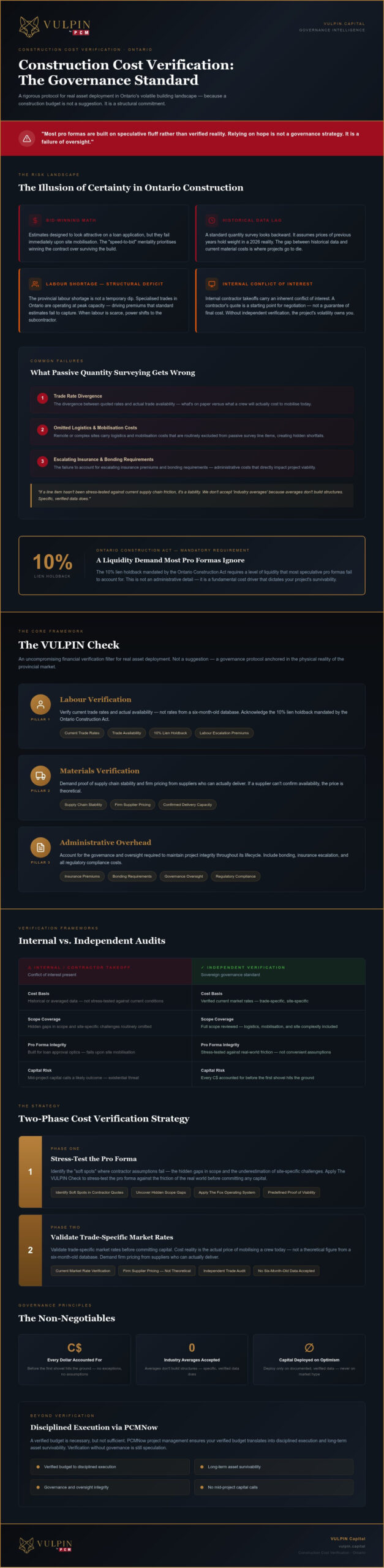
A standard quantity survey is often nothing more than a historical autopsy. It looks backward. It assumes that the prices of previous years hold weight in a 2026 reality. They don’t. The gap between historical data and current material costs is where projects go to die. Rigorous construction cost verification Ontario protocols demand proof for every assumption. Common failures in passive surveying include:
- The divergence between quoted rates and actual trade availability.
- The omission of logistics and mobilization costs in remote or complex sites.
- The failure to account for escalating insurance premiums and bonding requirements.
If a line item hasn’t been stress-tested against current supply chain friction, it’s a liability. We don’t accept “industry averages” because averages don’t build structures. Specific, verified data does.
Ontario Market Volatility in 2026
The provincial labour shortage isn’t a temporary dip. It’s a structural deficit. Specialized trades in Ontario are operating at peak capacity. This drives premiums that standard estimates fail to capture. When labour is scarce, the power shifts to the subcontractor. This creates a volatility that “bid-winning” math cannot account for. Regulatory requirements, specifically the 10% lien holdback mandated by the Ontario Construction Act, require a level of liquidity that most speculative pro formas ignore. These aren’t just administrative details. They’re fundamental cost drivers that dictate your project’s survivability. In a climate of provincial inflation, cost reality is the actual price of mobilizing a crew today, not a theoretical figure from a six-month-old database.
The VULPIN Check: A Rigorous Protocol for Financial Verification
The VULPIN Check is not a suggestion. It is an uncompromising filter designed for real asset deployment. We don’t deploy capital based on optimism or market hype. We deploy it based on documented, verified data. This protocol serves as the foundation of our construction cost verification Ontario strategy. It ensures that every C$ committed is anchored in the physical reality of the provincial market. Without this check, you aren’t investing; you’re speculating. Rigorous construction cost verification Ontario protocols are the only way to filter out the noise of the speculative market.
Our verification process rests on three rigid pillars. First, labour. We verify current trade rates and availability, acknowledging the 10% lien holdback mandated by the Ontario Construction Act. Second, materials. We demand proof of supply chain stability and firm pricing from suppliers who can actually deliver. Third, administrative overhead. We account for the governance and oversight required to maintain the integrity of the project throughout its lifecycle. We refuse to commit resources without predefined proof of viability. This isn’t just budgeting. It’s a survival strategy for your capital.
Stress Testing the Construction Pro Forma
Contractor-provided quotes are often built on convenient assumptions. We identify the “soft spots” where these assumptions fail. These are the hidden gaps in scope or the underestimation of site-specific challenges. By applying The VULPIN Check, we stress-test the pro forma against the friction of the real world. We utilize The Fox operating system to provide the internal logic and governance framework needed for these high-stakes decisions. It’s about ensuring the project can withstand external shocks without requiring frantic mid-project capital calls.
Gatekeeping as an Asset Management Strategy
Saying “No” is the highest form of governance. The traditional financial world is driven by a frantic energy to close deals. We reject this. We identify the “No Go” point long before the first shovel hits the ground. Speculative hope is a liability that leads to ruin. Verified reality is the only asset worth holding. Our gatekeeping mechanism ensures that only projects with true structural integrity receive capital. This disciplined approach is what separates a master craftsman of systems from a detached manager. If you value the integrity of your structure, you must be willing to walk away when the verification fails to meet our standards. Aligning with this worldview is a prerequisite for any serious partner looking to engage with VULPIN Capital.
Comparing Verification Frameworks: Internal vs. Independent Audits
Trust is a vulnerability in high-stakes development. Relying on a contractor’s internal takeoff is an abdication of governance. A builder’s incentive is to secure the project, often by compressing numbers until they no longer reflect the physical reality of the site. This inherent conflict of interest turns a budget into a marketing document rather than a financial map. Sophisticated Ontario owners reject this energy. They prioritize independent construction cost verification Ontario as a sovereign act of protection. Verification is not an administrative burden. It is the exclusionary filter that separates professional operators from speculators. The cost of a rigorous audit is negligible compared to the catastrophic expense of a mid-project capital call.
The Limitations of Contractor Quotes
Contractor quotes are frequently sanitized to appear competitive. They contain hidden exclusions and vague allowances that inevitably transform into change orders. We don’t accept these gaps. We use Managing Construction Project Cost Overruns as a framework to identify where these breakdowns occur. Our internal operating system, The Fox, identifies patterns of speculative pricing that standard reviews miss. It looks for the hollow spots where labour rates don’t match the current provincial shortage or where material lead times are ignored. A quote without an independent audit is merely a list of hopes. We deal in documented facts.
Independent Verification: The Institutional Standard
By 2026, institutional lenders in Canada have moved beyond simple quantity surveying. They demand verified cost reports that withstand technical scrutiny. This is where the role of an Owner’s Rep becomes critical. We act as the technical gatekeeper, maintaining financial discipline when the frantic energy of the build threatens to compromise the budget. Standard industry audits often stop at the spreadsheet. The VULPIN Check goes deeper. It validates the technical viability of the execution plan itself. This institutional rigour is the only way to ensure construction cost verification Ontario standards are met with the gravity the market demands. A verified pro forma is a requirement for capital survivability. We don’t just check the math. We verify the structural integrity of the entire financial model. Without this level of oversight, you are building on sand.
Step-by-Step: Executing a Cost Verification Strategy
Execution is the point where theoretical models meet the friction of physical reality. A robust construction cost verification Ontario strategy must be methodical, slow, and resistant to external urgency. We don’t rush the intake process. We treat it as an evidentiary hearing for your capital. Every document submitted is a piece of testimony that must be cross-referenced against the current state of the provincial industry. If the data doesn’t hold up under technical scrutiny, the project doesn’t move forward.
The strategy follows four distinct phases of governance:
- Phase 1: Comprehensive document intake and initial pro forma stress-testing to identify structural budget flaws.
- Phase 2: Market-rate validation of trade-specific labour and materials against current documented provincial data.
- Phase 3: Detailed administrative and regulatory cost audit specific to the Ontario legal and tax landscape.
- Phase 4: Delivery of a final viability report and a sovereign capital deployment recommendation based on hard data.
Auditing the Trade Takeoffs
Takeoffs are often where speculative fluff hides. We verify material quantities directly against architectural drawings to ensure no “optimistic” omissions exist. Labour hours are scrutinized with equal rigour. If a schedule assumes a velocity that the current Ontario labour market can’t support, we flag it as a failure. We use historical data from FoxyHome sustainable housing projects to benchmark what sustainable, long-term costs actually look like. This isn’t about finding the lowest price. It’s about finding the real price. We don’t accept “best-case scenarios” because the real world rarely provides them.
Regulatory and Soft Cost Verification
The administrative burden in Ontario is heavy. We don’t leave it to chance. Our audit explicitly accounts for the 10% lien holdback required by the Ontario Construction Act. This is a mandatory liquidity requirement for 2026 that many speculative budgets fail to fund properly. We verify municipal development charges and permitting fees directly with authorities. Contingency funds are never based on an arbitrary percentage. They’re calculated based on the specific risk profile of the site and the complexity of the build. This level of construction cost verification Ontario is the only way to protect the integrity of your structure. If your current budget hasn’t been through this level of technical scrutiny, it isn’t ready for deployment. You can secure your project’s survivability by engaging with VULPIN Capital for a technical audit today.
Beyond Verification: Disciplined Execution via PCMNow
A verified report is merely a diagnosis. It has no value if the treatment isn’t administered with absolute precision. Many firms provide theoretical modelling but disappear when the first change order hits the desk. We don’t. Professional construction cost verification Ontario requires a seamless transition from the boardroom to the job site. If the execution is undisciplined, the most accurate budget in the world will still fail. We enforce the reality we’ve verified through a rule-governed construction schedule that leaves no room for speculative drift. This is where the VULPIN promise becomes tangible: we only deploy resources once viability is proven and the path to completion is secured by a documented methodology.
The transition from verification to execution is the point where most projects lose their integrity. Without a rigid governance framework, the frantic energy of a construction site quickly erodes the financial foundations laid during the audit. We treat the verified pro forma as a binding technical contract. Every C$ spent must be cross-referenced against the initial verification to ensure the project remains on its intended trajectory. This isn’t just management; it’s a sovereign oversight protocol designed to protect capital from the inherent chaos of the industry.
The VULPIN Check Meets PCMNow
Verification informs governance. It doesn’t end with a signature. The data gathered during the audit phase becomes the operating manual for the build. We maintain cost reality through the entire construction lifecycle by applying PCMNow Project Management. This is the uncompromising standard for execution in 2026. It ensures that the 10% lien holdback isn’t just a number on a spreadsheet but a managed liquidity pool. Every daily decision on the site is measured against the original verification. If a trade deviates from the verified rate or schedule, the system identifies the failure immediately. We don’t wait for a month-end report to discover a leak. We plug it in real-time.
Asset Survivability as the Ultimate Goal
We’re not interested in short-term speculative flipping. The provincial market is saturated with frantic energy looking for quick wins. We reject that. Our goal is generational asset survivability. A project is only successful if it remains structurally and financially sound for decades. This level of permanence requires a rejection of digital abstractions in favour of physical reality. By integrating construction cost verification Ontario with disciplined project management, we build structures that endure. We value the integrity of the system above the excitement of the deal. If you’re a serious operator who values stability over speculation, it’s time to move beyond hope. You can verify your project viability today and establish a foundation of true governance.
Establishing Structural Permanence in Your Portfolio
The path to asset survivability begins with a rejection of speculative energy. We’ve established that traditional estimates often fail to account for the physical reality of the provincial market. You must move beyond the illusion of certainty provided by contractor takeoffs. True financial discipline requires an independent construction cost verification Ontario framework that stress-tests every line item against real-world friction. By utilizing our proprietary VULPIN Check methodology, you ensure that capital is only deployed when viability is documented and absolute.
Our approach to governance-first asset management doesn’t stop at the audit. It extends into the disciplined execution of the build itself. We leverage Ontario-wide execution expertise to maintain the integrity of your budget throughout the entire construction lifecycle. You have the opportunity to build a generational asset on a foundation of verified facts rather than speculative hope. It’s time to demand a higher standard of oversight for your capital. Verify your construction cost reality with The VULPIN Check and ensure your project stands the test of time. You can build with confidence when the math is as solid as the structure.
Frequently Asked Questions
What is the primary difference between a cost estimate and cost verification?
An estimate is a predictive hypothesis often used to win bids; verification is a technical audit of physical reality. While an estimate relies on historical averages, professional construction cost verification Ontario standards require documented proof of current trade rates and material availability. Verification acts as a sovereign governance protocol that strips away speculative fluff to reveal the structural integrity of the budget. It ensures that resources are only committed when viability is proven through hard data.
Why are construction costs in Ontario more volatile than in other provinces?
Ontario’s volatility is driven by a structural deficit in specialized trades and rigid provincial regulations. The market faces a persistent labour shortage that shifts pricing power to subcontractors, creating premiums that standard models ignore. Additionally, the mandatory 10% lien holdback under the Ontario Construction Act creates specific liquidity requirements. These factors, combined with provincial inflation, make historical data obsolete. You must verify costs against the friction of the current market to ensure asset survivability.
How does The VULPIN Check account for sustainable building materials?
We verify the technical viability and supply chain stability of every material choice through The VULPIN Check. Sustainable materials are audited not just for their upfront cost, but for their contribution to long-term asset survivability. We use data from FoxyHome Sustainable Housing projects to benchmark the performance and durability of these components. This ensures that environmentally conscious choices don’t compromise the financial structure of the project but rather enhance its generational permanence.
Can cost verification help resolve a dispute with a general contractor?
Verification provides an objective, evidentiary basis for resolving financial discrepancies with a general contractor. By identifying “soft spots” and unrealistic labour hour assumptions, our audit removes the ambiguity that often leads to conflict. It allows for a technical discussion based on documented market rates rather than speculative claims. This high-integrity professionalism establishes a boundary that protects the owner’s capital and ensures the project remains governed by reality rather than frantic site energy.
How much time should I allocate for a professional cost verification audit?
A professional audit is a deliberate and methodical process that rejects the frantic urgency of the traditional market. The duration depends on the complexity of the architectural drawings and the depth of the trade takeoffs. We prioritize accuracy over speed because a rushed verification is a failure of oversight. This technical scrutiny ensures that every line item is stress-tested against the real-world friction of the Ontario landscape before any capital is deployed for the build.
What happens if The VULPIN Check determines a project is not viable?
We identify the “No Go” point as an act of sovereign protection for your capital. If The VULPIN Check reveals that a project lacks structural financial integrity, we recommend against deployment. Saying “No” is often the highest form of governance in a world driven by short-term speculative flipping. Our gatekeeping mechanism ensures you don’t commit resources to a failure. We prioritize the long-term stability of our partners over the excitement of a new deal.
Does VULPIN Capital provide verification for residential and commercial projects?
Yes, we provide rigorous verification and management services for both complex commercial developments and sustainable residential projects. Our national delivery focus ensures that construction cost verification Ontario standards are applied with consistent rigour across all asset classes. Whether through PCMNow Project Management for large-scale builds or FoxyHome for residential housing, our proprietary systems like The Fox maintain the same uncompromising standard of financial discipline and asset survivability.
How does the Ontario Construction Act impact my budget contingency planning?
The Ontario Construction Act mandates a 10% lien holdback that must be factored into your liquidity and contingency planning. This is not an optional reserve; it is a statutory requirement that impacts your cash flow throughout the construction lifecycle. Our verification process ensures that your contingency funds are based on these specific legal realities rather than arbitrary percentages. Proper governance requires accounting for these administrative burdens to prevent mid-project capital calls and ensure project viability.