

A pro forma is not a proof of reality; it is often a document of institutional hope. Most developers mistake speculative momentum for genuine absorption, only to realize too late that assessing market demand for a development project was treated as a formality rather than a rigorous audit. You likely recognize the quiet anxiety that comes with trusting a broker’s optimism over your own internal standards. This fear of project failure is a rational response to an industry that prizes speed over structural permanence.
This manual provides the discipline required to strip away speculative hype through a stern governance framework. We reject the frantic energy of traditional markets in favour of a methodical, engineering-first approach. By following this guide, you will learn how to utilize the VULPIN Check to verify the hard reality of market needs. We will outline the exact administrative steps needed to minimize financial exposure and ensure the long-term survivability of your assets.
Key Takeaways
- Identify why broker-driven demand reports often prioritize commissions over accuracy and how to look past speculative hype.
- Establish a rigorous proof-of-concept by using the VULPIN Check as a mandatory protocol for assessing market demand for a development project.
- Integrate both quantitative demographic shifts and qualitative regulatory signals to recognize the true conditions of the market.
- Develop a disciplined break-even absorption model to stress test your project against worst-case financial scenarios.
- Shift your focus from speculative flipping to long-term asset survivability through high-performance frameworks like FoxyHome.
Beyond Speculative Hype: Why Standard Market Assessments Fail
Standard market reports are often little more than institutional fiction. They are designed to facilitate transactions, not to protect capital. When assessing market demand for a development project, most operators rely on broker-driven data. These reports prioritize commissions over accuracy. They mistake temporary market noise for genuine, sustainable demand. We reject this frantic energy in favour of a stoic path. Our approach is grounded in the physical reality of the asset, not the digital abstraction of a spreadsheet.
Historical data is a lagging indicator. It tells you what happened yesterday, but it cannot guarantee asset survivability tomorrow. Relying on past performance in a volatile economy is a governance failure. True market analysis requires stripping away these distractions. It demands a focus on structural permanence and institutional oversight. By applying disciplined real estate investing principles, we filter out speculative projects that lack the necessary integrity to endure market shifts.
The Flaw in Traditional Feasibility Studies
Traditional feasibility studies are built on optimistic pro formas that don’t account for industrial friction. They often ignore the hard reality of rising net-zero home construction costs in Canada. When construction costs escalate, speculative projections crumble. Catastrophic project failure is the direct result of this oversight. Comparable sales are frequently irrelevant. They reflect a shifting economic landscape that has already moved on. You cannot build the future by looking exclusively at the rearview mirror of “comps” that don’t reflect current labour or material realities.
Defining Demand as a Governance Constraint
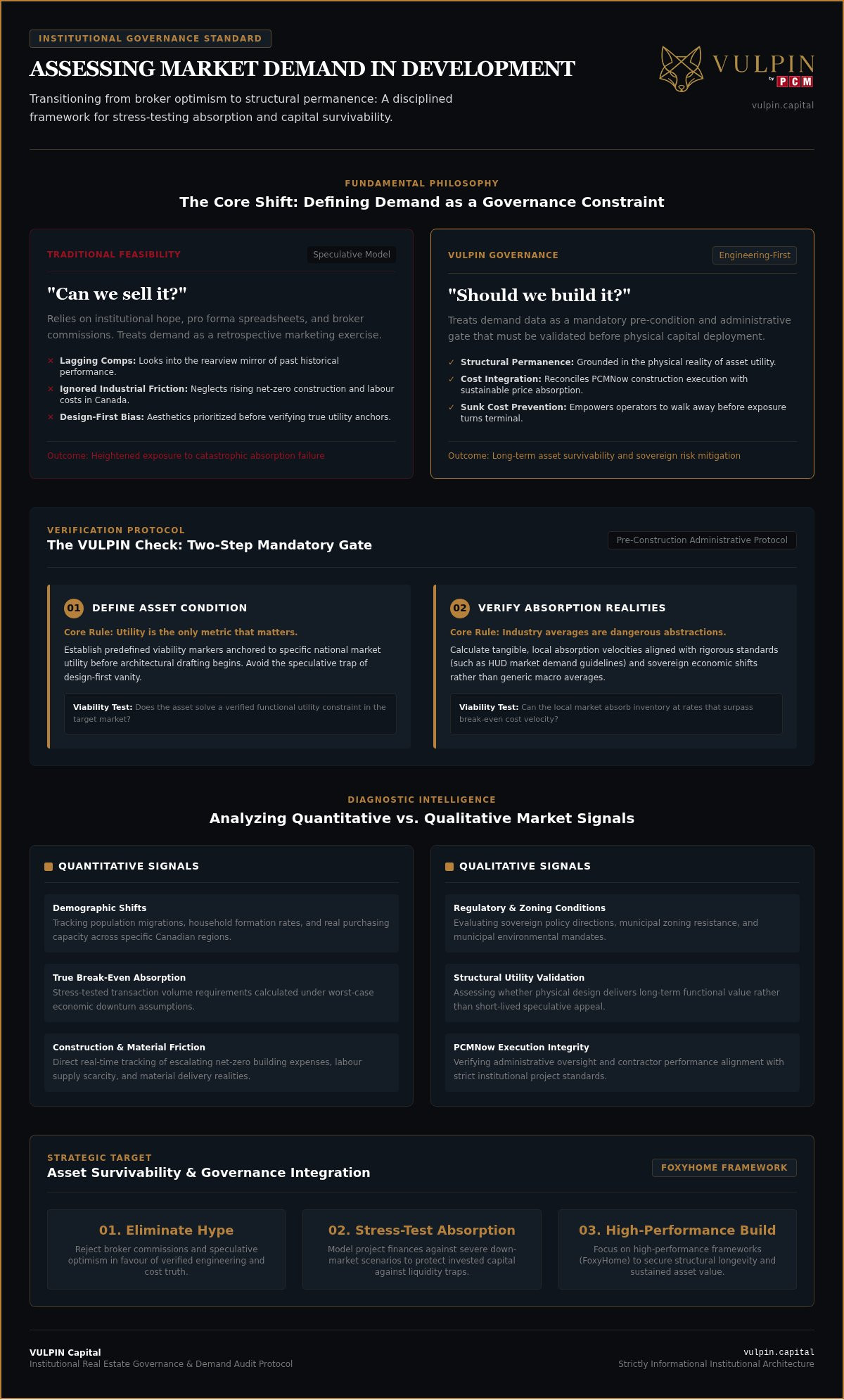
We must shift our mindset. The question is not “can we sell it?” but “should we build it?” This is a fundamental change in framework. It moves demand assessment from a marketing exercise to a strict governance constraint. We prioritize administrative oversight and autonomous control over frantic market trends. We don’t chase the crowd. We build for long-term stability. When assessing market demand for a development project, we treat the data as a mandatory gate, not a suggestion. Demand is a verifiable condition of project viability that must be documented and proven before a single dollar is deployed.
The VULPIN Check: Establishing Proof of Project Viability
Deploying capital without verification is not investing; it is gambling. Assessing market demand for a development project must be a rigorous, administrative gate that precedes any physical construction. We utilize the VULPIN Check as a mandatory protocol to ensure resources are only committed when the proof of viability is absolute. This governance framework prevents the sunk cost fallacy. It allows operators to walk away from projects that fail to meet strict internal standards before financial exposure becomes terminal.
Validation requires more than just looking at sales figures. We integrate PCMNow Project Management to reconcile construction-cost reality with demand signals. If the cost to build exceeds the market’s capacity to absorb the asset at a sustainable price point, the project is a failure of logic. We prioritize the integrity of the system over the excitement of the deal. This is not about chasing the highest return; it’s about ensuring the asset can survive the friction of the real world. You can explore how we standardize these protocols to protect long-term capital from speculative volatility.
Step 1: Define the Asset Condition
Utility is the only metric that matters. Before a single line is drawn, you must identify the specific utility the project provides to the national market. We use The VULPIN Check to set predefined viability markers that anchor the development. Do not fall into the trap of design-first development. Aesthetics cannot save a project that lacks a demand anchor. A project without a clear utility is merely a speculative monument to vanity that risks total absorption failure.
Step 2: Verify Absorption Realities
Industry averages are dangerous abstractions. You must calculate real-world absorption rates based on tangible local data and sovereign economic shifts. We align our methodology with rigorous standards, such as the HUD market demand guidelines, to ensure our projections are grounded in administrative reality. Stress test your entry and exit price points against current interest rates. If the model breaks at a two-percent rate hike, it does not meet our standard of generational asset survivability. We build for endurance, not for the next market cycle. Verification is a continuous process that requires constant oversight and a willingness to adjust the trajectory when the data shifts.
Analyzing Quantitative vs. Qualitative Market Signals
Data is a weapon. Used poorly, it destroys the user. Assessing market demand for a development project requires a dual-lens approach that most traditional firms fail to implement. We don’t rely on intuition or the frantic optimism of the crowd. We demand technical verification. Quantitative data provides the structural skeleton of a project, but qualitative insights provide the operational muscle. An experienced operator’s “gut feeling” is a liability unless it’s backed by administrative oversight and a documented methodology.
We prioritize long-term stability over the excitement of a trend. This means looking past the surface level of demographic shifts and supply pipelines. We analyze interest rate trajectories as barriers to entry rather than mere spreadsheet variables. If the numbers don’t reflect the rugged reality of the current economic environment, they are useless. We reject the superficiality of GIS modeling that fails to account for the developer’s individual risk tolerance and cost reality. Our focus remains on the intersection of sustainable housing demand and the enduring performance of the asset.
The Quantitative Trap: When Numbers Lie
Market growth is often an illusion created by inflationary noise. You must distinguish between genuine capital inflow and the simple devaluation of currency. Relying on census data that is three years out of date is a governance failure. It creates a lag that can lead to catastrophic misalignment between the asset and the actual population. We utilize a construction project risk management framework to audit every data source. This ensures that our projections reflect the physical reality of the market rather than a historical abstraction. We filter for accuracy, not for the results that make a project look easier to fund.
Qualitative Verification: The “On-the-Ground” Reality
Spreadsheets can’t account for the friction of local regulatory shifts. You must verify construction-cost reality by engaging directly with trades and suppliers. If the labour availability in a region is non-existent, the quantitative demand signal is irrelevant. We assess the sovereign capability of a project to survive these shifts before a single dollar is deployed. Qualitative signals act as a critical early warning system for market saturation or administrative gridlock. Community sentiment can halt a project faster than a bank can pull funding. By integrating these qualitative filters, we ensure that every development meets the standard of a high-performance asset capable of generational survivability.
Stress Testing Demand: A Disciplined Framework for Decision-Making
Market sentiment is a distraction. Institutional interest, while validating to the uninitiated, is never a substitute for asset-level stress testing. Assessing market demand for a development project requires a stoic filter that rejects the frantic optimism of the industry. We don’t build based on what we hope will happen; we build based on what the structure can withstand. This disciplined framework demands a break-even absorption model designed for the harshest economic realities.
We utilize The Fox operating system to ensure autonomous decision-making remains free from emotional bias. This system provides the administrative logic required to maintain control when market conditions shift unexpectedly. Protecting your demand margins also requires a rigorous approach to managing construction project cost overruns. If a project cannot absorb a significant cost escalation while demand remains stagnant, it is a structural failure of the pro forma. You must prioritize the integrity of the capital over the excitement of the deal. To implement these standards in your next project, you can audit your current governance protocols with our team.
Scenario Planning for Economic Volatility
Economic volatility is a certainty, not a possibility. You must test your demand assumptions against a 2% and 4% increase in borrowing costs to ensure the project remains viable. Evaluate the project’s survivability if sales or leasing takes 50% longer than your initial projections. We employ a condition-driven asset acquisition strategy to identify the absolute floor of the market. This ensures that the asset remains a functional reality even when the broader economy enters a period of contraction. We value the durability of the result over the speed of the execution.
The “Kill Switch” Mechanism
Discipline is defined by what you refuse to do. Every project must have a “kill switch” mechanism. These are specific, predefined proof points that, if not met, require you to walk away immediately. Rejecting a project is often the most profitable decision a developer can make because it preserves capital for assets that meet our uncompromising standards. We foster a governance-first culture that rewards this level of discipline over raw deal-flow. Our organization is built on the belief that a single, high-performance asset is worth more than a dozen speculative failures. This is the difference between a master craftsman and a frantic speculator who lacks a documented methodology.
Asset Survivability: Integrating Demand into Long-Term Governance
The “build and flip” mentality is a symptom of a decaying market. It prioritizes the quick win over the integrity of the structure. We reject this frantic energy. True asset survivability requires moving toward generational asset management. Assessing market demand for a development project is not a one-time event; it’s a continuous integration into long-term governance. We treat asset management as a matter of principle and autonomy. This ensures that the project doesn’t just exist but thrives across decades. By defining our identity through what we refuse to be, we establish a boundary of high-integrity professionalism that stands against speculative volatility.
High-performance assets are the only logical response to a shifting economic climate. FoxyHome sustainable housing meets the rising demand for durability and efficiency. We don’t build for the average consumer; we build for those who value structural permanence. A robust construction project governance framework protects the project’s demand-driven value by enforcing strict administrative oversight. This rejection of standard financial metrics in favour of tangible verification signals a preference for concrete results over theoretical modeling. Our framework ensures that every decision aligns with the reality of the physical asset.
Designing for Permanent Demand
Sustainability is no longer an “extra” in the Canadian market. It’s a core demand requirement. We realize long-term value through structural permanence and administrative oversight. FoxyHome delivers environmentally conscious residential solutions that are built to endure. We prioritize high-performance materials and engineering standards that resist the volatility of traditional markets. This approach creates a self-sustaining asset that doesn’t rely on speculative hype for its value. We focus on the centre of the market’s true needs rather than the frantic edges of digital abstraction.
The Final Governance Gate
Before full resource deployment, a final VULPIN Check is mandatory. This is the ultimate gate in our governance-first manual. It ensures all stakeholders are aligned with the stoic, long-term vision of the asset. We don’t proceed on assumptions. We proceed on verified proof. If the data doesn’t support the trajectory, we stop. This discipline is what separates a master craftsman from a manager who is detached from the industrial reality. You can secure your development’s future by requesting a VULPIN Check consultation to ensure your project meets our uncompromising standards of excellence and survivability.
Securing the Floor: The Path to Asset Survivability
The industrial reality of development demands a departure from speculative hope. Assessing market demand for a development project is not a marketing exercise but a mandatory governance gate. By stripping away digital abstraction and applying a stoic filter to signals, you protect capital from the frantic energy of traditional markets. True success is found in the structural permanence of high-performance assets that survive economic shifts. We prioritize the master craftsman’s discipline over the frantic deal-flow of the speculator.
Our governance-first methodology ensures that resources are only deployed when proof of viability is absolute. This methodology relies on the proprietary VULPIN Check to verify every assumption before ground is broken. You now have the framework to move beyond the build and flip mentality and toward generational asset management. Contact VULPIN Capital to implement The VULPIN Check on your next project and secure your path toward long-term stability. Your commitment to these standards is the first step toward building a legacy of durable, high-integrity assets.
Frequently Asked Questions
What is the most common mistake when assessing market demand for a development project?
The most common error is mistaking speculative momentum for genuine absorption. Operators often rely on biased broker reports that prioritize commissions over accuracy. You must strip away the frantic energy of the market to find the hard reality of demand. Assessing market demand for a development project requires a stern audit of physical utility rather than a document of institutional hope. Without this discipline, projects fail when the speculative tide recedes and exposes a lack of real-world utility.
How does the VULPIN Check differ from a standard feasibility study?
Standard feasibility studies are often static documents designed to facilitate a transaction. The VULPIN Check is a continuous governance protocol that acts as a mandatory gate for resource deployment. It rejects theoretical modeling in favour of tangible verification. We don’t commit capital based on optimistic pro formas. We commit only when predefined proof of project viability exists. This systemized approach ensures that every decision is governed by administrative logic rather than market excitement.
Can I assess market demand without hiring an expensive consulting firm?
You don’t need external consultants if you have a documented methodology and the discipline to follow it. Assessing market demand for a development project is a matter of internal governance. By utilizing a framework like the VULPIN Check, you can verify demand through administrative oversight. This requires a rugged, industrial mentality and a commitment to intellectual honesty. You must be willing to walk away from a deal if the data fails to meet your predefined markers.
How do interest rates affect the demand for sustainable housing in Canada?
Rising borrowing costs act as a filter for project quality. When interest rates increase, the demand for high-performance assets like FoxyHome sustainable housing actually stabilizes. Buyers become more selective, prioritizing long-term energy efficiency and structural permanence over short-term aesthetics. We focus on the centre of the market’s true needs. High interest rates expose the fragility of speculative developments while reinforcing the value of assets built for generational survivability and low operational friction.
What qualitative signals are most important for a new development project?
Regulatory hurdles and labour availability are the most critical qualitative signals. These factors represent the “on-the-ground” reality that spreadsheets often ignore. Community sentiment and administrative gridlock can halt a project regardless of what the demographic data suggests. We treat these signals as early warning systems for market saturation. You must verify construction-cost reality by engaging directly with trades. If the physical capacity to build doesn’t exist, the quantitative demand is an irrelevant abstraction.
How do I stress test my pro forma for market absorption risks?
You must apply a “stoic” filter to your assumptions. This involves testing your pro forma against a four-percent increase in borrowing costs and a 50% delay in absorption. We use The Fox operating system to facilitate this autonomous decision-making process. By removing emotional bias, you can identify the absolute floor of the market. If the project cannot survive these worst-case scenarios, it fails our internal standards and should be terminated before capital is deployed.
Why does VULPIN Capital reject speculative flipping in its demand assessments?
Speculative flipping is the antithesis of our philosophy. It relies on the frantic, temporary energy of the market rather than structural permanence. We prioritize generational asset management and long-term stability. Rejecting the “build and flip” mentality is a matter of autonomy and principle. We build assets that are designed to endure for decades. This contrarian stance filters for partners who value the integrity of the structure over the excitement of a quick, speculative win.
What role does construction-cost reality play in verifying market demand?
Demand is an empty metric if the cost to build exceeds the market’s capacity to pay. We use PCMNow Project Management to validate the construction-cost reality against demand signals. If the industrial friction of labour and materials makes the asset unaffordable, the project is a failure of logic. We reconcile these costs early to protect our demand margins. This ensures that every development remains a functional reality rather than a speculative monument to vanity.