

A sustainability target that cannot withstand a cost review is not yet a project control. This guide to sustainable construction project management Ontario project teams can apply starts with a practical question: can each goal be defined, funded, verified, and carried through construction into long-term operation?
Environmental ambitions can lose force when they remain broad statements. Design intent may drift during construction, operational needs can be overlooked, and capital may be committed before viability is demonstrated. The answer is not to lower the standard. It is to make each requirement accountable and connect decisions across the project lifecycle.
This guide explains how to turn sustainability objectives into verifiable requirements, connect governance with cost reality, and maintain control through execution and asset operation. It also explains how VULPIN Capital supports evidence-based decisions before resources are committed, while PCMNow connects project controls with disciplined construction delivery. The aim is practical: sustainability that holds up beyond the design brief and supports a viable, enduring asset.
Key Takeaways
- For sustainable construction project management Ontario asset owners can use, turn environmental aims into defined outcomes, assigned responsibilities, and reviewable evidence.
- Build a governance sequence from baselines and viability testing through monitoring and handover, so sustainability requirements remain traceable across project stages.
- Assess design and delivery options against execution implications, operational needs, supporting evidence, and long-term asset relevance, not ambition alone.
- At each lifecycle stage, identify who is accountable, what evidence is required, and which decision and record will keep the project controlled.
- PCMNow and The VULPIN Check connect disciplined construction execution with predefined evidence of project viability.
What sustainable construction project management means for Ontario asset owners
Sustainable construction project management governs environmental, delivery, and asset-performance objectives across a project’s full lifecycle. It turns goals into documented requirements, assigns accountability, and uses evidence to assess whether those requirements are being met. Stating an ambition is not the same as verifying an outcome. Verification relies on project-specific evidence gathered during design, construction, and handover.
This guide is for asset owners and project sponsors responsible for decisions, resources, and long-term outcomes. It is not a guide to selecting a college programme. Owners need a working management framework that connects what the project is intended to achieve with what can be designed, built, documented, and operated.
How sustainability fits within construction project management
Sustainability belongs alongside scope, schedule, budget, and quality. An environmental requirement can affect design choices, procurement criteria, construction methods, and the information needed at handover. Consider those effects together. A change that supports one objective may affect another, so the decision process should make trade-offs visible and record the rationale.
For example, if an owner wants to reduce operating demand, the project team needs to define what that means for the asset and how the outcome will be assessed. The design must carry the requirement forward. Procurement and construction records should show what was selected and installed, while handover information should help the asset team operate and maintain the completed building. A sustainability label may describe a framework or assessment, but it does not, by itself, prove that an asset will perform as intended over time. The broader concept of sustainable construction connects building choices with environmental considerations. Project outcomes still require evidence specific to the asset.
Why Ontario context matters to project planning
Ontario asset owners need to account for the Ontario Building Code as part of the project’s compliance context. Check applicable provisions against the current code and the project’s circumstances before using them to define requirements. This is not a substitute for project-specific regulatory review.
Approvals and other requirements depend on the asset, the proposed work, and the authorities with jurisdiction. Establish the applicable approval pathway early and connect its requirements to design decisions, schedule assumptions, procurement, and construction records. A province-wide guide cannot determine every project’s obligations. The management principle is consistent: identify what applies, assign responsibility for tracking it, and retain evidence that decisions and delivery address it.
That is the practical meaning of sustainable construction project management Ontario: disciplined coordination of objectives and obligations from the project brief through the asset’s transition into operation.
Build a governance framework that carries sustainability from brief to handover
Sustainability commitments need a control structure, not just a place in the project brief. Controls at every project stage keep sustainability requirements visible, accountable, and supported by evidence as decisions and conditions change. For sustainable construction project management Ontario projects, the framework should clarify what the project is pursuing, who is responsible, how progress will be assessed, and what happens when evidence reveals a gap.
Set measurable requirements before committing resources
Start with outcomes the owner can define for the specific asset. Where reliable project information supports measurement, state the requirement in measurable terms and identify the method and review point. Do not invent targets to make an ambition appear precise. Record the evidence behind each baseline and flag assumptions that still need validation. An assumption is not established project data.
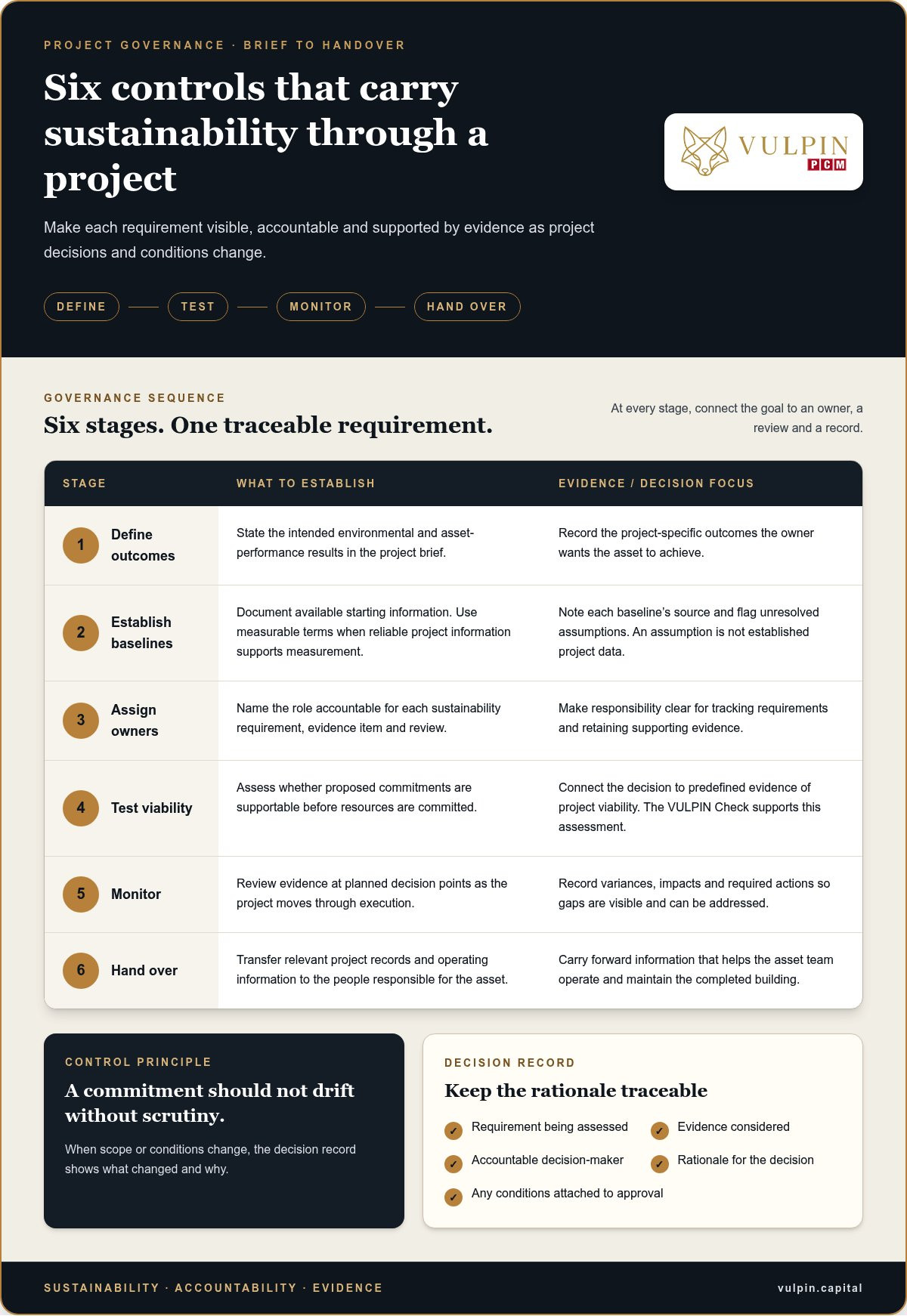
Use a sequenced governance framework:
- Define outcomes. State the intended environmental and asset-performance results in the project brief.
- Establish baselines. Document available starting information, its source, and any unresolved assumptions.
- Assign owners. Name the role accountable for each requirement, evidence item, and review.
- Test viability. Assess whether the proposed commitments are supportable before resources are committed. The VULPIN Check connects this decision to predefined evidence of project viability.
- Monitor. Review evidence at planned decision points and record variances, impacts, and required actions.
- Hand over. Transfer relevant records and operating information to the people responsible for the asset.
A decision record should capture the requirement, evidence considered, accountable decision-maker, rationale, and any conditions attached to approval. If scope or conditions change, the record shows what changed and why. This prevents an earlier commitment from drifting without scrutiny.
Maintain control through execution and handover
Keep approved sustainability requirements in the same management system as scope, schedule, budget, and quality. Assess a proposed substitution or scope change against the affected requirements, and record the decision owner and supporting evidence. If delivery departs from an approved requirement, document the deviation, its implications, corrective action, and resolution. This gives sponsors a basis for decisions and provides the asset team with a traceable account of what was delivered.
Handover is not an administrative finish line. Carry forward relevant operating and maintenance information, along with the evidence needed to understand the asset’s sustainability commitments. The Project Management in the Built Environment programme places built-environment project management in the context of sustainable buildings and the climate crisis. The practical governance task is to connect that intent to project-specific requirements and verified records.
VULPIN Capital’s project governance approach centres on evidence, viability, and controlled execution.
Balance sustainability ambitions with construction-cost reality and asset performance
Sustainability and cost discipline are not opposing mandates. A project needs to test whether an environmental objective can be delivered within its constraints and remain relevant to the asset’s intended use. A lower initial requirement may create different demands during construction or operation; a higher one is not automatically the better choice. Sustainable construction project management Ontario owners can apply means comparing options using evidence, not assumptions about price or performance.
Evaluate sustainability decisions beyond first cost
Assess each alternative against the same decision criteria. Life-cycle assessment can help examine environmental impacts across relevant stages of an asset’s life. It is a decision-making lens, not a promise of lower costs, savings, or a particular financial result. Before comparing options, establish what project-specific information is available, identify gaps, and record assumptions that could affect the conclusion.
| Decision criterion | Project-specific conclusion to document |
|---|---|
| Initial requirements | What scope, design, material, or evidence does each option require? |
| Execution implications | How could procurement, sequencing, installation, or coordination be affected? |
| Operational needs | What maintenance, operating knowledge, or asset-team responsibilities are relevant? |
| Evidence | Which project records or assessments support the comparison, and what remains uncertain? |
| Long-term asset relevance | Does the option fit the intended use, durability expectations, and ownership context? |
The table does not prescribe a winner. It gives the owner a consistent basis for making a decision. A conclusion is only as strong as the project data and stated assumptions behind it. Consider durability and maintainability alongside construction requirements, then retain the rationale so future reviewers can understand why an option was selected.
Keep approved outcomes intact when project conditions change
Conditions can shift after an outcome is approved. Assess a proposed substitution, scope adjustment, or specification change against approved sustainability requirements and documented constraints before accepting it. Record the trade-off, supporting evidence, decision authority, and any corrective action. A change may be justified, but it should not quietly erase an outcome.
Cost control belongs in the same governance process. Track the cause and implications of a variance, then assess available responses against approved project requirements rather than treating sustainability as an automatic cut. VULPIN Capital’s construction project cost overrun framework offers a related governance-first perspective on managing changes and cost pressures.
Put sustainable construction project management into practice across the project lifecycle
Turn the governance framework into a working sequence. At each stage, name an accountable role, define the evidence needed for the next decision, and retain a record. Specific measures and records depend on the project, but the control principle remains the same. Sustainable construction project management Ontario owners need provides a traceable line from the initial brief to operational stewardship.
Use stage gates to make decisions evidence-based
A stage gate is a deliberate review before a major commitment. Set gates before committing resources, making procurement decisions, or approving material scope changes. Identify the decision authority in advance. If required proof of viability is missing or incomplete, pause the commitment until the gap is resolved or formally assessed. For a broader governance structure, see the construction project governance framework.
- Briefing: The owner or sponsor defines intended outcomes. Evidence includes the project brief and known asset requirements. The decision is whether the objectives are clear enough to proceed. Record approved outcomes, assumptions, and accountable owners.
- Pre-construction: The project manager coordinates design development and viability review. Examine the current design, constraints, baseline information, and unresolved assumptions. The gate confirms readiness for procurement planning. Record open items, decisions, and conditions.
- Procurement: The procurement lead connects approved requirements to purchasing decisions. Retain evaluation criteria, relevant submissions, and the rationale for selections. The authorized decision-maker approves the choice. Record how it addresses requirements and any accepted trade-offs.
- Construction: The construction lead tracks approved requirements against work in the field. Use inspection records, submittals, and change documentation as applicable evidence. Review deviations and corrective actions before accepting changes, then retain decisions and close-out records.
- Commissioning: The commissioning lead coordinates planned checks and collects results. Decide whether the available evidence supports acceptance or identifies unresolved issues. Record test documentation, deficiencies, and follow-up actions. Commissioning verifies specified items; it does not, by itself, prove future performance.
- Handover: The owner’s designated asset representative receives relevant operating and maintenance information, final records, and outstanding obligations. Confirm the handover package is complete for ongoing oversight, and record acceptance and remaining actions.
Connect sustainable housing decisions to lasting stewardship
Residential decisions should account for intended use, operational needs, maintenance, and asset survivability, not just design-stage ambition. Net-zero home construction costs in Canada offers a related lens for examining residential decisions without assuming a universal cost or outcome. FoxyHome Sustainable Housing delivers environmentally conscious residential housing solutions with long-term asset survivability in view.
For disciplined execution across project stages, explore PCMNow Project Management.
How VULPIN Capital governs sustainable construction execution
Sustainable construction requires more than sound intent. It needs a management system that connects viability decisions, project controls, construction execution, and the asset’s future use. VULPIN Capital brings these disciplines together through PCMNow, The VULPIN Check, and The Fox for owners considering sustainable construction project management Ontario projects require. Each has a distinct role, and none substitutes for project-specific evidence or guarantees an outcome.
Connect project governance with disciplined construction execution
PCMNow is VULPIN Capital’s professional management service for complex construction projects. It focuses on construction-cost reality and disciplined execution, connecting approved requirements with the decisions and controls that shape delivery. That connection matters when design intent meets procurement, sequencing, scope changes, and field conditions. Project controls give decision-makers a documented view of what has changed, what evidence supports a response, and how that response affects approved objectives.
Records matter beyond construction, too. Clear decisions and traceable requirements give asset owners a stronger basis for ongoing oversight and condition-driven choices. This supports long-term asset survivability by keeping the rationale behind commitments visible, rather than leaving future operators with undocumented assumptions. Learn more about PCMNow project management and its execution approach.
Choose evidence over speculation before moving forward
The VULPIN Check governs real-asset deployment against predefined evidence of project viability. Before resources are committed, define the relevant proof and assess it against the decision at hand. If key evidence is incomplete, make the gap visible to decision-makers rather than concealing it with optimism or urgency. This creates a basis for proceeding, revising assumptions, or pausing a commitment. It does not guarantee cost, schedule, sustainability, or investment outcomes.
The Fox complements this governance with an operating framework for condition-driven asset decisions and survivability. It is not a construction certification. Together, these systems help distinguish a documented commitment from a verified result and keep accountability attached to decisions throughout the asset’s life.
For a governance-first approach to project viability and disciplined execution, explore VULPIN Capital’s governance-first approach.
Make sustainability accountable from the first decision
Sustainable construction project management Ontario owners can rely on begins with clear requirements, accountable decision-makers, and evidence that follows the project from planning through handover. Sustainability is not separate from cost control or delivery. Each commitment must be assessed against project viability, execution realities, and the asset’s needs over time.
The VULPIN Check provides a governance and verification process for real-asset deployment, using predefined proof of viability before resources are committed. PCMNow manages complex construction projects with a focus on cost reality and disciplined execution. For residential projects, FoxyHome delivers environmentally conscious housing solutions with long-term asset survivability in view.
These are practical disciplines, not promises of guaranteed outcomes. Make assumptions visible, preserve the rationale behind decisions, and verify what the project actually delivers. If that approach fits your priorities, explore VULPIN Capital’s governance-first approach and take the first step towards evidence-led project execution.
Frequently Asked Questions
What is sustainable construction project management in Ontario?
It is the coordinated governance of a construction project’s sustainability requirements, cost, schedule, quality, and long-term asset needs. Sustainable construction project management Ontario owners can use is a documented process for making decisions and checking what the project delivers, not a label. Applicable building and approval requirements form part of the project context. Verify current requirements for the specific asset and its circumstances rather than assuming one rule applies to every project.
Is sustainable construction project management only for green building specialists?
No. It involves project sponsors, designers, construction managers, contractors, and asset operators, with responsibilities defined for each project. Sustainability objectives need to connect to ordinary project controls, including scope, procurement, schedule, cost, quality, and handover. Specialist expertise may inform particular design or technical decisions. Governance makes sure those decisions remain visible, assigned to accountable roles, and connected to approved project requirements throughout delivery.
How do you manage sustainability goals during construction?
Start with clear requirements, established baselines, assigned owners, and defined evidence for assessing progress. Carry the requirements into procurement, site controls, change reviews, commissioning, and handover. Record decisions and deviations as they occur, including who approved a response and what evidence supported it. The right measures depend on the project. An early estimate or broad aspiration is not proof that a sustainability outcome was delivered.
Can sustainable construction be managed within a disciplined project budget?
Yes. Budget discipline depends on clear requirements, realistic project information, and controlled decisions, not on removing sustainability objectives by default. Compare alternatives using evidence specific to the asset, including construction implications and relevant operational needs. Track approved scope and assess proposed changes before committing resources. Do not assume generic savings or payback. Evaluate any financial case against the project’s design, intended use, and delivery conditions.
What does a construction project manager do on a sustainable building project?
A project manager coordinates scope, schedule, cost, quality, communication, and delivery responsibilities. On a sustainability-focused project, the role also includes carrying agreed requirements into procurement and construction, documenting proposed changes, and coordinating verification and handover. The project’s governance structure determines precise duties. Explicitly assign sustainability accountability so requirements do not fall between design, construction, and the people responsible for operating the completed asset.
What is the difference between construction project management and construction project management training in Ontario?
Construction project management is the work of governing and delivering a project; training programmes teach knowledge and skills relevant to that work. This guide focuses on owner-side decisions, not choosing a college programme. Those decisions include defining project requirements, controlling commitments, monitoring execution, and preparing the asset for its intended use. Training can support professional development, but it is distinct from the governance system used to manage a live construction project.
When should sustainability requirements be set in a construction project?
Set them during project definition and planning, before major decisions make them difficult to incorporate. Define the intended outcomes, how requirements will be documented, who is accountable, and what evidence will be reviewed. Revisit the requirements at procurement, change-control, construction, and handover stages. This keeps approved objectives connected to real decisions as the project develops, rather than leaving sustainability as an early ambition without an owner or verification path.