

The right time to hire an owner’s representative is before key project decisions become expensive commitments. If you’re asking when to hire an owner’s representative, look at the point when scope, budget, design, and procurement start to affect one another. Unclear responsibilities can hide cost or schedule issues until fewer practical options remain.
Not every project needs the same level of support. Scale is only one factor: limited internal capacity, multiple decision-makers, demanding procurement, or little room for schedule or budget changes can all increase the need for owner-side coordination.
This guide explains which project conditions may call for owner-side representation, how earlier involvement can support planning and accountability, and what oversight the role can provide through design and construction. It also explains how to distinguish governance and execution oversight from simply attending meetings, so you can assess the need while decisions are still open.
Key Takeaways
- Decide when to hire an owner’s representative by assessing project complexity, stakeholder demands, and your team’s capacity to track decisions and unresolved issues.
- Compare feasibility, pre-construction, procurement, construction, and closeout to identify where independent oversight can best support project governance.
- Before engagement, define the representative’s scope, reporting expectations, decision rights, and level of delegated authority.
- Separate advisory input, coordination, and monitoring from authority to make decisions on the owner’s behalf.
- For complex construction and development execution, PCMNow Project Management applies a disciplined approach centred on construction-cost reality.
When to hire an owner’s representative: recognize the need before execution
The practical answer to when to hire an owner’s representative is before major decisions about scope, budget, procurement, or delivery become difficult to change. Once design instructions are issued, work is tendered, or contracts are committed, changing direction can be harder. Early involvement gives the owner-side role time to organize oversight and clarify decision-making while options are still open.
An owner’s representative coordinates oversight and decision-making on the owner’s behalf, while designers and contractors remain responsible for their respective design and construction work. The representative connects information across the project and keeps the owner’s interests in view. The role is more than meeting attendance, but it does not transfer the owner’s authority to approve scope, spending, or commitments unless specific decision rights are delegated.
Project size alone doesn’t settle the question. A smaller project may involve several stakeholders, interdependent design and procurement choices, or an owner without the time or technical capacity to track open issues. A larger project may have capable internal staff but still benefit from a defined owner-side structure. Consider the coordination demands, how quickly new information reaches decision-makers, and whether the owner can maintain effective oversight.
What an owner’s representative does for the owner
The role connects information across design, procurement, and construction so decisions don’t get stuck in separate channels. A representative can monitor scope, review schedule and budget reporting, flag unresolved issues, and document decisions and their rationale. These practices support visibility and accountability, but don’t guarantee a particular cost, schedule, or quality outcome. The owner retains approval authority unless specific decision rights are delegated.
The role draws on project-management principles such as planning, coordination, and managing stakeholder interests. A general overview of the Project manager role offers useful context. An owner’s representative applies that kind of coordination from the owner’s side, with responsibilities and authority set by the agreed project scope.
Why timing matters more than a fixed project threshold
Early engagement can help the owner set reporting expectations, clarify decision rights, and assess how design choices affect procurement and delivery before commitments are made. For example, if a design decision affects what can be procured or when construction can proceed, owner-side coordination can make those dependencies visible while the team still has options.
Starting during construction can still add useful oversight, but some earlier decisions will already be fixed. The right hiring point depends on the project’s decision load and the owner’s capacity, not a universal budget threshold. If you can’t reliably connect current scope, schedule and budget information with outstanding decisions, consider whether structured owner-side oversight is needed.
Which project phase is the right time to hire an owner’s representative?
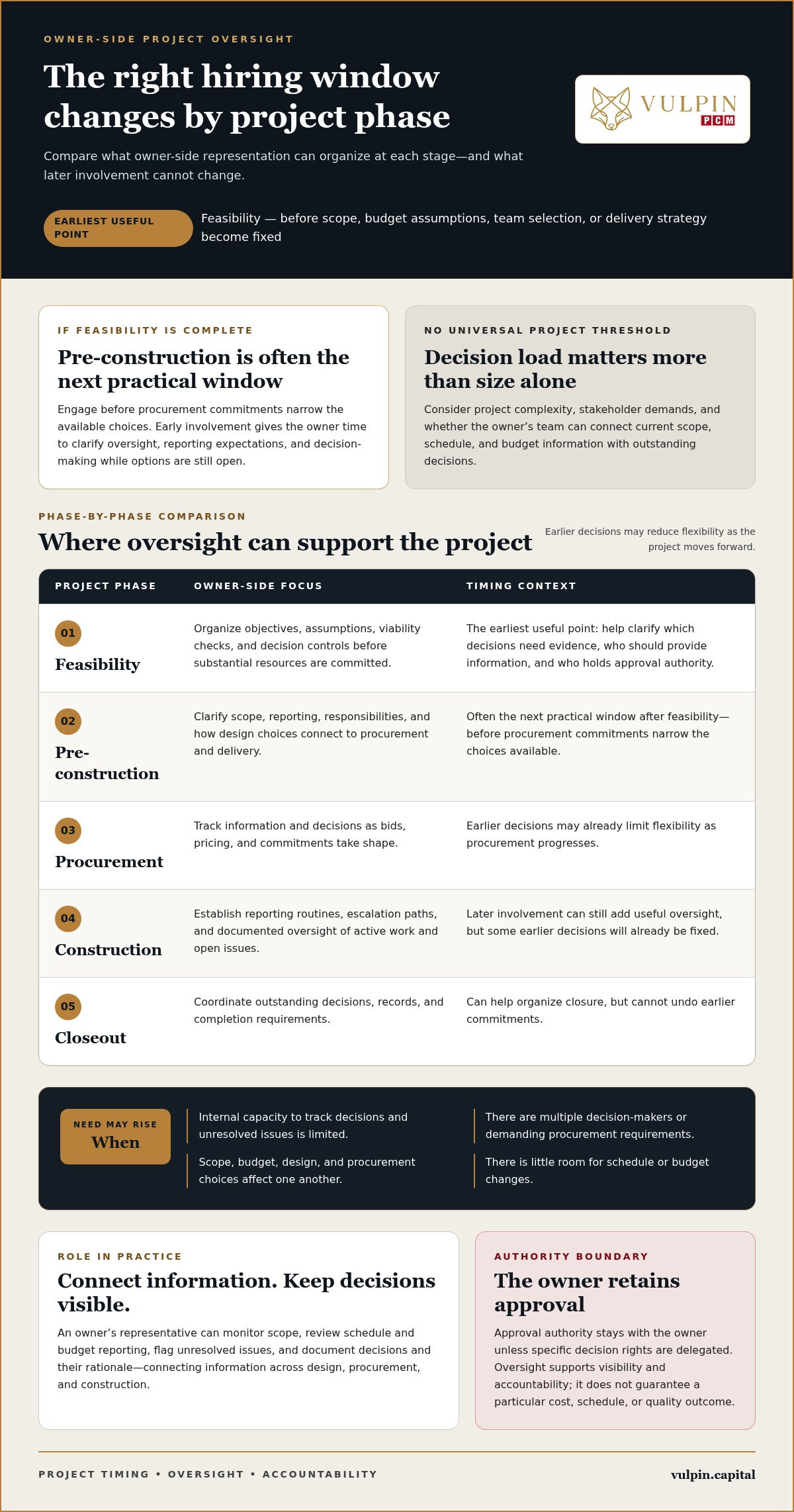
The earliest useful point is feasibility, before scope, budget assumptions, team selection, or delivery strategy become fixed. At this stage, an owner’s representative can help organize oversight and clarify which decisions need evidence, who should provide information, and who holds approval authority. If feasibility is complete, pre-construction is often the next practical window, before procurement commitments narrow the available choices.
Each phase offers a different kind of support:
- Feasibility: Organize objectives, assumptions, viability checks, and decision controls before substantial resources are committed.
- Pre-construction: Clarify scope, reporting, responsibilities, and how design choices connect to procurement and delivery.
- Procurement: Track information and decisions as bids, pricing, and commitments take shape. Earlier decisions may already limit flexibility.
- Construction: Establish reporting routines, escalation paths, and documented oversight of active work and open issues.
- Closeout: Coordinate outstanding decisions, records, and completion requirements. This phase can organize closure, but can’t undo earlier commitments.
Engaging during feasibility and pre-construction
Early involvement helps turn project intent into a working governance structure. The owner can define objectives, establish how scope and budget assumptions will be recorded, set reporting expectations, and decide how recommendations move to approval. The VULPIN Check governance standard describes a verification approach that requires predefined evidence of project viability before resources are committed. That principle can help inform how assumptions and decision controls are documented.
Clear authority matters, too. The American Institute of Architects’ standard form of agreement provides a reference point for defining an owner’s representative’s scope. A written understanding of responsibilities helps distinguish advice, coordination, monitoring, and delegated authority.
Engaging after procurement or construction has begun
Later engagement can still be useful. An owner’s representative joining during procurement or construction can assess current reporting, organize decision records, identify unresolved issues, and establish escalation paths. These steps can make project status easier to understand and support more disciplined decisions going forward.
However, signed commitments and completed work can’t simply be reset by adding oversight. Some issues may still be addressed through decisions ahead; others may be constrained by existing agreements, sequencing, or work already done. Knowing when to hire an owner’s representative means matching the engagement point to the decisions still open. For complex construction and development execution, explore VULPIN Capital’s project-management approach.
Does your project need an owner’s representative? Assess the risk signals
Assess what the owner must coordinate, which information they need to interpret, and what decisions they must make. One complication doesn’t prove that dedicated representation is necessary. Several conditions together, especially when the owner lacks time or technical capacity to monitor them, warrant a closer look.
| Project demand | Lower coordination demand | Higher coordination demand |
|---|---|---|
| Scopes and coordination | Work is contained, with few dependencies between design, procurement, and construction. | Connected workstreams depend on timely information and decisions across multiple disciplines. |
| Stakeholders | Responsibilities and communication paths are clear. | Several consultants, contractors, approval points, or owner groups need alignment. |
| Reporting | Scope, schedule, and budget information is organized and easy for the owner to review. | Updates are fragmented, cost visibility is limited, or emerging issues are difficult to trace. |
| Decision-making | Approvals have clear owners and can be made with available information. | Decision rights are unclear, issues lack an accountable owner, or approvals stall between parties. |
Project complexity and coordination load
Look beyond the number of participants. Consider how many scopes depend on one another, how design information affects procurement, and how contractor sequencing connects to owner decisions. Even when roles are assigned, gaps can remain between them. If the owner must repeatedly reconcile conflicting updates or chase answers across the project team, that coordination load deserves attention. There is no universal stakeholder count or project-value cutoff that determines the need.
Owner capacity, governance, and visibility
Ask whether someone on the owner’s team can consistently review project information, understand its implications, make timely decisions, and record the basis for approvals. Warning signs include reports that don’t align, no clear route for escalating an unresolved issue, or decisions moving forward without a named accountable owner. These are prompts to examine project controls, not automatic diagnoses.
A useful test is whether the owner can answer these questions from current records: What is unresolved? Who owns the next action? What information supports the decision? If those answers are hard to establish, governance may need strengthening. The construction project governance framework offers further context on structuring oversight and accountability.
The decision is cumulative. Consider coordination demands, stakeholder alignment, reporting quality, decision clarity, and the owner’s capacity together. If several are strained at once, assess whether owner-side oversight could provide the structure and visibility the project lacks. This combined assessment is a more useful guide to when to hire an owner’s representative than project size alone.
Before Hiring: Define Authority, Scope, and Timing
A representative can provide useful oversight only when the mandate is clear. Before engagement, set out what the owner needs monitored, which decisions remain open, and how information should reach the people authorized to act. This preparation also distinguishes owner-side oversight from the design and construction work performed by other project participants.
Set the mandate before work begins
Use this sequence to define the role:
- Clarify the objectives. Record the owner’s priorities and what the project must accomplish.
- Identify the project phase. Note what has been decided, what is underway, and what remains unresolved.
- List the decisions in view. Identify upcoming approvals, dependencies, and the information needed to make them.
- Set reporting needs. Specify what the owner needs to understand about progress, budget information, open issues, risks, and required actions.
- Define authority and interfaces. State which approvals and commitments stay with the owner, what the representative coordinates or monitors, and how responsibilities connect with designers, contractors, and other participants.
Be precise about the level of involvement. Advisory input means providing analysis or recommendations; the owner decides. Coordination means aligning information and actions among participants. Monitoring means tracking progress, reporting, and unresolved matters against the agreed scope. Delegated decision-making means the representative can make specified decisions within the authority assigned by the owner. These functions are distinct. Don’t assume one includes the others.
Put the agreed scope, interfaces, reporting expectations, and authority in writing. This is about reducing ambiguity over who provides information, who coordinates a response, and who approves a commitment.
Establish useful reporting and escalation
Useful reporting is concise and ready to support decisions. It should show current progress, unresolved items, relevant risks, accountable next steps, and matters requiring owner action. The right reporting cadence depends on project activity and the pace of decisions. Set it often enough to support oversight without creating updates that obscure what needs attention.
Agree on an escalation path before a problem stalls. If information is missing, a decision is delayed, or responsibilities overlap, the representative should know who to notify and what direction is needed. Clear records also help distinguish an issue that can still be managed from a commitment or completed work that can’t simply be reversed.
Once the timing, mandate, and oversight needs are defined, review PCMNow Project Management for complex construction and development execution. To examine project-management support, explore VULPIN Capital’s project-management approach.
How VULPIN Capital approaches owner-side project execution
Complex coordination, limited owner capacity, weak project visibility, and consequential decisions are reasons to examine a project’s governance and execution needs. They don’t automatically prove that one particular role is required. The key question is whether the project has a clear structure for tracking information, assigning accountability, and moving decisions forward with the owner’s interests in view.
VULPIN Capital provides PCMNow Project Management for complex construction and development projects. Its approach emphasizes construction-cost reality and disciplined execution. Project oversight is treated as an execution and governance function, not simply a calendar of meetings. The work is grounded in the project’s conditions, information, responsibilities, and decision structure, without promising a predetermined result.
From project signals to disciplined execution
When workstreams depend on one another, the owner needs a coherent view of what is known, what remains unresolved, and which decisions require direction. Structured project management can support coordination and oversight across the project while keeping responsibilities and decision pathways visible. It doesn’t remove the owner’s role or make uncertainty disappear. It provides a disciplined framework for managing the work and the information that informs decisions.
This governance-first perspective connects with the VULPIN Check, a verification process for real asset deployment. It requires predefined evidence of project viability before resources are committed. The principle is relevant to construction execution: decisions should be supported by defined evidence and clear accountability, rather than undocumented assumptions. Project controls and oversight still need to reflect the circumstances at hand.
A practical next step for owners
If your assessment points to a need for structured execution support, review PCMNow Project Management. Consider how its focus on complex construction and development projects relates to the coordination, reporting, and decision demands you have identified.
Discuss disciplined project execution with VULPIN Capital if your project calls for a more defined owner-side management structure. The useful question is not simply when to hire an owner’s representative. It is whether the representative’s scope, authority, and timing align with the decisions still ahead. Representation is most useful when its mandate fits the project’s actual conditions.
Put project oversight on a disciplined footing
The decision about when to hire an owner’s representative comes down to the project’s demands, the owner’s capacity, and which decisions are still open. Engage early enough to shape oversight and clarify authority, then define the representative’s scope, reporting, and escalation responsibilities in writing.
For complex construction and development projects, PCMNow Project Management focuses on construction-cost reality and disciplined execution. The VULPIN Check applies predefined viability verification before resources are committed, while The Fox supports rule-governed asset-survivability decisions. Together, these reflect an approach centred on evidence, governance, and deliberate decisions, not promises of a particular outcome.
If your project needs structured owner-side execution, Discuss disciplined project execution with VULPIN Capital. A clear mandate can help put accountability and project decisions on firmer ground.
Frequently Asked Questions
When should I hire an owner’s representative?
Hire one before major scope, procurement, budget, or delivery decisions become difficult to change. Feasibility and pre-construction are useful windows to organize responsibilities, reporting, and decision rights. The right point depends on project complexity, your capacity to oversee the work, and which decisions remain open. If engagement starts later, oversight can still become clearer, but existing commitments and completed work may limit what can change.
Is an owner’s representative necessary for a small construction project?
Not always. Project size alone doesn’t determine whether owner-side representation is useful. A smaller project may still involve multiple participants, connected workstreams, or demands that exceed the owner’s available time and technical capacity. A larger project may already have internal oversight. Assess how well you can coordinate responsibilities, review reporting, track unresolved issues, and make informed decisions before deciding whether dedicated representation is warranted.
Can I hire an owner’s representative after construction has started?
Yes. An owner can engage an owner’s representative after construction begins to improve coordination, issue tracking, reporting, and decision documentation. The representative needs a clear picture of existing commitments, approvals, work completed, and unresolved matters. That can help structure oversight from the point of engagement. It can’t guarantee recovery of missed time or costs, or reverse work and commitments that are already in place.
What does an owner’s representative do during pre-construction?
During pre-construction, an owner’s representative can coordinate project information, clarify responsibilities, organize reporting expectations, and support the owner’s decision process. For example, they can help make visible how a design decision connects to procurement or delivery planning. The exact scope depends on the project and agreed authority. The owner retains decisions that haven’t been delegated, while designers, contractors, and other participants retain their defined responsibilities.
How do I know if my construction project is too complex to manage alone?
Assess whether you can reliably oversee connected scopes, stakeholders, reporting, and decisions while meeting your other responsibilities. Warning signs include fragmented updates, unclear accountability, delayed information, or decisions with no documented owner. No single signal sets a universal threshold. Ask whether you have the time and technical capacity to understand current issues, identify who must act next, and make informed decisions as the project progresses.
Does an owner’s representative replace a construction manager?
Not necessarily. The roles can differ in scope, authority, and relationship to project delivery, and may overlap or complement one another. An owner’s representative works from the owner’s side; construction management responsibilities depend on the project arrangement. Don’t assume one role automatically replaces the other. Define responsibilities, reporting lines, interfaces, and decision authority so the owner can see who coordinates each matter and who is accountable for acting.
What should I define before engaging an owner’s representative?
Set out the project objectives, current phase, unresolved decisions, reporting needs, and authority the owner intends to retain. Specify whether the representative will provide advice, coordinate information, monitor progress, or make defined decisions under delegated authority. Document how the role interfaces with designers, contractors, and other participants. Agree on an escalation route for missing information or delayed decisions. A clear mandate connects the work to actual project needs.