

A progress report is not proof of progress. For owners searching “independent project monitoring Canada,” the real question is whether reported scope, schedule, cost and emerging risks align with observable site conditions and verifiable records. A polished dashboard can’t answer that on its own.
Owners need timely visibility when decisions depend on what has actually been completed, tested or approved. Independent monitoring verifies evidence at defined milestones; it doesn’t replace project management, commissioning or an audit. The distinction matters: monitoring tests evidence and records findings, while project management directs execution. This article explains how to structure proportionate oversight for Canadian real assets, taking applicable requirements into account for each project.
You’ll learn what a monitor should verify, which evidence is useful at key milestones, and how to turn findings into documented decisions with accountable follow-up through handover. The VULPIN Check centres on proof of viability before resources are committed; PCMNow focuses on construction-cost reality and disciplined project execution. The principle is straightforward: decisions should rest on evidence, not assumption.
Key Takeaways
- Set a clear monitoring purpose, scope, reporting cadence and escalation path before review begins.
- Use independent project monitoring Ontario readers can apply as a framework: compare milestone evidence with approved project controls and decision thresholds.
- Keep monitoring distinct from project management, commissioning and audit by defining who verifies, who delivers and who makes decisions.
- Match the depth of evidence review to the project’s complexity, then document findings and assign accountable follow-up.
- Carry key decisions, supporting evidence and unresolved items into handover so asset decisions start with a reliable project record.
What independent project monitoring means for a real-asset project
A project can appear on schedule in a report while site conditions tell a different story. Independent project monitoring gives the sponsor a structured view of whether evidence supports reported progress. It is oversight, not day-to-day delivery: the monitor examines status and decision exposure without directing construction work or taking over the project team’s responsibilities.
Independent project monitoring verifies whether project evidence supports reported status; it does not manage the work that produces that status. Independence concerns the monitor’s reporting line and the basis for conclusions, not whether the monitor understands the project. A useful review requires familiarity with the approved baseline, project controls, key decisions and records that explain changes. Findings should go to the sponsor or another agreed oversight party, with supporting evidence and limitations made clear.
The broader discipline of evaluation also emphasizes objectivity: Monitoring and evaluation (M&E) are processes used to improve the management of outputs, outcomes, and impact, with the credibility and objectivity of reports depending on the independence of the evaluators. For sponsors considering independent project monitoring Ontario as part of a wider Canadian governance approach, the central test is whether conclusions can be traced to reliable evidence. Project-specific requirements depend on the applicable jurisdiction and project.
What does an independent project monitor verify?
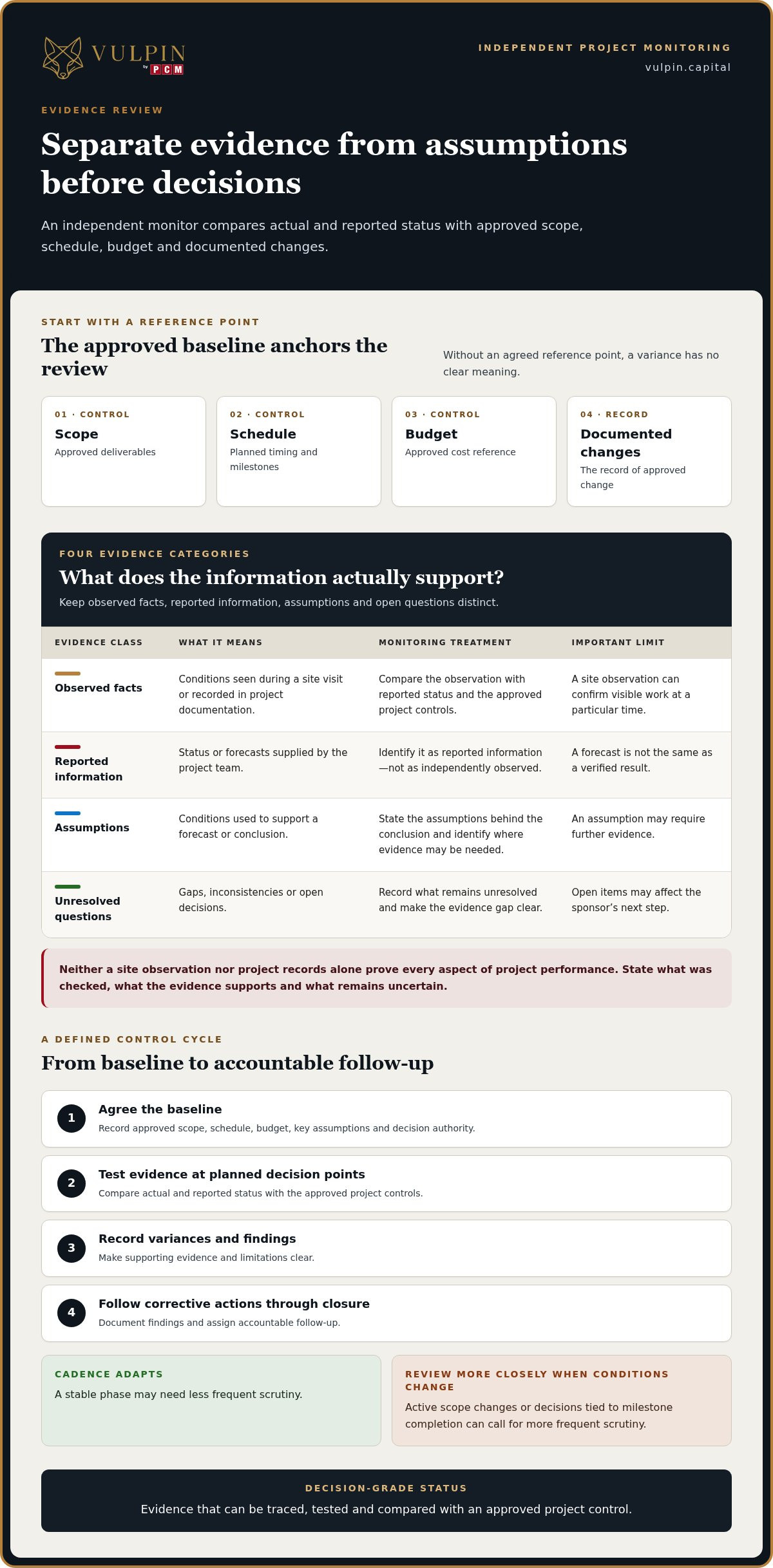
The monitor compares actual and reported status with the approved scope, schedule, budget and documented changes. The baseline matters: without an agreed reference point, a variance has no clear meaning. A review may draw on site observations and project records, including progress updates, schedules, cost reports, change documentation and decision records.
- Observed facts: Conditions seen during a site visit or recorded in project documentation.
- Reported information: Status or forecasts supplied by the project team, identified as reported rather than independently observed.
- Assumptions: Conditions used to support a forecast or conclusion, which may need further evidence.
- Unresolved questions: Gaps, inconsistencies or open decisions that may affect the sponsor’s next step.
These distinctions prevent a forecast from being mistaken for a verified result. A site observation can confirm visible work at a particular time, while project records may explain how that work relates to scope, schedule or cost. Neither alone proves every aspect of project performance. The monitor should state what was checked, what the evidence supports and what remains uncertain.
When does a project need independent oversight?
Additional oversight can be useful when responsibilities are distributed across stakeholders, delivery is complex or commitments depend on clear decision gates. A sponsor may have limited access to day-to-day site activity or receive updates assembled by several parties. Routine reporting can then leave gaps between stated progress and the evidence available to support it.
This can arise across Canadian real assets, from building work to infrastructure and other complex developments. The case for monitoring is not defined by one universal project size. It depends on the sponsor’s visibility, the consequences of decisions and the quality of existing controls. Governance and execution remain distinct: The VULPIN Check centres on predefined proof of project viability before resources are committed, while PCMNow Project Management focuses on construction-cost reality and disciplined execution.
How independent monitoring tests project evidence at each milestone
Monitoring works best as a defined control cycle, not a last-minute review of a status report. It starts with an agreed baseline, tests evidence at planned decision points, records variances and follows corrective actions through closure. Set the review cadence to reflect project risk, phase and change. A stable phase may need less frequent scrutiny than a period with active scope changes or decisions that depend on milestone completion.
A reported status is decision-grade only when its evidence can be traced, tested and compared with an approved project control. That standard helps sponsors distinguish verified progress from forecasts, assumptions or claims that still need support. For sponsors searching for independent project monitoring Ontario, the same evidence discipline applies across Canadian projects, subject to the requirements of the applicable jurisdiction.
Set the baseline before tracking progress
Before monitoring begins, record the reference point against which changes will be judged. A useful baseline identifies approved scope, schedule, budget, key assumptions and who has authority to make project decisions. It also specifies which reports and source documents are available for review, when site observations will occur and how often findings will be reported. Without this agreement, two parties may use the same word, such as “complete,” to describe different conditions.
Define material variance for the project instead of relying on a universal threshold. A variance could involve a change to an approved deliverable, a schedule shift affecting a decision date or a cost forecast that challenges an agreed control. The sponsor should determine which variations require notification, escalation or formal approval. As an example of the value of objective assessment, the Auditor General of Ontario highlights that program evaluation can examine performance using objective data and independent assessment. Project monitoring applies a related evidence principle to project controls, but an audit or program evaluation is not a substitute for project-specific review.
Verify milestones and escalate variance
At each review, compare reported status with observable work and supporting records. If a report marks an installation complete, the monitor can check the relevant site condition and examine records tied to that milestone. A site visit captures conditions at a point in time; it doesn’t establish facts beyond what was observed or documented. Findings should state the evidence reviewed and any limitations.
Use a consistent sequence to move from evidence to accountable action:
- Define the milestone: Identify the approved requirement, expected evidence and decision threshold.
- Test the status: Compare reported completion with observations and records, noting gaps or conflicting information.
- Record the variance: Document the evidence, potential scope, schedule or cost impact, responsible party and decision deadline.
- Escalate and close: Route the issue to the agreed decision authority, track corrective action and record evidence of resolution.
Closure requires more than verbal assurance. The record should show what changed, what evidence supports resolution and whether a decision remains outstanding. Evidence-led project governance connects verification to clear decision gates and accountable follow-up.
Independent monitoring vs. project management, commissioning, and audit
These roles can examine the same project records, but they answer different questions. Confusion arises when evidence review is mistaken for authority to direct work, or when a technical test is treated as an overall assessment of project status. For sponsors considering independent project monitoring Ontario as part of capital governance, the mandate should identify who delivers, who verifies, who reports and who decides.
Independent monitoring reviews evidence against an agreed project mandate and reports status, variance and unresolved exposure to the designated oversight party. The monitor may identify a concern, but doesn’t normally instruct contractors, reallocate project resources or approve changes unless the governance arrangement expressly assigns that authority. Clear boundaries preserve accountability rather than duplicate it.
Monitoring and project management have different accountabilities
Project management coordinates delivery. It organizes resources, decisions, schedules, communications and execution so the project team can carry out approved work. Its evidence may include work plans, schedules, cost forecasts, change records and progress updates. The project manager is accountable for managing within the authority assigned to that role and bringing decisions to the appropriate parties.
Monitoring has a separate function. It examines relevant information, tests whether reported status is supported and communicates findings through an agreed reporting line. It doesn’t run the construction work. PCMNow Project Management is VULPIN Capital’s execution-focused capability, with an emphasis on construction-cost reality and disciplined project execution. That is distinct from governance and verification, including The VULPIN Check’s use of predefined proof of project viability before resources are committed.
Monitoring is not the same as commissioning or an audit
Commissioning is a defined verification activity focused on systems and their performance against intended requirements. Depending on the project and commissioning scope, specialists may review documentation, observe tests and record deficiencies or results. This technical work can inform a monitor’s assessment, but it doesn’t by itself establish whether the whole project remains aligned with approved scope, schedule, budget or decision controls.
An audit is a structured examination with a defined scope, criteria and evidence trail. It may assess records, controls, transactions or compliance with specified requirements. Monitoring, by contrast, is generally organized around ongoing or milestone-based visibility for project decisions. Neither label guarantees that every issue will be found. The usefulness of each depends on its scope, evidence, timing and reporting arrangements.
- Project management: Coordinates execution and delivery decisions; reports through the project’s management structure.
- Independent monitoring: Reviews project evidence and reports status or variance to the agreed oversight party.
- Commissioning: Checks specified systems against intended requirements, often using technical tests and records.
- Audit: Examines defined subject matter against stated criteria and documents its evidence trail.
None replaces the project team, technical specialists or decision-makers. Monitoring can surface a discrepancy; the responsible parties still assess technical implications, determine corrective action and exercise their assigned authority. Clear boundaries also support a wider construction project governance framework, connecting evidence, authority and accountability without confusing oversight with delivery.
How to establish an effective project monitoring process
A monitoring process needs a mandate before it needs a dashboard. The sponsor should define what oversight must establish, who receives findings and which decisions the evidence is meant to inform. This keeps the work proportionate: enough scrutiny to give decision-makers a reliable view, without duplicating project management or technical review.
Use a setup checklist to make the mandate operational:
- Purpose: State the oversight questions the sponsor needs answered.
- Scope: Identify project phases, controls, milestones, records and exclusions in the review.
- Independence: Set reporting lines and disclose relevant relationships so findings can be assessed objectively.
- Cadence: Set review timing based on project risk, phase, change and upcoming decisions.
- Escalation: Name the recipient and route for material concerns or decisions that cannot wait for routine reporting.
There is no universal review frequency or evidence threshold that fits every project. A stable phase with established controls may call for a different level of review than a phase involving active change or a significant decision. Adjust the plan when project complexity, risk or the quality of available information changes. This is the practical discipline behind independent project monitoring Ontario and other Canadian projects: fit the oversight to the asset and its decision needs, not an arbitrary template.
Write a monitoring brief before work begins
Put the mandate in writing. Specify access to project records and sites, reporting recipients, review cadence, responsibilities, confidentiality expectations and escalation routes. Clarify how approved scope changes will update the baseline and whether they require a change to the monitoring plan. A written brief reduces ambiguity when reporting lines, evidence needs or decision authority shift during delivery.
Define practical boundaries as well. Identify who supplies records, who responds to findings and who can approve changes or corrective action. If a monitor lacks access to a source needed to test a claim, record the limitation rather than conceal it in a confident summary. Broader risk controls can be considered alongside construction project risk management, while keeping monitoring’s specific mandate distinct.
Make monitoring findings usable to decision-makers
A report should be concise without stripping away the evidence behind its conclusions. Use a dated status dashboard and separate verified findings from reported information, interpretation, risk and decisions required. For each variance, state the relevant control, supporting evidence, likely implication and uncertainty. A forecast may help frame a decision, but it isn’t a verified fact.
Every action needs an owner, due date and closure evidence. For example, if a record doesn’t support reported milestone completion, identify the missing or conflicting information, name the party responsible for responding and record what will establish resolution. This makes reporting a traceable decision process rather than a collection of observations. A disciplined project monitoring mandate helps connect oversight with accountability.
From project monitoring to governed asset decisions
Monitoring has lasting value only if its findings carry through the transition from the project team to asset ownership and operations. At handover, a clear record lets the next decision-maker see what was approved, what was completed, what remains unresolved and what evidence supports each conclusion. It turns project history into usable asset knowledge rather than a folder of disconnected reports.
Project closeout and building-performance optimization are related, but they aren’t the same task. Closeout assembles project records and identifies outstanding obligations or issues. Later optimization examines how the asset performs in use and whether operations should change. Routine operations then maintain the asset over time. A monitoring record supports these stages; it doesn’t replace operational expertise or ongoing performance review.
Carry verified project knowledge into the asset record
A useful handover record brings together the material evidence and decisions needed to understand the asset’s condition at transition. Include approved changes and their status, outstanding risks and responsible parties, relevant commissioning records, completion evidence and decisions that shaped the delivered scope. If an item is incomplete or disputed, label it clearly and identify the evidence still required.
Keep assumptions visible. A projected performance outcome, for example, shouldn’t be presented as an established operating result before it has been observed and documented in use. The record should distinguish verified completion from future expectations, and unresolved items from closed ones. That distinction helps owners make deliberate decisions without inheriting false certainty.
Execution discipline contributes to the quality of this record. PCMNow Project Management focuses on construction-cost reality and disciplined project execution. Project management and governance verification remain distinct, but a well-documented execution process gives future reviewers a stronger basis for understanding decisions and outcomes.
Use governance gates before committing further resources
Handover isn’t the end of governance. It’s a decision point. Owners may need to resolve an outstanding item, fund further work, change an operating approach or proceed with another stage of real-asset deployment. Each decision should draw on documented findings, the asset’s condition and evidence relevant to the decision. A forecast can inform deliberation, but it should not be mistaken for proof.
The sequence is disciplined: establish what must be demonstrated, verify the available evidence, make the decision through the appropriate authority, execute the approved action and review the result. The VULPIN Check applies predefined proof of project viability before resources are committed. It serves a governance and verification purpose, distinct from PCMNow Project Management’s focus on execution. Independent project monitoring Ontario sponsors use can contribute evidence to those gates, but it doesn’t make the decision or eliminate delivery risk.
The Fox supports rule-governed asset-survivability decisions, connecting documented conditions to longer-term decision-making. No single report guarantees an outcome. The standard is a traceable chain from evidence to decision and accountable follow-up. To explore VULPIN Capital’s approach to real-asset governance and execution, explore VULPIN Capital.
Make the next capital decision evidence-led
Treat oversight as part of how capital is governed, not as paperwork added after uncertainty appears. For sponsors considering independent project monitoring Ontario, that means deciding in advance what evidence must be in place before a commitment, what will be verified during execution and how unresolved findings will affect the next decision.
This sequence connects distinct disciplines without confusing their responsibilities. The VULPIN Check uses predefined viability proof before resources are committed. PCMNow Project Management focuses on disciplined construction execution. Verification informs the decision; project management organizes delivery. Neither removes risk, but clear gates can help keep assumptions from quietly becoming facts.
Strong governance is built through deliberate decisions and accountable follow-through. If your next real-asset decision calls for a more disciplined framework, explore VULPIN Capital’s governance and project-management approach. Move forward with evidence, clear authority and a record built to support the asset over time.
Frequently Asked Questions
What is independent project monitoring?
Independent project monitoring is an objective review of project evidence for the sponsor or another designated oversight party. It tests whether reported progress and emerging issues are supported by records and observations, without taking over delivery decisions. In searches for independent project monitoring Ontario, the key distinction is that independence refers to the monitor’s reporting relationship and evidence-based conclusions, not a lack of familiarity with the project.
How is independent project monitoring different from project management?
Project management coordinates the people, resources, schedule and decisions needed to deliver the work; monitoring examines evidence and reports whether the reported status is supported. For example, a project manager may coordinate a response to a delayed equipment delivery, while a monitor records the schedule effect and checks whether the revised forecast is documented. The roles can inform each other, but monitoring doesn’t direct the project team.
When should independent project monitoring begin?
Begin before key commitments or delivery decisions depend on progress claims, ideally while the approved project baseline and decision authorities are being established. Early involvement gives the monitor a reference point for later changes and helps clarify which records will be available. Monitoring can still begin after work has started, but the initial review should document gaps in baseline information rather than imply a complete historical view.
What does an independent project monitor review?
A monitor reviews information relevant to the agreed mandate, which may include approved plans, schedule and cost updates, change approvals, risk records, milestone documentation and site observations. The precise evidence depends on the asset and project phase. For example, consider a change request alongside its approval status and recorded schedule or scope implications. Its appearance in a report alone doesn’t make it an authorized change.
Does independent project monitoring guarantee a project will finish on time and on budget?
No. Monitoring can identify unsupported progress claims, emerging variances and unresolved decisions, but it can’t control every cause of delay or additional cost. Site conditions, decisions, supply constraints and changes may affect delivery. Its value is earlier, clearer information for the people with authority to respond. Sponsors should treat monitoring as a risk-governance measure, not a promise of schedule or budget performance.
What should an independent project monitoring report include?
A useful report identifies the review period, evidence examined, current status, material variances and any limits on the assessment. It should distinguish verified observations from information supplied by others, then set out the issue’s potential impact and the decision or response required. Each action needs an accountable owner and a due date. Later reports should show whether the action was completed and what record supports closure.
How does monitoring support a real asset after construction?
At handover, monitoring records can give the asset owner a clearer account of approved changes, completion evidence, commissioning results and outstanding matters. That information helps operations teams understand which items need follow-up and which assumptions still require confirmation. It doesn’t replace routine maintenance or later performance analysis. Instead, it gives those activities a documented starting point, so future decisions can account for the project’s actual history.