

A construction project can have a full team and still leave the owner unsure who is making decisions, why costs are changing, or whether early assumptions still hold. When hiring an owner’s representative for construction, the role serves as a governance layer, not another contractor. The representative provides owner-side oversight of project decisions and execution, while the contractor builds and consultants provide their professional services.
That distinction matters. An owner’s representative doesn’t take over every responsibility or guarantee that a project will stay on budget and schedule. The mandate, authority, deliverables, and reporting cadence need to be clear. With disciplined oversight, the owner can better assess project viability, construction-cost reality, and the decisions that shape delivery. This guide explains what the role does, how it differs from a project manager, contractor, and consultants, and what effective oversight can look like from planning through completion. It also outlines how VULPIN Capital manages complex construction and development projects.
Key Takeaways
- Define the owner’s representative’s scope, authority, reporting, and escalation paths before work begins.
- For an owner’s representative construction Ontario project, establish how project information will be turned into clear decisions for the owner.
- Distinguish owner-side oversight from construction delivery: the representative supports accountability, while the contractor executes the contracted work.
- Plan oversight across key project stages, from defining the project and reviewing viability to execution and operational handover.
- PCMNow Project Management focuses on construction-cost reality and disciplined execution on complex construction and development projects.
What an Owner’s Representative in Construction Does for the Project Owner
An owner’s representative provides coordination and oversight from the owner’s side under a clearly defined mandate. The role is to organize project information, maintain a record of decisions, and bring issues requiring the owner’s attention into view. The representative acts in the owner’s interests but doesn’t replace the owner as decision-maker. The mandate determines the representative’s authority: some matters may be delegated, while others remain with the owner.
This is oversight, not construction delivery. The contractor remains responsible for the work it has agreed to perform. Monitoring progress, coordinating communication, or raising concerns doesn’t make the representative the contractor. Clear accountability matters because overlapping or undefined roles can leave the owner unsure who is responsible for execution.
The term can overlap with construction management. As outlined in Construction Management, a construction management professional or firm may sometimes serve as an owner’s representative, but titles alone don’t define the work. The mandate does. For owner’s representative construction Ontario projects, set the scope, authority, deliverables, and reporting requirements to fit the specific project.
Which project problems can owner-side representation address?
Fragmented communication, unclear decision rights, and limited visibility are governance problems. They can leave an owner receiving updates without knowing what requires action, which assumptions have changed, or who is responsible for the next step. A representative can create a more structured path from project activity to owner decisions.
Documented responsibilities clarify who advises, who decides, and who executes. For example, a consultant may provide technical advice, the contractor may carry out contracted work, and the owner may retain approval over a project decision. A useful reporting process distinguishes routine updates from issues that need a decision or escalation.
- Record who has authority for key decisions.
- Separate advice, approval, and execution responsibilities.
- Report changes, unresolved issues, and decisions required, with enough context for the owner to act.
- Track whether an owner decision is needed and when it is due under the project’s process.
These controls improve visibility and decision discipline. They don’t guarantee schedule, budget, or project outcomes, and they can’t remove every risk. Their value is helping the owner see issues sooner and make informed choices with a clear record of the evidence and reasoning behind them.
Who typically engages an owner’s representative?
Owners and developers may engage owner-side representation when a project involves complex construction or development decisions, multiple advisers, or more coordination than they can manage effectively themselves. The practical goal is to maintain a coherent view of decisions and execution while keeping the owner’s authority intact.
This guide addresses the service from the project owner’s perspective, not the occupation from a job seeker’s perspective. The useful question is whether the project needs a defined governance function and, if so, what that function is authorized to do.
PCMNow Project Management manages complex construction and development projects, with a focus on construction-cost reality and disciplined execution. Its project management work supports structured oversight without replacing the contractor responsible for construction.
How an Owner’s Representative Connects Governance to Construction Execution
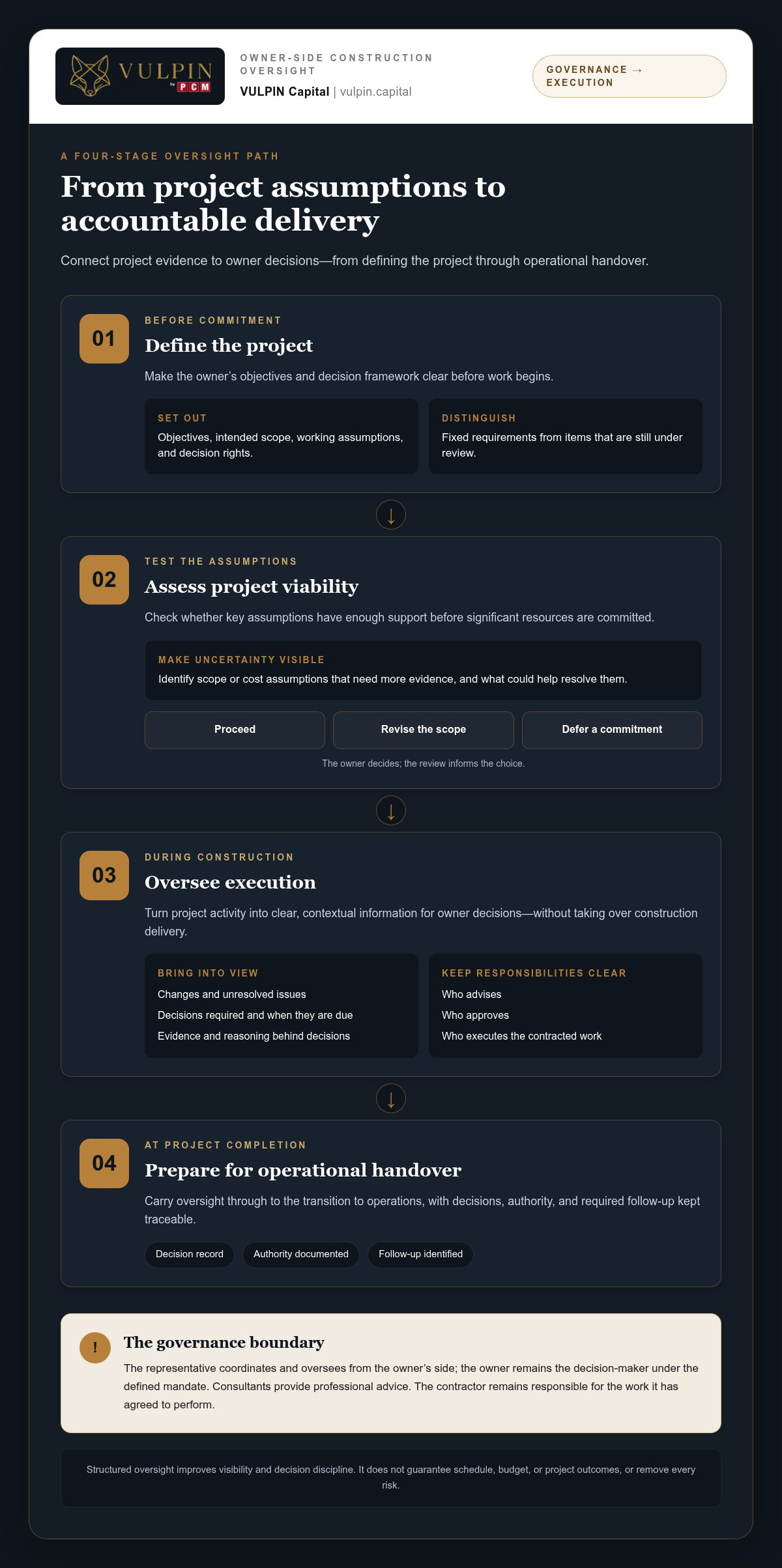
Oversight is useful when it connects project evidence to decisions. An owner’s representative can help establish that connection across four stages: define the project, test viability, oversee execution, and prepare for operational handover. The owner should receive a clear account of what has changed, what decision is required, and what evidence supports it, rather than a stream of activity without context.
Governance is documented authority, evidence, and accountability applied to each project decision. Record the decision, who holds authority, the information considered, and any follow-up required. This creates a traceable process, but it doesn’t make uncertain conditions disappear.
What does owner-side oversight look like before construction?
Before construction, clarify the owner’s objectives, intended scope, working assumptions, and decision rights. Distinguish fixed requirements from items still under review. Then test whether the project’s assumptions are supported before significant resources are committed. The VULPIN Check provides a rigorous governance and verification process, using predefined proof of project viability to inform that discipline. The construction project governance framework offers a related perspective on setting rules and decision controls before execution.
A practical viability review might identify a scope or cost assumption that needs more evidence. The purpose isn’t to force a project forward or stop it automatically. It is to make uncertainty visible, identify what could help resolve it, and give the owner a basis for deciding whether to proceed, revise the scope, or defer a commitment. Early planning can also clarify how contract documents reflect the owner’s objectives and approval authority.
How does oversight support execution without taking over delivery?
Once work proceeds, oversight follows the agreed mandate. The representative tracks decisions and relevant project information, reports exceptions, and escalates issues through established channels. The contractor remains responsible for its contracted construction work; owner-side oversight doesn’t substitute for delivery. PCMNow Project Management focuses on construction-cost reality and disciplined execution on complex construction and development projects. It provides project management, not construction contracting.
Cost assumptions and scope decisions need a record that can be revisited. If new evidence changes an assumption, the owner should be able to see what changed, why it matters, and which approval is needed. A useful report separates routine status from exceptions, identifies the decision-maker, and records the decision and its rationale. This supports accountability without suggesting that every issue can be predicted or every outcome controlled.
At handover, the same discipline shifts to operational readiness. Document outstanding decisions, unresolved items, and the information the owner needs to take responsibility for the asset. For owners assessing whether this approach fits their project, VULPIN Capital’s project management perspective centres on governance, cost reality, and execution rather than unsupported promises.
Owner’s Representative vs. Construction Manager: Where the Responsibilities Differ
Similar titles can describe different authority. An owner’s representative works from the owner’s side, helping the owner assess information, coordinate decisions, and oversee the project under a defined mandate. A construction manager’s duties depend on the project arrangement and agreement. The role may involve coordinating construction activities, managing aspects of delivery, or, in some arrangements, representing the owner. The title alone settles nothing.
Representation advises and oversees for the owner; delivery roles perform the work assigned to them. This distinction helps prevent a common governance failure: assuming someone is accountable for a decision or task when the written scope assigns it elsewhere.
| Role | Whose interests it serves | Typical focus | Decision authority |
|---|---|---|---|
| Owner’s representative | The project owner, within the mandate | Owner-side oversight, coordination, reporting, and decision support | Advises and may exercise authority delegated by the owner; reserved decisions stay with the owner |
| Construction manager | As set out in the project agreement | Coordination or management responsibilities defined for construction | Depends on the agreement and any delegated authority |
| Contractor | Its contractual obligations to the project | Executing the contracted construction work | Directs its work within the contract and applicable project requirements |
| Advisor or consultant | The client or party named in its engagement | Scoped professional or technical advice | Provides advice within scope; does not automatically hold project approval authority |
How does an owner’s representative differ from a construction manager?
The boundary depends on the mandate and contracts, not on a universal industry arrangement. A construction manager may coordinate construction activities, while an owner’s representative may monitor project information and prepare decisions for the owner. Those functions can overlap. If they do, the written scope should identify who reports, who recommends, who approves, and who is accountable for each assigned task.
For example, both roles might review a proposed change, but that doesn’t mean both can authorize it. The owner’s representative could assess the information and present a recommendation, while approval remains with the owner. The agreement should make that boundary explicit. In owner’s representative construction Ontario engagements, clear authority is more useful than relying on a job title.
How is an owner’s representative different from a contractor or advisor?
A contractor performs the work it has agreed to deliver. An advisor provides expertise within a defined scope. The representative helps the owner interpret information from these parties, identify decisions that need attention, and coordinate the owner’s response. This role doesn’t transfer the contractor’s delivery responsibilities or turn advice into approval.
The VULPIN Check’s governance process reflects the importance of evidence before resources are committed. It reinforces a disciplined question: what information supports the decision, and who has authority to make it? That clarity supports oversight without implying that risk or uncertainty can be eliminated.
How to Define an Owner’s Representative Mandate Before Work Begins
A mandate turns owner-side oversight into defined work. Treat the steps below as a project-governance sequence, not a universal legal or contract template. The mandate should fit the project’s scope, complexity, agreements, and decision structure. For an owner’s representative construction Ontario engagement, clarity at the outset helps prevent a recommendation from being mistaken for approval or oversight from being confused with delivery responsibility.
Build the mandate in this order:
- Establish objectives. Record the intended project outcomes, scope, key constraints, and assumptions that currently support the project’s direction.
- Map authority. Identify who advises, recommends, approves, and executes. Specify decisions reserved for the owner or another authorized party.
- Define reporting. Set out deliverables, access to relevant records, meeting cadence, and how progress, decisions, and exceptions will be presented.
- Set escalation paths. State how unresolved issues, proposed scope changes, and material variances reach the appropriate decision-maker.
- Review the mandate. Revisit it when project conditions, scope, or assumptions change, and document any agreed adjustment to the representative’s responsibilities.
What should the owner and representative agree on?
Agree on the practical mechanics, not just a broad description of the role. Specify what the representative will produce, which records they can access, how often they report, and how urgent or unresolved issues move through the project. Separate recommendations from approvals. A representative may assess a proposed scope change and explain its implications, while approval remains with the owner or another party authorized under the project’s arrangements.
Keep a traceable record of changes: what changed, why, what information supports the change, what decision is required, and who is responsible for deciding. This helps keep the mandate aligned with the project without treating every change as automatically authorized.
How should owners assess emerging cost and scope risks?
Compare current project evidence with the assumptions the owner approved. If new information affects scope or a cost forecast, identify the variance, its basis, and the decision it may require. Forecasts remain provisional as design, scope, and other project information develop. A disciplined review makes that uncertainty visible; it doesn’t guarantee that costs or schedules will hold.
The construction project cost overrun framework connects cost oversight to documented assumptions and governance, rather than treating a forecast as a fixed fact.
A defined mandate supports consistent oversight, but it can’t remove project risk or guarantee schedule and cost outcomes. If your project needs structured project management, explore PCMNow Project Management for complex construction and development projects, with a focus on construction-cost reality and disciplined execution.
How PCMNow Approaches Owner-Side Construction Project Management
PCMNow is VULPIN Capital’s project management service for complex construction and development projects. Its focus is practical: construction-cost reality and disciplined execution. PCMNow is not a contractor and does not promise a particular project outcome. Its project management work brings structured attention to decisions, assumptions, and delivery. For owners assessing owner’s representative construction Ontario support, the key question is how oversight will connect project evidence to decisions while respecting the agreed responsibilities of each party.
The work starts with the project as it stands, not with an assumption that every early plan remains valid. Scope, cost assumptions, available evidence, and unresolved decisions all inform what the owner needs to consider next. Viability is something to examine, not assume.
What distinguishes a governance-led approach?
A governance-led approach puts evidence and authority at the centre of decisions. Responsibilities are defined, assumptions are reviewed against available information, and commitments are considered through a deliberate process. The VULPIN Check is a rigorous governance and verification process that uses predefined proof of project viability before resources are committed. It provides decision-making discipline, not a guarantee that a project will proceed or succeed.
The Fox is an operating system for asset survivability and decision-making. Its relevance is the framework: asset decisions can be governed by rules rather than improvised in response to each new pressure. In construction project management, that principle supports consistent review of what is known, what remains uncertain, and who holds decision authority.
- Evidence: Identify what supports key assumptions and what remains unverified.
- Authority: Keep recommendations distinct from decisions reserved for the owner or another authorized party.
- Review: Revisit assumptions when project information changes, and document the reasoning behind decisions.
Governance can help mitigate risk by making uncertainty and accountability more visible. It cannot eliminate every risk, control every external condition, or guarantee schedule, cost, or outcome. The discipline is to make decisions on a defined basis, then review that basis as the project develops.
What is a practical next step for a project owner?
Before discussing project management, prepare a concise picture of the project. Note its objectives, current stage, and unresolved decisions. Include the assumptions informing the current scope and cost outlook, and identify who currently has approval authority. These details give the discussion a concrete starting point rather than a vague request for oversight.
Then define what you need the role to do. Discuss the mandate, scope, deliverables, reporting expectations, and decision responsibilities before setting the engagement. Early clarity helps distinguish owner-side project management from delivery, professional advice, or a combination of roles within the project’s agreements. PCMNow’s project management is focused on complex construction and development projects.
If a governance-led discussion fits your project, explore VULPIN Capital’s project approach.
Set the Next Project Decision on a Clear Basis
Start by identifying the decision your project needs to make and the evidence that would support it. For an owner’s representative construction Ontario mandate, connect the owner’s objectives to decision authority, current assumptions, and a clear process for reviewing new information. Oversight should help you govern the work, not obscure who is responsible for acting.
VULPIN Capital’s approach puts that discipline into practice through distinct tools and responsibilities. PCMNow manages complex construction and development projects. The VULPIN Check uses predefined evidence of project viability before resources are committed. The Fox provides a rule-governed framework for asset decision-making. These processes support informed decisions; they don’t remove every project risk or promise a particular outcome.
Consider whether your project would benefit from a governance-led discussion grounded in its actual stage, objectives, and unresolved decisions. Explore VULPIN Capital’s project approach and take the next step with a clearer basis for action.
Frequently Asked Questions
Can an owner’s representative approve construction changes on the owner’s behalf?
Only if the owner has delegated that authority through the applicable mandate or project procedures. A representative may review a proposed change, identify its implications, and recommend a response without having authority to approve it. For example, the owner might reserve approval of changes affecting scope while authorizing the representative to confirm routine administrative matters. In owner’s representative construction Ontario arrangements, make the written approval limits clear before change requests arise.
Does an owner’s representative guarantee a project will finish on time or within budget?
No. Representation can improve oversight, surface variances, and support informed responses, but it can’t guarantee a completion date or final cost. Design development, site conditions, decisions, and other project factors may affect delivery. Ask for reporting that distinguishes approved assumptions from current forecasts and identifies changes requiring attention. This gives the owner a clearer basis for decisions, not certainty about outcomes. A disciplined process mitigates risk; it doesn’t eliminate it.
Can an owner’s representative join a construction project that is already underway?
Yes, an owner’s representative can be engaged after construction has started, subject to agreeing on a practical scope and access to relevant project information. A useful starting point is to review the current schedule and cost assumptions, approved changes, open issues, decision records, and upcoming approvals. That baseline helps identify what is known and what needs clarification. Bringing someone in mid-project doesn’t automatically change existing contracts or transfer other parties’ responsibilities.
Does the owner’s representative replace the architect or general contractor?
No. The representative doesn’t replace either role. The architect provides design services within the agreed scope, while the general contractor carries out construction work assigned under its contract. The representative can help the owner organize questions arising from design or construction information, then track the owner’s decisions. For instance, they may coordinate a review of a design revision without taking over the architect’s professional work or the contractor’s delivery obligations.
What information should an owner prepare before discussing representation?
Prepare a concise project brief: the intended outcome, current stage, known scope, working cost and schedule assumptions, and decisions that remain open. Gather the current agreements, recent reports, change records, and relevant correspondence if available. Flag any assumption that has recently become uncertain, such as a scope item awaiting a decision. This gives the discussion a factual starting point and helps identify where owner-side oversight could add clarity.
Is an owner’s representative legally responsible for the contractor’s work?
Not automatically. The representative’s appointment alone doesn’t establish responsibility for the contractor’s performance or determine who holds health and safety responsibilities. In Ontario, the Occupational Health and Safety Act uses the role of “constructor” for the party with overall control and responsibility for health and safety on a project. How the law applies depends on project arrangements and actual roles, so owners should obtain project-specific legal advice about their obligations.
Can an owner’s representative work alongside an existing project manager?
Yes, if the responsibilities are complementary and clearly documented. For example, an existing project manager may coordinate day-to-day project activities while the representative focuses on owner reporting and decision support, but that division must fit the actual agreements. Define who consolidates updates, who raises exceptions, which decisions each person can make, and how conflicting recommendations reach the owner. Without these boundaries, adding another role can create duplicate reporting rather than better visibility.