

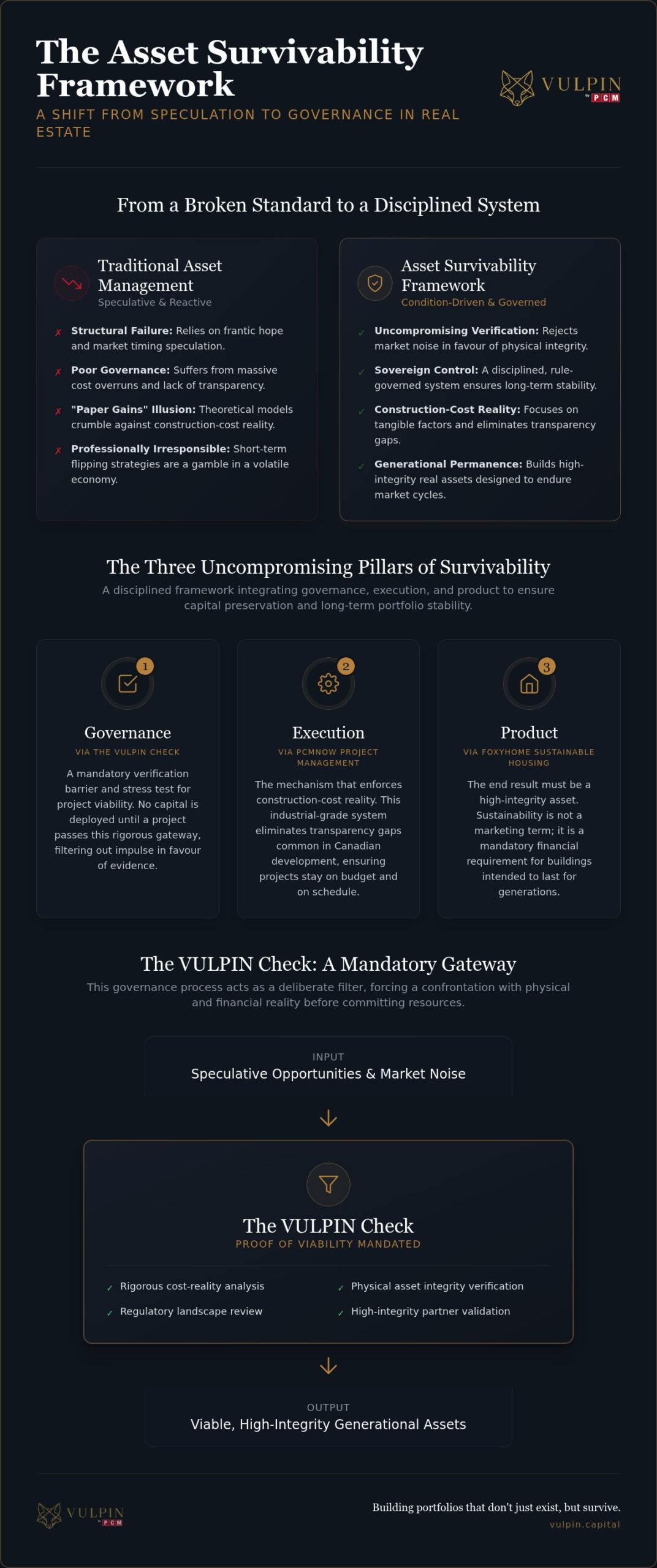
Speculation is not a strategy; it’s a structural failure disguised as ambition. Most developers in Canada operate on the frantic hope that market timing will outpace poor governance. You’ve likely felt the weight of massive cost overruns or the suffocating lack of transparency in a project’s lifecycle. Traditional flipping strategies are no longer just risky; they’re professionally irresponsible in a volatile economy. This article establishes the asset survivability framework for real estate, a contrarian approach that rejects market noise in favour of uncompromising physical verification.
We agree that the current industry standard is broken. You’re tired of theoretical models that crumble when the first shovel hits the dirt. We promise a shift toward a disciplined, condition-driven system that ensures your assets survive for generations. This isn’t about quick wins or digital abstractions. We’ll examine the mechanics of the VULPIN Check as a mandatory gatekeeper, the use of PCMNow for industrial-grade cost control, and how “The Fox” operating system provides the sovereign control required for long-term portfolio stability. It’s time to stop managing assets and start governing them.
Key Takeaways
- Replace passive management with a governance model designed to withstand the unpredictable nature of Canadian market cycles.
- Establish the VULPIN Check as your mandatory gateway for verifying project viability before a single C$ is committed to any development.
- Implement an asset survivability framework for real estate to shift your focus from speculative market timing to the physical integrity of the asset.
- Utilize PCMNow to enforce construction-cost reality and eliminate the governance gaps that lead to project failure and transparency loss.
- View sustainability as a mandatory financial requirement for building generational assets rather than a mere environmental gesture.
What is an Asset Survivability Framework in Real Estate?
Survivability is the ultimate metric of a real asset. It is not defined by net present value or projected internal rates of return. Instead, an asset survivability framework for real estate measures the capacity of a physical structure and its underlying capital to endure the brutal reality of market cycles and construction risks. While most investors chase the frantic energy of a “hot market,” survivability demands stoic discipline. It requires a total rejection of speculative noise in favour of structural permanence.
There is a fundamental divide between simple asset management and true asset governance. Management is often reduced to reactive maintenance; it is the act of keeping a building operational. Governance is different. It is the administrative oversight that ensures the asset remains viable through catastrophic shifts. An asset survivability framework for real estate prioritizes condition-driven acquisition over market-driven speculation. We don’t acquire based on hope. We acquire based on a rigorous verification of physical reality and the autonomous control of the development process. This approach focuses on tangible factors like local regulatory landscapes and hard construction costs in Canadian dollars, ignoring the frantic energy of interest rate speculation.
The Failure of Traditional Asset Management
Traditional models are built on the illusion of “paper gains.” These metrics look impressive on a digital spreadsheet but offer no protection when construction-cost reality sets in. In Canada, where material prices and labour shortages can derail a project in months, relying on historical market trends is dangerous. These models fail because they lack a rule-governed operating system. This is why we developed “The Fox.” It is a proprietary operating system that replaces human error with documented methodology. It treats real estate as a high-stakes engineering problem rather than a financial game. If an asset cannot survive the construction phase without bleeding capital, it is not an asset; it is a liability. Our system ensures that the integrity of the structure is never sacrificed for short-term financial modeling.
The Three Pillars of Survivability
A framework is only as strong as its execution. Our approach rests on three uncompromising pillars that ensure long-term portfolio stability:
- Governance: The VULPIN Check acts as a mandatory verification barrier. No capital is deployed until a project passes this rigorous stress test for viability.
- Execution: We use PCMNow Project Management to enforce construction-cost reality. This is the mechanism that eliminates the transparency gaps common in traditional Canadian development.
- Product: The end result must be FoxyHome Sustainable Housing. Sustainability is not a marketing buzzword; it is a financial requirement for an asset intended to last for generations.
By integrating these pillars, we move beyond the frantic urgency of the market. We operate on a different time scale. This is how you build a portfolio that doesn’t just exist but survives. Each pillar serves as a structural component in a larger machine designed for one purpose: the preservation of capital through the creation of high-integrity real assets.
The VULPIN Check: Stress Testing for Asset Viability
Verification is the antidote to impulse. In the Canadian real estate sector, capital is often deployed based on optimism rather than evidence. The VULPIN Check serves as a rigorous governance process that mandates a Proof of Viability before any resources are committed. This is a deliberate speed bump. It’s designed to slow down the frantic energy of acquisition and force a confrontation with physical reality. By requiring documented proof that a project can survive construction-cost reality, we filter out the noise. This isn’t a checklist; it’s a barrier. If a project cannot withstand this level of scrutiny, it doesn’t belong in a sovereign portfolio.
This methodology acts as a filter for high-integrity partners. We aren’t interested in those who seek to bypass the hard work of due diligence. The check forces an administrative pause, ensuring that every decision is grounded in engineering reality and administrative oversight. It’s a rejection of the “move fast and break things” mentality that has plagued the industry. We prefer to move slowly and build things that last. By establishing this mandatory gateway, we protect the integrity of the capital and the permanence of the structure.
Rejecting Speculative Flipping
We don’t participate in the short-term speculative market. Flipping is a gamble on timing; we build for generational permanence. This ideological screening mechanism ensures our partners are aligned with a long-term hold strategy that prioritizes stability over the excitement of a quick exit. The VULPIN Check is the non-negotiable gateway for asset deployment within our broader asset survivability framework for real estate. We explicitly reject projects that prioritize exit speed over structural integrity or governance transparency.
Verification Over Trust
Trust is a vulnerability in project governance. Traditional models rely on the surface credentials of contractors or the historical reputation of developers. We demand more. The VULPIN Check incorporates third-party audits and granular data verification to identify red flags before they become balance sheet liabilities. Whether it’s a hidden regulatory hurdle in Ontario or a supply chain bottleneck in British Columbia, we find the failure points early. This methodology ensures that every C$ spent is backed by a verified condition.
We don’t manage based on hope. We govern based on the unvarnished truth of the asset’s condition. This is how we maintain portfolio stability when the rest of the market is reacting to the latest interest rate headline. Moving beyond “surface credentials” means looking at the actual mechanics of how a project is run. We verify the flow of funds, the accuracy of the pro forma, and the viability of the construction schedule. This level of oversight is what differentiates a survivor from a statistic.
Condition-Driven Strategy vs. Market Speculation
Market timing is a ghost. It represents a fundamental misunderstanding of what makes a real asset durable. Most investors in Canada spend their days watching the Bank of Canada, hoping for a minor interest rate adjustment to rescue a failing pro forma. This is the definition of frantic energy. Our approach is built on stoic discipline. The survivability of a project depends on its physical condition and the rigour of its governance; it does not depend on the whims of central bankers. We prioritize the internal logic of the asset over the external noise of the economy. If an asset requires a “perfect” market to succeed, it has already failed the test of survivability.
The tuition paid by those who prioritize exit prices over execution reality is often the total loss of their equity. We have seen this across the Canadian landscape, from stalled mid-rise developments in the Greater Toronto Area to over-leveraged projects in Vancouver. These failures occur because the operators built on the shifting sands of market sentiment rather than the bedrock of administrative oversight. An asset survivability framework for real estate demands that you look at what you can control. You cannot control the market, but you can control the autonomous governance of your portfolio.
The Fallacy of the “Hot Market”
Market euphoria is a veil that masks structural rot. In a “hot market,” sloppy operators can hide inefficiencies behind rising valuations. This creates a dangerous illusion of success. The VULPIN approach rejects this entirely. We acquire assets based on their intrinsic survivability, meaning their capacity to generate value even in a stagnant or declining market. Our proprietary operating system, “The Fox,” is the mechanical heart of this strategy. It enforces rule-governed operations that are indifferent to trends. We don’t buy because a neighbourhood is “trending”; we buy because the physical and legal conditions of the asset meet our uncompromising standards for permanence.
Real Asset Governance: A Sovereign Philosophy
We view a real asset as a self-sustaining, reliable internal logic. It is a physical system that must be governed with the same precision as a piece of industrial machinery. This is a sovereign philosophy. It requires maintaining autonomous control over every stage of the lifecycle, from the initial VULPIN Check to the final delivery of a FoxyHome. We use engineering-led vocabulary because buildings are not just financial instruments; they are complex physical structures. Terms like “structural permanence” and “administrative oversight” are not metaphors. They are the requirements for building a national real estate portfolio that can withstand the test of time. By treating governance as a technical requirement, we eliminate the volatility associated with human emotion and market speculation.
Implementing Governance through PCMNow Project Management
Execution is the point of maximum friction. It’s where theoretical models collide with the brutal reality of the Canadian construction industry. PCMNow Project Management serves as the execution arm of our asset survivability framework for real estate. It’s not a passive management service; it’s a mechanism of administrative oversight designed to protect the integrity of the capital. We reject the standard industry practice of reactive adjustments. Instead, we enforce a four-step governance protocol that ensures the asset remains viable from inception to completion.
- Step 1: Construction-Cost Reality. We establish hard costs at the project onset. Most pro formas in Canada are based on optimistic projections that ignore the volatility of material prices in C$. We demand reality.
- Step 2: Financial Transparency. We implement strict stakeholder reporting. Every expenditure must be verified against the project’s sovereign logic.
- Step 3: Elimination of Scope Creep. Disciplined governance prevents the “nice-to-haves” from cannibalizing the project’s margins. We build what is required for survivability, nothing more.
- Step 4: Milestone Verification. The VULPIN Check is not a one-time event. It’s a recurring barrier used to verify project milestones before additional capital is released.
Owner’s Representation for Complex Developments
A standard project manager focuses on tasks; a VULPIN-governed operator focuses on outcomes. We act as the owner’s representative to ensure that every contractor and sub-trade adheres to the documented methodology. This level of rigorous administrative oversight is the only way to protect capital in complex developments. PCMNow is the mechanism that turns a pro forma into a physical reality. We don’t delegate responsibility to third parties without maintaining absolute autonomous control. If you require this level of disciplined execution, you can learn more about our project management protocols.
Mitigating National Development Risks
Operating across different Canadian provinces requires a standardized governance model that accounts for local jurisdictional risks. Whether dealing with the specific regulatory hurdles in Ontario or the environmental requirements in British Columbia, we use “The Fox” operating system to track performance. This allows us to identify project distress before it becomes a crisis. Contingency planning isn’t an afterthought; it’s a structural component of the asset. By maintaining this level of oversight, we ensure that a single localized failure doesn’t compromise the stability of the national portfolio. We build for permanence, which requires a relentless focus on the mechanics of execution.
FoxyHome: Building Generational, Sustainable Assets
FoxyHome represents the physical manifestation of our governance manifesto. It is the tangible result of the asset survivability framework for real estate. We don’t view sustainability as an environmental elective. It’s a mandatory financial requirement. In the Canadian climate, an inefficient structure is a liability that bleeds capital through energy costs and premature degradation. FoxyHome integrates modern construction techniques with a focus on long-term structural permanence. This approach ensures that the asset doesn’t just meet current building codes but exceeds them to withstand future regulatory shifts and environmental stressors.
High-performance housing is a mechanism for reducing long-term maintenance liabilities. When you build with engineering-led precision, you eliminate the common failure points found in speculative developments. We prioritize durability over aesthetic trends. Every component of a FoxyHome is selected based on its capacity to endure. This is how we transform a residential structure into a generational asset. It’s about creating a self-sustaining, reliable internal logic for the building itself.
The Financial Case for Sustainable Housing
The ROI of a FoxyHome is found in its longevity and reduced operational overhead. We look beyond the monthly energy bill to the total cost of ownership over decades. A building that requires less intervention is a building that preserves its value. In the Canadian market, “Net-Zero” is no longer a niche concept; it’s the new standard for asset survivability. It provides a sovereign shield against energy price volatility and future carbon-related tax structures. VULPIN Capital’s commitment to environmentally conscious residential solutions is rooted in this rugged, industrial logic. We build assets that are self-sustaining because self-sufficiency is the ultimate form of risk mitigation. A structure that generates its own value and resists decay is the only asset worth governing.
Your Next Step in Disciplined Development
Engagement with the VULPIN ecosystem is not a standard service agreement. It’s a partnership based on shared principles. We use an ideological screening process to ensure that our partners value the integrity of the structure above the excitement of the market. We don’t work with speculators. We work with operators who understand that stability requires a documented methodology and a rejection of frantic market energy. Alignment with our worldview is a prerequisite for any resource commitment.
If you are prepared to move beyond market-driven hope and embrace a condition-driven strategy, your path begins with verification. You must be willing to subject your projects to the same level of scrutiny we apply to our own. To start this process, you should learn more about the VULPIN Check methodology and how it serves as the foundation for our entire asset survivability framework for real estate. This is the first step toward building a portfolio that survives for generations. We don’t offer shortcuts; we offer a system that works because it’s grounded in reality.
Governing for Generational Permanence
True asset stability isn’t found in a spreadsheet. It’s built through the rigorous application of an asset survivability framework for real estate. Market timing is a fallacy. Survivability requires the uncompromising governance of the VULPIN Check and the industrial-grade execution of PCMNow. You must reject the frantic energy of speculation to protect your capital’s integrity across our national landscape. We don’t manage projects; we govern outcomes. By prioritizing physical reality and structural permanence, you ensure your portfolio survives the inevitable volatility of the Canadian market.
This is the only path to building something that lasts. If you’re ready to move beyond the industry’s broken standards, it’s time to subject your strategy to a higher level of scrutiny. It’s time to stop hoping for favourable conditions and start building assets that create their own. Apply for a VULPIN Check on your next project to begin the transition from manager to governor. Your legacy depends on the integrity of the structures you leave behind. We look forward to seeing what you build.
Frequently Asked Questions
What is the primary difference between asset management and asset survivability?
Asset management is reactive maintenance; it’s the act of keeping a building operational on a day-to-day basis. Asset survivability is proactive governance. It focuses on the capacity of a real asset to endure brutal market cycles and construction risks over generations. One keeps the lights on while the other ensures the structure remains a viable piece of capital for a century or more. We prioritize the integrity of the structure above all else.
How does the VULPIN Check prevent construction cost overruns?
The VULPIN Check prevents overruns by mandating a Proof of Viability before any capital deployment occurs. It identifies failure points in the construction-cost reality at the project onset. By establishing hard costs in Canadian Dollars and identifying regulatory hurdles early, we eliminate the “paper gains” that lead to massive overruns. This rigorous verification barrier ensures that only projects with a high probability of survival move forward in our system.
Why does VULPIN Capital reject speculative real estate flipping?
VULPIN Capital rejects speculative flipping because it’s a gamble on market timing rather than a disciplined investment strategy. We build for generational permanence and long-term stability. Our ideological screening mechanism filters for partners who seek to preserve capital through our asset survivability framework for real estate. We don’t participate in the frantic energy of quick exits. We focus on the stoic discipline of building high-integrity assets that last.
What role does “The Fox” operating system play in real estate governance?
“The Fox” is our proprietary operating system that replaces human emotion with documented methodology. It serves as the mechanical logic required to maintain autonomous control over complex real estate portfolios. By treating asset management as a high-stakes engineering problem, “The Fox” provides the administrative oversight necessary for structural permanence. It ensures that every operational decision aligns with the framework’s core principles of stability and verification without external interference.
How can sustainable housing improve the survivability of my portfolio?
Sustainable housing is a financial hedge against energy price volatility and future carbon-related tax structures in Canada. FoxyHome structures reduce long-term maintenance liabilities and enhance asset longevity through superior build quality. High-performance housing isn’t an environmental elective; it’s a technical requirement for any asset intended to survive for generations. This approach preserves the asset’s value by ensuring it remains efficient and compliant with future regulatory shifts in the Canadian market.
What is PCMNow and how does it protect property owners?
PCMNow is the execution arm that protects property owners through rigorous administrative oversight and financial transparency. It eliminates the transparency gaps common in Canadian development by establishing strict stakeholder reporting and milestone verification. This mechanism turns a pro forma into physical reality while preventing scope creep from cannibalizing project margins. It ensures that the owner’s capital is used efficiently to achieve the project’s sovereign logic through every phase of construction.
Is the asset survivability framework applicable to national projects across Canada?
Yes, the framework is specifically designed to handle the regulatory and geographic complexities of the Canadian market. We provide a standardized governance model that accounts for varying provincial regulations and labour shortages from coast to coast. This national scope ensures that localized risks in one jurisdiction don’t compromise the stability of your entire portfolio. We maintain a consistent standard of asset survivability regardless of the project’s location or the local market conditions.
How do I know if my project is ready for a VULPIN Check?
Your project is ready for a VULPIN Check when you’re prepared to prioritize verification over trust. You must possess a documented pro forma and a commitment to our stoic, governance-first methodology. We screen for partners who value the physical integrity of the structure above the frantic energy of market trends. If you’re ready to subject your project to uncompromising scrutiny and administrative oversight, you are ready to engage with our ecosystem.