

Renter households in Canada grew by 21.5% from 2011 to 2021, but demand alone doesn’t make a rental project viable. Build-to-rent development feasibility in Canada depends on whether achievable rents can support the land, construction and operating costs over the long term. The building may resemble conventional apartments; the difference is the plan to retain it as rental housing rather than sell units individually.
That distinction changes how a project is assessed. CMHC examined private rental apartment feasibility in six Canadian markets and found that achievable rents were generally not high enough to support development costs. Strong demand is only one part of the equation. This article explains how BTR differs from conventional apartment development, how Canadian costs and contingencies affect feasibility, and what rental demand can and cannot tell you about a project’s prospects.
Key Takeaways
- Compare BTR’s long-term rental-hold model with conventional apartment development, including how each approach shapes financing and operating assumptions.
- Build a Canadian cost model that accounts for land, government charges, underground parking, construction costs and contingency exposure.
- Test rental demand against local affordability and achievable rents; housing need alone does not establish project feasibility.
- Use The VULPIN Check when you need a disciplined assessment of project viability before moving further into development planning.
How is BTR different from traditional multifamily or apartment development?
Build-to-rent (BTR) keeps completed apartments as rental housing under one long-term ownership structure. Conventional multifamily projects may instead sell units individually. That changes the feasibility test: BTR underwriting must account for rental income, operating costs, capital needs and the value of holding the asset, not just construction costs and unit-sale proceeds.
Federal and local measures differ on GST and development charges. The Government of Canada lists removing the Goods and Services Tax for new rental projects, including student residences, as a financing measure. Model property-tax relief only when the municipality’s project terms support it. GST treatment does not establish a property-tax abatement.
Federal construction financing can alter the capital stack. For eligible projects, assess whether these financing options align with the design and delivery plan.
Financing scenarios have different tests. A feasibility study should show a debt coverage ratio of at least 1.25x for chartered bank financing and 1.20x for Canadian BDC financing. Private lenders assess the project against their own underwriting terms, so model their proposed loan conditions separately rather than assuming bank terms apply. CMHC’s Apartment Construction Loan Program requires 20% of units to be designated affordable and maintained as affordable for 10 years.
For BTR, construction financing must bridge project costs until rental operations begin. Compare lender conditions, affordability obligations and construction methods before finalizing the capital plan. PCMNow Project Management can support project execution, while the financing case depends on realistic costs, delivery assumptions and sustainable rental income.
What is Build-to-Rent (BTR) or Build-for-Rent (BFR)?
BTR, also called BFR, means building housing to hold and operate as rental properties, rather than selling units individually. The investment case depends on durable rental income, operating costs and the value of the property at exit. Canada’s national rental vacancy rate was 1.5%, the lowest since tracking began in 1988. That shortage signals pressure on supply, but does not prove a project’s rents can cover its costs.
Zoning, permitting and rental rules differ by province and municipality. Local permitted uses, approval processes and tenancy requirements shape project design, timing and operating assumptions.
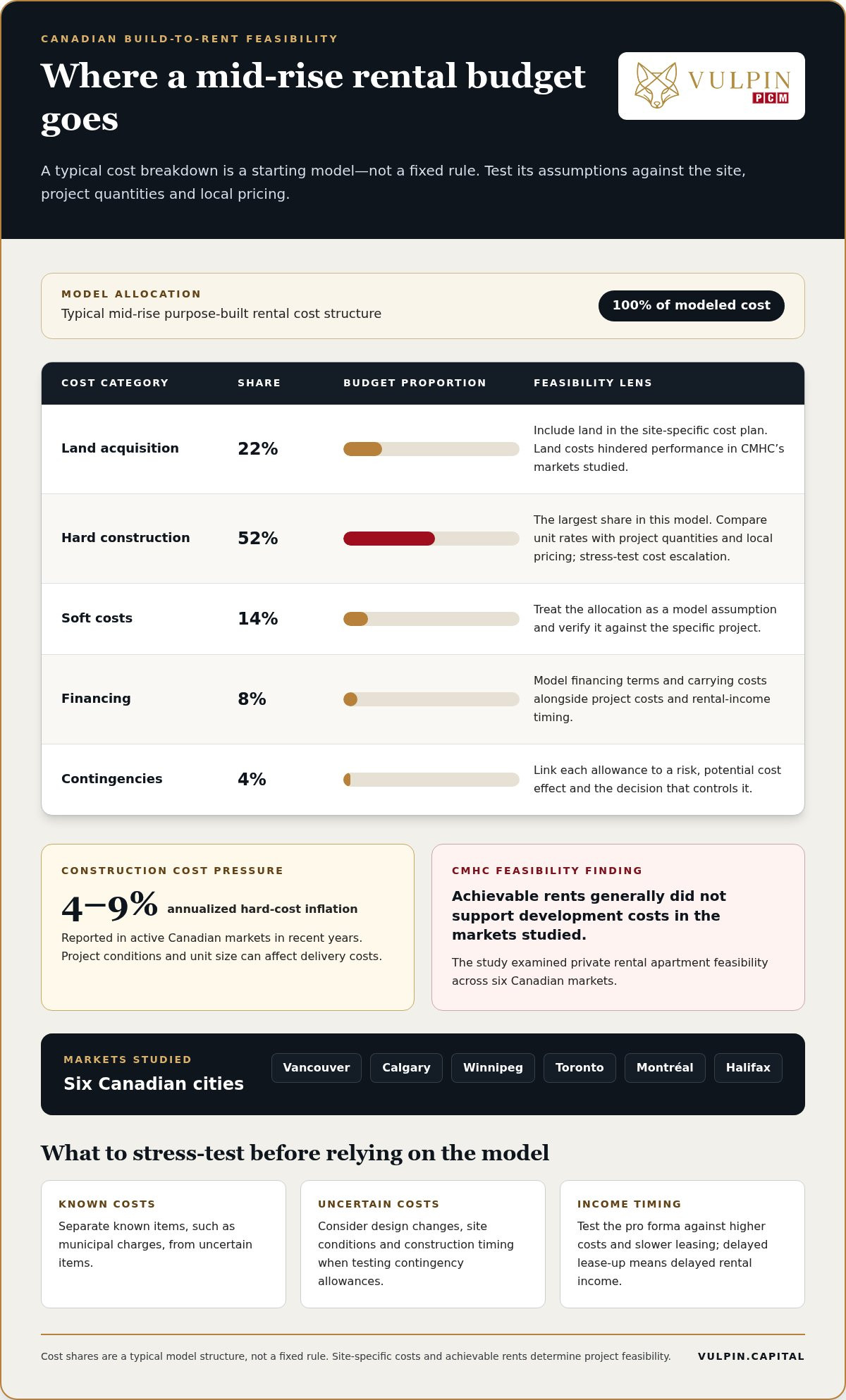
Start a feasibility study by collecting site, design, construction and market data. Then test highest-and-best use and conduct primary rental market research. The feasibility process includes those steps over 2-4 weeks. Compare proposed unit types with local asking rents, competing supply, vacancy and expected leasing pace. CMHC examined private rental apartment feasibility in Vancouver, Calgary, Winnipeg, Toronto, Montréal and Halifax; achievable rents generally did not support development costs in the markets studied.
Build the rental pro forma around achievable rents, operating expenses, lease-up timing and capital requirements. Model a slower lease-up as delayed income, not as a minor timing adjustment. Then test exit value against the income the property can sustain. A 50-basis-point cap-rate expansion at exit can reduce a development project’s IRR by 4-8%, so exit assumptions materially affect returns.
Capital Cost Allowance belongs in the project’s tax assumptions, not as a substitute for operating cash flow. Amenities and services should support the intended tenant profile and leasing plan. In Toronto, 65% of new builds offered rental incentives by the second quarter of 2025, showing why the lease-up strategy deserves direct scrutiny.
For projects where housing performance and delivery discipline must align, consider sustainable housing planning alongside the feasibility work.
Canadian development costs and contingencies
For build-to-rent development feasibility in Canada, start with a site-specific cost plan. Land, government charges and underground parking hindered project performance in the six Canadian markets studied by CMHC. These costs can weaken affordability before construction begins. Statistics Canada provides a benchmark source for unit rates in Canadian development cost estimates. Compare those benchmarks with project quantities and local pricing.
A typical mid-rise purpose-built rental cost breakdown assigns 22% to land acquisition, 52% to hard construction, 14% to soft costs, 8% to financing and 4% to contingencies. Treat this as a model structure, not a fixed rule. Stress-test the contingency allowance against design changes, site conditions and construction timing before relying on the total.
Cost pressure is material. Annualized hard-cost inflation in active Canadian markets has run 4-9% in recent years. That range shows how unit size and project conditions can make rental supply difficult to deliver at rents renters can afford. Municipal charges and underground parking can further constrain income available for operations and financing.
The main risks interact. Construction cost escalation increases required capital; slower lease-up delays rental income; financing terms affect carrying costs; and market rents may not support the completed project’s cost base. For affordable housing, assess whether rents, operating expenses and capital obligations fit together before construction. This is a central test of build-to-rent development feasibility in Canada.
Use a contingency register to link each allowance to a risk, its potential cost effect and the decision that controls it. Separate known costs, such as municipal charges, from uncertain items, such as construction changes. Then test the pro forma against a higher-cost scenario and slower leasing. This review shows which assumptions matter most before the project advances.
Drivers of build-to-rent demand
Rental demand reflects household formation, affordability and access to ownership. From 2011 to 2021, renter households in Canada grew more than twice as fast as owner households. That shift supports a long-term case for built rental housing, but it does not establish demand for every unit type or rent level. A residential strategy must identify the households a project can serve.
Affordability is central to that assessment. It is the primary issue for 89% of Canadian households in core housing need. The Canada Mortgage and Housing Corporation projects Canada needs 430,000 to 480,000 housing starts per year until 2035 to improve affordability. For a BTR project, the practical test is whether local incomes can support the rents required by its operating and financing costs.
Location matters because housing costs influence where people choose to live. According to the Canada Mortgage and Housing Corporation, a 1% increase in house prices in a destination city leads to a more than 1% decline in the number of people moving there. That relationship makes employment access, transit and nearby services relevant demand factors. A lower-cost location can still underperform if it separates renters from work or essential services.
Toronto shows how housing supply decisions can shift. Sixty-one condo applications covering 27,000 units had pivoted to purpose-built rental. The conversion adds potential rental supply, but it also means feasibility depends on competing projects reaching completion and attracting tenants. Track proposed and active properties, unit mix, rents and incentives rather than treating an application count as leased demand.
Use a demand test before locking the unit plan: define target renters, compare local income and asking rents, then assess competing supply and access to jobs. Federal housing targets set context; local tenant capacity determines whether a specific project can sustain its rent assumptions. Assess your housing project strategy against these demand drivers before advancing the plan.
VULPIN Capital: The VULPIN Check
VULPIN Capital’s The VULPIN Check is a next step when a BTR project needs a disciplined viability assessment. Bring the development assumptions into one review: site conditions, construction requirements, rental demand, costs and long-term operating logic. The aim is to assess whether the physical plan and financial structure hold together before more capital is committed.
As a project moves into delivery, PCMNow Project Management supports project management, while FoxyHome Sustainable Housing provides sustainable housing solutions. These offerings address different project needs: feasibility review and execution are distinct stages.
For a grounded review of a Canadian rental development, contact VULPIN Capital or visit vulpin.capital.
Set the next decision on solid ground
A disciplined assessment of build-to-rent development feasibility in Canada should do more than produce a model. It should show which assumptions govern the decision, where the project is exposed and what must be resolved before capital is committed. Treat feasibility as a working control document, not a one-time approval exercise. Revisit it as design, costs, financing and local rental conditions change.
For a project-specific next step, VULPIN Capital’s The VULPIN Check, PCMNow Project Management and The Fox can support viability review and project execution. Each has a distinct role in turning assumptions into decisions and disciplined delivery.
Contact VULPIN Capital about your project to discuss the work ahead. A careful decision now gives a sound project a firmer foundation for the long term.
Frequently Asked Questions
What is build-to-rent housing and how does it work in Canada?
Build-to-rent housing is developed to operate as rental property rather than being sold unit by unit. In practice, one ownership structure manages leasing, maintenance and long-term asset decisions. For a Canadian feasibility review, map the intended tenant profile to the unit mix, lease terms and operating plan. Provincial tenancy rules and municipal requirements also shape how the completed property can be managed.
What are the typical development costs per unit for Canadian build-to-rent projects?
There is no single per-unit cost that applies across Canadian projects. Calculate it by dividing the project’s defined total development cost by the number of residential units, then specify what the total includes. For example, distinguish residential costs from parking or shared-space allocations. Compare projects only when land, soft costs, financing, construction scope and unit mix use consistent accounting.
What rental rates, vacancy rates, and operating expenses should be assumed in a Canadian build-to-rent feasibility study?
Use achievable local rents, not just asking rents, and account for incentives that reduce collected income. Set vacancy assumptions to reflect the specific submarket and competing supply. Itemize operating expenses rather than applying one broad allowance: property taxes, utilities, insurance, maintenance, administration and property management affect net operating income differently. Test rent and vacancy assumptions together, since slower leasing can also delay stabilized income.
What financing options and loan-to-cost requirements are available for build-to-rent developments in Canada?
Potential financing routes include chartered banks, BDC, private lenders and CMHC programs such as the Apartment Construction Loan Program. Loan-to-cost compares proposed debt with eligible project costs; it is distinct from a debt coverage test based on operating income. Underwrite each term sheet separately, including eligible costs, required equity, affordability conditions, construction advances and repayment structure.
What return metrics and feasibility thresholds are used to evaluate Canadian build-to-rent developments?
Common measures include cash-on-cash return, internal rate of return, debt coverage and exit value. According to CMHC’s analysis, economic rent is the rent required to obtain a cash-on-cash return of 10% over 10 years. Treat that as a defined analytical measure, not a universal approval threshold. Stress-test returns against changes in operating income, financing costs and exit capitalization rates.
How do build-to-rent returns compare with condo development and purpose-built rental housing in Canada?
Build-to-rent and purpose-built rental both rely on operating rental income, so their returns depend on rent collection, expenses and eventual asset value. Condo development instead relies more directly on unit sales and sale proceeds. Compare them using consistent assumptions for land, construction, timing, financing and risk. The stronger strategy depends on whether rental cash flow or unit-sale revenue better supports the project’s capital requirements.