

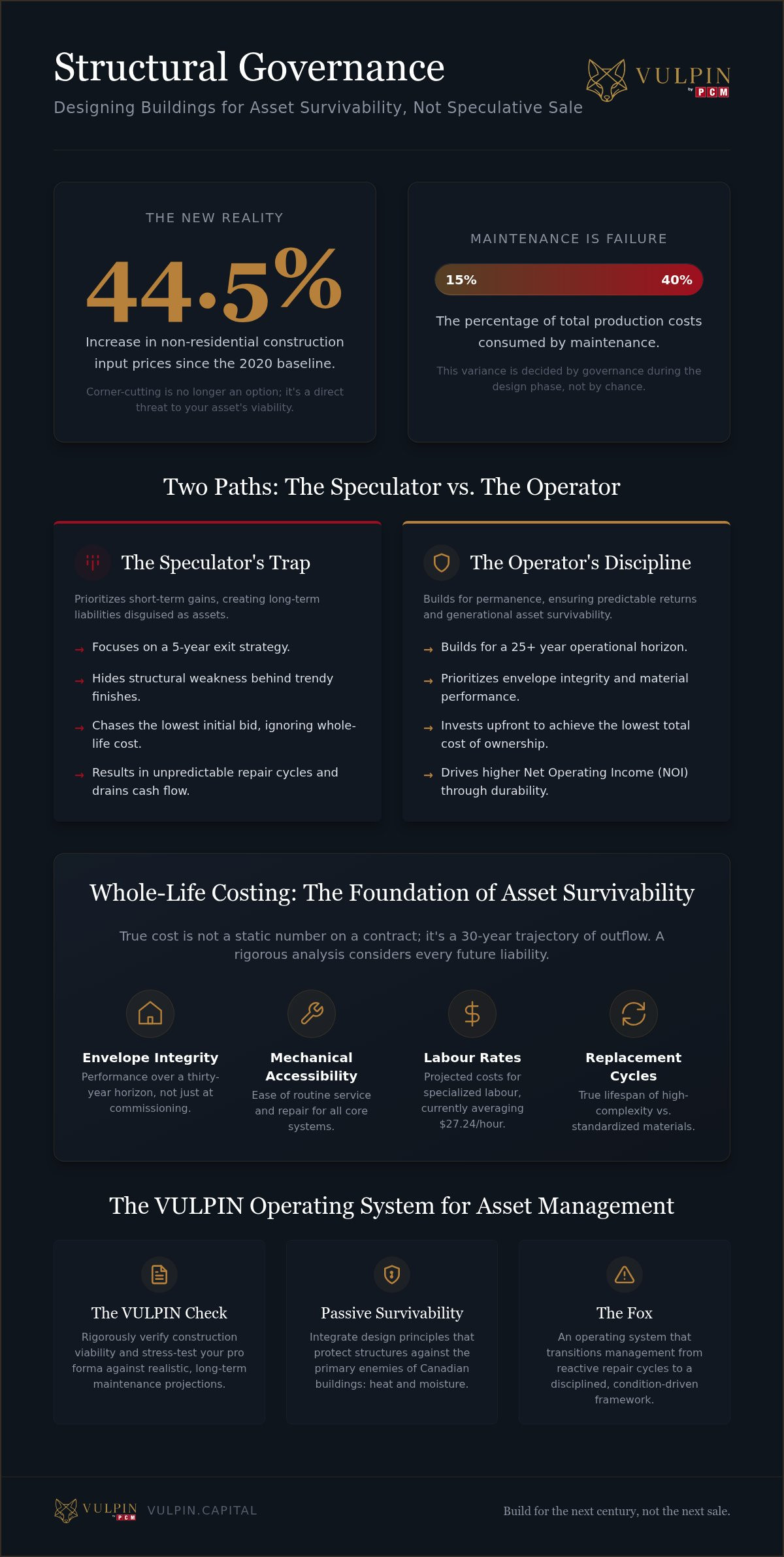
Most buildings are designed for the brochure, not the balance sheet. The industry celebrates the visionary architect while the owner bleeds capital into a crumbling envelope by year seven. Designing buildings for lower maintenance costs isn’t an aesthetic choice; it’s a matter of structural governance. We reject the frantic energy of speculative flipping in favour of tangible, physical reality. With non-residential construction input prices now 44.5% higher than the 2020 baseline, you can’t afford to let contractor corner-cutting compromise your building envelope.
You’re likely tired of unpredictable repair cycles and architects who prioritize style over serviceability. We’ll show you how to transition from speculative building to disciplined asset survivability by integrating rigorous governance into your design phase. This guide details how to secure a predictable 25-year maintenance schedule and drive higher net operating income. We’ll look at the frameworks needed to ensure your asset doesn’t just exist, but survives for generations.
Key Takeaways
- Reframe maintenance as a failure of initial governance to shift your focus from short-term capital expenditure to whole-life asset survivability.
- Master the principles of designing buildings for lower maintenance costs by prioritizing material performance and labour efficiency over speculative aesthetic trends.
- Utilize The VULPIN Check to rigorously verify construction viability and stress-test your pro forma against realistic maintenance projections.
- Integrate passive survivability into your design to protect structures against the primary enemies of Canadian buildings: heat and moisture.
- Adopt The Fox operating system to transition from reactive repair cycles to a disciplined, condition-driven management framework.
Maintenance as a Function of Asset Governance
Maintenance is not an inevitability. It is a metric of failure. When a structure requires premature intervention, it signals a collapse of oversight during the design phase. We do not view repair costs as operational necessities. We view them as the physical manifestation of poor governance. Designing buildings for lower maintenance costs requires a rejection of the superficial. It demands a transition from speculative excitement to the stoic reality of structural permanence.
Building maintenance costs often account for 15% to 40% of overall production expenses. This is a staggering range. The difference between the lower and upper bounds is decided before the first shovel hits the ground. It is decided by whether the operator prioritizes the integrity of the system or the optics of the facade. Governance ensures that the building serves the balance sheet, not the architect’s portfolio.
Whole-Life Costing vs. Initial Price Tags
The lowest bid is a psychological trap. It prioritizes immediate capital expenditure (CapEx) at the expense of long term survivability. A rigorous Life-cycle cost analysis reveals that the “cheaper” contractor is often the most expensive partner an owner can select. True cost is not a static number on a contract; it’s a 30 year trajectory of outflow. We do not chase the lowest initial price. We chase the lowest total cost of ownership.
To achieve asset survivability, one must calculate the true cost of every component including:
- Envelope integrity over a thirty year horizon.
- Mechanical system accessibility for routine service.
- Labour rates for specialized repairs, which currently average $27.24 per hour.
- The replacement cycle of high-complexity materials.
Rejecting the Speculative Market Mindset
Speculative flipping has compromised the Canadian building stock. The incentive structure of the “flip” rewards the disposable. It encourages developers to hide structural weaknesses behind modern finishes. This is a betrayal of the asset. Disciplined developers realize higher net operating income (NOI) by refusing this frantic energy. They understand that administrative oversight is the only shield against value erosion.
By implementing strict standards during the design phase, you eliminate the repair cycles that drain cash flow. We prioritize durability because permanence is the only hedge against market volatility. If you build for a five year exit, you’re a speculator. If you build for a twenty five year horizon, you’re an operator. Alignment with this worldview is a prerequisite for those seeking to minimize the burden of ownership. We build for the next century, not the next sale.
Materiality and the Construction-Cost Reality
Materiality is the physical expression of structural discipline. It is where theoretical models collide with the abrasive reality of the Canadian climate. Designing buildings for lower maintenance costs requires a cold assessment of how materials perform under stress, not how they look in a digital render. We reject the trend-driven selection of high-performance composites that lack a documented history of survivability. If a material cannot endure thirty years of freeze-thaw cycles without intervention, it has no place in a sovereign asset.
The relationship between material complexity and repair labour is linear. As systems become more intricate, the cost to service them scales aggressively. Average building maintenance labour rates reached $27.24 per hour in July 2026, but specialized technicians for proprietary envelopes command significantly more. Every unique component you specify is a future liability. Every non-standard joint is a potential breach. We prioritize materials that are rugged, industrial, and easily serviced by a standard workforce.
The Durability Index for Canadian Exteriors
The building envelope is your first line of defence. It is a mechanical system in its own right. When evaluating masonry versus complex glazing, the “centre” of the envelope is the most critical failure point. This is where moisture management systems often collapse due to contractor corner-cutting. By consulting the Whole Building Design Guide’s LCCA resources, operators can quantify the delta between durable masonry and high-maintenance glass curtains. We favour materials with high thermal mass and simple shedding planes. Complexity is the enemy of permanence.
Standardization as a Risk Mitigation Strategy
Unique components are a liability for a long-term hold. When a proprietary window seal or a custom-moulded panel fails ten years from now, the manufacturer may no longer exist. This creates a dependency that erodes autonomous control. Standardization is not a compromise on quality; it is a strategy for risk mitigation. Using high-quality, off-the-shelf components ensures that replacement parts remain accessible and affordable. Those who prioritize long-term hold understand that disciplined execution via standardized systems is the only path to predictable NOI.
We ensure ease of access for future repairs by designing for serviceability. Mechanical and electrical systems should never be entombed in inaccessible cavities. A building must be a serviceable machine, not a static monument. Through PCMNow Project Management, we enforce these standards during construction to ensure the reality matches the design intent. We verify every material against the harsh truth of construction-cost reality.
The VULPIN Check: Verifying Construction Viability
Verification is the antidote to speculation. Most developers rely on hope as a strategy; they hope the architect’s details are sound and they hope the contractor follows them. We do not operate on hope. The VULPIN Check is our proprietary gatekeeping mechanism. It ensures that capital is only deployed when proof of viability exists. Designing buildings for lower maintenance costs is a futile exercise if the design cannot be executed with technical precision or if the pro forma ignores the reality of repair cycles.
We stress-test every pro forma against realistic maintenance projections. If a project cannot survive a 25 year horizon without ballooning repair costs, it is rejected. This is the stoic reality of asset management. We require tangible verification of every assembly before construction begins. We do not trust the optimistic projections of builders who lack skin in the game. Only through rigorous verification can an operator realize true autonomy over their asset’s financial future.
Pre-Construction Stress Testing
The early design phase is where “maintenance traps” are set. These are often aesthetic choices that compromise the building envelope, such as non-standard roof penetrations or complex facade transitions. The VULPIN Check identifies these liabilities before they become permanent. We evaluate the contractor’s specific ability to execute high-performance details. If the labour force lacks the discipline to meet our standards, the project does not move forward. This rigorous screening filters for partners who value structural permanence over quick wins.
Disciplined Execution with PCMNow
Project management is the bridge between a sound design and a low maintenance asset. Without administrative oversight, even the best plans succumb to contractor corner-cutting. PCMNow Project Management enforces disciplined execution of the design intent. We do not allow “value engineering” to erode the integrity of the building envelope. We prioritize the integrity of the structure above the frantic energy of the construction schedule.
Built-in defects are the primary driver of unpredictable repair costs in years five to ten. These are not inevitable. They are the result of poor governance during the build. The role of the owner’s representative is to verify asset integrity at every stage. We ensure that:
- Waterproofing membranes are installed without compromise.
- Mechanical systems are calibrated for long term efficiency.
- Material substitutions are strictly prohibited unless they meet our durability index.
This level of oversight protects the net operating income and ensures generational asset survivability. We do not accept shortcuts. We only accept verified results. By maintaining this boundary of high-integrity professionalism, we ensure the building remains a reliable machine for capital preservation.
Designing for Passive Survivability in National Climates
Passive survivability is the ultimate expression of asset autonomy. It describes a structure’s ability to maintain critical life-support conditions without external energy inputs. In the context of designing buildings for lower maintenance costs, this means building a shell so robust that mechanical intervention becomes a secondary concern. We don’t design for the best-case scenario. We design for the reality of the Canadian climate; a landscape defined by aggressive thermal swings and relentless moisture. If your building requires constant mechanical nursing to remain habitable, you don’t own an asset. You own a liability.
Through FoxyHome Sustainable Housing, we prioritize the building envelope as the primary engine of performance. By reducing the mechanical load, we eliminate the need for over-engineered HVAC systems that require constant tuning and part replacements. A high-performance envelope is a static asset; an HVAC system is a moving liability. We integrate modern construction techniques with a focus on long-term durability to ensure the structure remains sovereign against environmental decay.
Moisture Management and Building Longevity
Moisture is the primary catalyst for structural decay. In national climate zones, the physics of vapour barriers and rainscreens must be handled with industrial precision. Poor drainage design isn’t just an oversight; it’s a precursor to catastrophic foundation maintenance. We simplify roof lines to minimize ice damming and water ingress. Every valley, dormer, and complex roof junction is a potential breach point that will eventually demand capital. We favour simple shedding planes that direct water away from the structure with minimal mechanical assistance.
Reducing Mechanical Complexity
Mechanical complexity is a tax on your future cash flow. A better envelope is always cheaper to maintain than a complex heating and cooling network. High-performance insulation offers an ROI that transcends mere energy savings; it reduces the cycle frequency and wear on your mechanical infrastructure. We utilize passive solar gain as a tool to reduce operational strain. By letting the building’s orientation do the heavy lifting, you preserve the longevity of your equipment and reduce the frequency of repair cycles. Designing buildings for lower maintenance costs requires you to stop solving thermal problems with more machinery.
Learn how to secure your property’s future by exploring our governance-first investment frameworks.
Implementing The Fox: Systems for Condition-Driven Management
Designing buildings for lower maintenance costs is a hollow victory if the subsequent management is undisciplined. Once the structure is commissioned, the operator must transition from the execution phase to a generational hold. Most property management firms operate in a state of frantic reaction. They wait for a mechanical failure to occur before deploying capital. We reject this energy. We implement The Fox. This is our proprietary operating system for asset survivability. It establishes a rule-governed environment where physical reality dictates every operational decision. There is no room for ambiguity when the integrity of the asset is at stake.
Condition-driven management represents the final stage of our governance-first approach. It moves the owner away from the speculative chaos of traditional markets and toward a state of autonomous control. We do not follow arbitrary calendars. We follow the data provided by the building itself. This methodical cadence ensures that resources are only committed when the condition of the system warrants intervention. It is the only way to protect your net operating income over a thirty year horizon.
Condition-Driven vs. Time-Based Maintenance
Time-based maintenance is a legacy of poor data. It assumes that every component wears at a uniform rate regardless of environmental stress. We know this is false. The Fox eliminates the guesswork in capital improvement planning by utilizing tangible verification. Whether it is monitoring the moisture levels in a rainscreen or the vibration in a mechanical pump, we use data to realize when a system actually needs service. This maximizes the service life of existing building components and prevents the premature disposal of functional assets. With average hourly pay for building maintenance reaching $27.24 as of July 2026, you cannot afford to waste labour on unnecessary tasks.
The Governance of Generational Assets
Building a legacy requires a disciplined, slow, and methodical management style. VULPIN rejects the frantic urgency of the modern financial world. We are not managers; we are operators. Our methodology is a technical manual for permanence: Verify, Execute, Govern. We verify the pro forma through The VULPIN Check. We execute the build through PCMNow Project Management. We govern the lifecycle through The Fox. This sequence creates a self-sustaining internal logic that protects the asset from the erosion of time and market trends. If you align with this worldview, you are no longer a speculator. You are an architect of systems, committed to the durability of the physical world.
Transitioning to Sovereign Asset Management
Building for the future requires more than aesthetic vision; it demands the rejection of speculative shortcuts. Maintenance is a metric of governance. By utilizing the VULPIN Check for asset verification and PCMNow for disciplined project management, you eliminate the built-in defects that erode capital. You’re no longer managing repairs; you’re governing a system. True autonomy comes from condition-driven management. Designing buildings for lower maintenance costs is the first step in a 25 year strategy of capital preservation. Implementing The Fox operating system ensures your asset remains a reliable machine for generational wealth. This is how you transition from a frantic manager to a master of systems. It’s time to build structures that don’t just exist but thrive under rigorous administrative oversight. Your path to predictable NOI and structural permanence starts with a commitment to documented methodology.
Secure your project’s future with The VULPIN Check
Take control of your structural legacy today. We look forward to seeing your project survive and thrive for generations.
Frequently Asked Questions
What are the most common design flaws that increase maintenance costs?
Common design flaws include complex roof geometries and inaccessible mechanical systems. These choices create moisture traps and ice damming in cold climates. Designing buildings for lower maintenance costs requires simple shedding planes and clear service access. If a technician cannot reach a valve without destroying a finished wall, the governance has failed. We prioritize structural simplicity to ensure long term serviceability.
How does the Canadian climate specifically affect building maintenance design?
The Canadian climate subjects structures to extreme thermal expansion and relentless freeze-thaw cycles. Designing for this reality requires a high performance envelope that manages vapour and bulk water with industrial precision. We prioritize passive survivability to ensure the structure remains sovereign against moisture ingress. This is the primary driver of foundation and envelope failure in national zones. We build for the reality of the environment, not the ideal.
Does designing for lower maintenance always mean higher upfront costs?
Higher upfront costs are often a myth perpetuated by speculative developers. Designing buildings for lower maintenance costs is about the strategic allocation of capital toward durability rather than superficial trends. While high performance materials may carry a premium, they eliminate the frantic repair cycles that drain net operating income. You aren’t spending more; you’re investing in structural permanence. It’s a shift from short term CapEx to whole life value.
What is the difference between property management and asset governance?
Property management is a reactive service focused on tenant comfort and minor repairs. Asset governance is a disciplined operating framework designed for long term survivability. Governance establishes the rules that property managers must follow. It utilizes systems like The Fox to move from frantic, time based maintenance to a methodical, condition driven approach. This protects the owner’s capital from the entropy of traditional market energy.
How can The VULPIN Check help identify maintenance risks before construction?
The VULPIN Check acts as a rigorous screening mechanism before any capital is deployed. It identifies maintenance traps in the early design phase and verifies the contractor’s ability to execute technical details. By stress testing the pro forma against realistic repair projections, we ensure that resources are only committed to projects with a documented path to survivability. Verification replaces hope as a management strategy.
Why is material standardization important for long-term asset survivability?
Standardization eliminates the risk of proprietary system failure. When you use unique or custom components, you create a dependency on specific manufacturers who may not exist in a decade. Standardization ensures that high quality replacement parts remain accessible and that repair labour remains efficient. It is a strategy for autonomous control. We favour off the shelf components with proven performance over speculative, one off designs.
Can existing buildings be retrofitted for lower maintenance costs?
Existing structures can be retrofitted by auditing the building envelope and simplifying mechanical networks. Retrofitting focuses on reducing complexity and implementing condition driven oversight. By applying the principles of asset governance to an older building, an operator can stabilize repair costs and extend the service life of critical systems. It requires a transition from reactive fixes to a documented management methodology. We stabilize the asset through technical discipline.
What role does PCMNow play in ensuring low-maintenance construction?
PCMNow Project Management is the bridge between design intent and physical reality. It ensures that contractors do not compromise the building envelope to save time or money. Through disciplined execution, PCMNow verifies that every waterproofing membrane and mechanical connection meets our strict standards. This administrative oversight prevents the built in defects that lead to unpredictable repair costs in year five. We enforce construction cost reality on every project.