

A new build isn’t maintenance-free; it’s simply at the beginning of its maintenance record. A long-term maintenance plan for new builds starts at handover, not after the first failure. Fresh finishes and functioning systems can make upkeep seem distant, while manuals, commissioning records, warranty documents and asset details may be scattered or incomplete.
It’s reasonable to expect a newly completed property to perform as intended. But without clear condition records and assigned responsibilities, even a sound starting point can become difficult to manage. Inspections get missed, small changes go undocumented, and future work becomes harder to forecast.
This guide explains how to turn verified handover information into a practical maintenance baseline, with clear ownership for inspections, routine tasks and escalation. You’ll learn how to record the initial condition, prioritize building systems and components, and update assumptions as operating evidence accumulates. The result is a measured plan that carries a Canadian property from handover into disciplined, long-term operation, rather than relying on the false assurance that new means no maintenance.
Key Takeaways
- Build your long-term maintenance plan for new builds from verified handover records, then refine it as operating evidence accumulates.
- Organize assets, documents, condition notes and unresolved items into a baseline that can guide future decisions.
- Separate routine care, preventive tasks, corrective work and capital planning so priorities are clear.
- Assign responsibility for each task and escalation, then track inspections and completed work in an annual calendar.
- Carry documented project decisions into asset stewardship. The VULPIN Check provides a governance and verification framework, not maintenance work.
Why a New Build Still Needs a Long-Term Maintenance Plan
A newly completed building may need fewer repairs at first than an older property. That is not the same as having no maintenance obligations. Heating, ventilation, plumbing, electrical, life-safety and building-envelope systems all have care requirements once they enter operation. A plan gives those requirements structure before staff, owners or operating conditions change.
A long-term maintenance plan for new builds is a living record of the property’s assets, condition, responsibilities, completed work and future needs. It is not a prediction that something will fail. It helps preserve performance and supports decisions based on evidence rather than memory. Stewardship starts with what is known, then develops as inspections and operating experience add information.
Early ownership often centres on learning how systems work and completing routine care, rather than assuming major repairs are imminent. For example, a drainage concern observed during operation may call for a documented inspection and follow-up, not an immediate capital project. Conversely, a system that appears to function normally still needs the care set out in its operating information. Planning keeps both responses proportionate.
What belongs in a long-term maintenance plan?
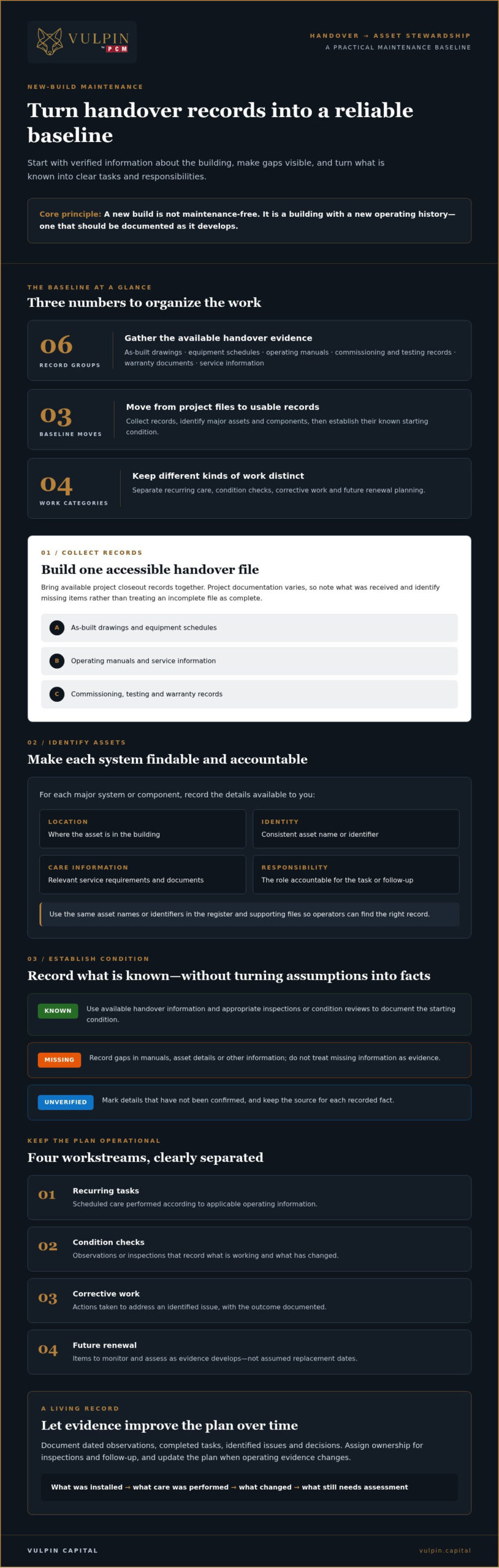
Start with the property’s identity and a register of its major assets and systems. For each item, record its location, available operating information, known condition, accountable role and relevant history. The plan should distinguish recurring tasks, condition checks, corrective work and future renewal planning. For every item, make the purpose clear: what must happen, who owns it and what evidence supports the next decision.
- Recurring tasks: scheduled care performed according to the applicable operating information.
- Condition checks: observations or inspections that record what is working and what has changed.
- Corrective work: actions taken to address an identified issue, with the outcome documented.
- Future renewal: items to monitor and assess as evidence develops, rather than assumed replacement dates.
Why does new construction not remove the need for planning?
Every building moves from construction into operation. Equipment settings, controls and components must be understood and cared for in accordance with their documentation and applicable requirements. A missing manual or unclear asset record can make a later inspection harder to interpret, even if the property is new. General background on Understanding Maintenance Types can help distinguish preventive, predictive and corrective approaches.
A new asset is not a maintenance-free asset. It is an asset with a new operating history. Build that history through dated observations, completed tasks, identified issues and decisions. If evidence changes, update the plan. If information is missing, record the gap instead of treating an assumption as fact.
This discipline supports continuity when ownership or day-to-day responsibility shifts. The plan becomes a shared reference, not a one-time handover document. Its value lies in making the building’s condition legible over time: what was installed, what care was performed, what changed and what still needs assessment. That is stewardship, not a prediction of failure.
Turn New-Build Handover Records into a Reliable Maintenance Baseline
Handover records are more than a closing archive. They are the evidence base for the building’s first operating decisions. A disciplined transfer turns project information into a usable register, so future inspections and work can be tied to the assets actually installed. For a long-term maintenance plan for new builds, the key is to separate verified information from assumptions from the start.
Which handover documents help establish the baseline?
Bring available project closeout records together in one accessible location. These may include as-built drawings, equipment schedules, operating manuals, commissioning and testing records, warranty documents and service information. Project documentation varies, so record what was received and identify missing items rather than treating an incomplete file as complete. Use consistent asset names or identifiers across the register and supporting files so operators can find the right record quickly.
Industry resources can add useful context to an owner’s operating practices. For example, Industry Standards from BOMA International connects property professionals with education and resources relevant to building operations. Use such material as context, not as a substitute for the building’s own records or applicable project requirements.
How should owners turn records into a baseline?
Work through the handover in a fixed sequence. Keep a record of the source for each fact, and mark unverified details clearly.
- 1. Collect records. Assemble final drawings, schedules, manuals, commissioning records, warranty documents and available service information.
- 2. Identify assets. List major systems and components. Record each item’s location, identifying details, relevant service requirements and supporting documents where available.
- 3. Establish condition. Use the information provided and appropriate inspections or condition reviews to document what is known at the start of operations. Date observations and note their source.
- 4. Assign responsibility. Name the role accountable for maintaining each record, arranging recurring tasks and escalating issues. Ownership should be explicit, even when several parties contribute.
- 5. Log open items. Record missing documents, unclear specifications, unresolved commissioning matters or other information gaps. Assign each item a responsible party and a follow-up action.
For example, if an equipment schedule identifies a ventilation unit but its manual is missing, list the unit and its known details, mark the manual as missing, and assign responsibility for resolving the gap. Don’t guess at service intervals or specifications. An evidence-led inspection or review can establish what is known; keep assumptions labelled until verified.
This record-transfer discipline is part of sound construction project governance: decisions made during delivery are more useful in operation when their supporting evidence is preserved. The VULPIN Check applies the same principle by linking resource commitments to predefined evidence of project viability. It is a governance and verification process, not maintenance work.
Once the baseline is assembled, keep it current. Add completed work, dated observations and newly verified information to the relevant asset record. The result is not a frozen handover package, but a traceable account that supports future decisions.
Prioritize New-Build Maintenance by Condition, Consequence, and Timing
New construction can reduce some early repair needs. It doesn’t remove the need to decide what deserves attention, when, and on what evidence. A useful long-term maintenance plan for new builds avoids both extremes: treating every asset as urgent and postponing all planning because the property is new.
Use four decision factors: observed condition, consequence if action is delayed, operational importance and strength of available evidence. A documented change affecting an essential system may warrant prompt assessment. A future renewal forecast, by contrast, belongs in capital planning until condition evidence changes the decision. Asset Management Principles from The IAM offers context on managing physical assets across their life cycle.
Which building systems should the plan track?
Organize the asset register into categories that reflect the property’s physical systems. Include the building envelope, structure, mechanical systems and electrical systems. Add site elements and shared equipment when they fall within the owner’s responsibility. For each asset, connect observations and planned work to its records. Don’t impose universal service intervals: use manufacturer information, project documentation, actual conditions and qualified assessments to set appropriate actions.
How should owners distinguish routine work from future renewal?
Routine work is recurring care and checks intended to maintain operation. Corrective work responds to an identified issue. Future capital planning tracks potential renewal needs without presenting a forecast as a confirmed defect. Keep these categories separate so a minor observation isn’t mistaken for a major project, and a projected renewal doesn’t conceal a current concern.
Apply the same logic across the register. A concern affecting a critical function may rank above a visible but low-consequence finish issue. Where evidence is limited, note the uncertainty and identify the assessment needed before committing to a larger scope of work. Base priorities on documented facts, not an assumption that every new component will perform identically.
Priority follows condition and consequence, not building age alone. Treat schedules as starting points, then revise them when inspections, operating records or qualified assessments add evidence. This measured approach recognizes the advantages of a new asset without confusing “new” with “no planning required.”
Make the Maintenance Plan Operational, Funded, and Reviewable
A plan only works if people can act on it. Convert priorities into assigned tasks, calendar entries, approvals and records. For a long-term maintenance plan for new builds, accountability means more than naming a department: each activity needs a role responsible for scheduling it, ensuring it’s completed, reviewing the result and recording the evidence.
How should responsibilities and records be organized?
Set out the operating roles before the calendar fills with tasks. One person may hold several roles, but the plan should still show who owns each step and where an issue goes if it can’t be resolved within normal operations. Link findings and completed work to the relevant asset so its history remains traceable.
- Schedule: identify who places each recurring task in the annual operating calendar.
- Complete: record who performs or coordinates the activity.
- Review and approve: name who assesses findings and authorizes follow-up work.
- Document and escalate: state who updates the record and who receives issues requiring a decision.
Keep inspection findings, work orders, invoices and updated asset details linked to the system they concern. A simple status convention helps everyone see what needs attention: planned, active, completed or deferred. For deferred work, record the reason, decision owner and circumstances that would trigger reconsideration. A status without context is not a useful control.
How can the plan improve after occupancy?
Set a review point in the operating calendar and reopen the plan when material evidence changes. Compare actual operating experience with original assumptions. Repeated service calls, new inspection findings, equipment changes or revised operating conditions can alter priorities. Record what changed, why the assessment changed and who approved the next action. This creates a measured path from initial assumptions to evidence-led updates.
Funding should follow the same discipline. Use the annual planning process to distinguish recurring operating work from corrective needs and potential capital renewals. Build the forecast from the asset register, documented condition, known work and project-specific assessments, then record the basis for each proposed allocation. Don’t rely on a universal percentage or reserve formula; make assumptions explicit and revise them as reliable cost and condition information becomes available.
Reviewing the plan doesn’t mean rewriting every task. Confirm what remains valid, close completed items and revise entries where operating evidence or responsibilities have changed. This keeps the document useful without turning it into an unchecked list of old assumptions.
Disciplined project execution can help establish the records and cost awareness that support this transition. Explore PCMNow Project Management for project management focused on construction-cost reality and execution.
Carry Maintenance Governance from Project Delivery into Asset Stewardship
A maintenance plan is only as reliable as the decisions and evidence carried forward from construction. Design choices shape what must be operated. Project records explain what was installed and tested. Operational readiness determines whether the incoming owner or team can use that information. If these parts remain disconnected, the plan begins with gaps that can complicate later decisions.
Governance provides continuity. It sets the evidence required to support decisions, identifies who is accountable for them and preserves the rationale behind commitments. That discipline does not predict that defects or failures will occur. It makes the transition from project delivery to ongoing stewardship more controlled and traceable.
What does governance add to new-build maintenance planning?
Predefined evidence requirements give project decisions a clear basis. During delivery, this can mean recording the information needed to understand installed systems, commissioning outcomes and unresolved items. At handover, accountable owners can see what has been verified, what remains open and who is responsible for follow-up. The plan then inherits more than a folder of documents; it inherits decision history.
The VULPIN Check is a governance and verification process that links resource commitments to predefined proof of project viability. It is not a maintenance service. PCMNow Project Management manages complex construction projects with attention to cost reality and disciplined execution. Clear project controls and documented decisions can help form a stronger foundation for later asset stewardship, without guaranteeing a particular operating result.
For owners, the practical test is whether each significant handover record can support an operational decision. Can the team identify the asset, understand the available evidence and trace responsibility for unresolved matters? A long-term maintenance plan for new builds becomes more useful when these questions have documented answers. The VULPIN Check reflects this evidence-led approach to governance for real assets.
How does sustainable housing fit the long-term view?
Sustainability belongs in a whole-life view of an asset. Design and construction choices can influence how a property performs and what information its operators need, but sustainable housing does not mean maintenance-free operation. Systems still require appropriate care, condition records and review as actual operating evidence accumulates.
FoxyHome Sustainable Housing delivers sustainable housing solutions designed with long-term asset survivability in mind. That orientation is compatible with disciplined stewardship: consider durability and operating needs alongside the evidence required to manage the completed property over time. Keep assumptions visible, then test them against the building’s actual condition and use.
The next step is to carry project governance into operation: preserve the evidence, assign decision ownership and update the maintenance plan when facts change. VULPIN Capital’s VULPIN Check and PCMNow Project Management bring governance and disciplined execution to real-asset projects.
Carry the Plan Forward with Evidence and Discipline
A new property’s operating history begins with the decisions made after handover. Keep stewardship practical: test assumptions against evidence, make ownership clear and let documented conditions shape future choices. A long-term maintenance plan for new builds is not a prediction of failure. It is a framework for making sound decisions as the asset changes.
That approach aligns with VULPIN Capital’s governance-first view of real assets. The VULPIN Check ties resource commitments to predefined proof of project viability. PCMNow focuses on construction-cost reality and disciplined project execution. FoxyHome connects sustainable housing solutions with long-term asset survivability. Together, these offerings support evidence-led asset stewardship.
Put that perspective to work as you consider how project governance and execution inform long-term asset decisions. Explore VULPIN Capital’s governance-first approach to real assets, and carry the same discipline into the property’s next stage. Consistent, evidence-led stewardship gives owners a stronger basis for the decisions ahead.
Frequently Asked Questions
Do new builds need a long-term maintenance plan?
Yes. A new building still needs a long-term maintenance plan for new builds to guide care as its use and operating demands become clearer. For example, a space used differently than originally intended may place new demands on ventilation or controls. A documented plan gives the owner a way to assess that change, record decisions and keep property-specific knowledge available when staff or ownership changes.
When should I start a maintenance plan for a new build?
Start developing it before handover, then finalize the initial operating version as project information becomes available. Early preparation gives the incoming owner time to identify missing records, clarify who will make operating decisions and prepare for the first scheduled tasks. Don’t wait for a full year of operating history: begin with verified project information, and mark estimates or untested assumptions so they can be checked during use.
What documents should a new-build maintenance plan include?
Include project records that help identify, operate and manage the building’s assets. Along with drawings and manuals, retain equipment start-up or commissioning reports, approved changes from the original design, control settings where documented, operator training materials and relevant service contacts. Keep warranty documents with their related asset records. Use a consistent file name or asset identifier so an operator can quickly connect a report or instruction to the correct system.
Who is responsible for maintaining a new building after handover?
The owner or the party designated to operate the property should establish who is accountable after handover. Responsibilities can be delegated, but the plan should identify who authorizes work and who ensures records are retained. For shared properties, distinguish assets under the owner’s control from those managed through a shared operating arrangement. Record how issues are reported and escalated so responsibility doesn’t become unclear when several parties are involved.
How should a maintenance plan address warranty documents?
Keep each warranty document connected to the asset it covers, and create a simple index of the stated coverage period, applicable conditions, exclusions and claim steps. Record the document source and the person responsible for retaining it. Before arranging work that could involve a warranty claim, consult the actual warranty terms and relevant project records. Requirements vary by document, so don’t assume one asset’s terms apply to another.
Can a maintenance plan be created before the building has operating history?
Yes. Create an initial plan using available project records and clearly label any provisional assumptions. For example, planned operating tasks can be entered with their documentation source, while unknown performance details remain open for assessment. After occupancy, compare expectations with actual system behaviour and revise the relevant entries. The first version is a controlled starting point, not a claim that every future maintenance need is already known.
How often should a new-build maintenance plan be reviewed?
Review it at least as part of the annual operating and budget cycle, and sooner when a material change could affect priorities. A new use for a space, a major system alteration, repeated service issues or an inspection finding may require an earlier review. Record the review date, decisions made and any changes to task ownership or planning assumptions. That record helps the next reviewer understand why the plan evolved.