

Software won’t save a project built on a foundation of administrative negligence. Most operators treat budget deviations as an inevitable force of nature. They are wrong. These failures are the logical outcome of unverified assumptions. You’ve watched margins dissolve under the weight of unpredictable material volatility and a lack of transparency from general contractors. Managing construction project cost overruns is not a digital problem. It is a governance problem.
We recognize the exhaustion of navigating a Canadian market where the Bank of Canada policy rate remains at 2.25 per cent and a looming skilled-labour shortage threatens to derail every timeline. You must realize that more software is not the solution; you need a rigid framework for asset deployment. This article details why strict administrative oversight is the only way to achieve total visibility into construction-cost reality. We will demonstrate how to move from speculation to structural permanence, ensuring long-term asset survivability through disciplined execution.
Key Takeaways
- Understand why software is merely a tool and how a governance-first operating system provides the only true defense against budget erosion.
- Discover how the VULPIN Check serves as a rigorous verification gate to filter out non-viable projects before capital is ever committed.
- Learn the mechanics of managing construction project cost overruns through disciplined administrative oversight rather than reactive project coordination.
- Identify the role of PCMNow in maintaining total visibility into construction-cost reality during every stage of complex asset deployment.
- Shift your focus from short-term speculative gains to the structural permanence required for long-term asset survivability.
The Anatomy of Cost Overruns in Canadian Construction
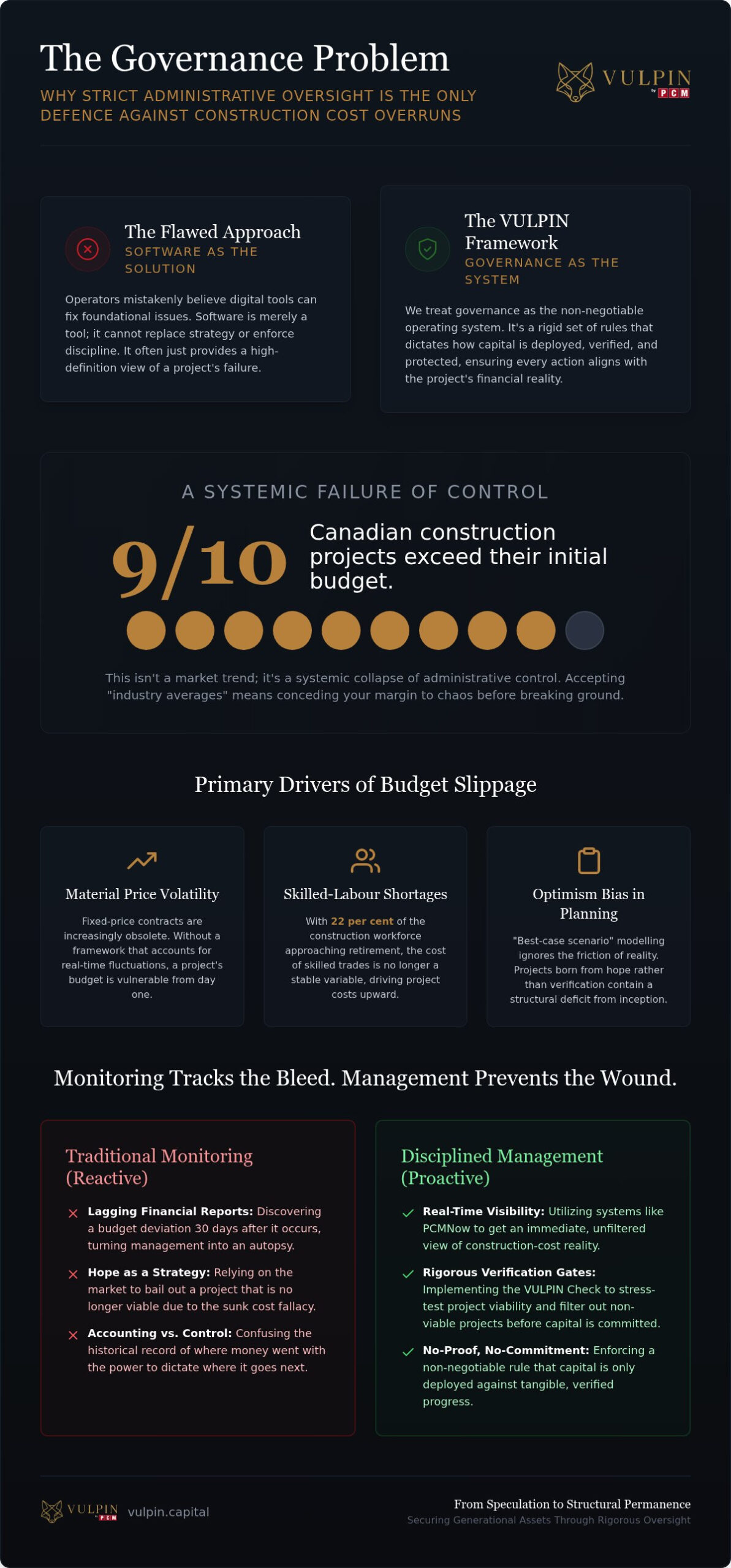
Traditional project management in the Canadian market is a broken machine. It relies on hope rather than verification. When nine out of ten projects exceed their budgets, we must stop calling it an industry trend and start calling it a systemic collapse of administrative control. A Cost overrun is not a mathematical error. It is a failure of governance. It represents a disconnect between the theoretical model and the physical reality of the site.
Operators often hide behind “industry averages” to justify their own lack of oversight. This is a coward’s metric. If you accept a 10 per cent overrun as standard, you’ve already conceded your margin to chaos. Managing construction project cost overruns starts with rejecting the idea that budget slippage is inevitable. It’s the result of specific, preventable lapses in the project’s operating system. We don’t build on averages; we build on tangible verification.
The psychological trap of the sunk cost fallacy further complicates this reality. Once a foundation is poured, many developers feel they must continue at any cost. They throw good capital after bad, hoping the market will bail them out. We don’t believe in hope. We believe in structural permanence and the cold reality of the pro forma. If a project is no longer viable, the most disciplined act is to stop. Most managers lack the stoicism to make that call.
Primary Drivers of Budget Slippage in 2026
The 2026 Canadian landscape presents unique challenges that traditional management cannot handle. Material price volatility has rendered fixed-price contracts nearly obsolete. If your governance framework doesn’t account for real-time fluctuations, your project is already underwater. Labour shortages also drive escalation. With 22 per cent of the construction workforce approaching retirement, the cost of skilled trades is no longer a stable variable. Finally, optimism bias in the planning phase creates a structural deficit. Most projects are born from a desire to see them succeed, leading to “best-case scenario” modelling that ignores the friction of physical reality.
The True Cost of Lagging Financial Reports
If you discover a budget deviation 30 days after it occurs, you aren’t managing a project; you’re writing an obituary. Real-time visibility is the only standard that matters. Most firms confuse accounting with control. Accounting is a historical record of where your money went. Control is the administrative power to dictate where it goes next. Hidden change orders are the silent killers of project margins. Without a strict governance gate, these small erosions accumulate until the project’s viability is compromised. Managing construction project cost overruns requires a system that identifies these leaks before they become floods. Transparency is not a courtesy from your general contractor. It’s a prerequisite for capital deployment.
Beyond Software: Why Project Governance Prevents Overruns
Software is a tool. It is not a strategy. We reject the industry’s obsession with digital interfaces that mask structural administrative rot. Many operators believe that AI or predictive analytics can replace the need for rigid oversight. They are wrong. Predictive controls are useless if the underlying data is a product of site-level “optimism bias” or poor reporting. Governance is the operating system. It is the definitive set of rules that dictates how capital is deployed and verified. It is the boundary that ensures every action follows a documented methodology. Without this framework, you aren’t managing a project; you’re simply watching it fail in high definition.
Our philosophy explicitly rejects the frantic energy of speculative markets. Real asset development requires a stoic commitment to physical reality. By establishing uncompromising standards, we filter for high-integrity partners and contractors. If a general contractor cannot provide the transparency we demand, they are a liability. We don’t seek to please the mass audience of the construction world. We seek partners who respect the gravity of capital deployment and the necessity of structural permanence.
The Difference Between Monitoring and Management
Monitoring tracks the bleed. Management prevents the wound. Most project dashboards serve as expensive autopsies. They provide a historical record of why the project died after the capital has already vanished. We enforce a “no-proof, no-commitment” rule for every asset deployment. This is the only standard for managing construction project cost overruns that actually protects the pro forma. A Systematic Review of Cost Overrun Factors confirms that structural governance failures are the primary drivers of budget erosion. We prioritize tangible verification over theoretical modelling every time. It’s a matter of principle. We don’t release funds based on promises; we release them based on verified physical progress.
The Fox: Systems for Asset Survivability
The Fox provides a specialized operating system for asset survivability. It utilizes a condition-driven approach to manage assets nationally. Rules govern our operations. We eliminate the influence of emotional decision-making or developer “gut feelings.” We don’t care about market hype or the latest speculative trends. We care about the integrity of the structure and its ability to survive over a long-term temporal framework. This methodical rhythm prioritizes durability over the frantic pursuit of quick wins. If you seek to move beyond speculation and toward structural permanence, you may find alignment with our governance-first platform. We operate on a different time scale, ensuring that every asset we touch is built to endure.
The VULPIN Check: Stress Testing Project Viability
Most construction projects are failures before the first shovel hits the dirt. They are built on spreadsheets designed to please investors rather than reflect the friction of physical reality. We reject this culture of administrative negligence. The VULPIN Check is our rigorous verification process that ensures project viability before any capital is committed. It is a filter designed to fail the weak. If a project cannot survive our stress tests, it does not deserve to exist. We prioritize the integrity of the structure over the excitement of the deal.
Effective governance requires a cold, analytical look at “worst-case” economic scenarios. We don’t model for the best-case; we model for the breaking point. This involves stress testing the pro forma against sustained interest rate volatility and the continued escalation of material costs. Historical data, such as the Cost Overruns on State of Washington Construction Contracts, demonstrates that project size and the number of bidders are often poor predictors of success compared to fundamental governance. By utilizing third-party audits to validate construction-cost reality, we eliminate the echo chamber of optimistic internal reporting. Managing construction project cost overruns is only possible when you start with a foundation of truth.
Pre-Construction Verification Protocols
We do not accept digital abstractions as fact. Site conditions must be verified through physical inspection and geotechnical certainty. Our protocols extend to auditing the contractor’s actual capacity to execute. Credentials on a website are meaningless; we demand proof of labour stability and equipment autonomy. The VULPIN Check acts as a sovereign gatekeeping mechanism. It ensures that capital only flows to projects where the risks are documented, quantified, and mitigated. We don’t manage by hope. We manage by verification.
Rejecting Speculation for Condition-Driven Data
Speculative flipping is a high-risk gamble that relies on market franticness to cover up poor execution. We refuse to participate in that energy. Our focus is the development of generational assets that provide long-term stability. This is why we prioritize FoxyHome sustainable housing solutions. These assets are built for survivability, utilizing low-carbon materials and energy-efficient designs that align with the 2025 National Building Code of Canada. We replace the uncertainty of the market with the certainty of engineering. Managing construction project cost overruns requires a shift from short-term greed to long-term structural permanence. The VULPIN Check is the ultimate administrative safeguard that separates viable real asset deployment from speculative fantasy.
PCMNow: Implementing Disciplined Project Execution
PCMNow transforms complex projects through disciplined construction management. It isn’t a passive tracking tool. It’s an active enforcement of governance. Most owners hire coordinators who merely observe the chaos. We provide a guardian of capital. This role exists to protect the pro forma from the erosion of site-level incompetence. Managing construction project cost overruns requires this level of administrative oversight. We maintain a rhythmic, methodical communication flow with all stakeholders. Every weekly report is a confrontation with construction-cost reality. We don’t hide behind “green” status lights. We report on the structural health of the investment.
Our approach rejects the frantic energy of traditional project management. We don’t move at the speed of digital abstraction. We move at the speed of physical verification. This steady cadence ensures that every decision is grounded in truth. It forces a level of intellectual honesty that most firms avoid. If you’re tired of speculative management, you can access our disciplined project execution framework to secure your capital. We don’t seek to please every contractor; we seek to protect the asset’s viability at all costs.
Managing Change Orders with Stoic Authority
Every change order is a signal. It points to a gap in the original planning or a failure in administrative governance. We don’t accept change orders as an inevitable part of the process. We treat them as failures that must be audited. PCMNow enforces a process of rigorous verification for every additional expense. We demand physical proof of necessity before any capital is released. This preserves the integrity of the original project vision. We don’t allow scope creep to erode project margins. If a change isn’t essential for structural permanence, it’s rejected. This stoic authority is the only way to prevent the slow bleed of capital.
Aligning Stakeholders through Transparent Reporting
Stakeholders deserve the truth, not a marketing summary. Our reporting functions like a technical manual for an asset’s health. We focus on asset survivability rather than superficial metrics. If the pro forma is under threat, the board knows immediately. This level of transparency filters for partners who value integrity over speculation. PCMNow ensures project success through absolute administrative oversight. It is the mechanism that turns the VULPIN Check into a physical reality. By providing the board with a technical manual for their asset, we ensure they remain in autonomous control. We don’t manage by consensus; we manage by the documented methodology. This ensures the long-term temporal framework of the project is never compromised by short-term urgency.
Securing Generational Assets Through Rigorous Oversight
Real asset development is a marathon of decades. It is not a sprint of fiscal quarters. We explicitly reject the frantic energy of traditional markets that prioritizes short-term speculative flipping over structural permanence. This shift in mindset is essential for the survival of capital. When the construction phase ends, the asset’s true life begins. If you have been successful in managing construction project cost overruns through disciplined execution, you have earned the right to transition into long-term asset management. This transition must be as methodical as the build itself.
Sustainable housing is the only viable path for national developments in the current Canadian climate. With the 2025 National Building Code of Canada integrating greenhouse gas emissions as a formal objective, resilience is now a legal and engineering mandate. FoxyHome sustainable housing solutions are designed to meet these rigorous standards. We don’t build to the minimum code; we build for generational survivability. This requires integrating modern construction techniques, such as mass timber and modular assembly, with the same uncompromising governance that prevented budget erosion during the initial deployment. Managing construction project cost overruns is merely the first gate in a long-term strategy for asset autonomy.
From Short-Term Gains to Long-Term Stability
We believe in the financial case for high-performance, sustainable residential housing. These are not vanity projects. They are high-integrity assets designed to withstand both physical and economic volatility. By rejecting the speculative franticness of the retail investment world, we focus on the slow, steady appreciation of real value. This is the definition of sovereign control. We build assets that don’t just exist; they endure. This long-term temporal framework ensures that the structure remains a viable, self-sustaining entity for the next generation of owners. We prioritize the integrity of the structure above all else.
Partnering for Disciplined Asset Deployment
Not every organization is ready for this level of administrative oversight. Our systems are designed to filter for specific partners who value tangible verification over theoretical modelling. VULPIN Capital operates as a master architect of project systems, providing the internal logic required for autonomous control. We don’t manage by consensus. We manage by a documented methodology that has been stress tested against reality. If your organization values the integrity of the structure above the excitement of the market, you may be ready to secure your next project with the VULPIN Check. The transition from construction to condition-driven asset management through The Fox is the final step in securing your legacy. We don’t just build buildings. We architect systems for survivability.
Architecting Systemic Permanence
Managing construction project cost overruns is not a matter of digital adoption. It’s a matter of administrative will. Budget erosion is a failure of governance, not an inevitability of the Canadian market. You must realize that hope is not a management strategy. By utilizing the VULPIN Check methodology, you replace speculative franticness with tangible verification. National PCMNow Project Management expertise ensures that the pro forma remains a physical reality during every stage of execution. Engineering-led sustainable housing solutions provide the final framework for long-term asset survivability. We don’t build for the erratic energy of today. We build for the stability of the next generation.
Your capital deserves a foundation of truth. We invite you to discover how VULPIN Capital secures asset survivability through disciplined governance. The path to structural permanence requires a rejection of traditional negligence. Build with conviction.
Frequently Asked Questions
How does project governance differ from standard project management?
Governance is the sovereign operating system that dictates the rules of engagement. While standard project management often focuses on the reactive coordination of tasks, governance establishes the administrative framework for every capital deployment. It is the difference between following a schedule and enforcing a methodology. We don’t coordinate chaos; we impose order through rigid oversight.
What are the most common causes of construction cost overruns in Canada?
Budget erosion is the logical result of administrative negligence. The primary drivers in the current market include material price volatility and the 22 per cent skilled-labour retirement rate. These are known variables. Most firms fail because of optimism bias and a lack of transparency from general contractors. Managing construction project cost overruns requires a rejection of these unverified assumptions.
Can the VULPIN Check be applied to existing projects already in progress?
We apply the VULPIN Check to projects in progress to identify structural rot and stop the bleed. It serves as a cold, technical autopsy of the project’s current health. If the data reveals a lack of viability, we provide the evidence required to halt the loss of capital. We prioritize the integrity of the remaining funds over the desire to finish a failing build.
What is the role of an owner’s representative in preventing budget slippage?
The owner’s representative acts as a guardian of capital rather than a project assistant. Their role is to enforce the governance framework and maintain absolute visibility into construction-cost reality. They don’t exist to please the contractor. They exist to ensure that every dollar released is backed by tangible, verified physical progress on the site.
How do sustainable housing solutions impact long-term asset value?
Sustainable housing solutions like FoxyHome ensure structural permanence and long-term asset survivability. Compliance with the National Building Code 2025 is not an option; it’s a baseline for any asset intended to endure for generations. We build for durability and energy autonomy. This protects the asset from future regulatory shifts and rising utility costs.
What happens if a project fails the VULPIN Check during the pre-construction phase?
If a project fails the VULPIN Check, we reject it immediately. We do not commit resources to unverified models or speculative gambles. This is the ultimate administrative safeguard for managing construction project cost overruns. Rejection is a tool of discipline. It ensures that only the most viable, high-integrity projects move toward deployment.
How does ‘The Fox’ operating system improve asset survivability?
The Fox is a specialized operating system that replaces emotional decision-making with condition-driven data. It provides a national framework for asset management that prioritizes structural health over market trends. The system ensures the asset operates with its own internal logic. This autonomous control is what allows an asset to survive across a long-term temporal framework.
Is PCMNow suitable for small-scale residential developments?
PCMNow is suitable for any deployment where the protection of capital is the priority. We don’t believe that a smaller scale justifies a lack of rigour. Disciplined execution is required whether you’re building a single high-performance residence or a national housing development. We apply the same strict standards of administrative oversight to every project we touch.