

Proximity is a hollow metric of security. Many property owners, when searching for ‘owner’s representative services Oakville’ or similar regionally-focused terms, often mistakenly believe that a local address guarantees project integrity. It doesn’t. Geographic proximity is a distraction that masks systemic failures in oversight. You aren’t just looking for a neighbour; you’re looking for a fortress of administrative control. You likely share the common anxiety over construction cost overruns and the skepticism of speculative flipping that plagues the current 2026 landscape. VULPIN Capital agrees that the frantic energy of the market is no substitute for technical verification.
This evaluation demonstrates why structural governance and asset survivability matter more than a local postal code when selecting a development partner. You’ll learn how to identify a partner with a disciplined execution framework that prioritizes project viability before a single dollar of capital is committed. We will examine the specific systems required to secure a generational asset that remains indifferent to market volatility and the shifting financial burdens of new infrastructure regulations. By the end, you’ll understand why a governance-first approach is the only way to ensure your real estate assets survive the long term.
Key Takeaways
- Prioritize uncompromising governance over geographic proximity to ensure the long-term survivability of your real estate assets.
- Utilize The VULPIN Check as a mandatory verification gate to confirm construction-cost reality before any capital is deployed.
- Evaluate how owner’s representative services Oakville provide the administrative oversight necessary to reject speculative hype in favour of tangible results.
- Deploy the PCMNow management framework and The Fox operating system to maintain administrative rigour and prevent scope creep in complex projects.
- Shift focus from short-term flipping toward the development of generational assets that remain resilient against market volatility and regulatory shifts.
The Fallacy of Geographic Proximity in Real Estate Development
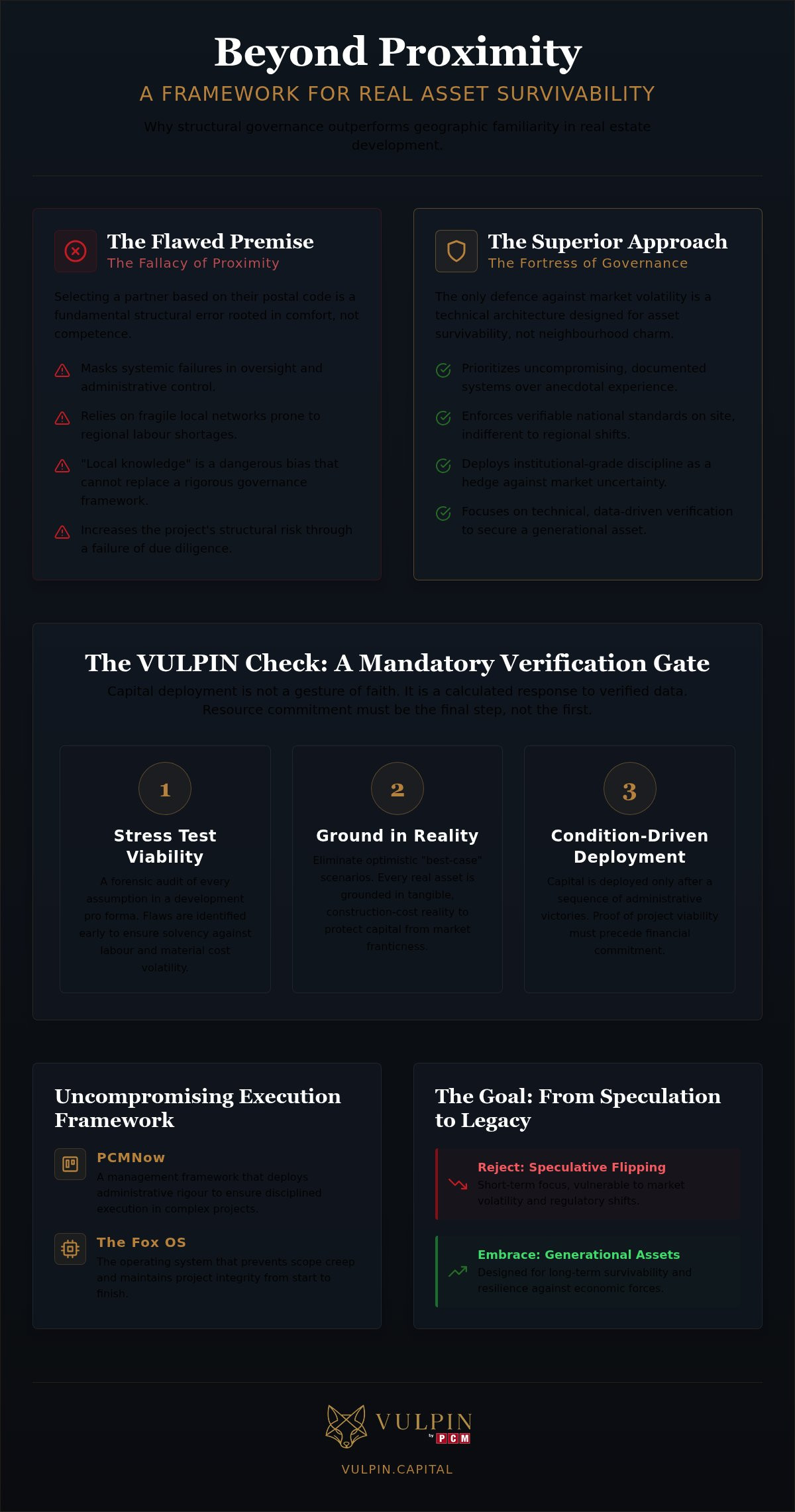
Selecting a development partner based on their physical location is a fundamental structural error. It’s a decision rooted in the comfort of familiarity rather than the cold reality of administrative competence. Physical distance does not dictate project integrity. In complex developments, the proximity of a contractor’s office is irrelevant to the durability of the asset. When seeking owner’s representative services Oakville, the priority must shift from local aesthetics to the implementation of a rigorous, rule-governed framework. Neighbourhood charm often serves as a mask for a lack of disciplined management.
The difference between a local builder and a national-standard governance firm is the difference between anecdotal experience and documented systems. A local operator relies on a network of relationships that are often fragile and prone to regional labour shortages. Conversely, a governance-first partner utilizes a technical architecture designed for asset survivability. A comprehensive Construction Management Overview highlights that professional oversight is defined by the application of standardized functions. It’s not about who you know in the community. It’s about the verifiable standards you enforce on the site.
The Risk of the Local Knowledge Bias
Local knowledge is frequently cited as a primary trust factor. In 2026, this is a dangerous bias. Connections with regional authorities cannot replace a rigorous project governance framework. These connections don’t mitigate the risk of cost overruns or technical failures. Geographic limitations actually restrict a developer’s ability to realize cross-regional economies of scale. You don’t need a partner who knows the streets; you need a partner who understands the data. Prioritizing physical proximity over technical, data-driven verification increases the structural risk of the entire project. It’s a failure of due diligence.
Defining National Asset Survivability
Your real estate assets don’t exist in a regional vacuum. They are subject to national economic forces and market volatility. A development partner must operate on a national scale of excellence to ensure long-term performance. This requires standardized systems that remain indifferent to regional fluctuations. Institutional-grade discipline is the only hedge against the uncertainty of the current Canadian market. By moving beyond a narrow geographic focus, you find the administrative rigour necessary to secure a generational asset. Survivability is a matter of autonomy and principle, not location.
The VULPIN Check: A Governance Standard for Real Asset Deployment
Capital deployment is not a gesture of faith. It’s a calculated response to verified data. The VULPIN Check serves as the primary gatekeeper in this process. It’s a rigorous verification framework that demands proof of project viability before a single dollar is committed. Most developers operate on a “spend and see” basis. We reject this. Resource commitment must be the final step in a sequence of administrative victories, not the first. By grounding every real asset in construction-cost reality, you eliminate the optimism that leads to insolvency. This is why sophisticated owners rely on owner’s representative services Oakville to enforce a higher standard of fiscal discipline.
Stress Testing Construction Viability
A development pro forma is only as valuable as the stress testing it survives. Many owners accept these documents as static truths. They aren’t. They are often collections of best-case scenarios that ignore the volatility of the 2026 market. Identifying flaws early requires a forensic audit of every assumption. Third-party construction project audits are no longer a luxury for sophisticated owners; they’re a necessity. This technical scrutiny ensures that your project remains solvent even when labour costs or material availability shift. You can explore the full framework of this process in The VULPIN Check: A Governance Standard for Real Asset Deployment. Ensuring that every real asset is grounded in physical reality is the only way to protect capital from market franticness.
The Mechanics of Tangible Verification
Moving from theoretical financial modelling to physical reality on-site is where most projects fail. Paper-based projections don’t account for site-specific friction or administrative decay. By implementing owner’s representative services Oakville, you ensure that your project remains a technical reality rather than a speculative dream. Budget inflation isn’t an inevitable part of construction. It’s a symptom of poor governance. We utilize The Fox, a proprietary operating system, to maintain autonomous project decision-making. This system ensures that decisions are made based on predefined logic rather than external urgency or emotional pressure. It keeps the project aligned with its original mandate and prevents the scope creep that erodes generational wealth. If you’re ready to move beyond speculative models, consider how a disciplined execution framework can protect your capital for the long term.
Condition-Driven Deployment vs. Speculative Market Hype
Market hype is a distraction. It prioritizes the frantic energy of the exit over the structural integrity of the build. We explicitly reject the flip mentality in favour of long-term generational assets. Developing a property for a quick sale is a strategy rooted in speculation, not engineering. Generational assets require a different timeline. They demand a stoic approach to acquisition where patience is valued over frantic market participation. Sophisticated owners utilize owner’s representative services Oakville to filter out the noise of lifestyle marketing and focus on technical performance.
Condition-driven real asset deployment Canada means capital only moves when specific technical conditions are satisfied. It’s an engineering-led philosophy. Market hype often masks the true costs of asset maintenance and regional labour shortages. If a development pro forma relies on market excitement rather than verified cost reality, it’s a speculative gamble. We don’t gamble. We execute based on predefined administrative triggers. This ensures that every deployment of capital is justified by tangible verification rather than theoretical modelling.
Why Speculative Flipping Destroys Long-Term Value
Speculative flipping is a race to the bottom. In 2026, the hidden costs of fast development are becoming visible through structural failures and rising maintenance liabilities. Developers who prioritize exit speed often sacrifice material durability and systemic oversight. You must learn to spot these operators before committing your capital. They focus on the facade while ignoring the core governance required for asset survivability. You can read more about this in our guide on Disciplined Real Estate Investing Principles. True value is built through slow, methodical oversight, not market timing.
FoxyHome: The Standard for Sustainable Residential Solutions
FoxyHome Sustainable Housing represents our commitment to sovereign, durable living. It isn’t about following environmental trends; it’s about engineering a structure that lasts for centuries. Realizing net-zero home construction costs Canada requires a governance-first approach to manage complex technical requirements and specialized labour. This isn’t achieved through standard retail builders. It requires owner’s representative services Oakville to manage the intersection of modern construction techniques and long-term asset survivability. We focus on the autonomous control of the home, ensuring it remains a functional asset regardless of external energy volatility. Stability is the only metric that matters.
Vetting Real Estate Development Partners: A Technical Framework
Vetting a development partner is not a social exercise. It’s a technical audit of their internal logic. Most investors are distracted by portfolio photographs that emphasize aesthetic appeal over structural governance. We reject this superficiality. A partner’s value is found in their administrative framework, not their marketing materials. To secure a generational asset, you must employ a technical vetting process that prioritizes verification over trust. Engaging owner’s representative services Oakville allows for an uncompromising audit of a developer’s internal systems before capital is at risk.
- Step 1: Audit the governance framework. Don’t look at the finished buildings; look at the documented systems that built them.
- Step 2: Demand a construction-cost reality check. Pro formas are often works of fiction. Verify the active numbers against current 2026 market benchmarks.
- Step 3: Verify the use of an autonomous operating system. We utilize The Fox to ensure project tracking is driven by objective data rather than human error.
- Step 4: Scrutinize the developer’s personal financial commitment. A partner without skin in the game is merely a manager, not a disciplined operator.
- Step 5: Evaluate the long-term asset management plan. Asset survivability doesn’t end at occupancy. It requires a permanent administrative strategy.
Validating the General Contractor’s Credentials
Surface-level credentials are insufficient for complex national projects. In 2026, a standard license is no guarantee of performance. You must identify early warning signs of project distress during the vetting phase: fragmented communication, opaque reporting, and a lack of a disciplined real estate asset management plan. Distress is a symptom of poor governance. Survivability depends on a partner who operates with institutional-grade discipline and refuses to accept the frantic energy of traditional construction cycles. It’s about the integrity of the system, not the charm of the contractor.
Beyond the Surface: Governance over Aesthetics
The best developer is the one who says no to unviable projects. Rejecting a project is a sign of technical strength, not weakness. It indicates a commitment to project viability over speculative growth. Maintaining project discipline requires owner’s representative services Oakville to enforce strict standards against market pressure and scope creep. You can explore our Construction Project Risk Management Framework to understand how we mitigate structural risk through administrative rigour. Securing your capital requires a governance-first partner who values the permanence of the structure above all else.
PCMNow: Uncompromising Execution for Complex Projects
Execution is the final arbiter of value. Without it, the most sophisticated pro forma is a liability. PCMNow Project Management provides the administrative infrastructure required for national construction deployment. It’s a system built for complex projects where the margin for error is non-existent. Traditional project management often fails because it lacks the internal logic to resist external pressure. We don’t suffer from this weakness. By utilizing owner’s representative services Oakville, you install a governance layer that remains indifferent to market franticness. This isn’t just management; it’s a technical standard of execution.
Scope creep is a failure of oversight. It occurs when administrative boundaries are porous. We use The Fox operating system to enforce these boundaries with mechanical precision. Every decision is tracked; every deviation is neutralized before it can compromise the asset. Managing construction project cost overruns is not a matter of luck. It’s a matter of strict governance. In 2026, boutique governance firms outperform large corporations because they operate as invested craftsmen rather than detached managers. A smaller, disciplined team provides the intellectual honesty that a corporate hierarchy cannot replicate. We prioritize the integrity of the structure over the scale of the organization.
Disciplined Construction Management
Maintaining the reality of construction costs requires a constant feedback loop between the site and the administrative centre. This is not a passive process. Administrative oversight is the only mechanism that protects the owner’s capital from the natural decay of the construction lifecycle. We don’t accept “market rates” as an excuse for budget inflation. We demand technical verification at every stage. You can read about our specific execution protocols in PCMNow Project Management: The Uncompromising Standard. Protecting capital requires a refusal to compromise on predefined benchmarks.
Closing the Gap Between Vision and Execution
Execution is the only metric that matters in real estate development. A vision without a disciplined execution framework is merely a hallucination. Ensuring your project remains viable from inception to occupancy requires a partner who values the integrity of the structure above all else. This is the final step in securing a generational asset. If you are a sophisticated owner who rejects speculative hype, it’s time to align with a governance-first platform. Engaging owner’s representative services Oakville ensures that your capital is deployed with purpose and protected by technical rigour. Alignment with our worldview is the prerequisite for securing your real asset’s future.
Securing the Future of Your Real Asset Portfolio
Real asset survivability is a product of administrative rigour; it’s not a result of geographic proximity or market optimism. You’ve seen how the uncompromising VULPIN Check methodology serves as a mandatory gatekeeper for capital deployment. It ensures that every project is grounded in construction-cost reality rather than speculative hype. By utilizing a condition-driven asset acquisition strategy, you prioritize long-term stability over the frantic energy of the market. Proximity is a hollow metric. Governance is the only standard that ensures permanence.
The implementation of owner’s representative services Oakville provides the technical oversight necessary to neutralize scope creep and manage cost overruns. Through the proprietary PCMNow project management system, your project remains aligned with its original mandate from inception to occupancy. This disciplined approach is the only way to protect generational wealth in an increasingly volatile market. We invite you to build with the technical autonomy your capital deserves.
Secure your asset with VULPIN Capital’s disciplined governance framework.
Frequently Asked Questions
What is the most common reason real estate development projects fail in Canada?
Projects fail when administrative oversight is sacrificed for market speed. In the 2026 Canadian landscape, projects often collapse due to a misalignment between theoretical financial models and physical cost reality. Without a disciplined governance framework, scope creep and labour shortages erode margins until the project is no longer viable. Success requires a refusal to accept optimistic projections. It demands technical verification at every stage of the lifecycle to protect the integrity of the asset.
How does The VULPIN Check differ from standard project due diligence?
The VULPIN Check is an uncompromising verification gate that demands technical proof of project viability before resource commitment. Standard due diligence often relies on superficial checklists and third-party reports that lack internal logic. We reject this passivity. Our methodology requires a forensic audit of every pro forma assumption to ensure the asset is grounded in physical reality. It’s a mechanism designed to filter for specific partners who value structural permanence over speculative excitement.
Why is speculative flipping considered a high-risk strategy for long-term owners?
Speculative flipping is a high-risk strategy because it prioritizes the exit over asset survivability. This mentality leads to the use of inferior materials and the neglect of long-term maintenance protocols. In 2026, these hidden liabilities eventually manifest as structural failures that destroy generational wealth. Sophisticated owners reject this frantic energy. They focus on the development of durable assets that remain resilient regardless of market volatility or shifting infrastructure regulations across Canada.
What should I look for in a construction project governance framework?
A robust framework must include autonomous operating systems and documented administrative logic. You should look for owner’s representative services Oakville that utilize technical tracking to neutralize human error. The framework must prioritize tangible verification over relationship-based trust. It should enforce strict standards against project drift and ensure that every capital deployment is justified by predefined technical triggers. This discipline is the only way to secure a generational asset against external urgency.
How do national development firms handle regional building code variations?
National firms utilize standardized governance systems that integrate regional technical requirements into a broader framework of excellence. While building codes vary across provinces, the logic of administrative oversight remains constant. We maintain a technical architecture that adapts to regional site conditions while enforcing national standards for asset performance. This approach ensures that regional variations in labour or regulation don’t compromise the structural integrity or the financial viability of the national real asset portfolio.
Can PCMNow be applied to existing projects that are currently in distress?
PCMNow Project Management is specifically designed to restore administrative rigour to projects currently experiencing distress. Distress is usually a symptom of porous boundaries and poor governance logic. Our system neutralizes scope creep by installing a technical layer of oversight that forces the project back into cost-reality. By implementing The Fox operating system, we provide the autonomous decision-making necessary to stabilize the asset and ensure its eventual completion without further capital erosion.
What are the core principles of condition-driven real asset acquisition?
Condition-driven acquisition relies on technical triggers rather than market timing or speculative hype. Capital is only deployed when specific, predefined conditions of viability are satisfied through forensic audit. This principle ensures that acquisition is a response to verified data rather than a reaction to frantic market energy. It requires a stoic patience that most retail developers lack. For the sophisticated owner, it provides a sovereign path toward securing real assets with long-term structural permanence.
How does VULPIN Capital ensure construction-cost reality in a volatile market?
We ensure cost reality through forensic audits of active pro formas and the continuous use of The Fox tracking system. In a volatile market, theoretical models fail because they don’t account for real-time site friction. Our systems provide a mechanical logic that tracks every dollar against physical progress. By utilizing owner’s representative services Oakville, we maintain a constant feedback loop that rejects optimism in favour of technical truth. This prevents budget inflation and secures the asset’s future.