

What should you do first when a dispute with your building contractor puts payment, timing, scope, or workmanship in question? Start with the evidence, not an ultimatum. Resolving disputes with building contractors begins by establishing what the contract required, what changed, and what work has actually been completed.
It is difficult to reach a sound resolution when the record is scattered across messages, invoices, site photos, and verbal conversations. One disagreement can also involve several linked issues. Before responding, organize the contract, approved changes, payment records, dated photos, and a timeline of key events.
This guide explains how to build that record, compare practical resolution routes, and escalate deliberately. It also covers why the right process depends on your contract and province or territory, and when a project-level discussion should give way to legal advice. Structured project oversight can help teams clarify facts and decision authority. PCMNow Project Management supports disciplined execution, not legal representation or a guaranteed dispute outcome.
Key Takeaways
- Gather the signed contract, approved changes, correspondence, dated photos, invoices, and schedule information before setting out your position.
- In resolving disputes with building contractors, match the resolution route to the contract, the issue, and the rules that apply in your province or territory.
- Understand what direct discussion, mediation, adjudication, arbitration, and litigation can each do before deciding how to proceed.
- Keep safety, critical work, dependencies, and project decisions visible while addressing the disagreement.
- Use project governance to strengthen accountability and record keeping, and seek legal advice when questions concern rights, deadlines, or formal procedures.
Why disputes with building contractors arise, and what is at stake
A contractor disagreement can unsettle more than the working relationship. You may be unsure what to approve, pay, or expect next, while the project still depends on coordinated decisions. There may be no quick fix. Start by separating what happened from what each party believes should have happened.
One dispute can contain several distinct questions. An invoice may include disputed work, a schedule delay may follow an unapproved change, or a workmanship concern may depend on design details and acceptance criteria. Treating every concern as one broad accusation makes the facts harder to assess. A dispute is easier to assess when each issue is tied to evidence and contract language.
Which contractor dispute are you dealing with?
Sort the concerns into categories before deciding what they mean:
- Payment: An amount, invoice, holdback, or payment timing is contested.
- Delay: A milestone or completion date has shifted, and the cause or responsibility is unclear.
- Scope change: The parties disagree about whether work was added, removed, or approved, and how it affects price or timing.
- Design: Drawings, specifications, or instructions appear inconsistent or incomplete.
- Deficiency: Completed work is alleged not to meet an agreed requirement or standard.
These categories can overlap. A disputed change, for example, may affect payment and delay follow-on work. Record the connection, but keep each question distinct. A difference of opinion is not, by itself, proof that either party failed to meet the contract. Review the relevant terms, including scope, approval procedures, schedule, and acceptance criteria, before drawing that conclusion. Construction Law in Canada provides broader context on construction contracts and dispute issues.
Why early, disciplined handling matters
Unresolved questions create operational friction. A crew may be waiting for direction, a later trade may depend on work whose status is contested, or an approval may be delayed because no one has recorded who has authority to decide. If the project continues without a clear record, later discussions can become tangled in differing recollections of instructions, dates, and decisions.
Capture events while they are fresh. Note what was observed, when it occurred, who was present, what decision is needed, and which work may be affected. Track safety and critical sequencing as separate management concerns so they are not lost inside an argument about responsibility. This is sound project control, not a finding about legal fault.
Resolving disputes with building contractors also requires attention to the governing documents and jurisdiction. The contract may set procedures for notices, changes, or dispute resolution. Provincial and territorial rules can affect rights, notice requirements, and available remedies. Record facts promptly, then verify the applicable terms and rules before relying on a deadline or choosing a formal route.
Build a clear evidence record before responding to a contractor
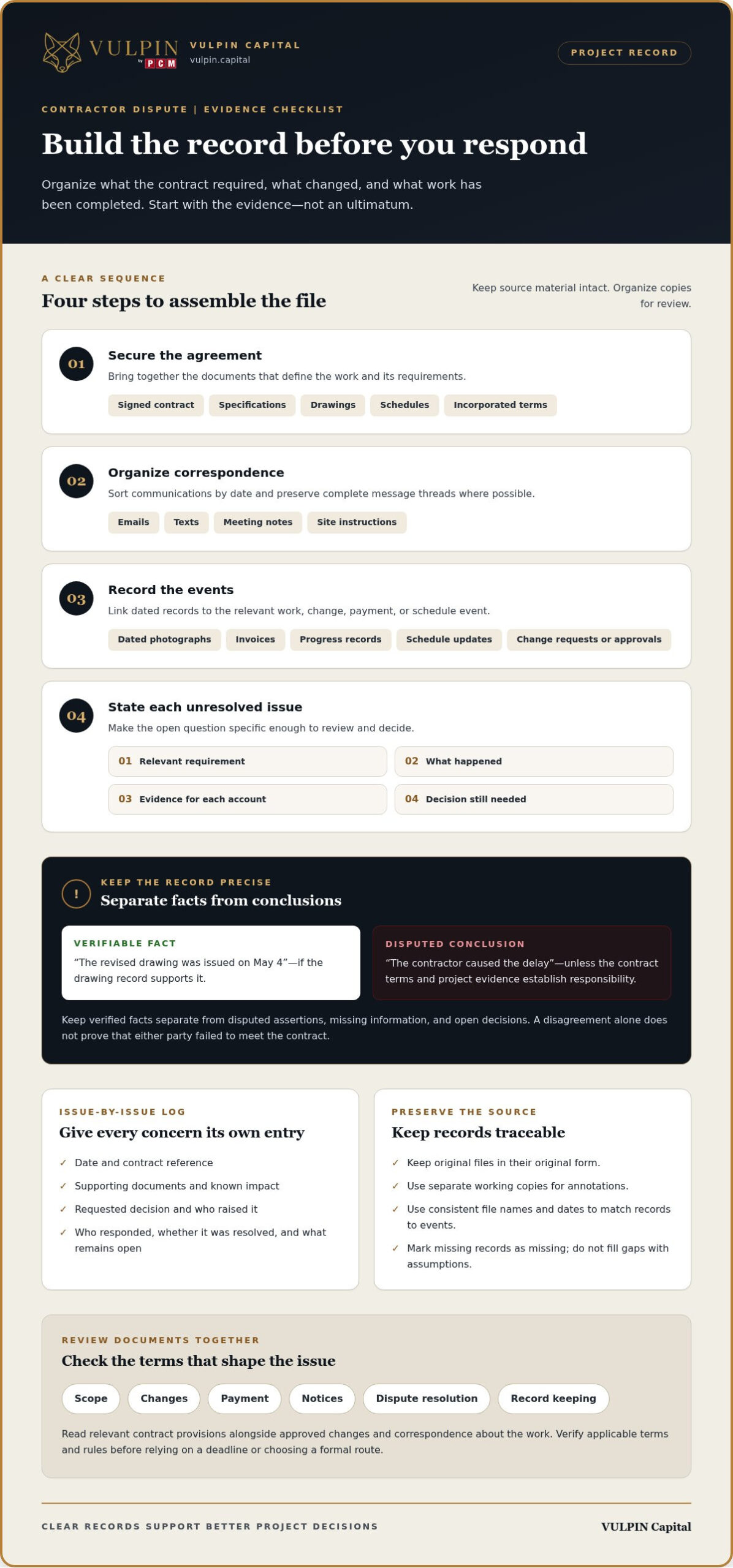
Before drafting a response, assemble the record in a consistent sequence. A well-organized file helps distinguish what the contract says from what people remember, assume, or still need to decide. Keep source material intact and organize copies for review rather than rewriting the history.
- Secure the agreement. Collect the signed contract, specifications, drawings, schedules, and any incorporated terms.
- Organize correspondence. Sort emails, texts, meeting notes, and site instructions by date. Preserve complete message threads where possible.
- Record events. Add dated photographs, invoices, progress records, schedule updates, and change requests or approvals.
- State each unresolved issue. Identify the requirement, what happened, what evidence supports each account, and what decision is still needed.
Keep verified facts separate from disputed assertions, missing information, and open decisions. For example, “the revised drawing was issued on May 4” is verifiable if the drawing record supports it. “The contractor caused the delay” is a disputed conclusion unless the relevant contract terms and project evidence establish responsibility. This distinction keeps the working record useful without presenting an allegation as a finding.
Create an issue-by-issue project record
A useful issue log links each concern to its evidence and an owner. Give each concern its own entry, including the date, contract reference, supporting documents, known impact, and requested decision. Record who raised it, who responded, and whether the response resolved it. If a response is incomplete, specify what remains open.
Keep original files in their original form, with a separate working copy for annotations. Avoid renaming or editing source records in ways that obscure their history. Use consistent file names and dates so a photo, instruction, or invoice can be matched to the relevant event. If a record is missing, mark it as missing rather than filling the gap with an assumption.
Review the contract and communications together
Locate provisions dealing with scope, changes, payment, notices, dispute resolution, and record keeping. Read them alongside approved changes and correspondence about the work. A change request may show what was proposed, while a later message may clarify whether it was approved. Keep the documents together, but do not treat a project interpretation as a legal conclusion.
Flag unclear wording, conflicting documents, and questions about rights or notice requirements for legal review. The process for resolving disputes with building contractors depends on the agreement and the law that applies to the project. CanDACC provides information about construction adjudication under the federal prompt-payment framework, but that does not establish that a particular process applies to every project. For project oversight, structured project management can support disciplined records and clear decision ownership; it is not legal representation. A sound file supports assessment, but it does not decide the dispute on its own.
Compare contractor dispute resolution options before escalating
There is no universally best route. The right process depends on the contract, the issue, the project, and the law in the province or territory involved. Some routes help parties negotiate a solution; others put the dispute before a decision-maker. Before choosing, identify the outcome you need: agreement on next steps, a decision on a payment issue, or a final resolution of broader claims.
| Route | Decision-maker and formality | Likely purpose | Basis and enforceability |
|---|---|---|---|
| Direct discussion | The parties communicate directly. Formality depends on how they structure the meeting or exchange. | Clarify facts, responsibilities, corrective actions, and next review points. | Usually begins with the project relationship and contract. Record any agreement clearly; its effect depends on the terms and applicable law. |
| Mediation | A neutral mediator facilitates negotiation but does not automatically decide who is right. | Help the parties explore settlement while retaining control over whether to agree. | May be provided for in the contract or arranged by agreement. A settlement’s effect depends on its documented terms and legal requirements. |
| Adjudication | An adjudicator makes a determination through a more structured process where the applicable framework permits it. | Address certain construction disputes, often where prompt-payment legislation applies. | Availability, eligible disputes, procedure, and the effect of a determination depend on legislation and project circumstances. Some statutory schemes provide an interim determination. |
| Arbitration | An arbitrator or panel determines the dispute in a private, formal process. | Resolve disputes where an arbitration agreement or applicable law provides for arbitration. | The agreement and relevant legislation govern procedure and the effect of an award. Review the contract and applicable rules. |
| Litigation | A court decides the matter under formal court procedures. | Seek a judicial determination or remedies available through the court process. | Governed by court rules and legislation. Jurisdiction, procedure, and the effect of a judgment depend on the claim and applicable law. |
When direct discussion or mediation may help
A direct discussion works best with an agenda, a defined issue, relevant records, and people who have authority to make project decisions. Confirm what is agreed, what remains contested, who will act, and when progress will be reviewed. Mediation adds a facilitator to support negotiation, not an automatic ruling on the merits. Put any settlement in writing and have it reviewed before relying on it.
When formal determination or court proceedings may enter
Adjudication, arbitration, and litigation are not interchangeable. Adjudication and prompt-payment rules vary across Canada, and statutory processes may apply only to particular projects or disputes. Arbitration depends on the relevant agreement or legal framework. Court proceedings follow the rules of the court with jurisdiction. Resolving disputes with building contractors requires checking the governing contract and jurisdiction before selecting a formal route. Seek jurisdiction-specific legal advice about deadlines, notice requirements, procedural rights, and the consequences of a decision. Do not assume a process is available or suitable because it is used elsewhere.
Use a measured escalation plan to protect project continuity
Escalation should be deliberate, not reactive. Keep operational work moving where it is safe and authorized, while tracking the disagreement separately. This helps prevent an unresolved claim from obscuring immediate project needs, or a project decision from being mistaken for a conclusion about legal responsibility.
- Clarify the issue. Identify the requirement in question, the evidence available, and the decision needed.
- Issue a written record. State the concern factually, note its known project impact, and identify any information still outstanding.
- Seek a decision. Assign a response owner and set a reasonable review date based on the contract and project circumstances.
- Assess escalation. If the issue remains unresolved, consider the contract’s process and obtain legal advice where rights or formal remedies are involved.
Maintain a separate status view for safety, critical work, dependencies, approvals, and decisions. For example, record whether a pending approval blocks a follow-on task, who has authority to approve it, and what instruction the team is following. Keep this operational tracking distinct from the question of legal responsibility. For related controls on forecast changes and project exposure, see the article on managing construction project cost overruns.
Set a formal but factual resolution meeting
Send a focused agenda and relevant records before the meeting. Identify the decision requested and ensure attendees have authority to address the project issue. Keep discussion anchored to the contract scope, evidence, documented impacts, and workable options. Avoid turning the meeting into an unstructured exchange of accusations. The objective is clarity, not forced agreement.
Assign one person to capture the record. Circulate notes promptly, separating agreed facts and actions from unresolved positions. List each action owner and review date. If a participant disputes the notes, record that response rather than silently changing the account. A controlled meeting record gives the team a stable basis for coordination and a clearer account of what remains open.
Recognize when legal advice is necessary
Project discussion has limits. Seek qualified construction-law advice when the disagreement concerns contractual rights, required notices, liens, payment obligations, or formal proceedings. Contract terms and jurisdiction determine applicable procedures and remedies. Project staff should not substitute an operational interpretation for legal advice about deadlines or rights.
Preserve relevant documents and communications while the issue is assessed. Do not make admissions or sign settlement terms without appropriate review. PCMNow Project Management supports disciplined execution on complex construction and development projects; it is project-management support, not legal representation or a guarantee of a dispute outcome. If your project needs structured oversight and clearer decision ownership, learn about disciplined project management from VULPIN Capital.
How disciplined project governance supports dispute resolution
A dispute can expose gaps in how a project records decisions, tracks changes, or assigns responsibility for a response. Governance gives the project a defined structure for those controls. It can improve visibility and accountability, but it cannot eliminate construction risk, compel agreement, or guarantee a schedule, budget, settlement, or other outcome.
What project management can contribute
Structured reporting can connect approved scope, decisions, progress, and emerging issues in one operational view. If a change affects cost or sequencing, the project record can show its status, related approvals, and downstream dependencies. Defined decision authority also helps identify who is responsible for responding, rather than letting a question circulate without an owner.
PCMNow Project Management supports disciplined execution on complex construction and development projects, with an emphasis on construction-cost reality. This work can help maintain project oversight while a dispute is assessed. It does not determine legal rights or replace legal advice. The project team still needs to distinguish operational decisions, such as managing a dependency, from legal conclusions about responsibility or remedies.
The VULPIN Check serves a different governance purpose. It is a verification process that commits resources only when predefined proof of project viability exists. It is not a dispute-resolution ruling and does not decide the merits of a contractor disagreement. Project controls support informed oversight, while formal legal questions require the appropriate legal process.
Choose the next step based on the project record
Before acting, bring four items into view: the unresolved issue, the evidence supporting the relevant positions, the contract process that may apply, and the person authorized to make the next project decision. This gives the team a practical basis for deciding whether the matter remains at project level or requires legal advice or formal escalation.
A construction project governance framework can help clarify how decision authority, reporting, and verification fit together. The article on construction project governance framework offers a related perspective on those controls. In resolving disputes with building contractors, governance is most useful when it creates a dependable record and a clear route for decisions, not when it is mistaken for a legal remedy.
PCMNow Project Management provides project-management support for disciplined oversight of complex construction and development projects. Keep legal merits and project controls distinct, and use each for the decisions it is designed to support.
Move forward with a clearer project structure
The next step is to decide what the project needs now: legal advice on rights or procedures, clearer operational oversight, or both. Keep those roles distinct. Project management can organize execution and decision-making, but it cannot determine legal responsibility or guarantee a dispute outcome.
For complex construction and development projects, PCMNow Project Management supports disciplined execution grounded in construction-cost reality. The VULPIN Check uses predefined proof of project viability before resources are committed. These are governance tools, not substitutes for legal advice. Used within their proper scope, they can help project teams make decisions with greater clarity.
Resolving disputes with building contractors is not about forcing certainty where the record or contract does not support it. It is about choosing the next step deliberately and keeping project decisions accountable. Explore PCMNow Project Management for disciplined project oversight on your construction or development project.
Frequently Asked Questions
What should I do first when I have a dispute with a building contractor?
Preserve the signed agreement and identify the specific decision or work in question. For example, if a change appears on an invoice but not in your project file, note the gap rather than assuming the change was unauthorized. Keep copies of relevant messages and records, and review the contract’s notice and dispute clauses. Resolving disputes with building contractors may involve rights or deadlines, so obtain qualified legal advice for your jurisdiction if those issues arise.
Can I resolve a contractor dispute without going to court?
Yes. Some disputes can be resolved without court proceedings through direct discussion, mediation, or another process available under the contract or applicable law. If a proposed solution involves a credit, repair, revised scope, or payment arrangement, record exactly what each party will do and by when. Do not assume an informal conversation changes contractual rights or satisfies a formal notice requirement. Confirm the applicable process before relying on it.
What are the most common disputes with building contractors?
Common disagreements concern payment, delay, scope or design changes, workmanship, deficiencies, and responsibility for project impacts. One event can create more than one issue. A revised design, for instance, may affect the work required, the approval record, and the sequence of later tasks. Separate those questions so each can be assessed against relevant documents. The fact that work is disputed does not, on its own, establish that a contract requirement was breached.
Is mediation binding in a construction dispute?
Mediation is generally a facilitated negotiation, not a decision imposed by the mediator. If the parties reach an agreement, its effect depends on the settlement’s wording and applicable law. Before relying on it, confirm that it clearly addresses the disputed work, payment or other obligations, any release of claims, and how ongoing work will proceed. Obtain appropriate legal review, particularly if the settlement changes contractual rights or leaves important terms open.
Can a contractor dispute involve adjudication in Canada?
It may, but adjudication is not available for every Canadian construction project or every type of disagreement. The applicable legislation and project circumstances determine whether a dispute qualifies and what process and effect apply. A payment issue, for example, may be treated differently from a broader workmanship claim under a particular framework. Review the contract and obtain jurisdiction-specific legal advice before relying on adjudication or assuming it replaces another process.
Should I stop paying a contractor during a dispute?
Do not stop or reduce payment based only on general online guidance. The contract and applicable law may affect payment obligations, holdbacks, notices, set-offs, and remedies. If an invoice includes an amount you dispute, preserve the invoice and supporting records, identify the specific contested item, and obtain qualified legal advice before changing payment. A unilateral decision could create additional contractual or legal issues, even if you believe the underlying work is deficient.
When should I hire a construction lawyer for a contractor dispute?
Seek qualified construction-law advice when the dispute could affect formal notices, payment remedies, lien rights, contract termination, settlement terms, adjudication, arbitration, or court proceedings. Legal advice is also prudent when contract wording or provincial rules make a deadline or remedy unclear. Project management can organize decisions and coordinate work, but it does not determine legal rights or provide legal representation. Share the relevant agreement and project records so advice can be based on the actual documents.