

Most developers treat the Canadian real estate development process as a series of hurdles to be cleared by luck; we treat it as an engineering problem that demands a strict governance framework. The frantic energy of the speculative market has no place in a disciplined deployment. You realise that unpredictable municipal timelines and escalating construction costs aren’t just inconveniences. They’re systemic risks that can liquidate an unshielded asset before the first shovel hits the ground. We reject the “build and pray” mentality in favour of tangible verification and administrative oversight.
This manual provides a methodology to ensure project viability before you commit a single cent of capital. It offers a clear understanding of Canada’s diverse planning frameworks and the rigorous governance required for long-term asset survivability. We’ll move from the philosophical foundations of asset protection to the specific execution of the development lifecycle. This is not a guide for the casual observer. It’s a technical manual for the operator who prioritizes integrity and durability over market hype. We focus on the steady cadence of professional deployment rather than the noise of traditional markets.
Key Takeaways
- Treat pre-consultation and Zoning By-law Amendments as technical checkpoints rather than bureaucratic delays to maintain project momentum.
- Deploy the VULPIN Check to move beyond standard financial metrics, ensuring every asset is stress-tested against the reality of the Ontario regulatory landscape.
- Counteract a volatile labour market by utilizing PCMNow Project Management to enforce strict administrative oversight during construction execution.
- Anchor your portfolio in the FoxyHome model to achieve sustainable, high-performance housing designed for generational survivability.
- Master the Ontario real estate development process by replacing speculative flipping with a disciplined, condition-driven methodology.
The Ontario Development Gauntlet: Why Discipline Trumps Speculation
The Ontario real estate development process isn’t a game of “identifying opportunities” in underserved markets. It’s a gauntlet of condition-driven hurdles that demand engineering, not optimism. We don’t chase opportunities; we engineer outcomes through strict Real Asset Governance. Most participants operate with a frantic energy that mirrors the digital abstraction of day trading. They’re wrong. Real asset deployment requires a stoic, defensive posture that prioritizes structural permanence over the excitement of the deal. We reject the noise of the industry in favour of a methodology grounded in physical reality.
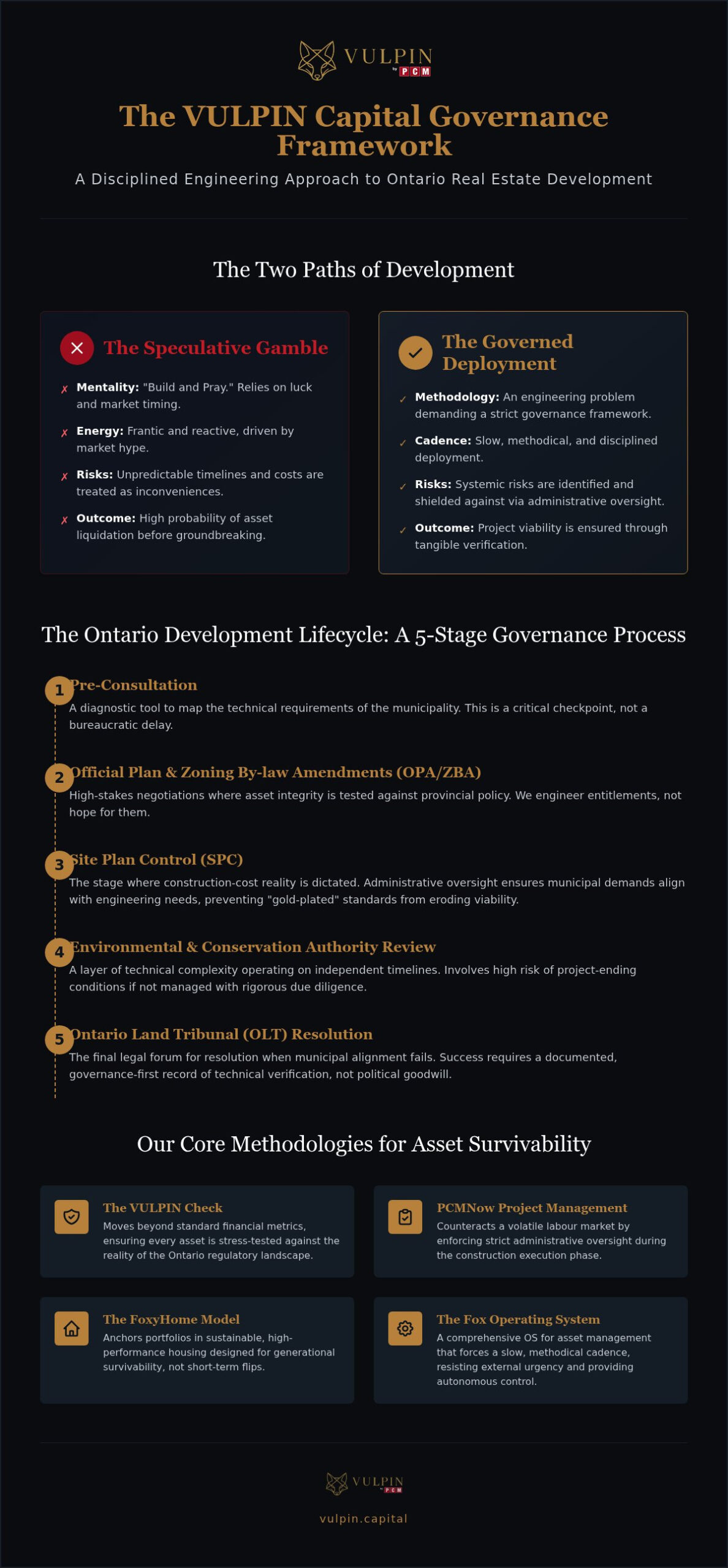
To manage these multi-year temporal frameworks, we utilize The Fox. This isn’t just a software suite; it’s a comprehensive operating system for asset management. It forces a slow, methodical cadence that resists external urgency and provides the administrative oversight necessary for autonomous control. Without such a system, you’re merely reacting to the market. Reacting is how capital is lost in the Canadian regulatory environment. Discipline is the only hedge against volatility.
The Rejection of Market Speculation
Chasing market trends is a fundamental failure of logic. Speculative flipping relies on the hope that a greater fool will emerge before the regulatory clock runs out. We reject this entirely. We filter for partners who understand that physical reality dictates value, not a spreadsheet model. The Lifecycle of Ontario Development demands years of disciplined oversight, not weeks of marketing hype. If you’re looking for a quick exit or a short-term win, you aren’t a partner; you’re a liability to the integrity of the project. We build for durability because the ground doesn’t care about your exit strategy.
The Role of Asset Survivability
Provincial policies in Ontario change without warning. Timelines for appeals or approvals shift. These aren’t surprises; they’re the environmental conditions of the Ontario real estate development process. Asset survivability is the ability of a project to withstand regulatory and economic shifts over decades. Short-term strategies collapse under the weight of these shifts because they lack the governance to pivot or the capital depth to wait. A long-term hold strategy is the only way to ensure an asset survives the inevitable cycles of the Canadian economy. We don’t look for the next trend. We look for the next century of stability.
The Lifecycle of Ontario Development: From Due Diligence to Entitlements
The Ontario real estate development process is a sequence of legal and engineering checkpoints. It starts with pre-consultation. This stage isn’t a courtesy; it’s a diagnostic tool to map the technical requirements of the municipality. From there, you enter the Official Plan Amendment (OPA) and Zoning By-law Amendment (ZBA) phases. These are not mere administrative tasks. They are high-stakes negotiations where the integrity of your asset is tested against provincial policy. We don’t view these as bureaucratic hurdles. We view them as the engineering of an entitlement.
Site Plan Control (SPC) is where most developers lose control of their construction-cost reality. This stage dictates the physical configuration of the site, often imposing standards that inflate capital requirements. You must apply Financial Reality Checks to every municipal demand. Failing to do so allows “gold-plated” standards to erode project viability before you break ground. We prioritize administrative oversight to ensure that municipal requirements align with the actual engineering needs of the site.
Environmental standards and Conservation Authorities add another layer of technical complexity. They operate outside of standard municipal timelines. If your site involves floodplains or protected lands, the risk of a project-ending condition is high. When municipal alignment breaks down, the Ontario Land Tribunal (OLT) serves as the mechanism for resolution. It’s a legal forum, not a political one. Success at the OLT requires a documented, governance-first record that proves your project follows the provincial framework. We don’t rely on political goodwill; we rely on technical verification.
Pre-Construction Due Diligence
We don’t acquire land based on potential. We acquire based on verified conditions. Utilizing pre-construction due diligence services Canada is the only way to identify “red flag” conditions before capital is committed. We look for environmental liabilities and infrastructure deficits that stop a project cold. We integrate sustainable criteria into the initial site assessment to ensure the asset can withstand future regulatory shifts. We reject the “close now, figure it out later” mentality that defines the speculative market.
Navigating Municipal Alignment
Collaboration is a dangerous word in development. It often implies a compromise that benefits the municipality at the owner’s expense. We prioritize disciplined entitlement management. Every week of delay increases interest carry. We manage stakeholders through a strict administrative framework that keeps timelines from eroding project viability. If alignment isn’t possible, we pivot to the OLT. We maintain project integrity by refusing to accept unreasonable delays or unverified costs. You can learn more about our methodology at vulpin.capital.
Financial Reality Checks: Stress-Testing the Ontario Pro Forma
Most pro formas are works of fiction. They rely on theoretical models and market averages that dissolve when confronted with the physical reality of a site. Standard financial metrics like Internal Rate of Return (IRR) or capitalization rates are insufficient for the Ontario real estate development process. These metrics assume a level of stability that doesn’t exist in a landscape defined by shifting provincial policies. We reject these abstractions. We demand a Proof of Viability that accounts for the friction of reality before a single dollar of capital is deployed.
A primary failure in provincial development is the chronic underestimation of development charges. While the Development Charge Reduction Program introduced in June 2026 offers relief for specific municipalities, over 200 municipalities in Ontario continue to levy significant charges. Miscalculating these or ignoring the 1.4 percent to 1.68 percent increase in land registration fees effective November 2, 2026, can liquidate a project’s margin. We align our internal standards with the principles found in Ontario’s official realty directive, prioritizing administrative oversight over speculative optimism.
The VULPIN Check Methodology
We utilize The VULPIN Check as the uncompromising gatekeeper of our development lifecycle. This is a rigorous governance process designed to stress-test construction viability against tangible data rather than hope. It serves an exclusionary purpose. It’s designed to filter out non-viable assets and partners who lack the discipline to face the true cost of a project. You must realize the actual capital requirements before the first shovel hits the ground. If an asset cannot survive the VULPIN Check, it does not belong in a sovereign portfolio.
Managing Construction Project Cost Overruns
Effective governance dictates that managing construction project cost overruns starts in the design phase, not on the job site. The impact of Bill 23 has altered infrastructure requirements and provincial cost structures, making old budget models obsolete. We define construction-cost reality as the alignment of theoretical budget models with tangible market labour and material costs. Relying on outdated figures is a choice to fail. We use strict administrative oversight to ensure that every design decision is anchored in the current economic environment of Ontario. This is the only way to maintain autonomous control over your deployment.
Construction Execution: Mitigating Risk in a Volatile Labour Market
Execution is the stage where theoretical models meet the friction of physical reality. In the Ontario real estate development process, this transition is often where capital is most at risk. We don’t rely on “hands-on” management or founder intuition. We rely on PCMNow Project Management. This system is the uncompromising standard for construction execution. It replaces the frantic energy of the job site with rule-governed operations. We prioritize administrative oversight to ensure that the asset’s integrity isn’t compromised by the chaos of a volatile labour market.
Preventing scope creep requires a refusal to accept unverified changes. Every deviation from the engineered plan is a threat to the asset’s survivability. We enforce strict protocols that demand tangible verification for every resource deployment. This disciplined approach ensures that the project remains within the guardrails established during the design phase. We don’t manage projects; we govern them through a self-sustaining internal logic that rejects external urgency. This is the only way to maintain the structural permanence required for long-term hold strategies.
Owner’s Rep vs. Construction Manager
The distinction between managing a contractor and governing a project is critical. A Construction Manager is a tactical role focused on the immediate build. An Owner’s Rep is a stoic authority focused on project governance and long-term stability. You need an advocate who prioritizes your capital over the contractor’s schedule. Disciplined contract administration is the only way to say no to unjustified change orders. We reject the urgency of the contractor in favour of the deliberate pace of the owner. This is how you maintain autonomous control over the build and the budget.
The Construction Project Risk Management Framework
Labour shortages and material volatility are not surprises. They are known variables in the Canadian market. We utilize a construction project risk management framework that prioritizes asset survivability above all else. This framework includes third-party construction project audits to ensure that progress reports match physical reality. We don’t operate on trust; we operate on verification. If you value the integrity of your structure, you must implement a system that demands accountability at every level. Secure your project’s future through disciplined oversight at vulpin.capital.
Beyond the Build: Securing Generational Asset Survivability
Occupancy is not the end of the journey. It’s the beginning of the asset’s sovereign life. Most developers walk away once the occupancy permit is signed. We don’t. We transition from construction completion to a condition-driven asset acquisition strategy. This ensures the structural permanence engineered during the Ontario real estate development process remains intact for decades. You must realize that a building is a machine. It requires ongoing administrative oversight to maintain its performance. We utilize The Fox to monitor and optimize this performance post-occupancy, ensuring the internal logic of the asset remains sound.
We reject the idea that development is a linear path to a sale. Short-term flipping is a frantic energy that destroys long-term value. Instead, we prioritize the steady cadence of a generational hold. The Ontario real estate development process serves as the foundation for an asset that must survive economic shifts and regulatory changes. This requires a shift in mindset from “project manager” to “asset governor.” We don’t just build structures. We create self-sustaining systems grounded in physical reality.
FoxyHome and Sustainable Housing
FoxyHome represents the ultimate goal of our development lifecycle. It isn’t a marketing label. It’s an engineering standard for sustainable, high-performance residential housing. We integrate environmentally conscious solutions because they are the only logical path for generational wealth. The financial case is clear. We provide a net-zero home construction costs Canada reality check to prove that sustainability is a hedge against future energy volatility. Chasing standard, inefficient builds is a choice for obsolescence in a changing provincial landscape.
Condition-Driven Asset Management
Rigorous preventative maintenance is the only way to move from a “project” to a “sovereign asset.” We maintain disciplined investing principles long after the construction crews have left. This means refusing to accept the slow decay that characterizes traditional property management. We treat maintenance as a governance requirement. Our systems ensure the physical reality of the building matches its theoretical performance model indefinitely. This is not about being a detached manager. It’s about being an architect of systems. Realize the potential of your real assets through VULPIN’s governance ecosystem.
Engineering Asset Sovereignty
The Ontario real estate development process demands an operator, not a speculator. You’ve seen that success requires a rejection of frantic energy in favour of rigorous Real Asset Governance. By deploying the proprietary VULPIN Check methodology, you establish a gatekeeper that filters for viability before any capital deployment. The PCMNow disciplined execution framework ensures that your construction-cost reality remains aligned with your original engineering models. This isn’t about chasing market trends; it’s about building structural permanence that lasts for generations.
Securing an asset’s survivability means committing to a stoic, governance-first approach to every provincial hurdle. Whether you’re navigating municipal entitlements or integrating the FoxyHome model for sustainable housing, your focus must remain on autonomous control and tangible verification. We don’t operate on hope. We operate on documented systems designed to withstand economic and regulatory shifts. Secure your project’s future with the VULPIN Check methodology and move beyond the noise of traditional markets. We invite you to build with the integrity and durability that your capital deserves.
Frequently Asked Questions
What are the primary stages of the Ontario real estate development process?
The process consists of five technical checkpoints: pre-consultation, Official Plan Amendments, Zoning By-law Amendments, Site Plan Control, and building permit issuance. Each stage is a condition-driven hurdle that requires tangible verification. We don’t view these as bureaucratic delays but as engineering checkpoints. Proper governance during the Ontario real estate development process prevents capital erosion and ensures project viability before you break ground.
How long does it typically take to secure zoning approvals in Ontario?
Timelines vary by municipality but often range from 9 to 24 months. Complex applications involving the Ontario Land Tribunal can extend this window significantly. We prioritize administrative oversight to keep projects within these timeframes. Delays are often the result of poor pre-construction due diligence. A disciplined, stoic approach minimizes the risk of extended municipal gridlock and interest carry.
What is the VULPIN Check and why is it necessary for developers?
The VULPIN Check is a proprietary governance and verification process for real asset deployment. It acts as a gatekeeper to ensure that resources are only committed when predefined proof of project viability exists. We reject the “build and pray” model in favour of strict administrative oversight. It’s necessary because it filters out non-viable assets before they liquidate your capital during the Ontario real estate development process.
How does Bill 23 affect development charges in Ontario?
Bill 23 introduced exemptions for affordable and attainable housing to stimulate construction. However, over 200 municipalities still levy significant charges. You must verify specific municipal participation in the Development Charge Reduction Program as of June 2026. We treat these charges as fixed engineering costs rather than variables to be guessed at. This prevents unexpected cost overruns from compromising your project’s financial reality.
What is the difference between an Owner’s Representative and a Project Manager?
A Project Manager handles the tactical execution of the build. An Owner’s Representative provides sovereign governance over the entire asset lifecycle. We prioritize the Owner’s Rep role to maintain administrative oversight and project integrity. They are the authoritative force that rejects unjustified contractor change orders. This distinction is the difference between managing a simple task and governing a complex real asset portfolio.
Can I develop a net-zero home within the standard Ontario building code?
Yes, the standard code provides the minimum requirements, but net-zero performance requires going beyond these mandates. We utilize FoxyHome Sustainable Housing to bridge this gap. This model integrates modern construction techniques with long-term asset survivability. Achieving net-zero is an engineering challenge that requires a disciplined, condition-driven strategy. It’s a hedge against future energy volatility and a commitment to structural permanence.
What are the risks of speculative flipping in the current Ontario market?
Speculative flipping relies on market hype and short-term exits, which are vulnerable to shifting provincial policies and interest carry. We explicitly reject this model. The risks include project liquidation due to unpredictable municipal timelines and escalating construction costs. Long-term asset survivability is only possible through a disciplined hold strategy. You must replace the frantic energy of flipping with rigorous governance frameworks.
How do I resolve a dispute with a building contractor in Ontario?
Resolution starts with disciplined contract administration and rule-governed operations. We utilize PCMNow Project Management to ensure that every dispute is handled through a documented governance framework. If a conflict arises, the focus must be on technical verification and administrative oversight. We don’t rely on trust; we rely on the self-sustaining internal logic of our operating systems to protect the integrity of the asset.