

A project delay is rarely an accident; it is a symptom of a systemic governance failure. When your site sits idle and your capital evaporates into compounding cost overruns, the problem is not merely external. The problem is a lack of disciplined oversight. The weight of unpredictable contractor performance and opaque reporting is the inevitable result of a governance vacuum. Troubleshooting common construction delays requires more than a revised timeline. It requires a fundamental shift in how you verify progress and enforce accountability. This is about protecting the integrity of the physical asset.
This manual provides a clear path to project recovery and predictable execution. You will learn how to identify the institutional rot that stalls progress and how to implement the VULPIN Check to stress-test your project’s viability. We reject the frantic energy of traditional markets. Instead, we focus on long-term asset survivability through a rugged, industrial mentality. We will preview the transition from chaotic site management to the PCMNow Project Management framework. This guide moves from philosophical foundations to the specific execution required to secure your investment against future volatility.
Key Takeaways
- Identify the boundary between temporary tactical setbacks and the systemic governance failures that erode long-term asset survivability.
- Apply a rigorous audit of labour and supply chain reality when troubleshooting common construction delays to halt capital erosion and stop the bleed.
- Reframe cost overruns as the late-stage manifestation of initial planning errors and enforce a strict governance-first financial reporting protocol.
- Integrate “The Fox” operating system to move beyond static, time-driven timelines toward autonomous, condition-driven asset management.
- Replace detached corporate management with the PCMNow framework, positioning project governance as a matter of principle rather than a mere scheduling service.
Distinguishing Between Surface Symptoms and Systemic Governance Failures
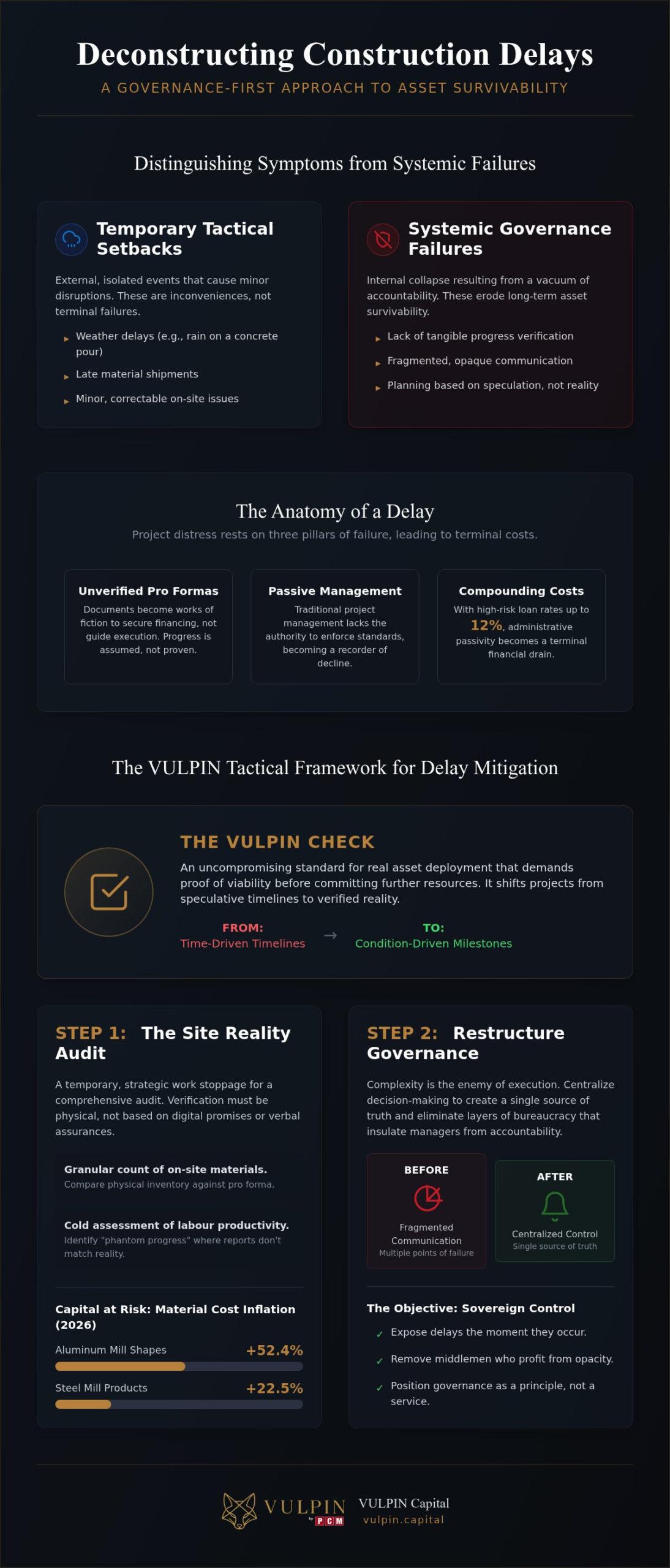
A tactical delay is an external event. Rain stalls a concrete pour. A late shipment holds up an HVAC install. These are inconveniences, not terminal failures. A systemic delay is different. It is an internal collapse. It is the result of a governance vacuum where accountability has been outsourced to hope. When owners ask what are construction delays, they often focus on the symptom rather than the cause. They make the fatal mistake of “working faster” to compensate for lost time. Speed without discipline creates rework. Rework destroys capital. In a market where nonresidential construction inputs rose 7.2% by mid-2026, there is no margin for redundant labour or wasted material.
Project distress rests on three pillars: lack of tangible verification, fragmented communication, and speculative planning. Traditional metrics prioritize the “finish line” at any cost. We reject this. We prioritize asset survivability. An asset survives when its structural and financial integrity remains intact despite external market volatility. Troubleshooting common construction delays requires moving past the frantic desire to catch up. It requires a return to structural reality. You cannot build a durable future on a foundation of unverified assumptions.
The Anatomy of a Delay: Why Your Schedule is Slipping
Control is lost when the critical path becomes a theoretical exercise rather than a governed reality. Most owners rely on unverified pro formas. These documents are often works of fiction designed to secure financing rather than guide execution. When complexity increases, traditional project management fails because it lacks the authority to enforce standards. It becomes a recorder of decline rather than an architect of progress. With construction loan rates reaching up to 12% for high-risk lending in late 2026, the cost of administrative passivity is terminal.
The VULPIN Check: Stress-Testing Your Current Progress
Rescuing a project starts with a VULPIN Check. This is the uncompromising standard for real asset deployment. We don’t commit further resources based on contractor promises. We demand proof of viability. This methodology shifts the project from speculative, time-driven timelines to condition-driven milestones. If the specific condition for the next phase isn’t met, the work doesn’t proceed. This discipline ensures that every dollar spent contributes to the long-term durability of the investment rather than just filling a hole in a failing schedule.
A Step-by-Step Tactical Framework for Delay Mitigation
When a project begins to slip, the instinct of the undisciplined manager is to accelerate. They throw more labour at a broken system. They hope that increased activity will mask structural incompetence. We reject this. To stop the bleed, the first step is often a temporary, strategic work stoppage for a comprehensive audit. You cannot fix a machine while its gears are grinding into dust. Troubleshooting common construction delays requires a pause to establish a baseline of reality. This is not a retreat. It is an administrative intervention designed to rescue the asset from compounding cost overruns.
Step 1: The Site Reality Audit
Verification must be physical. We do not accept digital promises or verbal assurances from subcontractors. A site reality audit involves a granular count of materials and a cold assessment of labour productivity. In 2026, targeted inflation has pushed the cost of aluminum mill shapes up by 52.4% and steel mill products by 22.5%. Every uninstalled component sitting in the mud is capital at risk. You must compare field reports against the approved pro forma to identify “phantom progress.” If the report says the plumbing is 80% complete but the fixtures aren’t on-site, the report is a lie. We build on facts, not optimistic projections.
Step 2: Restructuring the Governance Hierarchy
Complexity is the enemy of execution. Most delays are buried under layers of corporate bureaucracy that serve only to insulate managers from accountability. We centralize decision-making through a disciplined project management framework. This creates a single source of truth for all reporting. By removing the middlemen who profit from opacity, you ensure that every delay is exposed the moment it occurs. This sovereign control is the only way to maintain a predictable execution timeline in a volatile Canadian market where interest rates for construction financing can exceed 12%.
Step 3: The Psychology of the Change Order
The change order is often a tool used by contractors to monetize their own mismanagement. You must master the discipline of how to say no to contractor change orders that lack a foundation in physical reality. We shift the burden of proof from the owner to the executor. If a contractor claims a delay, they must provide documented evidence that the failure was external and unavoidable. We do not pay for their lack of foresight. If you require a partner to enforce this level of site discipline, exploring our governance-first methodology may be the necessary step to stabilize your project. We prioritize the integrity of the contract over the convenience of the contractor.
Financial Reality: Managing Cost Overruns and Stakeholder Expectations
Cost overruns are rarely new expenses. They are the delayed recognition of initial planning errors. When a project slips, the financial bleed is a symptom of institutional rot. Troubleshooting common construction delays requires a brutal confrontation with the balance sheet. We don’t accept estimates that shift with the wind. We demand a governance-first approach to financial reporting that prioritizes tangible verification over optimistic modeling. In a market where nonresidential construction inputs have surged 7.2% and diesel fuel has spiked 65.8% as of mid-2026, administrative passivity is a choice to lose money. You must present a hard-truth budget to your board. Credibility is built on the floor of reality, not the ceiling of hope.
Re-evaluating the Pro Forma Mid-Stream
The VULPIN pro forma stress test is the mechanism for determining if an asset remains viable. We analyze the impact of current delays on the long-term hold strategy. Sometimes, the most disciplined financial decision is to walk away. If the cost of recovery exceeds the terminal value of the asset, continuing is not resilience; it’s a sunk-cost fallacy. We identify the point of no return by stripping away speculative projections. We focus on the cost of capital, which for construction loans now ranges from 6.5% to over 12% for high-risk lending. If the numbers don’t work, the project must stop. We prioritize the survival of your principal over the ego of the architect.
Stakeholder Management and Reporting
Investors and boards don’t need comfort. They need truth. Implementing construction project reporting for stakeholders ensures that governance remains the priority. This framework rejects the frantic desire to hide bad news. Instead, it justifies the cost of disciplined project management as an essential insurance policy for your capital. Transparency is the only way to maintain institutional trust when timelines shift. We don’t report progress; we report verified conditions. This shift from optimism to reality is what separates professional operators from speculative amateurs. By providing a single source of truth, you eliminate the fragmented communication that allows delays to compound in the dark.
Implementing Condition-Driven Asset Management to Pre-empt Bottlenecks
Traditional project management is obsessed with the calendar. This is a fundamental flaw. Time is a passive metric. Conditions are active. Troubleshooting common construction delays requires a shift toward autonomous asset control. We don’t ask when a task will be finished. We verify if the physical conditions for the next phase exist. If they don’t, the machine stops. This prevents the compounding errors and rework discussed in our opening analysis. We prioritize the structural reality of the site over the theoretical promises of a schedule. This is how you maintain sovereignty over your capital.
The Fox: A System for Asset Survivability
The Fox is our operating system for asset survivability. It replaces the manager’s gut feeling with rule-governed operations. It is an administrative framework that automates the verification of predefined viability proofs. In a traditional hierarchy, a manager might hope a subcontractor shows up. Under The Fox, labour is only committed when the system confirms the preceding condition is physically met. This reduces reliance on human optimism. It creates a self-sustaining logic that protects the asset from the frantic, unverified energy of the broader market. We value the integrity of the system above the convenience of the operator.
Sustainable Housing as a Risk Mitigation Tool
Long-term durability is the ultimate hedge against market volatility. Analyzing net-zero home construction costs in Canada reveals a governance-first reality check. Sustainable building is not a marketing exercise. It is a risk mitigation tool. By integrating modern techniques like modular and prefab construction, we move production to controlled environments. This bypasses the current 3.1% construction unemployment rate and site-bound labour shortages. Modular techniques also stabilize the supply chain. By centralizing material procurement, we mitigate the impact of targeted price pressures. As of late 2026, metals like copper and aluminum continue to face demand-driven inflation. Factory-based construction allows for bulk verification and physical security of these assets. We build for a 50-year horizon. This ensures asset survivability through reduced maintenance and sovereign energy control. If you require a system that prioritizes long-term stability over short-term speculation, explore the VULPIN standard for national execution. We build structures that endure.
Beyond Project Management: The VULPIN Standard for National Execution
VULPIN Capital does not provide traditional project management. We provide governance. Large corporate firms offer scheduling services that merely document the decline of an asset. They are detached managers who profit from the complexity they fail to control. PCMNow Project Management is the uncompromising alternative. It is a governance service designed for national execution. Troubleshooting common construction delays at this level requires an engineering-led mentality that rejects the frantic energy of speculative markets. We prioritize structural permanence and administrative oversight. We are not here to please a mass audience. We are here to protect the integrity of the physical structure.
The PCMNow Advantage
The PCMNow framework is built on uncompromising standards for execution. We focus on construction-cost reality. In a Canadian market where overall nonresidential construction inputs rose 7.2% by mid-2026, there is no room for indifferent management. We don’t track progress. We enforce it. This commitment to asset survivability over short-term flips is what separates us from the rest of the industry. We realize that the integrity of the structure is paramount. Our methodology ensures that every resource committed is backed by tangible verification of on-site conditions. We reject the standard financial metrics that favour theoretical modelling over concrete results.
Partnering for Disciplined Execution
Engagement with VULPIN Capital begins with an ideological screening. We don’t partner with everyone. We filter for specific partners who value stability and documented methodology over the excitement of speculation. Alignment with our worldview is a prerequisite for engagement. Whether you require a project rescue for a stalled development or pre-construction due diligence to ensure viability, our approach remains stoic and methodical. We operate on a different time scale. We prioritize long-term temporal frameworks over the quick wins sought by the rest of the world. Our systems are built to endure.
The national building code standards for 2026 demand a level of technical precision that traditional firms cannot meet. We ensure your project complies with these evolving regulations while maintaining strict cost control. Reject the administrative passivity that leads to project failure. Implement a system of autonomous control that protects your principal. Secure your project with PCMNow Project Management and establish a boundary of high-integrity professionalism for your national assets. We are the master craftsmen of systems. We are the architects of stability in a world of digital abstraction.
Reclaiming Authority Over the Physical Asset
A project in distress is a project lacking governance. Rescuing an asset requires a return to structural reality and a rejection of the speculative energy that allows timelines to slip. By implementing the proprietary VULPIN Check methodology, you move beyond the hope-based reporting of traditional firms. You establish a boundary of high-integrity professionalism. Troubleshooting common construction delays is an exercise in verification, not acceleration. You must audit the supply chain, stress-test the pro forma, and enforce condition-driven milestones to ensure long-term durability.
We provide the engineering-led discipline required for national execution across complex residential and commercial portfolios. Our focus is asset survivability. We build systems that endure market volatility and regulatory shifts. Reject the administrative passivity of large corporate managers. It’s time to prioritize the integrity of the structure above all else. Implement Disciplined Governance with PCMNow to secure your project against future decay. Your principal deserves the protection of a sovereign operating system. Build for the next fifty years.
Frequently Asked Questions
What are the most common causes of construction delays in Canada?
Common causes include acute labour shortages and targeted material inflation. As of late 2026, construction unemployment in Canada sits at 3.1%, making skilled trades scarce. Material costs for steel and aluminum have risen by 22.5% and 52.4% respectively. However, the root cause is often a governance failure that allows these external factors to compound. Troubleshooting common construction delays requires identifying where the administrative oversight failed to account for these predictable market shifts.
How do I know if my project manager is actually managing the project or just reporting on it?
A manager who only reports is a passive observer of failure. Real management, such as the PCMNow Project Management standard, involves active intervention and condition-driven enforcement. If your manager provides “finish line” updates without physical verification of material counts or labour productivity, they are merely a recording secretary. Disciplined governance requires a master craftsman who manages the integrity of the system, not just the data in a spreadsheet.
Can I fire a general contractor for delays without incurring legal penalties?
Terminating a general contractor requires documented evidence of systemic failure. You must prove that the delays resulted from their own mismanagement rather than external factors. Using the VULPIN Check methodology provides the tangible verification needed to justify termination for cause. By shifting the burden of proof to the executor, you protect your principal from legal penalties. Contracts should always prioritize the survival of the asset over the convenience of the contractor.
What is the difference between an owner’s representative and a construction manager?
An owner’s representative acts as a sovereign advocate for your capital, while a construction manager often focuses on site logistics. The representative ensures that the project aligns with long-term asset survivability and strict governance standards. While a construction manager might manage the daily execution of building, the representative manages the viability and the discipline of the entire deployment. We position governance as a matter of principle, ensuring the architect’s vision doesn’t bankrupt the owner’s reality.
How does the VULPIN Check help in troubleshooting existing delays?
The VULPIN Check assists in troubleshooting common construction delays by stress-testing the project’s pro forma against physical reality. It identifies hidden viability issues that cause schedules to slip. By applying this rigorous verification process, we determine if the project is still worth the capital investment. We don’t commit further resources based on contractor promises. We only proceed when predefined proof of viability exists. This stops the financial bleed and prevents compounding errors.
What should be included in a construction project risk management plan?
A robust risk management plan includes physical material audits, labour productivity tracking, and rule-governed operations. It must account for targeted inflation, such as the 65.8% spike in diesel fuel costs seen in mid-2026. Your plan should move away from speculative timelines toward condition-driven milestones. Utilizing a system like The Fox ensures that decision-making remains autonomous and resistant to the frantic energy of traditional markets. Governance must be a proactive framework.
Is it worth investing in sustainable housing if the project is already over budget?
Sustainable housing is an essential risk mitigation tool, even when budgets are tight. FoxyHome solutions focus on long-term maintenance savings and energy autonomy, which protect the asset’s value for decades. While initial costs may seem high, the long-term asset survivability of a net-zero home in Canada outweighs short-term savings. We build for a 50-year horizon. Rejecting sustainability is a choice to accept future obsolescence and increased operational volatility.
How do I handle a contractor who constantly submits change orders?
Handle change orders by demanding documented proof that the delay was unavoidable. Most change orders are attempts by contractors to monetize their own planning errors. You must implement a governance-first framework that forces the contractor to prove the necessity of the request. If they cannot provide tangible verification, the answer is no. Shifting the burden of proof ensures that you only pay for legitimate scope changes, not administrative incompetence.