
Most sustainable housing is a performance of virtue rather than a feat of engineering. You likely recognize that the modern residential market is plagued by greenwashing and unpredictable costs that erode capital. It is a system built on frantic speculation, not physical reality. To secure turnkey sustainable homes Ontario, you must reject the standard industry chaos in favour of a disciplined, industrial mentality. You want a real asset that survives generational shifts, not a temporary structure that fails the first test of the Canadian climate.
We agree that the complexity of the 2026 Ontario Building Code and the $350 per square foot entry point for custom builds require more than just hope. This guide provides a technical framework for navigating construction through rigorous governance and uncompromising execution. You will learn how to apply a strict proof of viability to your project to ensure long term stability. We will examine the specific engineering standards required for asset survivability and how a master craftsman’s approach to project management creates a sovereign, high performance home.
Key Takeaways
- Implement the VULPIN Check to verify construction-cost reality and demand tangible proof of viability before any capital commitment.
- Understand that turnkey sustainable homes Ontario must function as sovereign real assets rather than vehicles for frantic market speculation.
- Utilize PCMNow project management to navigate the technical constraints of the 2026 Ontario Building Code and complex high-performance standards.
- Adopt The Fox operating system to ensure your build maintains its structural integrity and efficiency across generational shifts.
- Realize a FoxyHome solution that integrates disciplined governance with industrial-grade residential engineering for long-term survivability.
Defining Turnkey Sustainability: Beyond the Speculative Hype
A house is not an investment vehicle. It is a physical structure that either performs or fails. In the current market, the term “turnkey” is often misused to describe a cosmetic finish applied to a mediocre build. True turnkey sustainable homes Ontario must be defined by their survivability as real assets. This requires a total rejection of short term speculative flipping. If a building is designed to be sold in three years, it is not sustainable. It is a disposable commodity. Real sustainability is the result of disciplined resource deployment and a commitment to long term hold strategies.
We do not build green kits. We execute governed construction projects. A kit is a collection of parts. A governed project is a system of verified outcomes. This distinction matters because a high performance home is only as good as its weakest joint. Without a rigorous framework, “green” features are merely expensive additions to a flawed foundation. We prioritize the integrity of the structure over the excitement of the market. We build for those who value permanence over a quick exit.
The Ontario Sustainable Housing Landscape
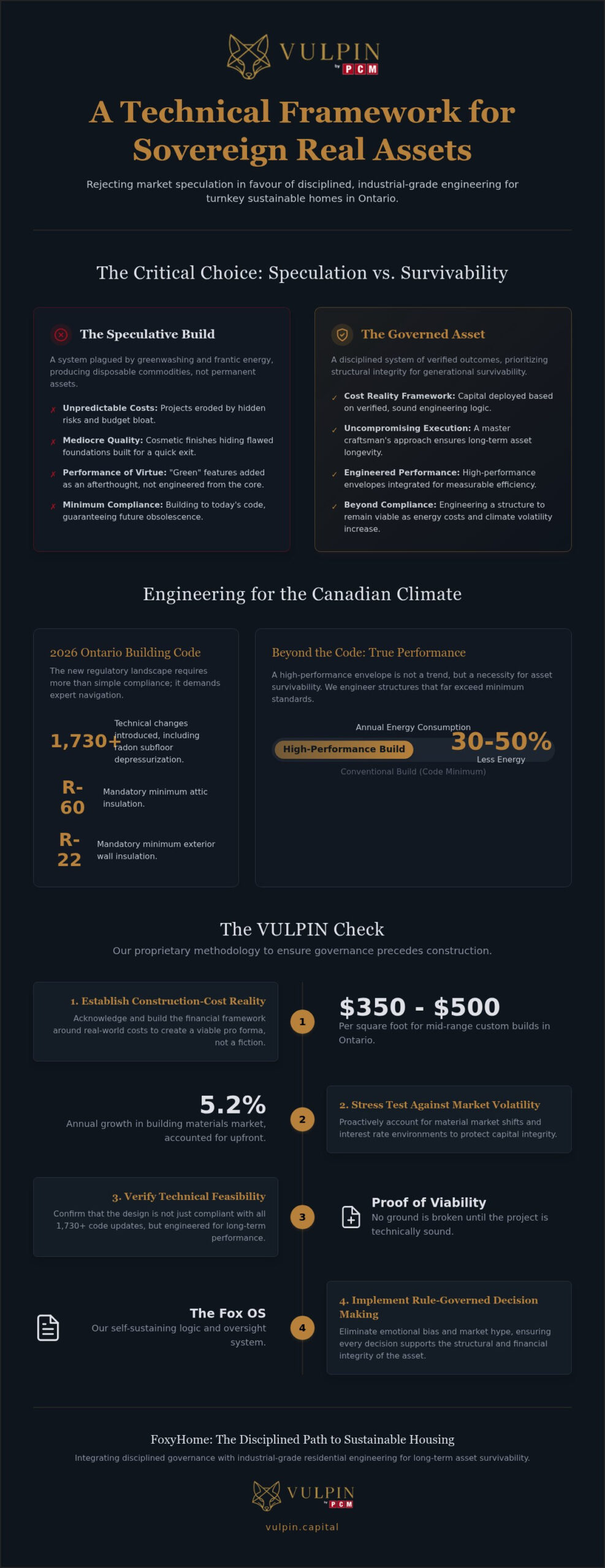
The regulatory environment in Ontario is shifting. The 2026 updates to the Ontario Building Code introduced over 1,730 technical changes. These include mandatory R-60 attic insulation and R-22 exterior wall requirements. While these standards are an improvement, the Canadian climate remains an unforgiving adversary. Relying on minimum code is a recipe for future obsolescence. By integrating foundational Green Building Principles, we move beyond simple compliance. We focus on high performance building envelopes that can consume 30 to 50 percent less energy than conventional builds. This is not about following a trend. It is about engineering a structure that remains viable as energy costs and climate volatility increase.
Why Turnkey Projects Often Fail Owners
Fixed price contracts are often a trap. They suggest certainty but frequently lack the transparency required to manage complex builds. When a builder prioritizes a quick exit, they compromise on the details that ensure asset longevity. Speculative market energy creates a frantic pace where quality is sacrificed for speed. This is why many turnkey projects fail to meet their performance promises. A contrarian approach is necessary. We reject the urge to rush. We replace market hype with tangible verification and strict standards. A turnkey sustainable homes Ontario project must be governed by proof of viability, not by the hope of a quick profit. Our methodology ensures that capital is only committed when the engineering logic is sound.
The VULPIN Check: Why Governance Precedes Construction
Construction is not an act of creation; it is an act of capital deployment. Most projects fail because they prioritize the aesthetic over the administrative. The VULPIN Check is our proprietary methodology designed to ensure that no ground is broken until the project is mathematically and technically sound. It is a filter for turnkey sustainable homes Ontario that prioritizes asset integrity over market speed. We don’t guess. We verify. This is the boundary of high integrity professionalism that separates a real asset from a speculative gamble.
The process follows a strict sequence of verification:
- Establish a rigorous construction-cost reality framework. We acknowledge that mid-range builds in Ontario now fall between $350 and $500 per square foot. Any pro forma that ignores these numbers is a fiction.
- Stress test against market volatility. While the Bank of Canada policy rate has stabilized at 2.25% in 2026, the building materials market is expected to grow at 5.2% annually. We account for these shifts before they impact your capital.
- Verify technical feasibility. We confirm the build meets the 1,730 technical updates of the 2026 Ontario Building Code, including radon subfloor depressurization requirements, before committing resources.
- Implement rule-governed decision making. This eliminates emotional bias and prevents the frantic energy of the retail market from compromising the structural integrity of the build.
Stress Testing Construction Viability
Hidden risks are the primary cause of budget bloat. We use “The Fox” operating system to govern every stage of asset deployment. This system acts as a mechanical metaphor for the organization, ensuring self-sustaining logic and administrative oversight. By incorporating research from the Endeavour Centre for Sustainable Building, we align our technical standards with the highest levels of regional expertise. Third-party audits are not optional; they are the mechanism for tangible verification. This disciplined oversight ensures that turnkey sustainable homes Ontario remain viable long after the contractors have left the site.
Rejecting Speculation for Asset Survivability
We do not work with speculators. We filter for partners who understand that a real asset is built for decades, not for a quick flip. This stoic perspective is the only way to avoid the “5 million dollar tuition” often paid by those who ignore governance. Disciplined governance is about autonomous control over the physical reality of your home. It’s a rejection of the digital abstraction that plagues modern finance. Before you commit your capital to a speculative market, you should verify the structural logic of your investment strategy. We value the integrity of the structure above all else. This focus on survivability ensures your home survives generational shifts and remains a high performance asset in the Canadian climate.
Evaluating High-Performance Building Systems in Canada
The choice of a building system is a technical decision, not a marketing one. Most owners get lost in the alphabet soup of certifications, assuming the label defines the value. It doesn’t. Whether you select Passive House, Net-Zero, or the recently launched LEED v5, the underlying physics remain constant. For turnkey sustainable homes Ontario, the system you choose is secondary to the framework used to execute it. A Passive House design built with poor oversight is simply an expensive failure. We prioritize the execution framework because the Canadian climate does not care about your certifications. It only cares about your airtightness and thermal bridges.
The current economic climate has forced a re-evaluation of construction methods. Stick-built custom homes in Ontario now start at approximately $350 per square foot, with luxury builds exceeding $500. Some competitors claim modular builds are the faster, cheaper alternative. We reject this oversimplification. While modular components offer controlled environments, they often introduce logistical complexities that unmanaged projects cannot absorb. Without disciplined governance, the “savings” of modular are quickly consumed by site-work errors and poor assembly. The asset’s survivability depends on the integrity of its execution, not the method of its manufacture.
Passive House vs. Net-Zero Energy
Passive House certification demands extreme airtightness and rigorous thermal insulation. In Ontario’s volatile climate, this is the most reliable path to long-term ROI. While Net-Zero focuses on energy generation, we prioritize conservation first. A building that requires minimal energy to heat or cool is a sovereign asset. Data from the Athena Sustainable Materials Institute confirms that the life cycle impact of these structural decisions is profound. Airtightness is the critical metric. A house that leaks air is a house that leaks capital. We focus on the building envelope because it is the only part of the structure that cannot be easily upgraded later.
PCMNow: Disciplined Execution of Complex Builds
PCMNow project management exists to bridge the gap between architectural intent and site reality. Sustainable construction requires specialized trades that understand high-performance systems. You cannot expect a standard framing crew to execute a Passive House envelope without rigorous administrative oversight. Our approach prevents scope creep by establishing a construction-cost reality framework at the outset. We manage the complexity so the owner doesn’t have to. By utilizing PCMNow, we ensure that every phase of the build is governed by tangible verification. This prevents the budget bloat that typically plagues turnkey sustainable homes Ontario when they are left to the frantic energy of the retail market.
Building for Generational Survivability: The Fox Framework
Market value is a digital abstraction. Asset survivability is a physical reality. Most residential properties in Canada are built to meet a price point, not a performance standard. For those seeking turnkey sustainable homes Ontario, the goal is not a quick exit but a permanent hold. This requires a shift from passive ownership to active asset governance. The structure must perform for decades, resisting the degradation that typically affects speculative builds. We utilize The Fox operating system to ensure this performance is not left to chance. It is the mechanical logic that keeps the asset viable across generational shifts.
Governance does not end when the keys are handed over. It simply enters a renewed phase of administrative oversight. Reactive repairs are a signal of failure. They indicate a lack of discipline in the maintenance of the structure. We replace this frantic energy with condition-driven maintenance. By treating the home as a high-performance industrial asset, we protect the capital invested in its construction. This is the difference between a house that slowly decays and a real asset that maintains its structural permanence.
Long-Term Asset Governance
High-performance assets require a higher standard of care. You cannot manage a Passive House or Net-Zero structure with the same neglect as a standard code build. A sovereign philosophy of ownership demands a documented preventative maintenance schedule. This schedule must prioritize the integrity of the building envelope. We realize that the R-60 attic insulation and R-22 wall systems required by the 2026 Ontario Building Code only work if they remain undisturbed and dry. Our framework provides the administrative tools to monitor these systems, ensuring that small issues do not become catastrophic failures of the building’s thermal logic.
Optimizing Performance After Occupancy
A building is a system of systems. After occupancy, these systems must be monitored to ensure they meet the technical feasibility established during the VULPIN Check. We use disciplined data collection to track HVAC performance and energy consumption. This is not about smart home gadgets for the sake of convenience. It is about tangible verification of the home’s efficiency. If the data deviates from the pro forma, the system identifies the friction point immediately. This rigorous standard ensures the home remains a real asset. To secure your future, you must establish your asset governance framework before the first shovel hits the ground. This focus on long-term temporal frameworks is what separates our partners from the rest of the market.
FoxyHome: The Disciplined Path to Sustainable Housing
FoxyHome represents the physical manifestation of our governance first philosophy. It is not a product in the traditional retail sense. It is a system of industrial grade residential engineering designed for those who reject the frantic energy of speculative flipping. To achieve turnkey sustainable homes Ontario, one must integrate VULPIN governance with high performance design from the first day of planning. This ensures the asset is built for structural permanence rather than market convenience. We do not offer kits; we execute sovereign real assets.
The integration of modern construction techniques with long term survivability requires a master craftsman’s approach to the building envelope. While others prioritize aesthetic trends, we focus on the mechanical logic of the structure. A FoxyHome is the result of a documented methodology that prioritizes the integrity of the building above all else. This focus ensures your project survives the volatility of the Ontario construction industry and the harsh realities of the Canadian climate. We replace the “affordable kit” myth with a framework grounded in physical reality.
The FoxyHome Implementation Process
Engagement begins with the VULPIN Check. We verify the technical feasibility and construction cost reality of your project before a single dollar is committed. This is the ideological screening mechanism that filters for partners who value stability. Once viability is proven, PCMNow Project Management takes administrative oversight of the build. You can expect a process defined by tangible verification and strict standards. We don’t manage projects from a distance; we operate as highly invested architects of systems. This disciplined cadence ensures that turnkey sustainable homes Ontario are delivered without the budget bloat common in unmanaged builds.
Your Next Steps in Real Asset Deployment
Real asset development is a matter of autonomy and principle. Before you begin, you must evaluate your readiness for a disciplined construction project. Most owners are not prepared for the rigour required to build a generational asset. We offer a stress test for your pro forma to identify hidden risks and friction points in your planning. If your worldview aligns with our commitment to long term survivability, we can initiate the formal governance process. Do not build on hope. Build on verified data. Initiate the VULPIN Check for your sustainable home project to secure your position in the real asset market. We value the integrity of the structure above all else. Your next project deserves the weight and durability of a governed system.
Securing Your Generational Asset
The path to turnkey sustainable homes Ontario is defined by a refusal to participate in the frantic energy of the retail market. You must prioritize structural permanence over the excitement of speculation. We have established that the integrity of a build relies on the VULPIN Check to verify viability before any capital is committed. Disciplined PCMNow project management ensures that complex high-performance systems are executed with industrial-grade precision. This is the only way to navigate the technical constraints of the Canadian climate without compromising your capital.
A real asset is not a temporary structure; it is a sovereign holding designed for generational survivability. By utilizing FoxyHome sustainable housing solutions, you align your project with a documented methodology that rejects greenwashing in favour of tangible verification. This is the boundary of professional integrity. If you are ready to replace market hope with administrative oversight, you can secure your asset with the VULPIN Check. We value the durability of the structure above all else. Your commitment to a disciplined framework is the only way to ensure your home remains a viable real asset in an unpredictable world.
Frequently Asked Questions
What is the VULPIN Check and why is it necessary for turnkey homes?
The VULPIN Check is a proprietary governance framework designed to verify technical and financial viability before capital is committed. It’s necessary because most residential projects rely on hope rather than data. By demanding proof of viability, we filter for turnkey sustainable homes Ontario that are structurally sound and economically realistic. It replaces market energy with a strict audit of engineering logic and cost reality to ensure the project is a viable real asset.
How much does a net-zero home cost to build in Ontario?
Custom residential construction in Ontario generally begins at $350 per square foot for mid-range builds. High-performance net-zero structures often exceed $500 per square foot due to specialized insulation and mechanical requirements. These figures reflect the 2026 market reality of rising material costs and strict labour standards. Owners must plan for these baselines to avoid the budget bloat that occurs when speculative estimates meet the physical reality of the Canadian climate.
What is the difference between Passive House and a standard sustainable home?
Passive House is a rigorous engineering standard focused on building envelope integrity and extreme airtightness. Standard sustainable homes often rely on “green” additions like solar panels or efficient appliances without addressing the primary structure’s thermal logic. A Passive House design prioritizes conservation to minimize energy demand. It’s a sovereign asset that maintains its internal climate with minimal mechanical intervention, regardless of external volatility or grid failure.
How does PCMNow manage construction cost overruns in Ontario?
PCMNow manages overruns through disciplined administrative oversight and a strict construction-cost reality framework. We eliminate the frantic energy of retail contracting by implementing rule-governed decision making at every stage. By managing specialized trades with technical precision, we prevent scope creep before it manifests. This methodology ensures that the project remains aligned with the initial pro forma, protecting the owner from the common pitfalls of unmanaged and speculative builds.
Why does VULPIN Capital reject speculative flipping in real estate?
Speculative flipping prioritizes short-term digital abstraction over the physical survivability of the asset. We reject this approach because it incentivizes compromised construction quality and cosmetic finishes. Our focus is on long-term hold strategies that value structural permanence and generational stability. We build for partners who recognize that a real asset is a tool for autonomy, not a vehicle for frantic market speculation or a quick exit strategy.
Can I use The Fox operating system for my existing property portfolio?
The Fox operating system is designed to govern both new builds and existing property portfolios through condition-driven maintenance. It provides the administrative tools required to monitor building performance and protect the integrity of the asset over time. By applying this system to an existing portfolio, owners can replace reactive repairs with disciplined oversight. This ensures that every property in the portfolio functions as a high-performance, sovereign real asset across generational shifts.
What are the primary risks of turnkey sustainable projects in Canada?
The primary risks include greenwashing, unpredictable construction costs, and technical failure in the harsh Canadian climate. Many turnkey sustainable homes Ontario fail because they lack a rigorous governance framework to manage specialized trades. Without tangible verification of airtightness and thermal bridges, “green” features become liabilities. We mitigate these risks by demanding proof of viability and utilizing disciplined project management to ensure the structure performs as engineered for decades.
How do I ensure my sustainable home survives for multiple generations?
Generational survivability requires a commitment to industrial-grade engineering and long-term asset governance. You must build beyond the minimum requirements of the 2026 Ontario Building Code, focusing on a high-performance envelope that resists degradation. Utilizing a system like The Fox ensures that maintenance is proactive and documented. This sovereign approach to ownership protects the structure from the decay that typically affects buildings designed for short-term market cycles rather than permanence.