

A home is not a lifestyle choice. It’s a structural hedge against a volatile future. Most owners treat construction as a series of aesthetic compromises, yet they wonder why their assets bleed value through utility overheads and unpredictable maintenance. Budgeting for a sustainable home build in Canada demands a departure from this speculative mindset. You aren’t just building a house. You’re deploying capital into a high-performance machine that must survive decades of regulatory shifts and environmental pressure.
We understand the frustration of watching material costs fluctuate while governance in residential construction remains non-existent. You likely realise that evolving building code standards across Canada, including some anticipated for 2026, have already increased construction costs by up to 12 percent. This article provides a rigorous framework for financial execution. You’ll learn how to organise your capital for a net-zero ready asset that prioritises long-term survivability over temporary market trends. We’ll explore the VULPIN Check methodology and how multi-plexing converts a single-family liability into a predictable income stream. It’s time to stop guessing and start governing.
Key Takeaways
- Reframe sustainability as a rigorous asset survival strategy that protects your capital against future energy volatility and carbon taxation.
- Navigate the complexities of budgeting for a sustainable home build Ontario by focusing on high-performance envelope integrity rather than speculative trends.
- Understand the FoxyHome model for converting underperforming single-family lots into resilient 5-unit multi-plex assets.
- Apply the VULPIN Check to provide a four-step governance framework that verifies project viability before any physical construction begins.
- Transition from abstract planning to concrete results through PCMNow project management to ensure disciplined execution and predictable utility overheads.
Beyond the Buzzword: Why Sustainability is an Asset Survival Strategy
Sustainability isn’t a marketing label or a moral luxury. It’s a financial hedge. In 2026, energy volatility and carbon taxation are no longer theoretical risks; they are permanent line items on a balance sheet. Budgeting for a sustainable home build Ontario requires moving past “eco-friendly” aesthetics to focus on high-performance building envelope integrity. This is the fundamental difference between a resilient asset and one that bleeds value through utility overheads. We don’t build to follow trends. We build to ensure your capital survives economic and environmental shifts.
We explicitly reject the green-washing that currently saturates the residential market. Bolting expensive technology onto a poorly insulated frame is a fundamental failure of engineering. True asset survivability depends on foundational green building principles that prioritize thermal resistance and airtightness. The FoxyHome approach is deliberate. We build for a fifty-year horizon. We don’t focus on the next quarter’s speculative flipping trends. We build for performance that can be measured and verified through strict standards.
The Cost of Inaction in a High-Performance Market
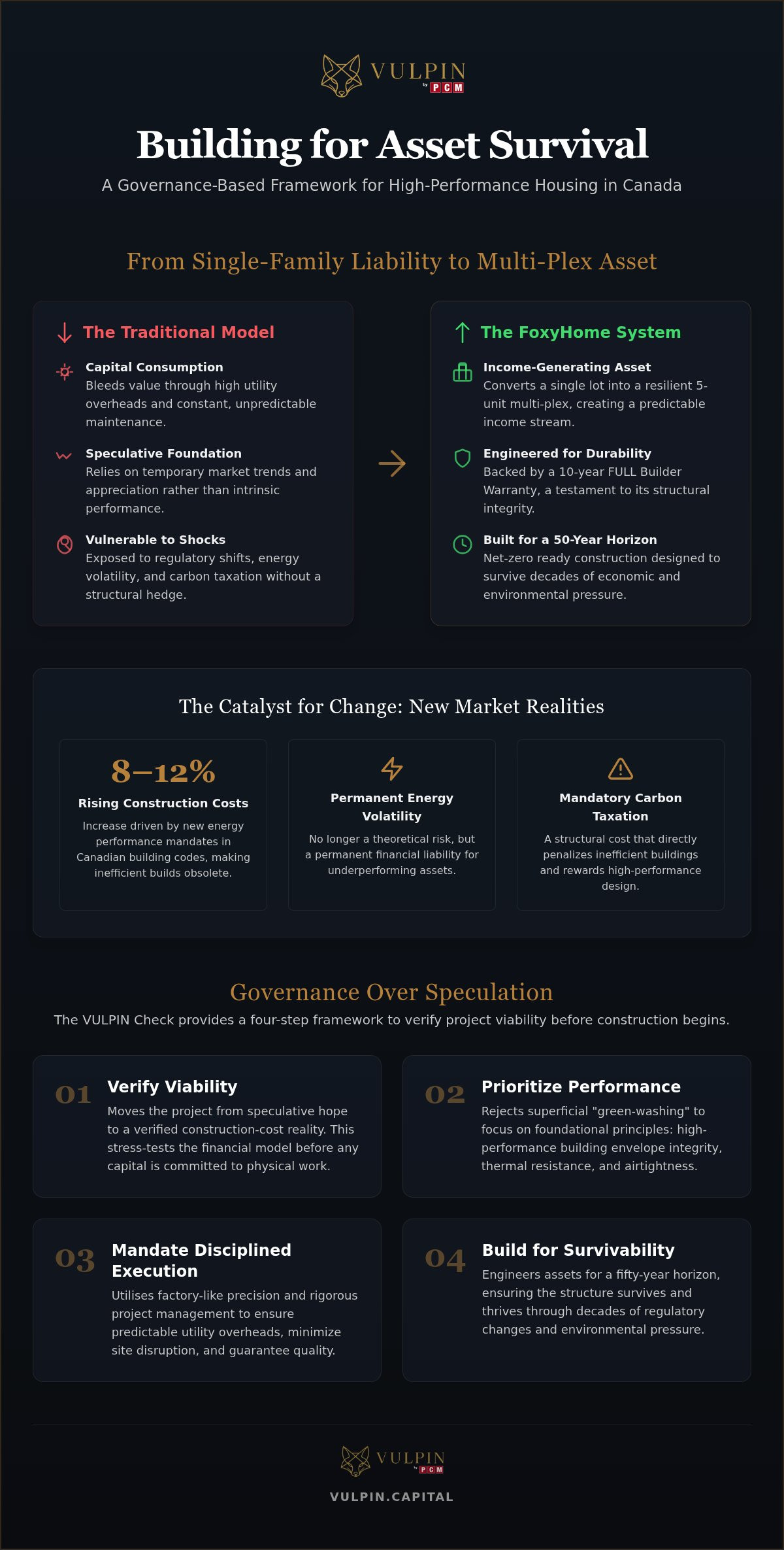
The 2026 Ontario Building Code update has already forced a significant shift. Construction costs have risen by an estimated 8% to 12% due to new energy performance mandates. Inefficient assets are now liabilities. As national codes continue to tighten, standard builds will fail to meet basic durability requirements. High-performance housing isn’t just about reducing your carbon footprint. It’s about reducing long-term maintenance costs. Standard construction in Canada often ignores the reality of our climate by prioritizing speed over durability. This results in buildings that require constant, expensive remediation. When you invest in a high-performance build, you’re buying out of that cycle of decay.
Governance as the Foundation of Sustainable Housing
A sustainable project is, at its core, a governance project. Without a construction project governance framework, your capital is exposed to the frantic energy of traditional markets. We use the VULPIN Check to verify every sustainability claim before we commit a single dollar. This process moves the project from speculative hope to verified construction-cost reality. Most owners start with a design they cannot afford or a system they cannot maintain. We start with a governance framework that ensures the budget reflects the physical reality of the build. Budgeting for a sustainable home build Ontario is about administrative oversight and autonomous control. If a project doesn’t meet our standards for structural permanence, we don’t build it.
The FoxyHome System: Redefining the Missing Middle Through Disciplined Execution
A single-family home is often a liability. It consumes capital through maintenance and taxes without producing a yield. We reject the traditional model of residential ownership that relies on speculative market appreciation. Instead, we convert these underperforming assets into 5-unit multi-plexes. This is the FoxyHome strategy for the “Missing Middle.” It addresses housing density requirements across Canada without compromising the architectural character of established neighbourhoods. By utilizing modern construction techniques, we minimize site disruption and ensure a faster path to commissioning. Every structure is backed by a 10-year FULL Builder Warranty. This isn’t a marketing promise. It’s a testament to our structural conviction and the integrity of our building envelope.
Effective budgeting for a sustainable home build Ontario requires a shift in how we view the land itself. You aren’t just building a residence; you’re developing a high-performance asset. This necessitates a move away from standard construction towards a factory-like precision in execution. Our systems are designed to withstand the harsh Canadian climate while maintaining the net-zero readiness mandated by the 2026 building code updates. When you build for the next fifty years, the upfront capital deployment reflects a commitment to long-term asset survivability.
From Liability to Income-Generating Asset
The Joe and Maria case study serves as our primary model for generational wealth preservation. By converting their single-family lot into a multi-plex, they transitioned from carrying a monthly debt load to managing a diversified income stream. Multi-plexing allows one plot of land to serve five households, significantly reducing the per-unit infrastructure cost. This requires a psychological shift. You must move from being a “homeowner” to becoming a disciplined asset manager. You’re no longer at the mercy of a single tenant or a single market trend. You’re operating a resilient piece of infrastructure that generates predictable cash flow.
The Fox Operating System: Ensuring Project Flow
We do not leave project success to chance. We utilize “The Fox,” our proprietary operating system, to ensure asset survivability and real-time decision-making. This system acts as a filter. It identifies and rejects toxic sites that are bogged down by municipal red tape or environmental liabilities before capital is deployed. A rule-governed approach to residential development is the only way to avoid the cost overruns typical of the industry. Those who value structural permanence understand that alignment with governance-first platforms is a prerequisite for success. We say “no” to projects that don’t meet our rigorous standards for administrative oversight and autonomous control. This ensures that every FoxyHome asset is built on a foundation of verified reality, not speculative hope.
The Hard Costs of High-Performance Housing: Net-Zero Reality in Canada
High-performance building is not an exercise in cost-cutting. It’s an exercise in capital discipline. Those who seek “cheap” sustainability usually end up with neither quality nor performance. A stoic evaluation of net-zero home construction costs in Canada reveals that upfront premiums for high-grade materials are unavoidable. You’re paying for structural permanence and mechanical precision. In the context of budgeting for a sustainable home build Ontario, these costs reflect the physical reality of meeting Passive House standards or the 2026 building code mandates. We don’t hide these numbers. We manage them.
Navigating national building standards requires technical oversight, not just architectural ambition. Soft costs, which include architectural design, specialized engineering, and permits, typically represent 15% to 30% of a total project budget in Ontario. Ignoring these expenses leads to the eventual failure of the asset. We prioritize building envelope integrity because it’s the only component you cannot easily upgrade later. Quality requires capital. Without it, you’re merely building a temporary shelter, not a long-term hedge.
Calculating ROI Beyond the Monthly Rent
Traditional financial metrics fail to capture the value of a high-performance asset. You must look at the total cost of ownership. Reduced utility overheads and lower insurance premiums for resilient structures provide a buffer against inflation. Sustainable assets also command a resale premium as the market becomes increasingly carbon-conscious. Life Cycle Costing is the only valid metric for generational assets, as it accounts for the total expenditure from commissioning through decades of operation. We don’t care about short-term flipping margins. We care about the durability of the capital deployment.
Managing Construction Cost Overruns
Construction is inherently volatile. FoxyHome and PCMNow exist to mitigate the risks of cost overruns that plague low-governance builds. In an inflationary environment, a fixed-cost mindset is essential. This requires a rigorous pre-construction phase where every material specification is locked in before breaking ground. Budgeting for a sustainable home build Ontario without third-party audits is a gamble we refuse to take. We utilize administrative oversight to ensure that the physical build matches the financial model. If the numbers don’t align with the engineering, the project doesn’t proceed. We value the integrity of the structure above the speed of the start.
Governance Over Speculation: How to Stress Test Your Sustainable Housing Project
Governance is the boundary between a successful asset and a financial catastrophe. Most residential projects fail because they rely on market momentum rather than internal logic. Budgeting for a sustainable home build Ontario is useless without a mechanism to enforce that budget. We don’t hope for stability; we engineer it. This requires a rigorous stress test of the pro forma to account for shifting interest rates and fluctuating material costs. We say “no” to the majority of projects that cross our desk because they lack the structural integrity required for long-term hold. This is not a business for the indecisive or the speculative.
The VULPIN Check Methodology
We utilize a proprietary 4-step verification process to filter for specific partners. Step 1 focuses on site viability. We stress test the zoning for multi-plex potential to ensure the land can support five units. Step 2 is financial verification. Resources are only committed when proof of viability exists. We don’t move on “intentions” or “potential.” Step 3 is a governance audit. We ensure the project aligns with long-term hold principles. If the objective is a quick exit, we aren’t the right partner. Step 4 is execution readiness, where we verify that technical specifications meet our standards for structural permanence. This methodology creates an ideological screening mechanism. It ensures that alignment with our worldview is a prerequisite for engagement.
Rejecting the ‘Flip’ Mentality
Speculative flipping destroys net worth. It also erodes neighbourhood stability. We explicitly reject the frantic energy of short-term markets. Our partners prioritize asset survivability. They understand that a high-performance building is a sovereign asset, not a tradeable commodity. Staying disciplined when the market is hot is a mark of professional integrity. It requires a stoic approach to market cycles. While others chase the excitement of speculation, we focus on tangible verification and strict standards. We use PCMNow project management to enforce this discipline on-site. It acts as an operational speed bump, forcing the project to slow down and process the gravity of every technical decision. This ensures that every mechanical detail and structural choice follows the documented methodology. It’s about autonomous control over the build process.
Budgeting for a sustainable home build Ontario is not a one-time event. It is a continuous process of administrative oversight. If you are ready to move beyond speculation and embrace a governance-first approach, you can initiate the VULPIN Check today.
Implementing the FoxyHome Model: From Single-Family Liability to Multi-plex Asset
The conversion of a single-family lot into a 5-unit multi-plex is the final stage of our methodology. It represents the transition from theoretical modeling to physical reality. Integrating FoxyHome Sustainable Housing with VULPIN Check governance ensures that every dollar deployed is protected by a rigorous verification standard. Budgeting for a sustainable home build Ontario is not a retail transaction. It’s a sovereign deployment of capital. It requires a unified system where the “Bank” (VULPIN) and the “Factory” (FoxyHome) operate in total alignment. Once the governance audit is complete, the project moves into PCMNow project management execution. This is where we enforce the uncompromising standards of construction required for net-zero readiness.
We provide a 10-year FULL Builder Warranty because we have total conviction in our building envelope. This isn’t a safety net for poor decisions; it’s a statement of structural permanence. We build with the expectation that the asset will remain high-performing long after the initial capital deployment. This level of durability requires a rejection of the “standard” materials found in speculative builds. We prioritize engineering integrity over aesthetic fluff. When we talk about “skin in the game,” we mean a deep, personal financial commitment to the internal development of these systems. We are operators, not just managers. Every FoxyHome asset reflects our commitment to technical excellence and administrative oversight.
The Partnership Filter
We use a stern, exclusionary tone for a reason. We aren’t looking for customers. We’re filtering for partners who understand the gravity of real asset management. If your goal is a quick exit or speculative gain, our systems will reject you. Condition-driven deployment requires all stakeholders to have skin in the game. Intellectual honesty is non-negotiable. We only work with those who value the integrity of the structure above the frantic energy of traditional markets. This ideological screening ensures that every project we undertake is built on a foundation of shared principles and long-term stability. We filter for those who seek autonomous control over their financial future.
A Call to Order: Organizing Your Real Assets
Fragmented property management is a recipe for asset decay. FoxyHome provides the physical reality to your financial strategy by delivering high-performance infrastructure that lasts decades. Every build is secured by our comprehensive warranty. This legacy of sustainable housing is only possible through disciplined execution and a refusal to compromise on mechanical specifications. It’s time to move away from the chaos of speculative flipping. Organizing your real assets starts with a commitment to a documented methodology. Begin your VULPIN Check for FoxyHome Sustainable Housing to determine if your project meets our standards for structural permanence and autonomous control. We don’t build for everyone. We build for those who prioritize survival.
Mastering the Architecture of Your Financial Future
Building a high-performance asset is an act of sovereign capital deployment. You’ve seen that sustainability is not a design choice but a rigorous administrative requirement for long-term survival. Effective budgeting for a sustainable home build Ontario requires moving beyond the frantic energy of the retail market. It demands a transition from speculative hope to tangible, verified results. By converting underperforming lots into resilient multi-plexes, you secure your capital against a volatile energy and regulatory landscape.
Our methodology ensures that every mechanical detail follows a documented system. We protect your investment through the proprietary VULPIN Check governance process and PCMNow disciplined execution. Every structure is backed by a 10-Year FULL Builder Warranty to guarantee structural permanence. Aligning your financial strategy with physical reality is the only way to achieve true autonomy. It’s time to stop reacting to market trends and start governing your real assets. Secure Your Asset’s Future: Begin the VULPIN Check. We look forward to building a legacy of durability with you.
Frequently Asked Questions
What exactly is ‘Missing Middle’ housing in the Canadian context?
Missing Middle housing refers to multi-unit residential structures that fall between single-detached houses and high-rise apartments. In Canada, this includes townhouses, triplexes, and the 5-unit multi-plexes we produce. These structures increase urban density while maintaining the architectural integrity of established neighbourhoods. We view this as a strategic deployment of capital into underutilized land. It’s a necessary shift to address housing shortages without the frantic energy of high-rise speculation.
How does FoxyHome differ from a standard general contractor?
FoxyHome is an industrial operator, not a detached manager. Standard general contractors often prioritize speed and aesthetic fluff over structural permanence. We operate as a factory that delivers high-performance residential solutions through a documented methodology. Our process is governed by the VULPIN Check and executed through PCMNow project management. We don’t just manage a site; we build a resilient asset backed by a 10-year FULL Builder Warranty.
Is a multi-plex conversion considered a sustainable building project?
A multi-plex conversion is a fundamental pillar of sustainable development. By increasing density on a single plot, you reduce the per-unit environmental footprint and infrastructure strain. Effective budgeting for a sustainable home build Ontario involves prioritizing high-performance building envelopes that meet 2026 net-zero readiness standards. Our models focus on thermal resistance and airtightness to ensure long-term asset survivability. Sustainability here is a matter of engineering integrity, not just moral posturing.
Can I stay in my home while it is being converted into a FoxyHome?
No. A FoxyHome conversion is a rigorous industrial process that requires the site to be fully vacant. We aren’t performing a cosmetic renovation; we’re transforming a single-family liability into a 5-unit multi-plex asset. This level of structural intervention is incompatible with residential occupancy. We prioritize the safety and integrity of the build process. Attempting to occupy the site would compromise our disciplined execution and administrative oversight.
What is the VULPIN Check and why is it mandatory for FoxyHome projects?
The VULPIN Check is a proprietary 4-step governance process designed to verify project viability. It’s mandatory because we refuse to deploy capital into speculative or poorly planned ventures. The process stress tests your site’s zoning, financial resources, and alignment with our long-term hold principles. It serves as an ideological screening mechanism. If a project fails this audit, we don’t build it. We only partner with those who value tangible verification.
How does the 10-year FULL Builder Warranty work for multi-plexes?
Our 10-year FULL Builder Warranty covers the structural integrity and core mechanical systems of the multi-plex. Unlike standard warranties that offer minimal protection, ours is a testament to our structural conviction. It ensures that the building envelope remains high-performing throughout its operational life. This warranty provides a sovereign buffer against maintenance volatility. It reinforces our commitment to building for the next fifty years, rather than the next market cycle.
Does FoxyHome help with finding land for new sustainable projects?
We don’t act as a real estate brokerage or land scout. Our focus is the conversion of existing single-family liabilities into high-performance assets. We expect our partners to bring a site that’s ready for the VULPIN Check audit. Budgeting for a sustainable home build Ontario starts with owning the land you intend to govern. We explicitly reject the frantic energy of the retail search market to focus on technical execution and asset management.
What are the primary financial risks in sustainable housing development?
The primary risks include construction cost overruns, utility overhead volatility, and poor project governance. Many owners fail because they treat sustainability as a design choice rather than a financial requirement. Without a rigorous framework like PCMNow, projects are exposed to the inflationary pressure of material costs and municipal red tape. We mitigate these risks by enforcing a fixed-cost mindset and requiring third-party audits. Asset survivability depends on autonomous control and technical oversight.