
Speculation is the silent rot that destroys capital. Most developments fail long before the first shovel hits the ground because they prioritize market noise over structural governance. In the current climate, a project’s success isn’t measured by its aesthetic appeal but by its ability to withstand economic volatility. In the realm of construction project management, success demands a level of discipline that few firms are willing to provide. The standard industry model relies on frantic energy and vague estimates; we reject that chaos.
You’ve likely experienced the frustration of uncontrolled cost overruns and the opaque reporting of general contractors. It’s a common struggle where scope creep turns a calculated investment into a liability. We agree that the traditional way of building is fundamentally broken. This article presents an uncompromising, engineering-led approach to project management that prioritizes asset survivability over speculative flipping. You’ll discover how the VULPIN Check and the PCMNow framework enforce a strict cost reality. We’ll explore a methodology designed for those who value long-term generational value and sovereign control over their physical assets.
Key Takeaways
- Understand why traditional coordination fails and how asset governance provides the only true defense against economic instability.
- Discover how PCMNow establishes a new standard for construction project management Oakville by enforcing strict cost reality over speculative estimates.
- Learn to use the VULPIN Check to verify project viability and ensure capital is only committed to documented, high-integrity builds.
- Master a stoic approach to risk that anticipates worst-case scenarios and eliminates the common, self-inflicted causes of scope creep.
- Shift your focus from short-term completion to long-term asset survivability through the integration of sustainable housing standards like FoxyHome.
The Fallacy of Coordination: Why Traditional Management Fails National Projects
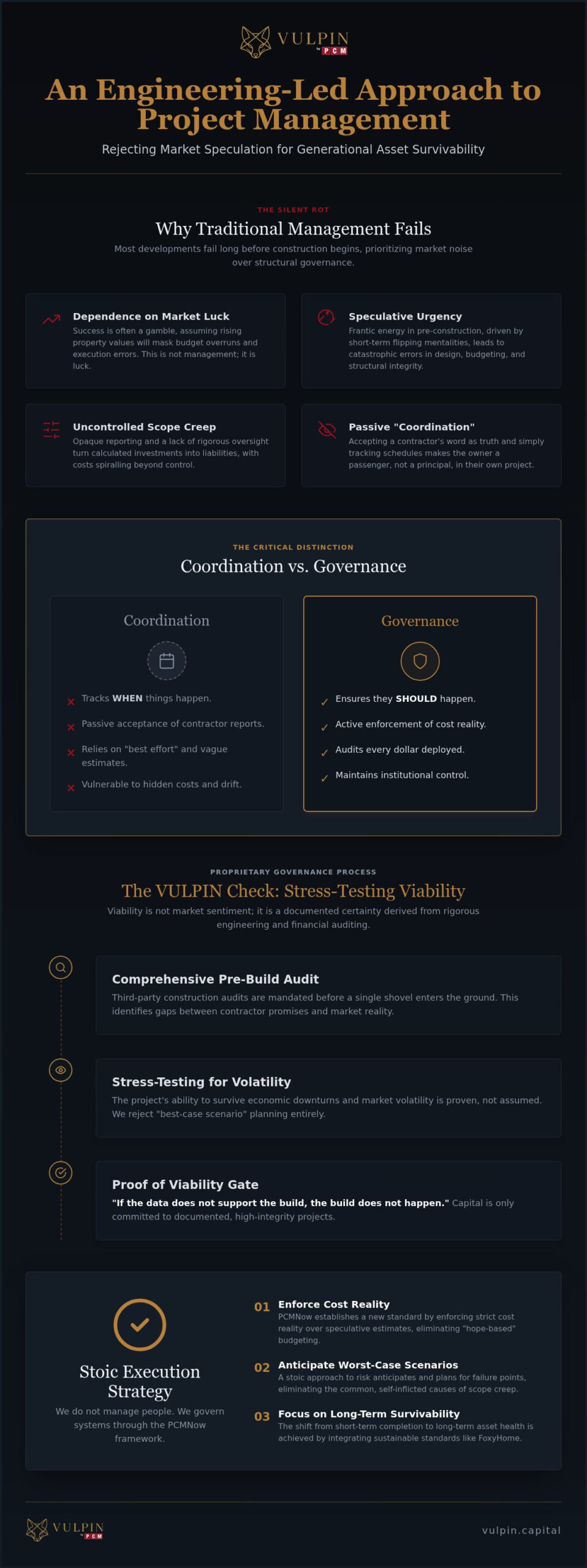
Most industry participants view project management as a simple exercise in scheduling and communication. This is a fatal misunderstanding of asset survival. Traditional coordination is passive; it accepts the contractor’s word as truth and tracks progress on a chart. True asset governance is active enforcement. It is the refusal to accept mediocrity, hidden costs, or administrative drift. In the high-stakes environment of construction project management Oakville demands a rigorous rejection of the standard “best effort” model. We do not manage people. We govern systems.
The industry frequently relies on market upside to mask execution errors. It’s a dangerous gamble that assumes rising property values will outpace budget overruns. If the market rises 10% while a build suffers a 5% leak in cost control, the manager claims success. This is not management; it is luck. We do not rely on luck. Effective oversight requires a total rejection of speculative energy in favour of physical reality. National projects demand a uniform standard of discipline that ignores regional market hype. Physical reality does not care about market sentiment. It cares about drainage, load-bearing capacity, and cost transparency.
Coordination vs. Governance: A Critical Distinction
Coordination tracks when things happen. Governance ensures they should happen at all. A typical project manager might report that the drywall is arriving on Tuesday. A governor audits the cost reality of that drywall before the purchase order is signed. Managing a contractor is often a polite fiction. In reality, you are either auditing their cost reality or you are being exploited. The role of the owner’s representative is to maintain institutional control over every dollar deployed. Without this, the owner is merely a passenger in their own build, vulnerable to the whims of the supply chain and the contractor’s profit margins.
The Cost of Speculative Urgency
Market noise creates a false sense of urgency that ruins the pre-construction phase. This frantic energy leads to catastrophic errors in design and budgeting. Speculative flipping mentalities prioritize speed over structural integrity and long-term value. We reject this approach entirely. VULPIN Capital refuses to engage with short-term speculative projects. These builds are designed to be someone else’s problem in five years. We build for the next fifty. Our focus remains on construction project management Oakville developers can trust to secure generational asset survivability. We prioritize the integrity of the structure above the excitement of the deal.
The VULPIN Check: Stress Testing Construction Viability
Viability is not a matter of market sentiment. It is a documented certainty derived from rigorous engineering and financial auditing. In the current economic climate, construction project management Oakville requires a departure from the “best-case scenario” planning that characterizes most developments. We utilize The VULPIN Check to enforce this departure. This is not a checklist; it is a proprietary governance process designed to verify real asset deployment. We refuse to commit capital or labour until the project’s ability to survive market volatility is proven. If the data does not support the build, the build does not happen.
This methodology acts as an ideological screening mechanism. It filters for partners who prioritize structural permanence over the frantic energy of speculative flipping. We aren’t interested in “making a deal work” through creative accounting or optimistic projections. We are interested in assets that endure. By establishing high-integrity boundaries at the outset, we protect the project from the administrative drift that leads to failure. This is construction project management Oakville developers use when they want to move beyond the superficial metrics of traditional firms.
Defining the Proof of Viability
Predefined proof is the threshold where theoretical planning meets physical reality. In a high-stakes environment, this means more than just having a permit. It requires a comprehensive audit of site conditions, supply chain logistics, and cost reality. We demand third-party construction audits before a single shovel enters the ground. This process identifies the gaps between what a contractor promises and what the market can actually deliver. The VULPIN Check eliminates hope-based budgeting by replacing it with tangible verification. If a project cannot provide this level of documented proof, it’s deemed non-viable. We do not manage projects into existence; we govern them into survivability.
Stress Testing the Pro Forma
A pro forma is a mathematical story, often told to satisfy lenders rather than to reflect reality. We move beyond these theoretical models to confront the harshness of construction-cost reality. This involves stress testing every budget line item against the worst-case scenarios of the Canadian market. We look for the “hidden” risks that national development projects often overlook, such as regional labour shortages or the impact of C$ currency fluctuations on imported materials. Our stoic approach requires the discipline to say “no” to projects that lack a clear path to survivability. It’s better to reject a non-viable project today than to manage a failure for the next three years. Owners who seek this level of administrative oversight often audit their current development plans to ensure their capital is not being wasted on speculative noise.
PCMNow Project Management: Enforcing Construction-Cost Reality
PCMNow is not a suggestion. It is the uncompromising standard for a construction project governance framework. In the world of construction project management Oakville often sees managers who act as mere conduits for contractor requests. This is a failure of leadership. PCMNow replaces this passivity with disciplined execution. Every C$ spent must be verified against the original project intent. We do not accept “market rates” as a justification for waste. We demand proof of value. This system ensures that the project remains an asset rather than a liability.
National execution requires a system that is immune to regional market deviations. Whether in Oakville or across the country, the framework remains rigid. Local contractors may try to drift from the plan; PCMNow ensures they don’t. It is a system built for those who value structural permanence over the frantic energy of the moment. We don’t just watch the build happen. We enforce the reality of its budget and its purpose. This level of administrative oversight is the only way to protect capital from the inherent chaos of the industry.
Disciplined Execution over Passive Management
Passive management prioritizes contractor convenience to avoid conflict. We prioritize the owner’s interest because we are operators, not just observers. Our ‘The Fox’ operating system provides the internal logic for every day-to-day decision. It forces a slow, methodical rhythm on the build. This cadence isn’t a sign of delay; it’s a sign of control. We don’t rush into errors. We execute with a calculated precision that ensures long-term stability. If a partner cannot align with this methodical pace, they aren’t the right fit for the build.
Managing Construction Project Cost Overruns
Most projects fail due to “death by a thousand change orders.” This is the result of weak governance during the pre-construction phase. We believe in managing construction project cost overruns through strict, uncompromising reporting. Every stakeholder operates within a rule-governed environment. There are no “verbal agreements” or “handshake deals” that bypass our auditing systems. By enforcing a strict cost reality, we ensure the asset’s survivability isn’t compromised by administrative laziness. This is the only way to maintain the integrity of construction project management Oakville investors can rely on for generational value.
Mitigating Risk in Complex Developments: A Stoic Execution Strategy
Risk in construction is rarely an act of God. It is almost always an act of management failure. Most project collapses are self-inflicted wounds caused by a lack of administrative discipline. A stoic execution strategy acknowledges this reality by preparing for the worst-case scenario in every budget line item. We don’t hope for stable supply chains; we build contingencies that assume they will break. In the field of construction project management Oakville professionals often mistake compliance for safety. By-law enforcement ensures the building won’t fall down; it does nothing to ensure your capital survives the build.
Governance must be autonomous. It must remain resistant to the frantic energy of external market pressures. We treat execution as a matter of principle rather than a simple pursuit of profit. If the integrity of the system is compromised, the project is compromised. This requires a level of intellectual honesty that many firms avoid. We do not adjust our standards to fit a contractor’s timeline. We hold the timeline to our standards.
The Five Pillars of Risk Mitigation
True risk mitigation relies on foundational pillars that ensure asset survivability. These are not suggestions; they are the requirements for any project under our oversight:
- Rigorous pre-construction due diligence: Verifying site conditions and cost reality before committing a single C$ of capital.
- Autonomous governance systems: Establishing oversight that is independent of contractor influence or regional bias.
- Strict adherence to the construction project risk management framework: Following a documented manual for identifying and neutralizing threats before they manifest.
- Rejection of speculative market trends: Ignoring the hype of short-term gains in favour of long-term structural value.
Owner’s Rep vs. Construction Manager
A construction manager often focuses on coordination. They manage the schedule and the trades. An owner’s representative provides a higher level of governance. They audit the construction manager. This distinction is critical for maintaining a sovereign position in your own development project. You cannot rely on a contractor to police themselves. You need a governor who filters for high-integrity professionalism in the contractor network. This ensures that every stakeholder is aligned with the project’s long-term survival. If you are ready to move beyond coordination and toward true oversight, you should secure your asset through proprietary governance today. This is the difference between construction project management Oakville developers expect and the rigorous standard we enforce.
Beyond the Build: Securing Generational Asset Survivability
Most developers view the occupancy permit as the finish line. This is a short-sighted perspective that ignores the reality of long-term maintenance and economic viability. Construction is merely the birth of the asset. The true objective is survivability. In the context of construction project management Oakville residents deserve structures that function as self-sustaining stores of value rather than depreciating liabilities. We build with the intention of permanence. This philosophy requires a condition-driven asset acquisition strategy that informs every choice made during the build. We don’t just build for today; we build for the next generation.
A building that cannot survive a decade of Canadian winters without massive capital injections is a failure of governance. We reject the industry’s obsession with “curb appeal” over structural endurance. True value is found in the systems that remain invisible to the casual observer: the envelope, the mechanical core, and the administrative framework that governs them. When we oversee a development, we are not just looking for a successful handover. We are securing a tangible store of wealth that remains resilient against market volatility and physical decay.
FoxyHome and Sustainable Housing
Sustainability is not an aesthetic choice or a marketing buzzword. It is a fundamental governance requirement. In the harsh Canadian climate, high-performance building standards are the only way to ensure an asset remains viable. FoxyHome Sustainable Housing integrates these standards into the core of every project. We focus on the financial case for net-zero home construction costs in Canada. By reducing long-term operational expenses, we increase the net value of the asset. A building that costs less to maintain is a building that is more likely to survive economic downturns. This is a pragmatic, industrial approach to environmental responsibility that prioritizes the owner’s bottom line.
Asset Management through The Fox
The transition from construction to operation is where most governance fails. We solve this through ‘The Fox’ operating system. This specialized framework moves the project from construction project management Oakville standards into a model of disciplined real asset governance. It ensures that the integrity of the build is maintained throughout the asset’s lifecycle. We explicitly reject the myth of passive speculation. Instead, we embrace disciplined real estate investing principles. This involves constant, documented verification of the asset’s condition and performance. The goal is a reliable, sovereign asset that serves as a generational store of value. We are the architects of systems that endure.
Enforcing the Standard of Permanence
Physical reality is the only metric that matters in the long term. We have established that coordination is not governance and that market speculation is a poor substitute for engineering-led governance. By implementing the VULPIN Check and the proprietary PCMNow methodology, you move beyond the frantic energy of traditional builds. You establish a national execution standard that prioritizes asset survivability over short-term completion. Construction project management Oakville developers rely on must be grounded in strict cost reality and autonomous oversight. This isn’t just about finishing a building; it’s about securing a generational store of value.
The integrity of your capital depends on the rigour of your governance. It’s time to transition from being a passive participant to becoming a disciplined operator of real assets. Secure your project’s future with the VULPIN Check and ensure your development survives the volatility of the modern market. Your commitment to structural permanence starts with a refusal to accept industry mediocrity. Build for the future with precision.
Frequently Asked Questions
What is the difference between project management and project governance?
Project management is a matter of administrative coordination; project governance is the enforcement of structural and financial viability. While a manager tracks a schedule, a governor audits the cost reality of every procurement. This ensures the owner maintains institutional control. We reject the passive model of traditional management in favour of a system that protects capital from the inherent chaos of the build.
How does the VULPIN Check verify construction project viability?
The VULPIN Check utilizes a proprietary stress-testing methodology to verify project viability before a single shovel enters the ground. It demands predefined proof of supply chain stability and cost transparency. Resources are only committed when the project survives this rigorous audit. This process eliminates hope-based budgeting and ensures that the development is a calculated investment rather than a speculative gamble on market sentiment.
Can PCMNow be used for both residential and commercial national projects?
PCMNow provides a uniform standard for construction project management Oakville and national markets require. It is equally effective for complex residential builds and large-scale commercial developments. The framework is designed to be resistant to local market deviations. By enforcing a strict cost reality across all project types, we ensure that every C$ deployed is verified against the original project intent.
Why does VULPIN Capital reject speculative real estate flipping?
We reject speculative flipping because it prioritizes short-term market noise over long-term asset survivability. Flipping mentalities often lead to compromised build quality and administrative drift. We focus on creating generational stores of value. Our goal is the development of self-sustaining assets that remain resilient against economic volatility. We build for permanence; we don’t build for the next buyer’s exit strategy.
How do sustainable housing solutions like FoxyHome impact long-term ROI?
Sustainable solutions like FoxyHome improve long-term ROI by drastically reducing operational expenses. In cold Canadian climates, high-performance building envelopes are a governance requirement, not an aesthetic choice. A building that costs less to heat and maintain is a more resilient asset. This pragmatic approach to sustainability increases the net value of the structure and ensures its viability through decades of physical and economic pressure.
What are the common signs of construction project distress in Canada?
Project distress often manifests as opaque reporting from general contractors and a sudden surge in change orders. These are self-inflicted wounds caused by a lack of pre-construction discipline. When a project relies on market appreciation to cover budget leaks, it’s already in failure. Institutional partners should look for administrative drift and a lack of documented cost reality as early warning signs of a project’s impending collapse.
How does ‘The Fox’ operating system assist in asset decision-making?
‘The Fox’ operating system serves as the internal logic for every execution decision we make. It moves the project beyond simple coordination into the realm of disciplined real asset governance. By providing a methodical rhythm for day-to-day operations, it ensures that the integrity of the build is never sacrificed for speed. This system provides the master framework needed to transition from construction to long-term asset survivability.
What should I look for when hiring an owner’s representative in Ontario?
When hiring an owner’s representative in Ontario, you must look for an auditor rather than a coordinator. They should provide construction project management Oakville investors can trust to police the general contractor. Demand a representative who utilizes a documented governance framework like PCMNow. You need a sovereign partner who prioritizes intellectual honesty and tangible verification over contractor convenience or the excitement of the deal.