

A pro forma is not a proof of viability; it’s often a work of fiction designed to satisfy a lender. In the volatile Ontario market, a standard construction project viability assessment Ontario firms typically use is frequently nothing more than a collection of optimistic assumptions masquerading as a financial plan. You’ve likely seen the fallout of this approach. Escalating labour costs and supply chain instability turn “guaranteed” returns into liabilities before the first shovel hits the ground. It’s a systemic failure of governance, not just a shift in the market.
We don’t believe in hope as a management tool. This manual outlines how to move beyond speculative appraisals by implementing a rigorous governance framework that ensures long-term asset survivability. You’ll learn to replace fragile projections with a stress-tested financial model and a disciplined framework for capital deployment. We’ll examine the mechanics of The VULPIN Check and how to establish clear proof of project survivability through a methodology that prioritizes physical reality over digital abstraction. This is about building structures that endure, supported by systems that can’t fail.
Key Takeaways
- Move beyond the limitations of standard commercial appraisals by defining viability through the lens of execution reality and long-term asset survivability.
- Implement the five pillars of The VULPIN Check to perform a construction project viability assessment Ontario demands for high-integrity capital deployment.
- Navigate the complexities of the Ontario Building Code and the rising costs associated with net-zero targets to protect your project’s financial integrity.
- Replace optimistic pro forma projections with a stress-tested model that validates hard costs against current market labour and material volatility.
- Discover how PCMNow Project Management serves as a critical governance layer to bridge the gap between initial assessment and successful project delivery.
Beyond the Appraisal: Defining Real Asset Viability
A commercial appraisal is a static snapshot. It’s a lender’s tool, not an operator’s manual. In the current climate, relying on a standard appraisal to determine a construction project viability assessment Ontario developers can trust is a dangerous oversight. Appraisals focus on market value, which is essentially a collective guess based on historical comparables. We focus on asset survivability. Survivability is a documented condition of resilience. It’s the difference between a project that looks good on paper and one that survives a 20% spike in material costs or a labour shortage that stalls a site for months.
The Failure of Market-Driven Assessments
Market optimism is a veil. It masks structural flaws in project planning and encourages a speculative flip mentality that prioritizes exit velocity over structural integrity. When inflation is high, historical comparables are irrelevant. They represent a past reality that no longer exists. Relying on them is a failure of logic. A true assessment demands a confrontation with construction-cost reality. This isn’t a digital abstraction found in a spreadsheet. It’s the physical cost of concrete, steel, and skilled trades in a constrained market. If your pro forma doesn’t account for execution failure, it isn’t a plan. It’s a hope. We reject hope as a financial strategy.
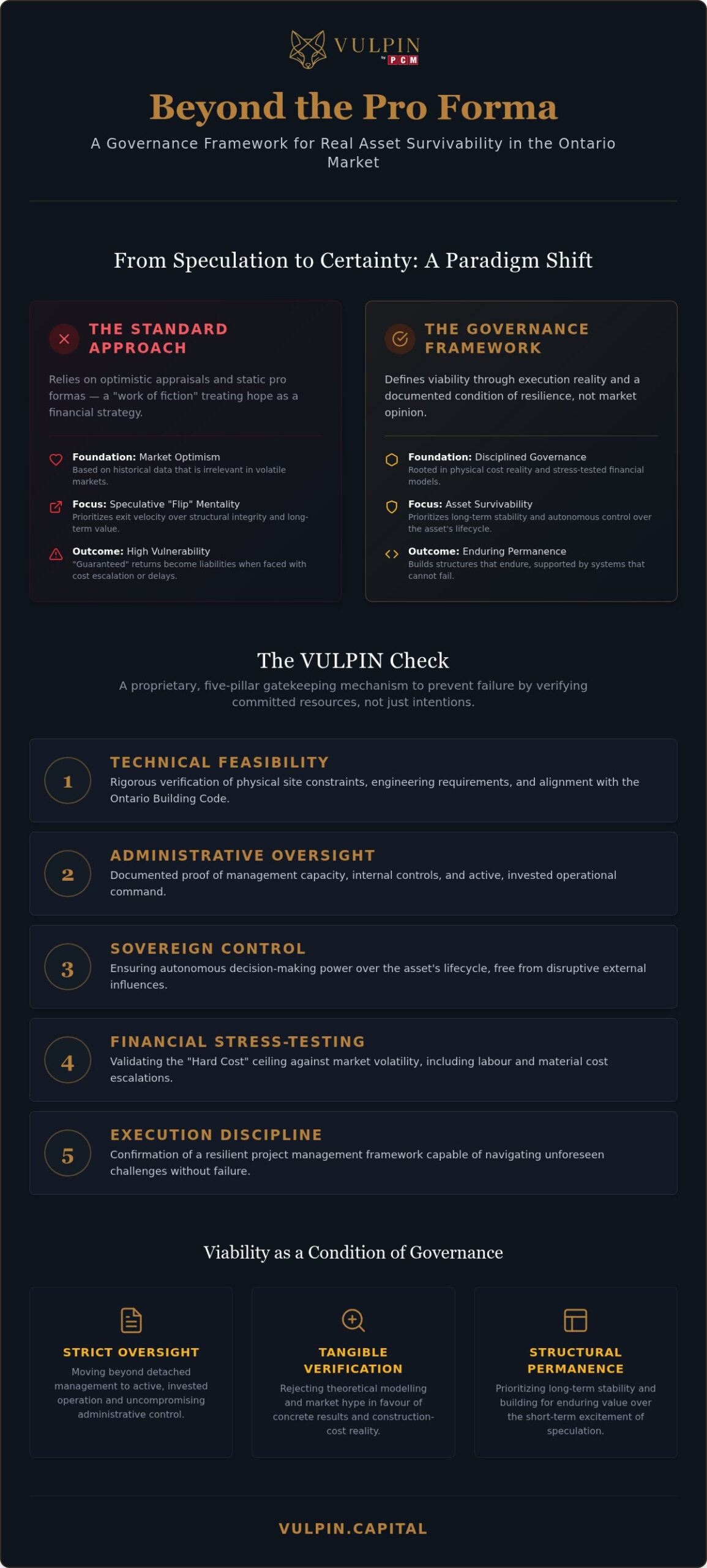
Viability as a Condition of Governance
Real asset deployment is a disciplined hunt. It requires an uncompromising boundary of high-integrity professionalism. To succeed, the developer must be the most skeptical person in the room. They must reject the hype-driven language of the brokerage world and demand tangible verification. We define viability as the precise intersection where a stress-tested financial pro forma meets execution reality. This isn’t about following trends. It’s about establishing autonomous control over the asset’s lifecycle.
This framework requires a specific set of standards:
- Strict administrative oversight: Moving beyond detached management to active, invested operation.
- Tangible verification: Rejecting theoretical modelling in favour of concrete results.
- Structural permanence: Prioritizing long-term stability over the excitement of speculation.
We don’t build for the flip. We build for permanence. By treating viability as a condition of governance rather than a market opinion, we establish a foundation that remains grounded when the rest of the industry loses its footing. This disciplined approach filters for partners who value the integrity of the structure above all else.
The VULPIN Check: A Proprietary Standard for Deployment
Standard industry audits are retrospective. They document failure after it occurs. The VULPIN Check exists to prevent it. It is our internal gatekeeping mechanism. We don’t deploy capital based on pro forma projections alone. We deploy based on verified conditions. This methodology ensures that every construction project viability assessment Ontario we conduct is rooted in physical reality, not market hope. We move beyond “predefined proof” to “committed resources.” This means we don’t just ask if a project can be built; we ask if the governance structure is capable of building it.
The five pillars of verification demand more than just signatures. They require committed resources across these critical areas:
- Technical feasibility: Verification of physical site constraints and engineering requirements.
- Administrative oversight: Documented proof of management capacity and internal controls.
- Sovereign control: Ensuring autonomous decision-making over the asset’s lifecycle.
- Financial stress-testing: Validating the “Hard Cost” ceiling against market volatility.
- Execution discipline: Confirmation of the project management framework’s resilience.
If one pillar is weak, the project is rejected. This isn’t a negotiation. It’s a filter for high-integrity partners who understand that asset survivability is non-negotiable.
Stress Testing the Execution Framework
We verify the project management structure before the first shovel hits the ground. Most firms look at the budget; we look at the machine that manages the budget. We prioritize The VULPIN Check over standard industry audits because it identifies the “break point.” Every project has one. It’s the moment where cost escalations or timeline delays render the asset unviable. Identifying this point early allows for a disciplined withdrawal or a strategic pivot. It’s about maintaining autonomous control over the deployment process.
Asset Survivability and The Fox Operating System
The Fox is not a suggestion. It’s a rule-governed operating system for decision-making. Standard management reacts to the market. Condition-driven management reacts to the asset. By using The Fox, we ensure that every decision is filtered through a framework of long-term stability. Every construction project viability assessment Ontario requires a robust operating system to manage the variables of execution. We aren’t interested in the next fiscal quarter. We’re interested in multi-generational timeframes. This rugged, industrial mentality ensures the structure remains permanent while speculative projects crumble. We build for the long-term temporal framework. We build for survivability.
Navigating Ontario’s Regulatory and Cost Realities
The Ontario Building Code (OBC) is a moving target. It defines the minimum legal standard, but for the disciplined operator, the minimum is often a financial liability. A rigorous construction project viability assessment Ontario requires looking beyond mere compliance. Regulatory hurdles are not just administrative checkboxes; they are physical and financial pressures that can sink a project if the governance is weak. Standard construction techniques are failing to meet the demands of asset survivability in a market defined by carbon taxes and tightening energy standards. We don’t accept standard as a benchmark for permanence.
Navigating these realities requires a rejection of the “business as usual” mentality. It demands a technical and institutional approach to every site constraint. Third-party audits are not just for lenders. They are critical tools for navigating regional regulatory friction. By using these audits as a mechanism for tangible verification, we ensure that the project remains grounded in physical reality rather than administrative abstraction.
The High Cost of Sustainable Execution
Sustainability is often treated as an optional luxury or a marketing layer. This is a fundamental error in judgment. Analyzing net-zero home construction costs Canada reveals that high-performance building is a financial necessity for long-term stability. FoxyHome principles are not moral posturing. They are a hedge against energy volatility and future regulatory obsolescence. Meeting these standards without bloating the budget requires a project structure that prioritizes mechanical efficiency over traditional, wasteful practices. You don’t build to the code of today; you build for the reality of tomorrow.
Quantity Surveying vs. Project Governance
A quantity surveyor provides a report. Governance provides a result. While a surveyor is a necessary tool for cost planning, they cannot execute a strategy. You need an owner’s representative who understands the specific cost drivers inherent to the Ontario landscape. There is a stark difference between theoretical cost planning and construction reality. Governance is the strategy that bridges this gap. It ensures that regional regulatory hurdles are navigated with administrative oversight rather than frantic reaction. We don’t just manage costs; we govern the entire deployment process to ensure the asset survives the friction of the real world. This is the only way to maintain autonomous control over the final structure.
Stress Testing the Pro Forma: From Speculation to Reality
A pro forma is not a promise; it’s a hypothesis that must be interrogated. Most developers treat the spreadsheet as a tool for persuasion. We treat it as a tool for destruction. Our construction project viability assessment Ontario methodology demands a four-step stress test to ensure the asset can withstand the friction of execution. We don’t look for reasons to say yes. We look for the exact point where the project breaks. If the model relies on market optimism to function, it’s a failure of governance.
- Validate the “Hard Cost” ceiling: We use current market data from active sites, not historical averages or lender-friendly estimates. If the ceiling is too low, the project is dead.
- Account for the “Governance Premium”: High-integrity oversight isn’t free. We build the cost of administrative discipline into the model from day one.
- Simulate worst-case scenarios: We model interest rate spikes and 18-month timeline delays. If the asset doesn’t survive these conditions, it isn’t viable.
- Verify the “Exit Condition”: We prioritize long-term hold survivability. The model must prove the asset can sustain itself without the need for a speculative exit.
The $5 Million Tuition: Learning from Failure
Failure in the Ontario market rarely happens on site; it happens in the pre-construction phase. Most projects fail because the team lacked the psychological discipline to walk away from a non-viable deal. We call this the “$5 Million Tuition”, the cost of learning that a bad spreadsheet can’t be fixed with good intentions. Early warning signs of distress are often hidden in the “miscellaneous” lines or unrealistic trade availability assumptions. If the numbers require a perfect sequence of events to work, the project is already in distress. Walk away. Discipline is the rejection of the sunk cost fallacy.
Mitigating Financial Risk through Disciplined Execution
Effective managing construction project cost overruns starts before the first contract is signed. It begins with a viability assessment that refuses to lie. By using “The Fox” operating system, we maintain a stoic perspective on financial reporting. We reject “short-term speculative flipping” because it relies on market energy rather than structural permanence. Our models are organized for operators, not gamblers. If you value the integrity of the structure over the excitement of the trade, you must establish a governance-first framework for your next deployment. This is how you ensure asset survivability in a market that rewards only the disciplined.
Implementing PCMNow: Governance as the Final Safeguard
A viability assessment is a technical manual for a machine that hasn’t been built yet. PCMNow Project Management is the operational reality of that machine. While many firms treat project management as a detached administrative task, we see it as the primary driver of asset survivability. The most rigorous construction project viability assessment Ontario can produce is worthless if the execution phase lacks a command-and-control structure. PCMNow integrates directly with the assessment data to ensure the stress-tested limits of the pro forma are never breached by sloppy site management.
Daily operations are governed by the construction project governance framework. This isn’t a set of suggestions; it’s a strict protocol for capital deployment and trade oversight. By establishing this framework early, we ensure stakeholder alignment through transparent, disciplined reporting. We don’t hide behind “industry standard” delays or cost overruns. We use documented methodology to maintain the integrity of the structure from the first day of deployment to the final occupancy permit.
The Uncompromising Standard of Execution
We take a stoic, authoritative approach to management because the stakes of real asset deployment demand it. We explicitly reject the frantic energy of traditional markets and the chaotic atmosphere of poorly governed sites. Progress must be methodical. Every action must move the project toward structural permanence and autonomous control. This is the mindset of a master craftsman applied to institutional-scale development. We don’t manage for the sake of activity; we manage for the sake of the asset’s long-term temporal framework. If the project cannot be executed with this level of discipline, it should not be started.
Your Next Step: The VULPIN Check
If you have a project in the pre-construction phase, it’s time for a cold, intellectual interrogation of your assumptions. Initiating a third-party audit through The VULPIN Check is the only way to verify if your plan is grounded in reality. This is an ideological screening mechanism. We are not looking for mass-market appeal or short-term speculators. We are looking for partners who value integrity, stability, and the rugged reality of physical development. Secure your asset’s future with a disciplined viability assessment that prioritizes survivability over hype. The market rewards the disciplined; it punishes the optimistic. Choose your side.
Securing Structural Permanence through Governance
Viability isn’t a market opinion; it’s a documented state of resilience. We’ve established that standard appraisals fail because they lack an execution-reality filter. A rigorous construction project viability assessment Ontario demands an uncompromising interrogation of hard costs and regulatory friction. By moving from speculative pro formas to condition-driven management, you replace market hope with administrative oversight. Asset survivability is the only metric that matters in a volatile landscape. It’s the difference between a project that exists on paper and a structure that endures in reality.
Our governance-first methodology is specialized in the Ontario construction-cost reality. We don’t manage for short-term gains or frantic exits. We operate as master craftsmen of systems, ensuring every deployment is backed by tangible verification and stoic discipline. If you value the integrity of your structure over the excitement of the trade, you’re ready for a different standard of oversight. Request a VULPIN Check for your next real asset deployment to establish autonomous control over your project’s future. Build for the long-term temporal framework. Your asset deserves nothing less than total discipline.
Frequently Asked Questions
What is the difference between an appraisal and a viability assessment?
An appraisal is a lender’s tool focused on historical market value. A construction project viability assessment Ontario operators rely on is a technical manual for asset survivability. While appraisals use comparables to guess value, our assessment uses tangible verification to prove execution reality. It’s the difference between a snapshot of the past and a blueprint for the future. We reject market opinions in favour of documented governance and structural permanence.
How long does a construction project viability assessment take in Ontario?
The duration depends on the project’s complexity and the state of existing documentation. We don’t prioritize speed; we prioritize the integrity of the data. A thorough assessment requires a deep interrogation of the execution framework and hard cost ceilings. This methodical pace ensures that every resource commitment is backed by predefined proof. We push back against external urgency to maintain autonomous control over the deployment process.
Why do most construction pro formas fail to reflect reality?
Most pro formas are built on market optimism rather than construction-cost reality. They rely on “comparables” that don’t account for current labour volatility or supply chain friction. This digital abstraction creates a governance gap where execution failure becomes inevitable. We’ve seen that pro formas fail when they lack a stress-tested financial model or ignore the “Governance Premium” required for high-integrity oversight and disciplined project management.
Can a viability assessment help secure better financing terms?
Tangible verification reduces lender risk. By presenting a stress-tested model and clear proof of project survivability, you demonstrate a level of discipline that standard applications lack. Lenders value the administrative oversight provided by The VULPIN Check. While we don’t promise specific terms, a governance-first approach signals that the project is managed by a disciplined operator rather than a speculative manager. It establishes a boundary of professionalism.
What are the most common “red flags” in an Ontario construction project?
Red flags often hide in the pro forma’s “Hard Cost” assumptions. If the budget relies on historical averages during high inflation, the project is in distress. Common warnings include:
- A lack of documented governance or administrative oversight.
- A speculative flip mentality that ignores long-term stability.
- Unrealistic timelines that fail to account for regulatory hurdles.
If the developer isn’t the most skeptical person in the room, the project’s integrity is compromised.
How does sustainable building affect the long-term viability of an asset?
Sustainability is a financial hedge against future regulatory obsolescence and energy volatility. Integrating FoxyHome principles ensures that an asset remains viable under tightening Ontario Building Code standards and net-zero targets. We don’t view sustainable building as an optional luxury. It’s a technical requirement for long-term asset survivability. Projects that ignore these costs today will face significant financial liabilities as carbon taxes and energy requirements escalate.
What role does the owner’s representative play in project governance?
The owner’s representative acts as the architect of the governance system. Through PCMNow Project Management, they bridge the gap between theoretical cost planning and construction reality. Their role is to provide stoic, authoritative oversight that prevents “frantic energy” from derailing the site. They ensure that every decision is filtered through the project’s specific execution framework, maintaining autonomous control and protecting the asset’s structural permanence against market trends.
Is The VULPIN Check suitable for residential and commercial developments?
The VULPIN Check is a governance standard for any real asset deployment. Whether the project is a FoxyHome residential development or a complex commercial structure, the pillars of verification remain the same. We filter for partners who value integrity and long-term stability over short-term speculation. Our methodology is designed for the master craftsman of systems who demands a documented, rule-governed framework for every capital deployment project.