

A quick resale plan doesn’t make a property project development, and a long timeline doesn’t make it sound. The developer vs flipper mindset is revealed by what triggers the decision to proceed: verified project viability, or confidence that resale will cover the risks.
It’s easy to blur the two. Both may involve renovation, construction and a plan to create value. But a resale narrative can distract from the fundamentals: whether the work is properly scoped, costs reflect construction reality, and the finished asset will remain sound. Optimism is not evidence. A spreadsheet is not execution.
This comparison helps you recognize the assumptions behind each mindset and assess a project through evidence, execution and long-term asset condition. It also offers practical questions to surface speculation before resources are committed. We’ll distinguish resale-led decisions from development based on verified viability, then connect that governance-first standard to The VULPIN Check and disciplined project management. The aim isn’t to praise one label. It’s to determine whether the project can withstand scrutiny before work begins.
Key Takeaways
- Look past project labels and identify what actually drives the decision to proceed.
- Use the developer vs flipper mindset comparison to distinguish resale assumptions from project-wide planning priorities.
- Test a project’s evidence, scope, costs, asset condition and intended outcome before committing resources.
- Strong answers rely on observable support, accountable assumptions and clear decision ownership.
- See how The VULPIN Check uses predefined viability evidence as a threshold for real-asset deployment.
Developer vs. flipper mindset: what is the real difference?
The labels can blur because both developers and flippers may acquire a property, improve it and eventually sell it. The difference isn’t simply the work performed or how long it takes. It’s the logic governing the decision: what must be true for the project to proceed, and what outcome is it designed to produce?
A developer is an operator focused on creating a viable, executable real-asset project. That may mean improving an existing property or coordinating a larger undertaking, with scope, construction requirements and asset condition considered together. Real estate development can involve a process from acquisition through construction to sale or lease, with professionals and risks that vary by project.
A flipper is an operator whose central thesis depends on reselling a property after acquisition or improvement. The purchase assumptions, planned work and expected resale are closely connected. A sale can also be the intended outcome of a developer’s project, but it doesn’t have to define the project’s entire rationale.
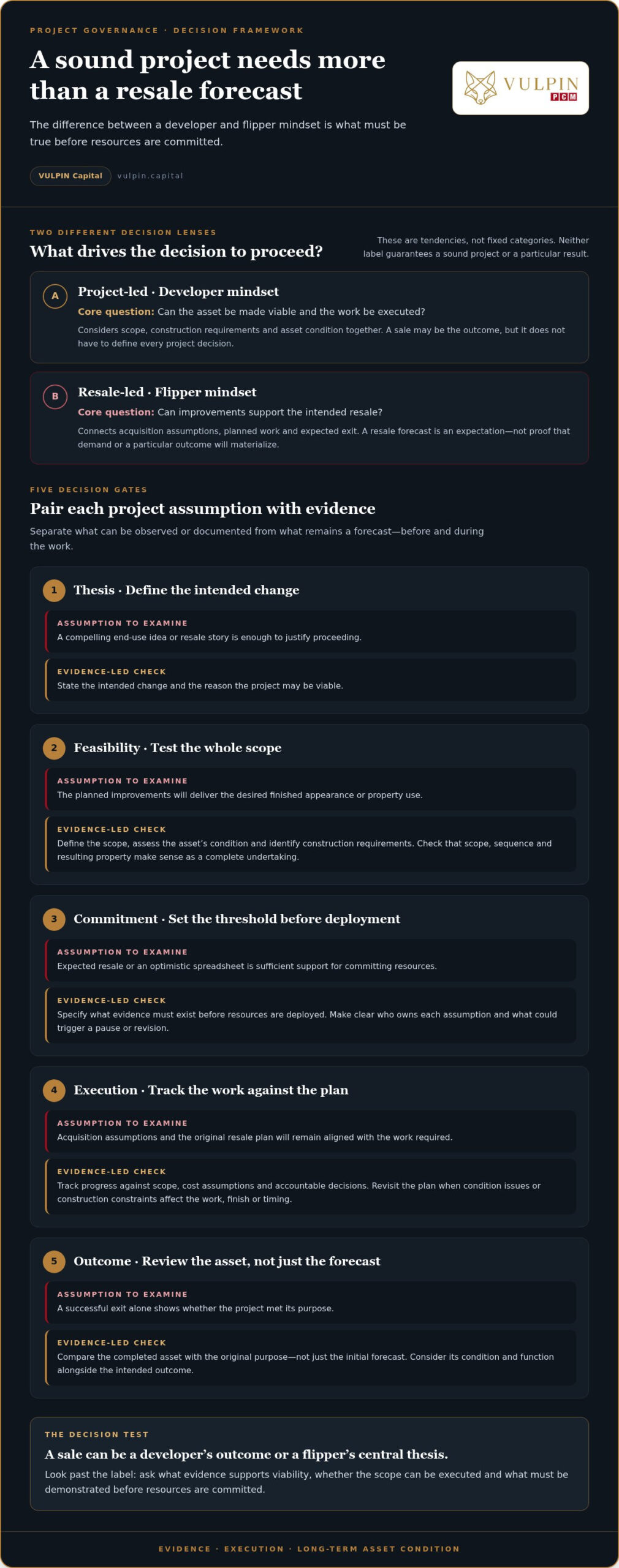
A project-led thesis asks whether the asset can be made viable and executed; a resale-led thesis asks whether improvements can support a successful exit. These are tendencies, not fixed categories. Neither label guarantees a sound project or a particular result.
What does a developer mindset prioritize?
It starts with viability. The operator examines what the project requires, whether the scope can be executed, and how construction decisions may affect the asset’s condition and function. A proposed conversion, for example, needs more than a compelling end-use idea. The scope, sequence and resulting property must make sense as a complete undertaking.
A developer may sell at completion, retain the asset or pursue another outcome. A sale is one possible result, not necessarily the reason behind every project decision. To identify the developer vs flipper mindset, examine what evidence supports the project before resources are committed.
What does a flipper mindset prioritize?
A resale-focused operator centres the decision on acquisition assumptions, improvements and expected resale. The plan depends on how the property can be changed and whether the resulting asset can attract a buyer at the anticipated exit. This is a distinct commercial focus, not proof that the work is unsound.
A short resale horizon isn’t, by itself, evidence of underlying viability. The planned improvements still need a credible scope, and the property’s condition matters beyond its presentation for sale. Resale-focused projects can be executed responsibly; the label alone says nothing certain about their outcome.
How developer and flipper decisions shape a project from day one
The first decision is the project thesis: what change is proposed, what would make it feasible, and what outcome is intended? From there, the sequence runs through feasibility, resource commitment, execution and the final outcome. The developer vs flipper mindset becomes visible at each decision gate, especially when evidence is incomplete and assumptions start carrying weight.
A disciplined review separates what can be observed or documented from what remains a forecast:
- Thesis: State the intended change and the reason the project may be viable.
- Feasibility: Define the scope, assess the asset’s condition and identify construction requirements.
- Commitment: Specify the evidence that must exist before resources are deployed.
- Execution: Track progress against scope, cost assumptions and accountable decisions.
- Outcome: Compare the completed asset with the original purpose, not just the initial forecast.
The developer’s sequence: prove, plan, then execute
A developer’s sequence uses viability evidence to inform the scope before commitments are made. For example, a proposed renovation needs a defined work plan that responds to the property’s observed condition, not just a desired finished appearance. Construction inputs, sequencing and delivery constraints belong in early planning because they can change what is feasible.
Governance makes the decision gates explicit: what must be demonstrated, who owns each assumption, and what could trigger a pause or revision. This aligns with the broad professional concerns represented by NAIOP, the Commercial Real Estate Development Association, whose membership includes commercial real estate developers and owners.
The flipper’s sequence: acquire, improve, and pursue resale
A resale-led sequence connects acquisition terms to planned improvements and the expected exit. The operator must make assumptions about the work required, the property’s condition after improvement and the resale market. Those expectations can inform the acquisition decision, but a forecast doesn’t prove that demand or a particular resale outcome will materialize.
Execution can also change the original thesis. Unexpected condition issues may require a revised scope; a construction constraint may affect the planned finish or timing. These aren’t automatic failures, but they can weaken the fit between the acquisition assumptions and the intended resale.
Execution evidence matters before resources are committed because a sound thesis can’t compensate for an undefined scope or untested delivery assumptions. Treat construction-cost reality and scope definition as decision inputs, not details to settle after work begins. PCMNow Project Management focuses on construction-cost reality and disciplined project execution, supporting the controls needed to carry an approved plan forward.
For real-asset deployment, The VULPIN Check sets a clear threshold: resources are committed when predefined evidence of project viability exists. Explore VULPIN Capital’s governance-first approach to see how verification can anchor decisions before execution.
Developer vs. flipper mindset: compare the assumptions behind each approach
The labels are useful only if they reveal how a project is judged. A developer and a flipper may both improve and sell a property, but they can set different thresholds for proceeding. The comparison below focuses on decision priorities, not a promise that either approach will produce a better result.
| Decision area | Developer emphasis | Flipper emphasis |
|---|---|---|
| Project thesis | Can the proposed real-asset project be made viable and executed? | Can acquisition and improvements support the intended resale? |
| Evidence threshold | Evidence that supports feasibility, scope and delivery assumptions. | Acquisition rationale, improvement plan and resale expectations. |
| Scope | Work defined in relation to project requirements and asset condition. | Work selected in relation to the planned improvement and exit. |
| Execution focus | Coordinating requirements and managing delivery against the project plan. | Completing the planned improvements in support of resale. |
| Uncertainty | Identify and manage project risks where evidence and controls allow. | Account for execution risks while recognizing resale conditions remain uncertain. |
| Intended outcome | A viable completed project, which may be sold, retained or used another way. | A completed improvement followed by a planned resale. |
These are tendencies, not rules. A developer may sell at completion, and a resale-focused operator can care about construction quality. The difference lies in the governing rationale, not a fixed holding period or an assumption that one operator overlooks the asset.
Is a developer just a flipper with a longer timeline?
No. The distinction is decision logic, not simply how long the property is held. Imagine two operators considering the same building for conversion into several units. One proceeds only if the proposed scope, condition and delivery requirements support a viable project. The other centres the decision on whether the acquisition and planned work support a resale. Either may ultimately sell, but the sale serves a different project rationale.
Where speculation enters the project thesis
Speculative exposure grows when an expected resale is treated as established fact rather than an assumption. Some uncertainties can be tested, such as the visible condition of the asset, the proposed work and whether the scope is clearly defined. Other conditions, including future buyer demand, remain external. Record which claims have support, which are forecasts, and who owns each assumption. This discipline doesn’t remove uncertainty; it makes the basis for the decision visible.
Use the developer vs flipper mindset comparison as a diagnostic, not a verdict. A project’s label can’t establish its quality. The evidence, scope, execution controls and assumptions behind the intended outcome must carry that weight.
A practical framework for identifying the mindset behind a project
Labels can start a discussion, but they can’t verify a project. To assess the developer vs flipper mindset, test the decisions behind the proposal: what is known, what is assumed, and who is accountable for acting on the difference. These five questions can reveal whether the project thesis rests on evidence or expectation.
Five questions that test a project thesis
- What evidence supports the core viability assumptions? Identify the documents, observations or other concrete inputs behind the project rationale. Separate those from expectations about future demand or resale.
- Is the construction scope defined? The proposed work should describe what is included and how it relates to the intended outcome. Broad phrases such as “modernize the property” don’t establish a workable scope.
- Are cost inputs and delivery constraints understood? Clarify what informs the construction-cost estimates, what remains provisional, and which sequencing or delivery dependencies could affect execution.
- What is known about the asset’s condition? Record observed condition issues and identify gaps that could change the work required. Don’t treat an unassessed element as if it has been verified.
- What conditions would change or stop the commitment? Define the evidence or project change that would prompt a pause, revision or decision not to proceed. Include who has authority to make that call.
A strong answer is specific enough to be examined. It points to observable support, names assumptions rather than hiding them, and identifies who owns each decision. If the answer depends on a future resale, state that clearly as an assumption, not as a confirmed project fact.
How to separate verified facts from assumptions
Use three labels for material inputs: verified, estimated and unresolved. For each unresolved item, record an accountable owner and a decision date. If a condition assessment is incomplete, for example, mark its impact on scope as unresolved and assign responsibility for resolving it before the relevant commitment gate.
This record won’t guarantee success. It does make the basis for decisions visible, so new information can be assessed against the original thesis instead of being absorbed without review. Keep dated updates and note what changed, who approved the change, and whether the viability case still holds.
Set a decision gate before resources are committed. If a material viability input remains unresolved at that gate, pause the commitment until the evidence is available or the project is formally reassessed. The VULPIN Check applies this principle through predefined evidence of project viability. Explore The VULPIN Check governance standard for more on this approach, or learn about VULPIN Capital.
How VULPIN Capital applies a governance-first developer mindset
The developer vs flipper mindset becomes practical when governance determines what can proceed. VULPIN Capital’s approach centres on evidence, decision rules and execution discipline. The objective isn’t to treat an expected exit as proof of viability. It’s to establish what the project must demonstrate before resources are committed, then maintain control as work moves forward.
This approach has distinct roles. The VULPIN Check provides governance and verification for real-asset deployment. PCMNow Project Management focuses on construction-cost reality and disciplined project execution. The Fox is VULPIN’s rule-governed operating system for asset survivability and decision-making. Each connects to a different part of the project’s decision structure.
The VULPIN Check: evidence before resource commitment
The VULPIN Check sets predefined evidence of project viability as the threshold for committing resources. This makes the deployment decision subject to a stated standard, rather than relying solely on confidence in a project narrative. The relevant question is whether the required evidence exists, not whether an anticipated return sounds persuasive.
Predefined proof requirements also make governance more explicit. They clarify what must be established before a commitment and give decision-makers a basis for reviewing the project. They don’t guarantee an outcome or remove uncertainty. They create a verification process for determining whether the project has met its stated viability threshold. Read about The VULPIN Check governance standard to understand this framework.
Governance continues through construction execution
A viable plan still has to be executed. Scope, construction-cost reality and delivery decisions must remain connected; otherwise, the work can drift from the basis on which the project was approved. PCMNow Project Management focuses on disciplined execution, connecting the plan with construction realities as decisions continue.
That connection matters when actual conditions or project requirements challenge initial assumptions. A governance-first approach makes those changes visible and brings them back to accountable decision-making. It doesn’t mean every project follows one fixed path. It means material decisions are governed rather than left to informal optimism.
Across deployment and execution, The Fox provides a rule-governed operating system for asset survivability and decision-making. Together, these elements reflect a disciplined developer mindset: establish the decision standard, verify project viability, and keep execution anchored to evidence and scope.
Development isn’t governed by choosing an exit and stopping there. It requires oversight of decisions throughout the project, from resource commitment to construction execution and the condition of the resulting asset. To explore how VULPIN Capital approaches governance-first real-asset development, visit VULPIN Capital.
Make the next real-asset decision evidence-led
The next project doesn’t need a label before it needs a decision standard. Use the developer vs flipper mindset distinction to examine what would justify proceeding, what could change the plan, and who is accountable for each decision. That discipline keeps the project rationale connected to the asset and the work required, rather than letting an appealing exit carry the entire case.
VULPIN Capital’s governance-first approach puts that principle into practice: The VULPIN Check ties resource commitment to predefined evidence of viability, PCMNow focuses on construction-cost reality and disciplined execution, and The Fox provides a rule-governed framework for asset survivability and decisions. These are controls for making and governing project decisions, not promises about outcomes.
If your priority is durable real-asset value, set the evidence threshold before commitment and keep decisions accountable through execution. Explore VULPIN Capital’s governance-first approach to real assets and consider how its framework can inform your next project. Sound decisions begin with a standard you’re prepared to uphold.
Frequently Asked Questions
Is a property developer the same as a house flipper?
No. In the developer vs flipper mindset, the distinction is the basis for proceeding, not simply whether both operators renovate and sell. A developer assesses whether a project can be made viable as a complete undertaking; a house flipper typically centres the decision on acquisition, improvements and resale. For instance, adding units may require broader planning than updating a home for sale. Either approach can be carefully governed or poorly assessed.
Can a real estate developer sell a property after completing the project?
Yes. A developer can sell a completed property. The sale may be planned from the outset, such as when the project aims to create a finished asset for a buyer or another owner. What distinguishes the developer’s approach is that the rationale can include the project’s feasibility and delivery, rather than relying only on the expected sale. The intended purchaser and sale timing are outcomes to plan for, not proof that the project is viable.
Does a developer mindset always mean holding an asset long term?
No. A developer mindset describes how project decisions are made, not a required holding period. An operator might develop a property, complete the work and sell it, or retain it for another use. The practical test is whether decisions account for the asset and project requirements independently of how long ownership continues. Holding for years doesn’t, by itself, establish sound development; a near-term sale doesn’t rule it out.
What does condition-driven real-asset development mean?
Condition-driven development starts with the asset as it exists, rather than treating a desired finished state as guaranteed. For example, if signs of water intrusion appear during an assessment, the project plan may need further investigation before the affected space is designed or finished. The observed condition informs scope and sequencing. This approach keeps decisions tied to the physical property and its documented needs, while leaving room to revise plans when new evidence emerges.
Can a flipper use governance and project controls?
Yes. Governance and controls are useful regardless of an operator’s resale focus. A flipper could document the approved scope, identify who can authorize changes, track construction decisions against the plan and define conditions for pausing work. Those controls make responsibilities and deviations visible. They don’t change the project’s central resale thesis, but they can bring more discipline to how that thesis is carried out and reassessed.
How can you tell whether a property project depends too heavily on resale assumptions?
Look for decisions that only make sense if an unverified future sale occurs as expected. For example, if the project has no clear rationale beyond a projected resale price, ask what evidence supports that forecast and what happens if buyer interest differs. Separate observed property facts from market expectations in the project record. If a change in the resale assumption would invalidate the whole plan, make that dependency explicit before resources are committed.
Does a developer need to manage construction directly?
No. A developer can be accountable for the project without personally directing every construction task. Responsibilities may be assigned to project managers or other construction professionals, while the developer retains oversight of scope, decisions and the intended outcome. The important distinction is between delegating execution and surrendering accountability. Project management, such as PCMNow, connects construction-cost reality and disciplined execution to the project’s governing plan.