

A pro forma can make an uncertain project look precise. A polished spreadsheet, however, is not evidence that approvals, construction costs or financing will hold. Evaluating real estate development risk means asking a harder question: what must be true before capital is committed, and what proof supports each answer?
These risks are difficult to assess in isolation. A delay in approvals can affect costs and financing, while a change in construction assumptions can alter a project’s viability. This guide offers a disciplined way to identify material risks, test the evidence behind them and compare opportunities using consistent decision criteria.
You’ll examine the proof gates that matter, from approval pathways and cost assumptions to financing resilience and decision-making authority. The VULPIN Check applies predefined evidence of project viability before resources are committed. PCMNow Project Management connects that early assessment to construction-cost reality and disciplined execution. Neither process guarantees success. Both help clarify what is known, what remains exposed and what must be demonstrated before a project moves forward.
Key Takeaways
- Evaluating real estate development risk means testing assumptions against evidence, not treating a detailed forecast as proof of viability.
- For each material risk, identify the supporting evidence, accountable owner, warning indicator and planned response.
- Compare opportunities by the quality and traceability of their documentation, not just by forecast confidence.
- Use a defined due-diligence sequence to turn project scope, findings and decision rights into a documented capital decision.
- The VULPIN Check uses predefined viability evidence as a governance gate before resources are committed. It supports disciplined decisions, not guaranteed outcomes.
What evaluating real estate development risk actually means
Evaluating real estate development risk is not a test of how convincing a forecast looks. It is the disciplined examination of a project’s assumptions against evidence, followed by a clear decision about what is established, what remains uncertain and who has authority to act. A forecast estimates what may happen. Verified facts document what is known. Decision rights identify who can approve a change, and an executable plan shows how work will proceed.
In practical terms, development risk evaluation tests whether a project’s critical assumptions have supporting evidence, accountable decision-makers and workable responses if conditions change. A projected return cannot do that work on its own. It summarizes selected inputs; it does not prove that approvals can be secured, a site can support the design, financing will remain available or the asset can operate as intended. The stages and exposures involved are part of the broader Real estate development overview.
Which risks belong in a development decision?
Assess connected exposures, not isolated spreadsheet lines. Approval pathways can affect timing and permitted scope. Site conditions may require design changes. Design choices influence construction methods and costs. Financing assumptions depend on project timing and the capital structure. Operating plans must also fit the completed asset and its intended use. In Canada, requirements can vary by jurisdiction and project, so regulatory conclusions need project-specific verification.
- Approval: Record the relevant approvals, their status and outstanding dependencies.
- Site: Identify known constraints and the evidence supporting site assumptions.
- Financing: Document funding conditions, timing and exposure to changed assumptions.
- Design and construction: Trace design decisions to scope, cost inputs and delivery plans.
- Operations: Test whether the operating approach is defined and consistent with the proposed asset.
One unresolved issue can affect several parts of a project. A site constraint may prompt a redesign, which can change scope, schedule and capital requirements. For each material exposure, name an owner, an indicator that could signal a change and a response with a defined decision-maker. Without those controls, a risk register is only a list.
Why a pro forma is not proof of viability
A pro forma is a model, not independent evidence. Its inputs may include assumed approvals, construction timing, costs, financing terms, occupancy or operating performance. Trace each input to its source and classify it as verified, conditional, estimated or unresolved. A precise output built on untested inputs is still uncertain. Sensitivity analysis can show how results change when assumptions move, but it cannot validate the assumptions themselves.
Test the dependencies behind the forecast. What must happen first? Which party controls that step? What changes if it is delayed, costs more than assumed or cannot proceed as planned? A sound decision record distinguishes evidence from expectation and identifies conditions that would pause or alter deployment. The VULPIN Check frames this discipline around predefined evidence of viability before resources are committed. It is a decision control, not a guarantee of project success.
How to test the major risks in a real estate development
A useful risk assessment tests whether project documents support the assumptions they are meant to control. For each exposure, record the evidence reviewed, its date and limitations, the accountable person, an observable warning indicator and the response if that indicator changes. “Costs monitored” is not a control unless someone is responsible for monitoring them and has authority to act.
A risk register names possible failures; demonstrated risk control connects each one to evidence, an accountable owner, an observable trigger and an executable response. This makes evaluating real estate development risk a practical review of how a project can respond under pressure, not merely a list of concerns.
Test site, approvals and development assumptions
Start with the site and intended use. Compare the project’s description of site conditions with the documents and technical work supporting it. Record what has been examined, what remains an assumption and whether new information could alter the proposed scope. Verify project-specific technical conclusions against the relevant reports and qualified expertise.
Map the approval pathway as a sequence of dependencies, not a single checkbox. Identify decisions that remain outstanding, who controls them and which project choices depend on them. Approval processes and requirements can differ across provinces and jurisdictions, so verify the applicable rules for the specific project rather than relying on a general summary. Then trace the schedule: if a key decision is unresolved, determine which later activities cannot reasonably proceed as planned.
Test financing, construction and delivery exposure
Review funding, costs, contingency and timing as a connected system. Funding may depend on milestones, and milestones may depend on approvals, design completion or procurement. Compare the financing assumptions with the project schedule and record what happens if a dependency shifts. A contingency figure is not meaningful on its own. Establish what it is intended to absorb, who can authorize its use and how a material change is escalated.
For construction, examine how mature the design is relative to the cost estimate and delivery plan. Identify assumptions that rely on unfinished design decisions, procurement choices or supplier availability. Check whether the project has a documented process for reviewing scope changes, assessing their schedule and cost effects, and approving or rejecting them. PCMNow Project Management focuses on construction-cost reality and disciplined execution, connecting these controls to delivery. A broader construction project risk management framework can help structure that review.
- Owner: Name the person accountable for monitoring and escalating the exposure.
- Indicator: Define the observable change that signals the assumption may no longer hold.
- Response: Document the available action, its decision authority and any effect on scope, schedule or capital needs.
Apply the same test to operating exposure. Ask whether the intended operating model is supported by a defined plan and whether changes in design or delivery could undermine it. The VULPIN Check provides a governance and verification approach built around predefined evidence. Learn more about The VULPIN Check. These controls make risks visible and actionable. They do not eliminate uncertainty or guarantee an outcome.
How to compare a development opportunity with its risk controls
Compare projects using the same questions, not the same sales narrative. A polished presentation can make assumptions feel stronger than they are. For each material exposure, record what supports the forecast, who owns the risk and what decision follows if the evidence is incomplete or conditions change. This makes evaluating real estate development risk a consistent review of readiness and control, not a contest between projected returns.
Compare evidence quality, not presentation quality
Classify the support before relying on it. A documented fact has a traceable source. A third-party input has an identifiable author and scope. An estimate depends on stated assumptions. An unsupported assertion has no adequate record behind it. Missing evidence should lower confidence in the relevant assumption, but no universal score can replace project-specific judgement. Apply the same questions to each opportunity to reduce narrative bias.
More analysis can add delay, so focus on evidence that could change a material decision: whether to proceed, revise scope, defer a commitment or stop. Record why the evidence matters and which decision it informs. This directs diligence toward consequential uncertainties rather than producing paperwork for its own sake.
Compare governance and decision rights
Evidence has limited value if no one can act on it. Identify who approves scope, budget changes and commitments, and who can authorize corrective action. Then review whether reporting shows deviations early enough for those people to respond. The construction project governance framework explores how decision authority and oversight support project control.
Use a comparison matrix to keep the review traceable. Tailor the entries to the project; the table is a decision aid, not a universal rating system.
| Risk area | Evidence to examine | Accountable owner | Decision consequence |
|---|---|---|---|
| Approvals | Current status, outstanding dependencies and documented pathway | Person responsible for approvals tracking | Proceed, revise timing or defer dependent commitments |
| Site and design | Site information, design basis and identified assumptions | Person accountable for technical coordination | Maintain scope or require further assessment or redesign |
| Cost and delivery | Estimate basis, design maturity, procurement dependencies and change records | Person overseeing cost and execution | Accept the plan, adjust scope or reassess capital needs |
| Financing and operations | Funding conditions, timing assumptions and operating plan | Person coordinating financing and operations | Proceed with conditions, defer or revise the plan |
Compare the traceability of each item, not just the confidence expressed in the forecast. Can the source be located? Does it match the assumption? Is it current enough for the decision? If an owner, trigger or consequence is missing, record the gap plainly instead of concealing it in an overall score.
This framework supports disciplined comparison; it does not rank investments or provide individualized financial advice. The VULPIN Check uses predefined viability evidence before resources are committed, while project outcomes remain uncertain. For a governance-led approach to real asset decisions, explore VULPIN Capital’s project verification approach.
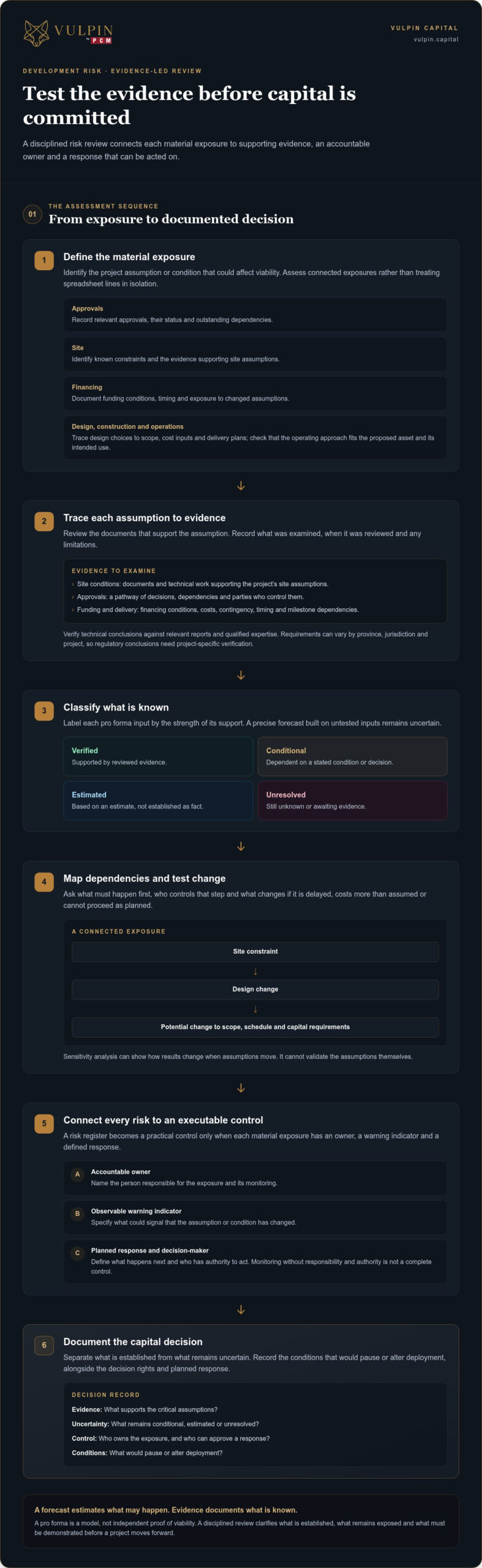
A practical due-diligence sequence before committing capital
A disciplined review should leave a record that another decision-maker can follow. Each step should produce an observable output, not just a general impression of confidence. Set the evidence standard before reviewing the project’s case for investment. This helps prevent a persuasive forecast from quietly redefining what counts as proof.
- Define the decision boundary. State the specific decision under consideration, the capital exposure involved and the assumptions it depends on. Record what is outside the review. The output is a short decision brief that makes clear what approval is being sought and what would change the answer.
- Set the evidence requirements. For each material assumption, list the proof required, its owner and any unresolved dependency. Distinguish documents in hand from information expected later. The output is an evidence register with sources, dates, status and outstanding items.
- Test dependencies and consequences. Trace how unresolved matters could affect scope, schedule, cost or financing. Define conditions that would require a pause, further analysis or a revised decision. The output is a dependency map and a written set of decision triggers. If a material assumption lacks evidence and could change the commitment, pause that decision rather than treating the gap as settled.
- Assign risk ownership and response. Give each material exposure an accountable owner, an observable indicator and a documented response. Specify who can authorize the response. The output is an action register that connects monitoring to decision authority, not a list of risks without a control mechanism.
- Check execution readiness. Compare current scope, cost assumptions and schedule dependencies with the available evidence. Define how proposed changes will be assessed and approved before they alter the project baseline. For example, a design change should prompt a documented review of its effects on cost and timing. The construction cost-overrun controls offer a related framework for governing these changes.
- Record the decision and its conditions. Document the evidence reviewed, material gaps, decision authority, rationale and any conditions that must be met before resources are committed. State who owns each condition and how its completion will be recorded. The output is a dated decision record with a clear proceed, pause or revise determination.
This sequence makes evaluating real estate development risk a repeatable governance process. The VULPIN Check uses predefined evidence of project viability before resources are committed. It supports disciplined decisions, but it does not remove uncertainty or guarantee an outcome.
To apply predefined proof gates to a development decision, explore The VULPIN Check governance process.
How The VULPIN Check applies proof gates to development risk
A development decision should not advance because a forecast is persuasive or a deadline is approaching. It should advance when the evidence required for that decision is present, reviewable and connected to clear authority. The VULPIN Check applies this principle through governance and verification before resources are committed. It treats evaluating real estate development risk as a question of proof and decision readiness, not confidence alone.
From project claims to predefined proof
The discipline begins before a project’s claims are treated as established. Decision-makers define what evidence must exist to demonstrate viability, which assumptions matter to the commitment and who is responsible for producing or assessing the evidence. Setting the standard in advance helps prevent a project’s narrative from shifting the goalposts once capital is under consideration.
Evidence gaps then have a practical consequence. If a critical assumption remains unsupported, the decision can pause while the gap is addressed. If new information changes the project’s scope or underlying assumptions, the plan can be revised and assessed again. If the required evidence is present, decision-makers can consider proceeding within their authority. The process makes the basis for each decision visible, including what remains uncertain.
This is a governance control, not a prediction of success. Verification can establish whether defined evidence exists; it cannot make future approvals, costs, financing conditions or operating performance certain. Nor does passing a proof gate assure an investment return. The purpose is narrower and more rigorous: commit resources only when predefined evidence supports the decision being made.
Connect governance with long-term asset survivability
The VULPIN Check, PCMNow Project Management and The Fox have distinct roles. The VULPIN Check governs and verifies whether predefined evidence of project viability exists before resources are committed. PCMNow provides project management focused on construction-cost reality and disciplined execution. This connection matters because early assumptions must remain accountable as design and delivery decisions develop.
The Fox supports asset-survivability decisions through an operating system for rule-governed decision-making. Its role is distinct from project verification and construction management: it supports decisions about whether an asset can remain viable under the conditions it faces. Together, these functions connect deployment discipline, execution oversight and longer-term survivability without treating any one of them as a guarantee.
Governance continues after an initial decision. If costs, scope or schedule move away from the assumptions supporting viability, the deviation should be visible to the people authorized to respond. Project management focused on cost reality helps keep execution connected to the approved basis, while rule-governed decision-making clarifies when a change calls for review. The control system must remain usable as conditions change.
The VULPIN Check is a decision framework, not a retail investment brokerage or a mechanism for short-term speculative flipping. It is designed around disciplined resource deployment and documented evidence. To explore this governance-first approach to development decisions, explore The VULPIN Check.
Make the next capital decision deliberate
Carry the evidence standard into your decision process. Before resources are committed, define what must be demonstrated, who has authority to decide and what happens if a material assumption changes. That discipline gives teams a clear basis for moving forward, revising the plan or pausing. Evaluating real estate development risk is not about removing uncertainty. It is about refusing to mistake an untested assumption for a sound basis to act.
The VULPIN Check sets predefined proof of project viability before resources are committed. PCMNow focuses on construction-cost reality and disciplined execution, connecting the decision to the work that follows. These are practical controls, not promises of a particular outcome or return.
If a governance-first approach fits the way you want to deploy capital, explore The VULPIN Check. Start with the evidence. Make the decision at a pace the project can support, and build from a foundation you can explain and defend.
Frequently Asked Questions
Should I invest in a real estate syndicate developing a property?
Only after assessing the structure, project evidence and your ability to accept the risks; a forecast alone isn’t a sufficient basis. Review how decisions are made, how conflicts are handled, what could trigger additional capital contributions and how an exit is defined. Consider whether your money could remain committed longer than planned or be difficult to withdraw. This is general information, not individualized financial advice. Have the offering documents assessed in light of your circumstances.
How can I assess whether a development project’s forecast is realistic?
Check whether key model inputs reconcile with dated, project-specific support. For example, compare a construction estimate with the design version it prices, and confirm that the schedule uses the same scope and procurement assumptions. Review a downside case that changes important inputs, such as completion timing or operating income, and identify which assumptions drive the result. A forecast is more useful when its source documents, limitations and revisions can be traced.
What happens if a real estate development project is delayed?
A delay can affect more than the completion date. It may extend financing needs, shift expected revenue and disrupt linked approvals, procurement or occupancy plans. The actual effect depends on the project’s agreements and funding structure. Review an updated schedule that identifies the cause, affected milestones, revised capital requirements and decisions needed to recover time. Compare it with the previous baseline so the change is visible, not buried in a refreshed forecast.
Can a development risk review guarantee that a project will succeed?
No. A review can test the quality of available evidence, expose assumptions and help decision-makers set conditions for proceeding or pausing. It cannot control future market conditions, approvals, construction events or operating performance. Treat a review as a way to improve the discipline and transparency of a decision, not as insurance against loss. Even a well-governed project can encounter events that its original analysis could not reasonably predict.
Which documents help assess a real estate development opportunity?
Useful records may include site information, surveys and technical reports; approval correspondence; current design documents; cost estimates; procurement and construction schedules; financing terms; and the operating plan. Review the governing or syndicate documents as well, including provisions on decision authority and additional funding. Check that versions align: a cost estimate based on an earlier design may not support the current budget. Confirm project-specific technical and provincial requirements before relying on them.
How do interest-rate changes affect real estate development risk?
Rate changes can alter borrowing costs, debt-service requirements and the economics of refinancing, but the effect depends on the project’s financing terms and timing. As of September 2, 2026, the Bank of Canada policy rate was 2.25%; this is not the project’s borrowing rate. Test the model against rate changes at relevant financing or refinancing points, and identify whether added costs would require revised scope, more capital or a pause.
What should an investor do when key project evidence is missing?
Pause any capital decision that depends materially on the missing evidence. Record exactly what is absent, which assumption it supports, who is responsible for resolving the gap and what finding would allow the decision to be reconsidered. If the evidence cannot be obtained or changes the project’s basis, revise the analysis rather than filling the gap with optimism. Keep the unresolved item visible in the decision record and do not treat silence as confirmation.