

A development proposal can look viable on paper and still fail the committee’s most basic test: what, exactly, is it being asked to approve? An investment committee memo for real estate development should answer that plainly. It is a decision-control document, not a project sales pitch.
Committees need to assess more than projected returns. They need to understand how underwriting assumptions connect to construction realities, when capital is required, which risks could change the outcome, and what evidence supports each conclusion. When those details sit in separate models or disappear inside an optimistic narrative, disciplined review becomes harder.
This guide provides a practical memo structure you can adapt to a development proposal. It shows how to define the decision, describe the project and capital requirements, test base and downside scenarios, disclose risks, and record approval conditions and decision gates. The aim is a clear, evidence-led record that helps the committee challenge assumptions before resources are committed. The VULPIN Check applies that same emphasis on verification and governance.
Key Takeaways
- State the decision required up front: approve, reject, defer, or authorize further diligence.
- Use an investment committee memo for real estate development to connect project scope, delivery plan, underwriting, and capital requirements in one decision record.
- Compare base, downside, and upside cases, separating assumptions from supporting evidence.
- Make risks reviewable with a register that identifies each risk’s cause, owner, mitigation, trigger, and remaining exposure.
- Translate approval into defined scope, capital limits, reporting, and change controls. The VULPIN Check supports governance by tying resource commitments to predefined proof of viability.
What an investment committee memo for real estate development must decide
A development memo must make the requested decision explicit and show the record behind it: evidence, assumptions, risks, and approval conditions. Ask the committee to approve, reject, defer, or authorize further diligence. “Discuss the opportunity” is not a decision. It leaves the sponsor without a clear mandate and makes the committee’s response difficult to document.
Development proposals involve a different kind of uncertainty from acquisitions. An acquisition memo assesses an asset that already exists. A development memo must address what still has to be delivered: scope, design, approvals, procurement, construction, and the path to operation or sale. A credible recommendation connects the proposed outcome to evidence about the work required to achieve it. The memo supports judgement, but it cannot replace verified project evidence. Underlying due diligence should be traceable to documents, estimates, and accountable sources, not confidence in a forecast.
Who reads the memo and what decision do they own?
Identify the committee members, delegated authorities, and project sponsor. The sponsor owns the recommendation and is accountable for presenting the proposal, disclosing open issues, and supplying the evidence behind the decision. State the decision date, required quorum, and applicable internal approval process so the record shows who had authority to decide.
Separate approval of a concept from authority to commit capital or begin construction. A committee might endorse further design work without approving the full capital requirement. Document the scope and limits of each authorization, along with any conditions that must be met before the next commitment. This prevents an early-stage endorsement from being treated as permission to proceed with work the committee has not reviewed.
What belongs in the executive decision summary?
Put the decision request first. Then state the project’s purpose, the capital required in Canadian dollars, and the principal unresolved issue. Summarize the base case and downside exposure in plain language. Name the conditions that would change the recommendation, such as evidence resolving a material delivery uncertainty or a change that makes the approved scope no longer viable.
A useful summary lets a member understand the decision before turning to the supporting analysis. Point to the evidence and identify what remains uncertain rather than smoothing over gaps with broad assurances. One sentence can set the standard: An investment committee memo for real estate development is an evidence-led record of the capital decision, its assumptions, risks, and conditions.
A practical investment committee memo template for a development proposal
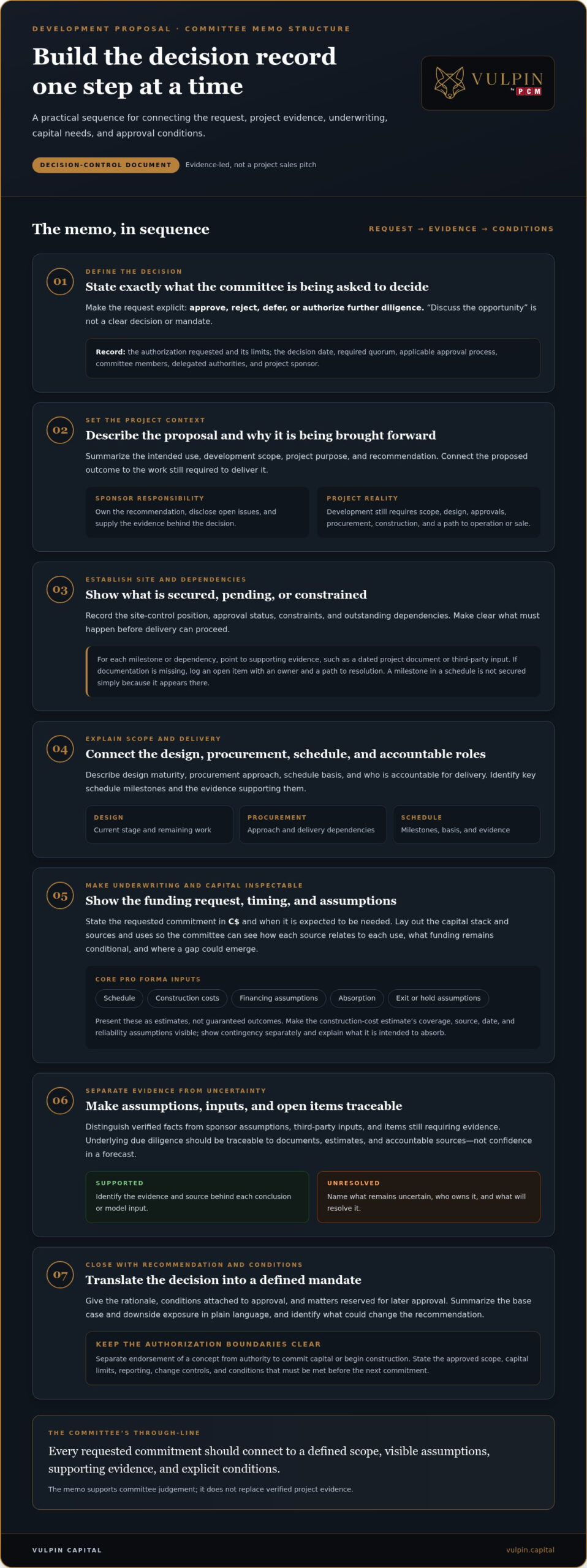
A useful template makes the project’s logic inspectable. Keep the sequence consistent across proposals, then tailor the evidence to the project. An investment committee memo for real estate development can follow this order:
- Decision requested: State the specific authorization and its limits.
- Project overview: Summarize the intended use, development scope, purpose, and recommendation.
- Site and dependencies: Record site control, approval status, constraints, and outstanding dependencies.
- Scope and delivery plan: Describe design maturity, procurement approach, schedule basis, and accountable delivery roles.
- Underwriting and capital: Present pro forma inputs, capital stack, sources and uses, requested commitment, and proposed timing.
- Evidence and open items: Separate verified facts, sponsor assumptions, third-party inputs, and items still requiring evidence.
- Recommendation and conditions: Give the rationale, conditions attached to approval, and matters reserved for later approval.
Project, site, scope, and delivery plan
Describe what is intended to be built and what must happen before delivery. Identify the current site-control position, approval status, major dependencies, design stage, procurement plan, and key schedule milestones. For each milestone, name the supporting evidence, such as a dated project document or third-party input. If documentation is missing, record it as an open item with an owner and a path to resolution. An expected milestone is not secured simply because it appears in the schedule.
Make the construction-cost basis visible rather than burying it in a single pro forma line. State what the estimate covers, its source and date, and the assumptions that affect its reliability. Show contingency separately and explain what it is intended to absorb. Cornell’s Testing Development Assumptions material highlights scenario analysis as part of rigorous real estate modelling. Apply that discipline by making model inputs traceable to evidence and identifying where judgement remains.
Capital request, underwriting, and recommendation
Show the requested commitment in C$, when it is expected to be needed, and how each source of capital relates to each use. Set out the capital stack and sources and uses so the committee can see how the project is funded, which funding remains conditional, and where a gap could emerge. Include the pro forma’s core inputs, such as schedule, construction costs, financing assumptions, absorption, and exit or hold assumptions. Present these as estimates, not guaranteed outcomes.
End with a direct recommendation and the evidence supporting it. Specify approval conditions and, where appropriate, reserve material changes, additional commitments, or later project stages for a separate decision. For broader governance context, see the construction project governance framework. The VULPIN Check ties resource commitments to predefined proof of project viability. Learn about VULPIN’s governance and verification approach.
How to test development assumptions, scenarios, and construction-cost reality
A forecast is not tested by labelling one case “conservative.” The committee needs to see which inputs change, why they change, what evidence supports them, and how the changes affect feasibility and required capital. In an investment committee memo for real estate development, show assumptions separately from evidence. This makes gaps visible instead of disguising them as precision.
| Case | Assumptions to test | Evidence to show | Committee implication |
|---|---|---|---|
| Base | Current schedule, cost basis, financing, absorption, and exit or hold plan. | Current project documents, dated estimates, market inputs, and financing terms or status. | Does the proposal remain feasible on the stated basis? |
| Downside | Project-specific delays, cost pressure, slower absorption, or changed financing assumptions. | Documented risks, estimate exclusions, schedule dependencies, and the rationale for each change. | What happens to capital needs, timing, and the approval recommendation? |
| Upside | Favourable outcomes with a credible basis, not simply a more attractive forecast. | Evidence that could support the improvement and the conditions required to realize it. | Is the upside relevant to the decision, or should it remain outside the approval case? |
Which assumptions deserve sensitivity analysis?
Prioritize inputs that could alter feasibility, timing, required capital, or asset performance. Test schedule duration and dependencies, construction costs and contingency, financing assumptions, absorption, and exit or hold assumptions. For each material input, record its basis, date, owner, and confidence level. Avoid arbitrary percentage shocks. A downside case should reflect a plausible project-specific issue, such as an unresolved design element affecting the estimate or a milestone dependent on an outstanding approval.
Change one input at a time to understand its effect, then assess connected pressures together. A schedule delay may affect financing costs and the timing of revenue; a scope change may affect both cost and delivery. Cornell’s real estate investment modelling material describes scenario analysis as a way to stress-test deals before high-stakes decisions. Make the consequence clear in the memo: does the change require more capital, weaken feasibility, or alter the decision gate?
How should the memo expose construction-cost uncertainty?
Break the budget into documented estimates, allowances, exclusions, contingency, and unresolved scope. State procurement status and identify design or approval changes that could affect cost or timing. A single total cannot show whether the work is defined, priced, or still dependent on assumptions.
A development budget is only as reliable as the scope it prices and the evidence behind that scope. For practical cost-control principles, see managing construction project cost overruns. Connect each material change to its impact on capital requirements and the committee’s authority, so approval does not silently expand as project conditions shift.
How to document risks, objections, and approval conditions
A useful risk register does more than name possible problems. It shows how each risk could affect the decision, what evidence supports the assessment, who owns the response, and what exposure remains. In an investment committee memo for real estate development, material risks belong in the main analysis, not hidden in an appendix.
Which risks belong in the committee memo?
Review risks across site control, approvals, scope, cost, schedule, financing, delivery capacity, and market dependencies. Rank them by decision relevance and exposure. Distinguish risks that can be managed during execution from unresolved assumptions that need evidence before capital is committed. If an approval dependency remains open, name the evidence needed, the accountable owner, and the decision point it affects.
Use a consistent register. For each risk, record:
- Cause and consequence: What could happen, and how could it affect delivery or feasibility?
- Evidence and owner: What supports the assessment, and who is accountable?
- Mitigation and trigger: What response is planned, and what event requires action?
- Residual exposure: What remains after mitigation?
Include the strongest objection to the recommendation. State it fairly, then answer it with project evidence, not reassurance. If the evidence is incomplete, say so and identify what must be resolved before the committee can proceed. A risk framework should make responsibility and escalation visible. See the construction project risk management framework for deeper planning guidance.
How should approval conditions be written?
Make every condition observable, assigned, documented, and tied to a decision gate. “Manage costs carefully” is not a condition. A usable condition identifies the required evidence, the accountable person or role, and whether the committee must review it before the next commitment. Record what is authorized now and what remains reserved for later approval.
For example, if a material scope item remains unresolved, a condition can require documented resolution and an updated cost basis before the committee considers the next capital commitment. Match the evidence and authority to the project’s governance process. This prevents a conditional approval from being mistaken for open-ended permission to expand scope or deploy additional capital.
Clear conditions turn committee intent into control. The VULPIN Check ties resource commitments to predefined proof of project viability. Explore the VULPIN Check’s governance and verification approach to connect documented conditions with disciplined real asset deployment.
From committee approval to controlled execution with VULPIN
Approval is not the end of the decision record. It is the start of a controlled mandate. The investment committee memo for real estate development should carry the authorized scope, capital limits, conditions, evidence, assumptions, and reporting requirements into the project record. Without that handoff, execution can drift from the decision the committee actually made.
What should happen immediately after approval?
Record the committee resolution, approved materials, delegated authority, conditions, and any dissenting views. Then turn each condition into an action with a responsible owner, required evidence, due point, and escalation path. Keep the approved scope and cost basis identifiable so project updates can be compared against the same decision baseline.
Set reporting against the matters the committee authorized:
- Scope and change: Report proposed changes against the approved scope, with the decision authority required for each change.
- Cost and capital: Track commitments and forecast changes against the approved cost basis and capital limits.
- Schedule and risk: Report milestone status, material dependencies, risk triggers, and unresolved conditions.
- Evidence and decisions: Retain the documents supporting updates and record changes to assumptions or prior decisions.
Set the reporting cadence according to the project’s governance requirements. The essential control is consistency: each report identifies what changed, why it changed, who is accountable, and whether the change remains within the approved mandate.
How VULPIN supports disciplined development decisions
The VULPIN Check is a governance and verification process for real asset deployment. It ties resource commitments to predefined proof of project viability. This verification approach connects committee conditions to the evidence required before commitments advance. It does not replace committee judgement. It provides a clearer structure for testing whether the decision’s stated basis remains intact.
Execution insight matters too. PCMNow Project Management focuses on construction-cost reality and disciplined project execution, connecting underwriting assumptions with delivery controls. Together, a clear memo and a controlled project record help keep approval conditions, construction evidence, and changes visible through execution. For the governance standard behind this approach, explore the VULPIN Check governance standard.
For a measured approach to real asset governance, explore VULPIN Capital’s governance approach.
Make the Decision Record Work Beyond Approval
A disciplined investment committee memo for real estate development does more than support a vote. It records what the committee authorized, which assumptions and evidence underpin that decision, and what conditions must be met before the project advances. That record gives sponsors and decision-makers a clear basis for reviewing changes during delivery.
Keep the recommendation tied to verifiable project evidence. Test the assumptions that could affect feasibility, timing, or capital needs. Then carry approval conditions, risk ownership, and change controls into execution instead of leaving them in the meeting record.
The VULPIN Check ties resource commitments to predefined proof of project viability. PCMNow Project Management focuses on construction-cost reality and disciplined execution, linking the memo’s controls to delivery work.
Explore VULPIN Capital’s governance-first approach to see how verification and execution discipline can support real asset decisions. A clear record is a strong foundation for the next decision and the work that follows.
Frequently Asked Questions
What should an investment committee memo for real estate development include?
It should state the decision requested, explain the project and delivery plan, and show the evidence behind the recommendation. Include site and scope details, approvals and dependencies, the development pro forma, capital request, sources and uses, schedule, construction-cost basis, key scenarios, material risks, and approval conditions. Separate verified facts from assumptions and unresolved items so committee members can see what supports the proposal and what still needs to be tested.
How long should a real estate development investment memo be?
There is no universal page count. Keep the main memo concise enough for committee members to understand the decision, material assumptions, capital request, risks, and conditions without searching through supporting files. Put detailed models, estimates, schedules, and source documents in appendices or linked project records. Length should reflect project complexity and the committee’s requirements, not a target number of pages. A short memo is useful only if it preserves the evidence needed to decide.
How do you present a development pro forma to an investment committee?
Show the pro forma’s material inputs, their basis and date, and who supplied or owns each assumption. Separate those inputs from verified evidence, then compare base, downside, and upside cases. Test schedule, construction costs, contingency, financing assumptions, absorption, and exit or hold assumptions. Explain how changes affect feasibility, timing, and capital requirements. Label projections as estimates, not promised outcomes, and make clear which evidence or unresolved assumptions could change the recommendation.
What risks should a real estate development memo disclose?
Disclose material risks affecting site control, approvals, scope, construction cost, schedule, financing, delivery capacity, and market dependencies. Rank them by relevance to the decision and potential exposure. Do not bury significant risks in an appendix. For each, identify its cause, potential consequence, supporting evidence, accountable owner, mitigation, trigger for action, and residual exposure. Also identify evidence gaps and state who is responsible for resolving them before a commitment or decision gate.
Can an investment committee approve a project subject to conditions?
Yes, a committee can make an approval conditional when its governance rules and delegated authority allow it. The record should state what is authorized now and what remains subject to a later decision. Make each condition observable and assign an owner, required evidence, due point, and escalation path. For example, require documented resolution of an open scope item and an updated cost basis before considering the next capital commitment. Avoid conditions that rely on vague assurances.
What is the difference between an investment memo and a project business plan?
An investment memo is a decision record for the committee. It frames the requested approval, evidence, assumptions, risks, capital requirements, and conditions. A project business plan is generally a broader operating document describing how the project is intended to proceed, including its objectives, resources, activities, and delivery approach. The memo may draw on the business plan, but it must independently make the requested decision and authority clear.
How should construction cost uncertainty be shown in an investment committee memo?
Show the cost basis and its date, then separate documented estimates from allowances, exclusions, contingency, and unresolved scope. Identify procurement status and design or approval changes that could affect price or timing. Explain what evidence supports the estimate and who is responsible for open items. In scenario analysis, show how relevant cost or schedule changes affect capital needs and feasibility. A single total without its scope and supporting basis conceals uncertainty instead of helping the committee assess it.