

Optimism is the single most expensive liability on a remote jobsite. When distance keeps you away from daily ground operations, relying on general contractor self-reporting often feels like an unavoidable hazard. You already recognize the quiet friction of approving unverified change orders while wondering if real work on the ground matches the figures on your balance sheet. Establishing rigorous project oversight for absentee owners isn’t about demanding more frequent check-in calls or polished photo updates; it demands replacing passive trust with structured, objective verification.
You don’t need to stand on a concrete slab to command real asset execution. In this guide, you’ll learn how absentee capital deployers eliminate blind spots, preempt cost overruns before funds release from escrow, and enforce uncompromised quality standards from afar. We outline the disciplined governance frameworks and digital verification protocols required to protect your capital across Canadian builds without compromise.
Key Takeaways
- Distinguish structural capital governance from standard property management to maintain sovereign authority over distant developments.
- Effective project oversight for absentee owners eliminates contractor self-reporting blind spots through systematic, independent physical verification.
- Separate owner representation entirely from general contractor internal management to remove inherent conflicts of interest and protect project margins.
- Establish non-negotiable verification gates and objective site audits before releasing capital draws from escrow.
- Leverage physical distance as a strategic strength to enforce contracts objectively and eliminate emotional decision-making on site.
What Is Project Oversight for Absentee Owners?
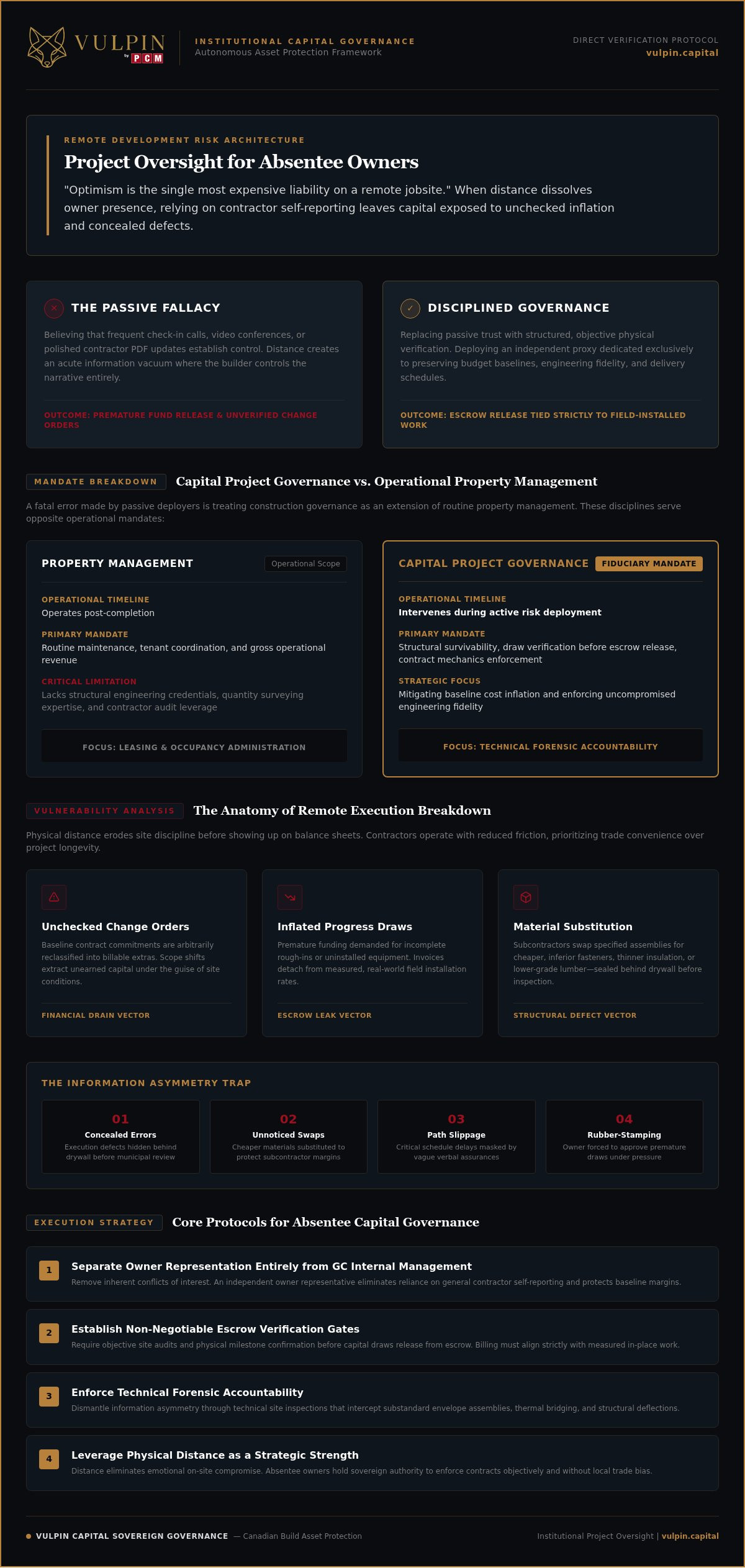
Capital deployed without verification is merely hope. True project oversight for absentee owners is not administrative clerical work, nor is it passive monitoring. It is the uncompromised enforcement of fiduciary governance over complex developments where the asset holder cannot physically step foot on the jobsite. Remote capital deployment routinely breaks down because distance dissolves owner authority, leaving significant expenditures vulnerable to unverified contractor self-reporting.
When you cannot walk the ground yourself, your capital depends on structured technical enforcement. As established in professional construction management, safeguarding an owner’s position requires an independent proxy dedicated exclusively to preserving budget baselines, engineering fidelity, and delivery schedules.
Capital Governance vs. Operational Property Management
A fatal error made by passive deployers is treating construction governance as an extension of routine property management. These disciplines serve opposite operational mandates:
- Property Management: Operates post-completion. It prioritizes routine maintenance, tenant coordination, and gross operational revenue. Property managers lack structural engineering credentials, quantity surveying expertise, and the legal leverage needed to audit general contractors.
- Capital Project Governance: Intervenes during active risk deployment. It manages structural survivability, verifies progress milestones before capital draws exit escrow, and enforces contract mechanics. Its sole focus is mitigating baseline cost inflation.
Entrusting a multi-million-dollar development to an operational property manager invites unchecked liability. Construction oversight demands forensic accountability, not leasing administration.
The Information Asymmetry Trap in Remote Developments
Distance creates an acute information vacuum. When owners rely solely on bi-weekly video conferences or polished contractor PDFs, the builder controls the narrative entirely. Execution errors get concealed behind drywall. Material substitutions pass unnoticed. Critical path slippage remains hidden under vague assurances until delays become irreversible.
This structural opacity forces the absentee owner into rubber-stamping premature invoices. Rigorous project oversight for absentee owners systematically dismantles this asymmetry. By deploying objective, condition-driven checkpoints, it ensures every dollar released directly reflects verifiable work installed in the field.
The Hidden Risks of Distance in Major Construction Projects
Physical distance erodes site discipline long before it shows up on balance sheets. When an owner cannot inspect ongoing work, contractors operate with reduced friction, making critical path decisions based on trade convenience rather than project longevity. This absence fosters compounded capital risks, turning small on-site variances into irreversible budget overruns.
Safeguarding capital deployment requires an independent and comprehensive review to intercept structural failures early. Establishing institutional project oversight for absentee owners closes these vulnerabilities by replacing casual off-site check-ins with unyielding, field-level enforcement.
Unchecked Change Orders and Draw Inflation
Change orders are the primary mechanism through which contractors extract unearned capital. Without on-site verification, scopes get reclassified arbitrarily. Baseline contract commitments quietly morph into billable extras.
Simultaneously, inflated progress draws demand premature fund release for incomplete rough-ins or uninstalled equipment. Deploying strict protocols for managing construction project cost overruns ensures that billing lines align precisely with measured, real-world installation rates. Owners seeking structural accountability often establish autonomous governance via vulpin.capital to stop capital leaks before funds release from escrow.
Compromised Quality Control and Material Substitution
Subcontractors facing tighter margins routinely swap specified assemblies for cheaper, inferior alternatives. Distance conceals these swaps. Substandard fasteners, thinner insulation, and lower-grade lumber get sealed permanently behind moisture barriers and drywall before municipal inspections occur.
These concealed defects compromise whole-life asset survivability. The resulting envelope failures, thermal bridging, and structural deflections remain invisible during construction, only to surface years later as catastrophic maintenance liabilities.
Regulatory and Contractual Exposure Across Jurisdictions
Distance blinds asset owners to the critical legal mechanics unfolding on site. If a general contractor collects progress draws but delays disbursements to lower-tier trades, your build is immediately vulnerable:
- Statutory Lien Exposure: Unpaid subtrades can encumber your title directly, freezing secondary financing regardless of your direct payments to the general contractor.
- Unauthorized Field Revisions: Informal trade adjustments compromise municipal compliance, triggering failed building inspections and costly retrofit work.
- Permit Expiry: Untracked schedule drift pushes builds past municipal review windows, exposing capital to substantial administrative redesign penalties.
Without forensic project oversight for absentee owners, these systemic blind spots compound unchecked until legal and financial exposure threatens the entire development asset.
Evaluation Framework: Selecting Remote Project Oversight
Selecting an oversight partner cannot rely on social rapport or general contracting references. Effective project oversight for absentee owners requires strict contractual independence, engineering competence, and zero operational ties to local trade networks. A representative embedded in the regional subcontractor ecosystem cannot defend an absentee balance sheet without bias. You need a forensic advocate whose commercial survival depends entirely on the owner’s capital preservation.
Key Criteria for Vetting an Owner Representative
Distinguish genuine capital governance from superficial administration by screening candidates against three non-negotiable standards:
- Technical Engineering Baseline: Reject purely administrative monitors. Your representative must possess structural engineering literacy and forensic quantity surveying capabilities to audit trade submittals, inspect load paths, and dissect schedule logic.
- Contractual Administration Rigour: Demand verified competence managing standard Canadian construction contracts, including statutory holdback compliance, notice periods, and formal dispute mechanisms.
- Autonomous Reporting Infrastructure: Refuse reliance on the general contractor’s software. Your representative must operate an independent data capture pipeline, feeding raw site telemetry directly to your dashboard.
Comparing Oversight Models for Absentee Capital
Absentee capital deployers typically encounter three primary oversight configurations, each offering radically divergent levels of protection:
- Architectural Field Review: Traditional architect administration remains strictly limited. Architects review design intent and general conformance during scheduled site visits. They do not audit trade invoicing, track material chain-of-custody, or enforce daily schedule productivity.
- Contractor Internal Project Management: The general contractor’s project manager protects the builder’s gross margin, not your capital. Trusting their progress updates creates an immediate conflict of interest.
- Independent Dedicated Project Oversight: This model provides autonomous, condition-driven execution verification. Frameworks like PCMNow Project Management enforce physical milestone completion before a single dollar moves.
Aligning commercial incentives is equally critical. Ensure your representation agreement divorces oversight fees from budget expansions. When fee structures scale with gross expenditures, representatives lose the incentive to reject questionable change orders. Comprehensive project oversight for absentee owners requires uncompromised structural alignment where the representative’s only priority is project delivery on your baseline terms.
Core Protocols for Remote Project Governance and Control
Verbal assurances have zero capital value. On an unmonitored jobsite, subjective progress estimates inevitably disguise emerging delays and cost inflation. Robust project oversight for absentee owners demands programmatic control gates where every capital disbursement requires physical, indisputable proof of completion. If the installed work cannot be verified mathematically against the baseline schedule, capital remains locked in escrow.
Establishing the Pre-Construction Viability Baseline
Governance starts months before excavation begins. Deploying The VULPIN Check validates contract viability, trade scope delineations, and scheduling logic against ground realities. Remote deployers must establish fixed pro formas, lock approved scope packages, and implement non-negotiable change order ceilings before breaking ground. You cannot defend an operational boundary that was never formally drawn.
Objective Field Auditing and Evidence Collection
General contractor self-reporting must be replaced by continuous, autonomous verification. Establishing real control requires structured evidence gathering across all phases:
- Traceable Digital Telemetry: Mandate date-stamped, high-resolution visual records and sensor-backed documentation for all critical path milestones prior to concealment behind walls or slabs.
- Forensic Quantity Surveying: Cross-reference material delivery manifests and trade billings against physical on-site installations to prevent front-loaded draw abuse.
- Independent Site Audits: Conduct unscheduled site walkthroughs to audit active trade headcounts, verify safety compliance, and confirm real daily productivity rates against the master timeline.
The Construction Project Governance Framework
Executing these verification controls requires an uncompromising administrative architecture. Under the construction project governance framework, statutory holdbacks and progress draws release only upon audited milestone sign-off. Documented dispute escalation mechanisms systematically bypass contractor posturing, ensuring schedule variances trigger immediate corrective action before capital erodes.
Establishing institutional project oversight for absentee owners converts physical distance from an operational handicap into a permanent risk barrier. Enforce structural integrity across your Canadian assets by partnering with deploy independent capital oversight with VULPIN Capital.
Disciplined Capital Execution: The Sovereign Owner Advantage
Physical distance is routinely viewed as a critical vulnerability. Handled correctly, it becomes your greatest tactical advantage. Proximity breeds familiarity, and familiarity erodes contractual boundaries. Being present in the field pulls owners into daily trade compromises, verbal concessions, and interpersonal friction that slowly erode budget baselines.
Rigorous project oversight for absentee owners converts geographical separation into an objective shield. By insulating your capital behind a disciplined fiduciary firewall, you enforce contract specifications through verifiable data rather than emotion.
Eliminating Emotional Bias Through Objective Systems
Contractors often exploit personal rapport to negotiate concessions on schedule drift or finish quality. Physical detachment eliminates that operational leverage. When you are absent from the daily noise of the jobsite, every request, invoice, and change order must stand on verifiable documentation.
Operating frameworks like The Fox replace subjective trade negotiations with rule-governed asset execution. Decisions follow strict pre-set logic: either the physical installation matches contractual specifications, or the draw remains unapproved. Systemic neutrality protects capital where informal relationships fail.
Securing Generational Value in Sustainable Assets
True asset survivability extends decades past initial commissioning. Remote builds managed with short-term expediency frequently suffer thermal envelope deficiencies, poor air sealing, and latent moisture vulnerabilities that drive up lifecycle operating expenditures.
Connecting rigorous capital governance to durable standards like FoxyHome Sustainable Housing ensures the structure withstands aggressive Canadian climate conditions. Independent verification guarantees that high-efficiency building envelopes, mechanical systems, and structural framing are executed precisely to engineering specifications, safeguarding generational equity against rapid operational decay.
Engaging Dedicated Project Governance
Recognizing project distress early prevents permanent balance-sheet impairment. Several operational warnings demand immediate forensic intervention:
- Contractor billing requests diverging from verified on-site milestone completion.
- Unapproved scope variations presented retroactively as emergency field conditions.
- Persistent schedule drift on critical path installations without technical justification.
Recovering a compromised build requires a disciplined structural audit of active trade accounts, material receipts, and schedule logic. Take complete command of your remote asset by engaging VULPIN Capital to establish uncompromising project oversight for absentee owners across your Canadian developments.
Enforcing Sovereign Capital Control Across Remote Builds
Physical distance doesn’t have to dilute your operational authority. By trading blind trust for mathematical verification, you protect your balance sheet from unverified change orders, compromised installations, and contractor self-reporting. Effective project oversight for absentee owners turns geographical separation into an asset, insulating your investments behind strict contractual firewalls and objective milestone gates.
Safeguarding capital deployment across Canada requires proven execution frameworks. Validating structural viability early through The VULPIN Check prevents baseline drift before breaking ground. Field-level realities demand the rigorous discipline of PCMNow Project Management to ensure billing matches physical work, while operating standards governed by The Fox secure whole-life performance.
Your capital deserves uncompromised representation on site. Command your developments with absolute clarity and Deploy Disciplined Project Governance with VULPIN Capital to build enduring, generational value with total confidence.
Frequently Asked Questions
How does capital project oversight differ from standard property management for absentee owners?
Capital project oversight governs active construction risk, whereas property management handles post-completion leasing, tenant relations, and operational maintenance. Property managers lack the structural engineering capabilities and contract administration experience required to audit general contractor billing. Independent project oversight for absentee owners enforces technical milestone verification, manages statutory holdbacks, and defends the capital baseline before funds exit escrow.
Can an absentee owner rely solely on the architect for construction administration?
Relying solely on an architect leaves significant operational blind spots. Architects evaluate general design intent and code conformance during periodic visits; they don’t conduct forensic quantity surveying, audit trade payrolls, or track daily critical-path productivity. Dedicated project governance provides continuous commercial defence, ensuring trade invoices, material deliveries, and schedule commitments match real-world jobsite installations rather than high-level aesthetic drawings.
How do remote project managers verify work without relying on general contractor photos?
Verification relies on independent data pipelines rather than curated builder snapshots. Professional representatives deploy date-stamped, sensor-backed telemetry, structured spatial scans, and unscheduled on-site audits. Independent inspectors cross-reference physical delivery slips and trade headcounts against the baseline project schedule. Work behind wall assemblies and under slabs requires verified inspection sign-offs before concealment, replacing subjective contractor claims with auditable technical evidence.
What is the standard fee structure for third-party construction project oversight?
Fee structures across the construction industry generally take the form of percentage-of-cost models, monthly retainers, or hourly advisory rates depending on project scale and complexity. For absentee capital deployers, the contractual arrangement should strictly decouple oversight compensation from project cost increases. Aligning fee incentives ensures the governance partner has no commercial motivation to endorse inflated change orders or permit schedule extensions.
How does an independent governance framework prevent contractor change order exploitation?
Governance frameworks eliminate change order abuse by enforcing strict pre-construction scope lock and formal approval protocols. Every proposed variance requires technical justification, baseline schedule impact modelling, and forensic pricing review against original tender documents. Work can’t commence, nor can capital disburse, without formal owner-side authorization. This protocol stops contractors from manufacturing billable extras out of routine trade obligations or field oversights.
Can project oversight services rescue a remote construction development that is already failing?
Yes, structured project oversight for absentee owners can stabilize distressed developments through a forensic capital and schedule audit. Independent representatives halt unverified draw disbursements, freeze disputed change orders, and reconcile on-site work against actual accounts payable. Establishing milestone gating and enforceable trade recovery schedules helps deployers regain balance-sheet control, mitigate statutory lien risks, and complete the build under disciplined governance.
What reporting frequency should an absentee owner demand from their project representative?
Absentee owners should require weekly execution dashboards paired with real-time exception reporting. Routine weekly updates must detail verified milestone progress, trade headcount velocity, and schedule variance against the critical path. Immediate alerts should trigger whenever an unauthorized field variance, safety infraction, or budget discrepancy occurs. This rhythm ensures remote owners maintain continuous strategic clarity without drowning in low-level administrative noise.