

A valid licence is not a guarantee of professional excellence. It is merely a permit to occupy your job site. Most property owners mistake a basic insurance certificate for a shield against disaster, but regulatory minimums do nothing to ensure a builder’s survival through a complex project. Validating a general contractor’s credentials requires more than a cursory glance at a PDF. It demands a rigorous, governance-first audit of their operational reality.
You likely understand the anxiety of watching a project stall while financial liabilities mount. It is a valid fear. The construction industry is not built on stability; it is built on thin margins and speculation. This is not a guide for those seeking the lowest bid. It is for those who demand autonomy and control over their assets. We do not value the excitement of a new bid. We value the integrity of the system.
This framework introduces a repeatable methodology for vetting construction partners. We will explore how tools like the VULPIN Check and PCMNow Project Management transform vague promises into disciplined execution. You will gain the confidence to reject market noise and prioritize the long-term stability of your capital.
Key Takeaways
- Distinguish between a municipal business licence and provincial trade credentials to ensure your builder is legally authorized for specific structural works.
- Execute a primary source verification protocol when validating a general contractor’s credentials by confirming insurance and WSIB standing directly with the issuing bodies.
- Audit the contractor’s CCDC history and financial solvency to determine if they possess the administrative depth required to realize a complex project.
- Replace referral-based hiring with the VULPIN Check, a methodology designed to filter for operational viability rather than social proof.
- Ensure long-term asset survivability by transitioning from initial validation to active governance through PCMNow Project Management.
Why Surface-Level Credentials Fail to Protect Your Asset
A general contractor often presents a folder of certificates as proof of capability. This is a deception. Possession of a document does not equate to the ability to execute a complex build. In the Canadian market, the gap between being legally permitted to operate and being operationally competent is vast. Validating a general contractor’s credentials is not a social exercise. It is a technical audit of survivability.
Referral-based hiring is a systemic failure of governance. Relying on a colleague’s recommendation replaces data with sentiment. Sentiment does not manage a supply chain. It does not mitigate financial exposure. We reject the “good guy” bias that plagues the industry. A builder’s personality is irrelevant to the structural integrity of your asset. High-integrity professionalism demands institutionalized verification over personal rapport.
The High Cost of Superficial Trust
Trust is a liability in construction. Fraudulent or expired credentials create immediate, uninsurable risks for the property owner. The process of validating a general contractor’s credentials must expose these hidden risks. In Ontario, for instance, WSIB clearance certificates are valid for only 90 days. If you fail to verify these quarterly, you inherit the contractor’s workplace liabilities. “Licence lending” is another systemic rot where an unqualified operator “rents” the credentials of a distant professional to bypass regulatory gates. A clean social media profile or a polished website provides zero insight into these administrative failures. Digital aesthetics are not governance.
Credentials as a Minimum Baseline
We define a licence as a prerequisite, not a qualification. Administrative compliance is the floor, not the ceiling. The VULPIN Check methodology treats these documents as the entry ticket to the evaluation process. True validation moves beyond the paper to assess operational depth. You must determine if the contractor possesses the administrative machinery to realize a complex project. Can they manage a CCDC contract under pressure? Do they have the solvency to weather a 15.7 percent surge in multi-family development costs? A stoic approach to selection ignores the frantic energy of the market. It prioritizes the internal logic of the system. We don’t look for builders who are “busy.” We look for organizations that are governed.
The Canadian Baseline: Mandatory Licensing and Insurance Standards
A municipal business licence is a fiscal formality. It is not a certificate of competence. In Canada, the authority to build is granted at the provincial level through bodies such as the Régie du bâtiment du Québec (RBQ) or BC Housing. These institutions set the administrative baseline for entry into the market. Validating a general contractor’s credentials begins by distinguishing between a local permit to trade and a provincial mandate to execute structural work. If your builder lacks the latter, they are operating outside the framework of professional governance.
Workers’ compensation coverage is the most critical pillar of project safety. In Ontario, the WSIB mandates clearance certificates that expire on specific quarterly dates: February 20, May 20, August 20, and November 20. A contractor without a current certificate is a direct financial liability to the property owner. You don’t just ask for a copy; you verify the status on the public registry. This is not a matter of trust. It is a matter of protecting your capital from workplace injury claims that can exceed millions of dollars.
Provincial Regulatory Oversight
Registries serve as the primary source of truth for an operator’s standing. Beyond confirming an active licence, these portals reveal disciplinary records and past legal judgements. In British Columbia, general contractors must complete 20 Continuing Professional Development (CPD) points annually to maintain their licence. If a builder fails this requirement, their operational viability is compromised. High-performance projects, such as those involving sustainable housing, often require specific endorsements that are not part of a standard trade licence. Using official tools for contractor license verification ensures you aren’t relying on forged or outdated documents. We reject the frantic pace of modern construction in favour of this slow, methodical verification of every partner.
Insurance and Bonding: The Financial Safety Net
Commercial General Liability (CGL) insurance is standard, but it is often insufficient. Most commercial contracts in Ontario require a minimum of $2 million in CGL coverage. However, if the project involves design elements, the contractor must also carry Professional Liability insurance to protect the asset from errors in engineering. You must be named as an “Additional Insured” on the policy to ensure the underwriter owes you a direct duty of care. For national developments, we demand Performance Bonds and Labour and Material Payment Bonds. These instruments ensure that if the contractor fails, the project continues. This level of standardized governance is what separates a stable asset from a speculative risk. Validating a general contractor’s credentials is the only way to ensure these safety nets are actually tied to the project.
Stress Testing Operational Reality: Beyond the Certificate of Insurance
A licence is a static document. Operational reality is dynamic. Validating a general contractor’s credentials requires a deep dive into the builder’s financial engine. We don’t settle for a simple letter of good standing. We demand a technical audit of the balance sheet. Is the organization solvent? A contractor with high debt-to-equity ratios is a project failure waiting for a catalyst. We look for Bank Letters of Reference to confirm liquidity and credit capacity. This isn’t about their current projects. It’s about their ability to absorb a shock without collapsing your timeline.
Reviewing the Canadian Construction Documents Committee (CCDC) contract history is non-negotiable. It reveals the scale and complexity of past engagements. If a builder claims expertise in multi-family development but their CCDC history shows only single-family residential work, there is a governance mismatch. The VULPIN Check internalizes this data. It verifies project viability before a single dollar is deployed. We reject the excitement of a new partnership in favour of the cold reality of documented performance. While international benchmarks exist, such as the California contractor license verification tool, the Canadian operator must be scrutinized under a governance-first lens that accounts for local solvency requirements.
Technical Proficiency Audits
We evaluate the contractor’s experience with specific asset types. Building a standard warehouse is not building a net-zero facility or a FoxyHome sustainable housing unit. These require different administrative oversight. We review past project pro formas against actual execution costs to identify patterns of optimism bias. Technical proficiency is the intersection of past performance and current resource allocation. This metric tells us if the builder can actually deliver what they’ve promised.
Sub-Contractor Governance
A general contractor is only as resilient as their weakest link. Validating a general contractor’s credentials must extend to their supply chain. How do they vet their trades? Tier-two credential failure is a common cause of catastrophic delays. If the primary builder is validated but their roofer lacks WSIB clearance, the entire project is exposed. This level of oversight is essential for managing construction project cost overruns. We do not trust the builder to manage their trades without a documented verification protocol. We demand visibility into every layer of the structure.
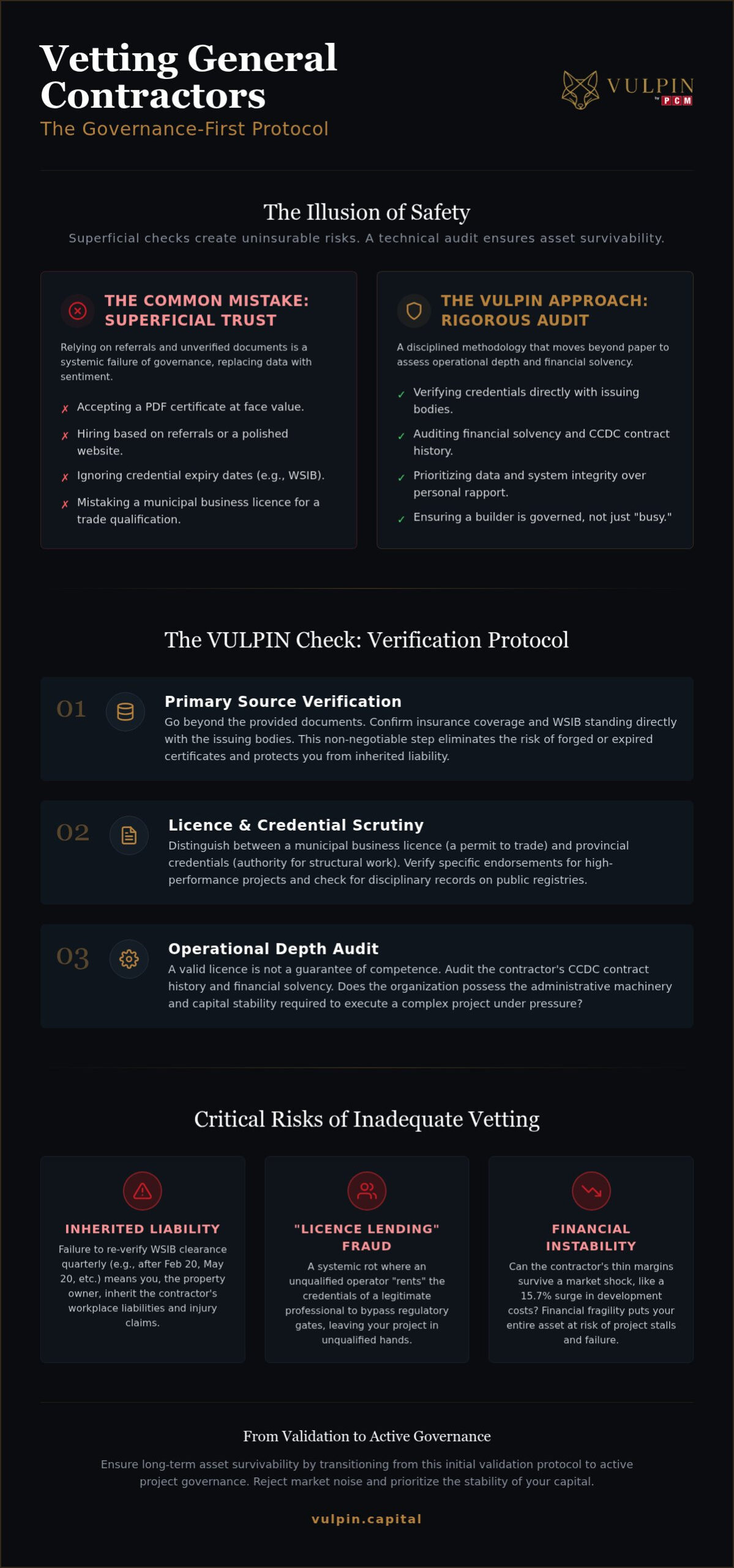
The VULPIN Methodology: A Step-by-Step Verification Protocol
Validation is not a one-time onboarding event. It is a continuous, administrative siege. We reject the concept of “set and forget” documentation. The VULPIN methodology replaces passive trust with active, institutionalized scrutiny. Each step in our protocol is designed to strip away marketing veneers and expose the builder’s technical core. Validating a general contractor’s credentials requires a manual, deliberate approach that resists the market’s frantic pace.
- Step 1: Primary Source Verification of all provincial trade licences and municipal business permits.
- Step 2: Direct confirmation of insurance coverage via telephone or secure portal with the underwriter.
- Step 3: Verification of WorkSafe or WSIB clearance certificates aligned with every 90-day payment cycle.
- Step 4: Deep-dive review of the contractor’s safety record and Experience Modification Rate (EMR) to assess operational discipline.
- Step 5: Implementation of the VULPIN Check to ensure the builder’s internal logic aligns with the long-term survivability of the asset.
Primary Source Verification (PSV)
Never accept a PDF certificate at face value. Digital documents are easily manipulated; they are not evidence of truth. Our protocol demands contacting insurers and provincial boards directly to confirm the policy’s current standing. We establish a strict chain of custody for every credential document. If the information does not come directly from the issuing authority, it does not exist. This stoic refusal to accept secondary evidence is the only way to eliminate the risk of “licence lending” or expired coverage.
Ongoing Governance and Periodic Audits
Credentials expire. Policies lapse. A builder who is validated in January may be a liability by June. We re-validate every credential at major project milestones and before every progress payment. This prevents the catastrophic risk of an uninsured failure mid-build. We don’t halt production for these audits; we integrate them into the project’s administrative rhythm. By utilizing PCMNow Project Management, we maintain a real-time ledger of contractor standing. This ensures that governance is a constant state, not a periodic interruption. Validating a general contractor’s credentials is the foundation of our internal logic. It is how we protect physical reality from digital abstraction. Deploy the VULPIN Check to secure your next deployment.
Integrating Contractor Governance into the Project Lifecycle
Validation is the foundation. Execution is the structure. Many owners stop at the contract, assuming the initial vetting persists throughout the build. It doesn’t. Integrating contractor governance into the lifecycle means transitioning from the initial act of validating a general contractor’s credentials to active, daily oversight through PCMNow Project Management. This is where the Owner’s Representative becomes essential. They are the administrative firewall. They don’t trust; they verify every progress claim against the current standing of every trade on site.
A governance-first approach is the only way to eliminate the friction of change orders. Delays are rarely accidental. They are usually the result of administrative failure or credential lapses in the supply chain. By maintaining a rigid verification protocol, you force the builder to operate within your logic, not theirs. Close-out is the final test. We don’t release final payment until every warranty is validated and every close-out document is audited for accuracy. This ensures the asset is handed over in a state of operational readiness, not administrative chaos.
Governance as a Competitive Advantage
Vetting is not a cost. It is a preservation of value. Disciplined governance attracts institutional-grade capital because it removes the speculative energy from the build. You reduce the “tuition cost” of project failure by identifying incompetence before it manifests in physical mistakes. Rigorous pre-construction due diligence is the only path to a predictable outcome. For a deeper analysis of this viability testing, see The VULPIN Check. We reject the frantic pace of the market in favour of this deliberate, slow, and resistant methodology.
The Stoic Conclusion: Trust, but Verify
Construction is an adversarial environment. To treat it otherwise is to invite disaster. Validating a general contractor’s credentials is a matter of principle and autonomy. We reject the builder-led trust model that dominates the industry. We prioritize the integrity of the asset over the convenience of the relationship. Commit your resources only when viability is proven through a documented, repeatable framework. This is the only way to ensure structural permanence in a world of digital abstraction. Apply the VULPIN Check to your next project and secure your physical reality.
Secure the Future of Your Real Assets
Verification is not a hurdle; it is a shield. We’ve established that a licence is merely a permit to occupy space, not a proof of capability. True asset survivability depends on moving beyond superficial paperwork to stress-test the operational and financial reality of your partners. Validating a general contractor’s credentials is a continuous administrative requirement that ensures your capital remains protected from the industry’s inherent instability. We reject the speculation of the open market in favour of structural permanence and sovereign control.
Our proprietary VULPIN Check methodology and uncompromising PCMNow governance standards are built for those who prioritize the integrity of generational assets. We specialize in sustainable housing and complex developments where administrative failure is not an option. You now possess the framework to lead with authority. Build with the confidence that comes from uncompromising oversight.
Deploy your capital with discipline: Start The VULPIN Check
Frequently Asked Questions
How do I verify a general contractor’s licence in Canada?
Verification must occur through provincial regulatory bodies. In British Columbia, use the BC Housing public registry. In Quebec, the RBQ provides a digital lookup tool. You must confirm the licence is active and matches the specific trade class required for your project. Validating a general contractor’s credentials through these primary sources is the only way to bypass forged PDF certificates. Never rely on a builder’s verbal confirmation of their status.
What is the difference between a business licence and a trade licence?
A municipal business licence is a local tax requirement that allows a company to operate within a city. It does not certify technical competence or structural authority. A provincial trade licence is a mandatory credential that grants the legal right to execute specific construction works. You must require both. Hiring a builder with only a municipal licence is a governance failure that exposes your asset to regulatory shutdowns and uninsurable liabilities.
How do I check if a contractor has active liability insurance?
You must request a Certificate of Insurance (COI) and then contact the issuing brokerage to confirm the policy’s current standing. Ensure the policy provides a minimum of $2 million in Commercial General Liability (CGL) coverage. You must be named as an “Additional Insured” to establish a direct duty of care from the underwriter. A document in a folder is not proof; only direct confirmation from the insurer validates the coverage.
What are the red flags of a fraudulent contractor credential?
Red flags include mismatched company names between the licence and the contract, expired WSIB clearance dates, and a refusal to provide underwriter contact details. If a builder claims they are “licenced through a partner,” they are likely engaged in licence lending. This is a catastrophic risk. Any hesitation in providing primary source documentation signals a lack of administrative discipline and an attempt to bypass institutionalized verification protocols.
Do I need to verify sub-contractors or just the general contractor?
You must verify the entire supply chain. A general contractor is an orchestrator, but the physical work is executed by trades. If a roofer or electrician lacks valid credentials, the project’s insurance is compromised. Validating a general contractor’s credentials is the first step, but your governance framework must extend to every tier-two operator on site. We demand visibility into the credentials of every individual contributing to the structural integrity of the asset.
What is a WSIB or WorkSafe clearance certificate and why does it matter?
A clearance certificate proves the contractor is in good standing with provincial workers’ compensation boards. In Ontario, these certificates expire every 90 days on specific quarterly dates. If you pay a contractor who lacks a valid certificate, you become liable for their premiums and any workplace injuries. This is a non-negotiable administrative requirement. It shifts the financial risk of injury from your balance sheet back to the provincial system.
Can a contractor work while their licence is under review?
A licence under review is not an active licence. Working without a clear, active status is a violation of provincial law and an immediate trigger for project suspension. We do not accept “pending” statuses or “applied for” claims. Structural permanence requires absolute certainty. If a builder cannot maintain their standing during the vetting process, they lack the administrative depth to manage your capital through a complex, long-term project lifecycle.
What happens if a contractor’s insurance expires during the project?
Work must cease immediately if a policy lapses. An uninsured job site is a liability that can bankrupt an owner. You must implement a tracking system, such as PCMNow Project Management, to flag expiration dates 30 days in advance. Do not release progress payments until a renewed certificate is verified with the underwriter. Maintaining this level of oversight is the only way to protect your physical reality from the chaos of administrative negligence.