

Warranty performance is shaped before handover, then demonstrated through disciplined records. After keys are delivered, homeowner reports can arrive through different channels, with no clear owner for the next step. Effective warranty management for new construction gives each issue a traceable path from first report to verified closeout.
When responsibility blurs between the owner, builder and trades, the problem is not simply where to store a claim. It is how to assign, document and resolve the work consistently. Provincial warranty requirements and deadlines can also differ, so a process that works on one project may not fit another.
This guide sets out a practical workflow from handover through inspection, corrective work and closeout. You’ll learn how to maintain clear records, assign accountability and choose an approach that fits project complexity and risk. It also explains how disciplined project governance, including PCMNow’s focus on execution and cost reality, can support long-term oversight without treating project-management systems as warranty software.
Key Takeaways
- Set up warranty records before handover so obligations, decisions and project information remain connected.
- Use a clear sequence to prepare records, receive and assess reports, assign corrective work, and verify closeout.
- Choose manual tracking, warranty software or integrated project management based on project complexity, handoffs and audit needs.
- For warranty management for new construction across Canada, verify the applicable provincial rules, policy wording and reporting deadlines for each project.
- Disciplined project execution and documented oversight can support warranty work as part of broader construction governance.
Why warranty management for new construction starts before handover
Warranty management for new construction is the documented coordination of obligations, reports, decisions, corrective work and closeout. It is an operating process, not a folder assembled after possession. Set up its controls while the project team can still connect construction decisions to the finished home.
Warranty coverage is the protection defined by a warranty; warranty administration is the process for receiving, assessing, assigning, documenting and closing reported issues. They are related, but not interchangeable. A policy or contractual commitment describes coverage and conditions. A management process ensures reports are handled against the relevant terms, by the right people, with a record of what happened.
What belongs in a new-construction warranty process?
Start with a clear reporting route for the owner and an issue log that captures each report’s date, location, description and supporting information. Triage determines what needs investigation and which obligation may apply. Assign an owner for the next action, record decisions and communications, and retain evidence of completed work and closeout.
Keep the underlying commitments distinct:
- Contractual commitments are obligations set out in project agreements.
- Product warranties relate to specific installed products and their applicable terms.
- Home warranty insurance is a separate form of coverage governed by its policy and applicable processes.
The general concept of a Warranty can include express and implied promises, but that overview is not a substitute for the project’s governing documents. Exact categories, obligations, claim procedures and timelines depend on contract terms, policy wording and jurisdiction.
Why does the handover record matter?
Handover is a control point, not the starting line for record keeping. The receiving party needs an orderly record of approved changes, inspection findings, product details and completion information. These records help assess later reports against what was specified, changed, installed and observed during construction. Without that history, even a straightforward issue can become a disagreement about scope or prior work.
For example, a report about a finish or installed component may require the team to identify the product, review approved substitutions and locate relevant inspection or completion records. A traceable handover package gives the investigation a factual starting point. It also helps distinguish a documented project condition from an assumption made after occupancy.
This is a governance discipline. The construction project governance framework connects oversight, records and decisions to an asset’s longer-term survivability. Apply the same standard at handover: preserve evidence, name the person responsible and keep the path from report to resolution visible.
How the warranty lifecycle works: from project records to resolved issues
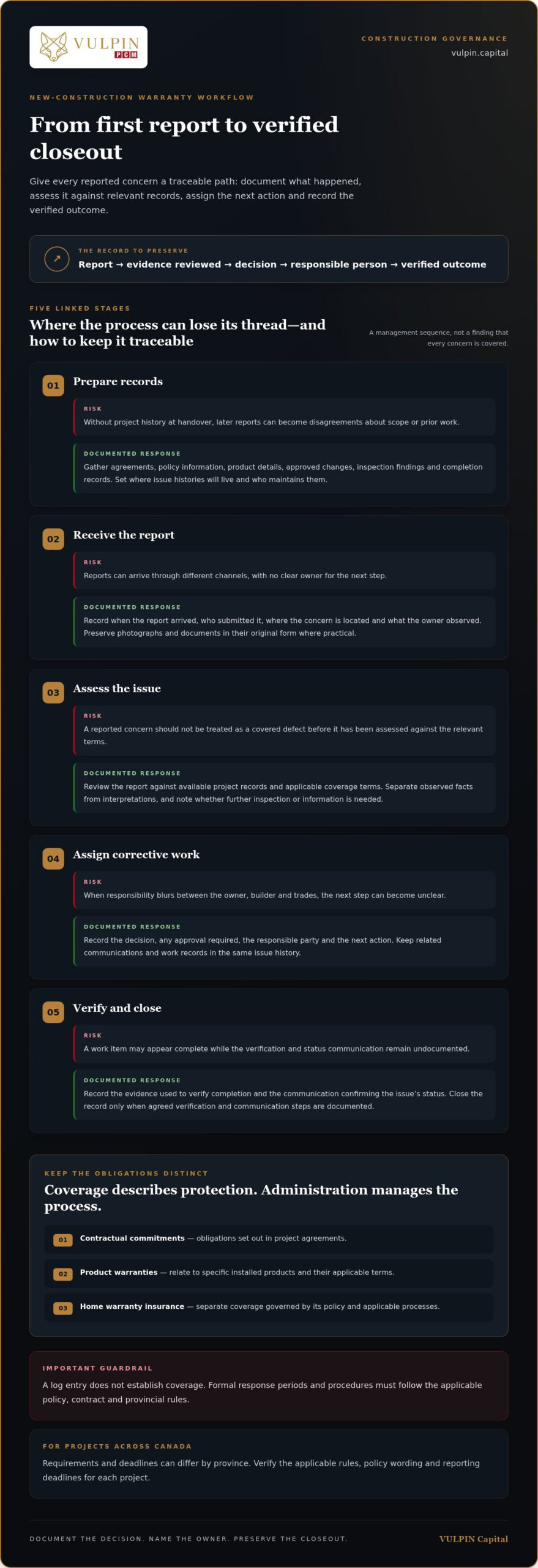
A reliable lifecycle gives every reported concern a controlled route through project records. It does not assume that every concern is a covered defect. The team documents what was reported, assesses it against relevant information, records its decision and tracks any resulting work. Dated evidence makes each step traceable without assuming coverage.
A complete warranty record links each report to the evidence reviewed, the decision made, the person responsible and the verified outcome. Keep that chain intact from intake through closeout.
- Prepare records. Gather relevant agreements, policy information, product details, approved changes, inspection findings and completion records. Establish where issue histories will be kept and who maintains them.
- Receive the report. Record when it arrived, who submitted it, where the concern is located and what the owner observed. Preserve photographs and documents in their original form where practical.
- Assess the issue. Review the report against available project records and applicable coverage terms. Record observed facts separately from interpretations, and note whether further inspection or information is needed.
- Assign work. Document the decision, any approval required, the responsible party and the next action. If corrective work proceeds, keep related communications and work records in the same issue history.
- Verify and close. Record the evidence used to verify completion and the communication confirming the issue’s status. Close the record only when the agreed verification and communication steps are documented.
These stages are a management sequence, not a replacement for formal claim requirements. Response periods and procedures must follow the applicable policy, contract and provincial rules. A log entry does not establish coverage, and a reported concern should not be labelled a covered defect until it has been assessed against the relevant terms. Keep the applicable policy and project documents accessible to those responsible for the assessment.
What should a warranty issue log capture?
Build one history for each issue. Include the report date, location, description, photographs, relevant documents and communication history. Track the responsible party, next action, status, inspection findings and resolution evidence. Preserve source records so later reviewers can distinguish what was observed from what someone inferred. If details change, add a dated update rather than silently replacing the earlier account.
How should reports be assessed and closed?
Use documented triage criteria to consider urgency, safety concerns, apparent scope and the investigation required. Record why an issue was escalated, referred for further review or assigned for work. Keep decisions, approvals, work assignments and completion evidence together. The closeout should show what was verified, by whom and how the owner was informed, not merely that a status changed to “complete.”
For Canadian projects, use the applicable provincial requirements and governing documents as the authority. Timelines and claim procedures can differ by policy, contract and jurisdiction, so do not carry assumptions from one project to another. A disciplined project record gives the team a factual basis for action. VULPIN Capital’s construction project management approach provides broader context for documented execution and oversight.
Manual tracking, warranty software, or integrated project management?
The right system depends on what it needs to control. Consider project volume, record complexity, how often responsibilities pass between teams or subcontractors, reporting needs and the ability to retrieve an auditable history. A simple register may suit a limited workload. Multiple active projects and frequent handoffs can make shared, structured records more useful.
The comparison below is a decision framework, not a product ranking. A tool can organize information and workflow. It cannot determine who has authority, make a sound assessment or replace documented decisions.
Setup effort: A manual register is quick to establish but needs consistent file conventions. Warranty software requires workflow configuration. Integrated project management requires alignment with existing project records and responsibilities.
Traceability: Manual records depend on careful updates and version control. Dedicated software can structure issue histories. An integrated system can connect issues with project information, provided records are consistently maintained.
Coordination: Basic tools can work when few people handle reports. Shared software can support handoffs across teams. Integrated oversight can connect warranty activity with broader project execution, but only if roles and decision paths are clear.
Scalability: Manual tracking can become harder to maintain as projects and open issues grow. Software can provide a repeatable structure for more activity. Integrated project management may suit complex delivery environments with linked records and reporting needs.
Governance: No method establishes accountability on its own. Each requires a named owner, defined authority, escalation rules and a review cadence.
When can a controlled manual process work?
A consistent register and file structure can serve projects with limited issue volume and few handoffs. Establish one source of truth, a standard naming and storage method, and a regular review of open items. Assign an owner to maintain the register. Without those controls, duplicate files, uneven status updates and reliance on one person’s memory can weaken traceability.
When does software or integrated oversight add value?
Shared records and reminders can help when several projects, teams or subcontractors need to coordinate. Before selecting a system, assess access controls, exportable records, reporting capability and fit with the actual workflow. Decide who can make coverage and work-assignment decisions, what triggers escalation, and how unresolved issues are reviewed. Those rules must exist outside the software as well as within it.
For warranty management for new construction, choose the least complex model that still preserves dependable records and clear accountability. Move beyond manual tracking when workload, handoffs or reporting demands make that standard difficult to sustain. Integrated project management is not the same as warranty software. It is a broader execution context in which warranty records may be managed alongside other project information. In either model, governance is the control system and software is one instrument within it.
How to build a warranty workflow for projects across Canada
A national process needs a common operating structure and project-specific compliance checks. Warranty management for new construction should not assume that one province’s coverage, claim steps or deadlines apply elsewhere. Build a workflow that records the applicable requirements for each project, then assigns people to carry them out.
- Map obligations. Identify the relevant contract commitments, product warranty information and home warranty insurance terms. Record the governing documents, reporting procedure and current deadlines for the project’s province. Verify these details against authoritative, current requirements rather than carrying assumptions from another jurisdiction.
- Separate compliance from service standards. Track formal policy, contract and provincial requirements distinctly from internal targets, such as acknowledging a report or reviewing open work at regular intervals. Internal standards can support consistent service, but they do not replace legal or policy obligations.
- Assign roles. Name who receives reports, who assesses them, who can approve work and who escalates unresolved questions. Make responsibility explicit at each handoff.
- Prepare records and intake. Set the record location, establish the owner’s reporting channel and define the information needed to assess a report. Explain the process in clear, accessible instructions.
- Review performance. Monitor open issues, ageing actions, repeated patterns and cases where responsibility remains unresolved. Use findings to improve project controls.
Every reported issue needs an owner, a next action and a recorded disposition. That standard applies whether the issue proceeds to corrective work, requires more investigation or is closed without work. The record should show what was considered and why, while keeping internal service expectations distinct from a coverage decision.
How should builders prepare for handover?
Assemble approved drawings, change records, inspection documents, product information and owner instructions in an organized package. State where reports should go, who holds each responsibility, how issues are escalated and where records are kept. Explain applicable maintenance responsibilities clearly, but do not present maintenance guidance as removing any valid warranty rights. Keep project-specific policy and contract terms as the authority.
How can teams review performance without losing accountability?
Set a review interval and examine open issues, overdue next actions, recurring concerns and unresolved ownership. Assign an accountable person to each follow-up, then record decisions and changes to the process. If corrective work affects project cost controls, connect the issue to the appropriate approval and recordkeeping process. This is where construction project cost overrun controls can inform disciplined oversight.
A review is useful only if it changes execution. If the same records are repeatedly missing, strengthen handover preparation. If reports stall between teams, clarify authority and escalation. For a broader framework for disciplined construction execution, explore VULPIN Capital’s project management approach.
How VULPIN Capital connects warranty oversight with construction governance
Warranty oversight is one control within project execution. It depends on the same foundations as the wider project: defined authority, reliable records and traceable decisions. A dedicated tool may help organize tasks, but it cannot determine who approves corrective work, settle disputed responsibility or decide when an unresolved issue must be escalated. Those rules belong in the governance structure.
For organizations managing complex construction and development, PCMNow provides project management focused on disciplined execution and cost reality. This is the project-management context for warranty oversight, not a warranty software feature. Connecting an issue to its project history and decision path helps keep post-handover work within the broader system of oversight.
What does governance add after practical warranty procedures are defined?
Governance makes decision rights explicit. The project should establish who can approve corrective work, who reviews disputed responsibility and who escalates an unresolved issue. A closeout record should distinguish completed work from open items, including the decision and accountable owner for anything that remains outstanding. That record can inform condition-driven asset oversight after the project team’s work changes or ends.
For example, if a reported concern involves more than one trade, a documented responsibility path can show who assesses it, who authorizes the next step and how an unresolved question moves upward. The record does not predetermine the outcome. It makes the process and rationale visible.
PCMNow Project Management belongs in this wider discussion of execution. Its role is project management for complex construction and development, not a promise of fewer defects, claims or warranty costs. The VULPIN Check is also distinct: it ties resource commitments to predefined proof of project viability. It is a governance and verification process, not a warranty guarantee or claims service.
When is a governance-first project-management approach relevant?
This approach is relevant when developments involve multiple stakeholders, frequent handoffs, substantial documentation or long-term ownership considerations. In these conditions, a clear decision structure helps keep responsibilities and records connected as work moves from construction into operation. The Fox provides a framework for rule-governed asset operations and decision-making, extending the governance perspective beyond project delivery.
Disciplined execution supports visibility. It does not eliminate defects or guarantee that every reported issue will be covered. It gives owners and project teams a more dependable basis for understanding what was decided, who is accountable and what remains unresolved. Warranty management for new construction is not a substitute for sound project governance, but it can be governed as part of it.
For organizations seeking governance-led construction project management, explore VULPIN Capital and its project-governance approach.
Make the next project more accountable by design
The next step is not to add another layer of administration. Make post-handover responsibility part of how project decisions are governed from the outset. For an upcoming project, define who owns unresolved issues, how decisions are recorded and what evidence will be retained for future asset oversight.
That discipline gives warranty management for new construction a place within the project’s operating structure, rather than leaving it to be reconstructed later from disconnected records. The right management approach depends on the project, but its foundation remains consistent: clear authority, traceable decisions and accountable execution.
For organizations aligning construction delivery with long-term asset governance, explore VULPIN Capital’s governance-led project management. Contact VULPIN Capital to discuss how PCMNow can support disciplined execution and project oversight.
Frequently Asked Questions
How long does a new-construction warranty last in Canada?
There isn’t one warranty duration for all Canadian homes. Coverage varies by province and by type of defect. For example, British Columbia has 2-5-10 coverage, Alberta has 1-2-5-10 coverage and Ontario coverage periods are one, two and seven years for specified categories. These are not interchangeable. Check the home’s policy for the applicable start date, covered items and reporting deadlines.
What is the difference between a home warranty and warranty management?
A home warranty sets out applicable coverage and conditions; warranty management is the administration of reports and related decisions. For example, a warranty may address a reported concern under particular terms, while the management process records when it was reported, how it was assessed and what happened next. Keeping these distinct helps prevent an internal tracking status from being mistaken for an insurer’s coverage decision.
Are cosmetic defects covered by a new-home warranty?
Not every cosmetic concern is automatically covered, and the answer depends on the applicable policy, contract, jurisdiction and assessment criteria. A visible mark, for instance, may need to be considered against relevant workmanship standards and reporting requirements. Describe the condition precisely, include clear photographs and preserve the date it was first observed. Do not assume that a concern is covered or excluded based on appearance alone.
What should a homeowner include when reporting a new-build issue?
Give the location and a factual description, noting when the issue first appeared and whether it has changed. Add dated photographs, relevant correspondence and any product or room information that may help identify the area. For example, “water appeared below the kitchen sink after use” is more useful than “plumbing is faulty.” Keep a copy of the submission and record how and when it was sent.
Do new-home warranties transfer to a new owner?
Generally, the warranty is attached to the home rather than the original owner and may continue after resale until its coverage expires. The remaining protection still depends on the applicable policy and its terms. A buyer should obtain the warranty documents and available claim history during the purchase process, then confirm the coverage start date and remaining periods from the records instead of relying on the seller’s recollection.
Is warranty management software necessary for a new-construction project?
No. A project can use a controlled register if its records remain complete and accessible to the people responsible. Software may become useful when information needs to move between teams or projects, but it does not decide whether a concern is covered or who has authority to approve work. For warranty management for new construction, choose tools that support the process rather than allowing the tool to define it.
What happens if a warranty issue is reported after a deadline?
A late report may affect how a claim is handled, but the outcome depends on the governing policy, contract and applicable rules. Submit the report as soon as possible, state when the problem was first noticed and explain the circumstances around the delay. Keep proof of submission and copies of related records. Do not assume the claim is accepted or rejected until the relevant administrator has assessed it under the applicable terms.